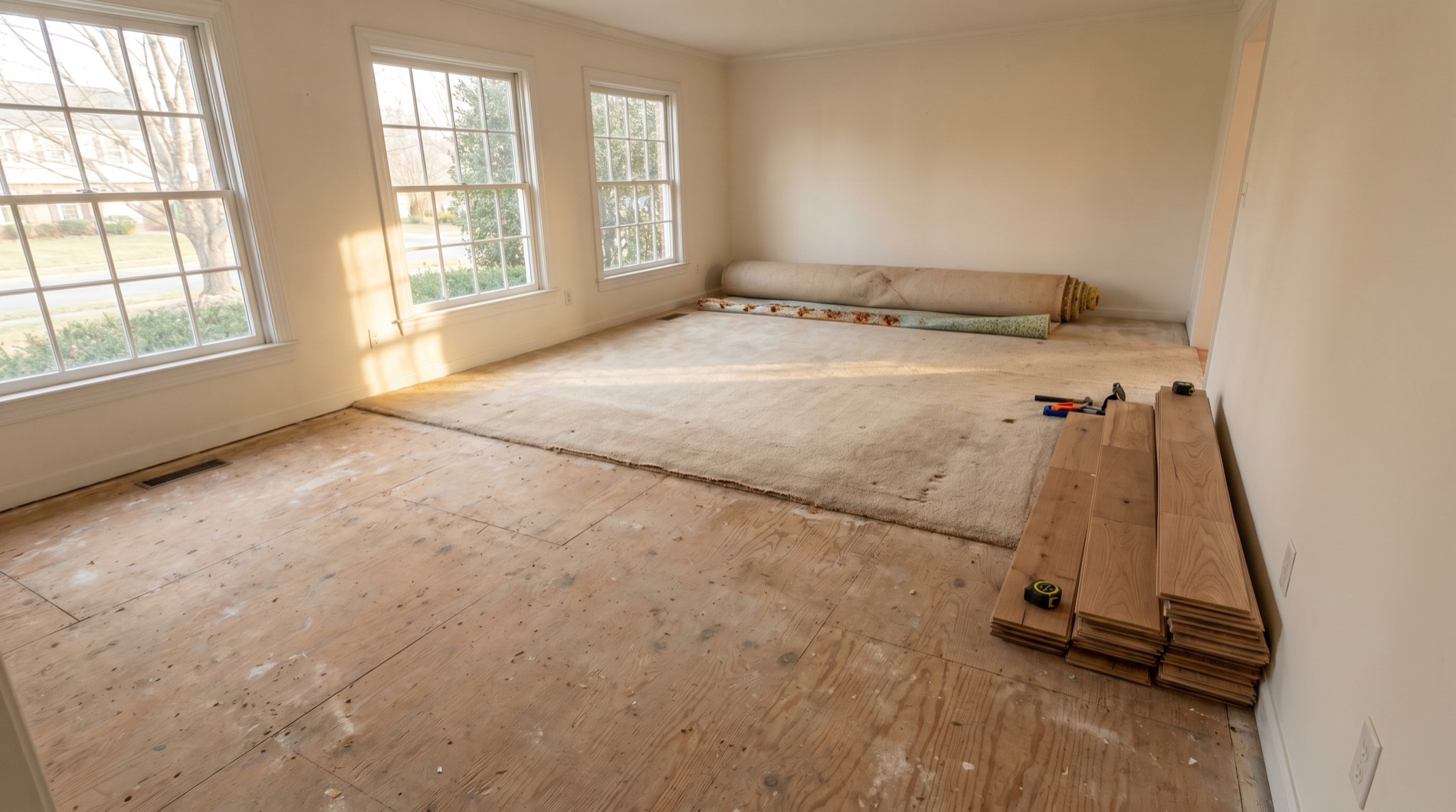
Replacing carpet with hardwood is the most common renovation conversion in the DMV. The carpet is 15 to 30 years old, smells like the previous owner, hides decades of pet stains and traffic wear, and is the single biggest visual gap between the home you bought and the home you want. The hardwood quote you get back from contractors lands somewhere between $7,000 and $25,000 for a typical Alexandria, Arlington, Fairfax, or Bethesda home, and the spread is enormous because the four cost drivers underneath the headline number are doing most of the work. Below is what a carpet-to-hardwood conversion actually costs in the DMV in 2026, how Potomac Floors quotes it as one all-in number, and the diagnostic check most contractors skip (looking for original hardwood already underneath the carpet) that can cut the price almost in half.
The short answer
Quick answer
In the DMV, carpet-to-hardwood conversion runs $4.50 per sqft all-in if there's a sound original hardwood floor under the carpet that can be refinished (the 70 percent case in pre-1990 Alexandria, Arlington, Falls Church, Bethesda, Vienna, and Chevy Chase homes). It runs $8.50 per sqft all-in if the existing subfloor is plywood (most DMV homes built after 1990) and a new hardwood floor goes in over the top. Carpet demo, tack-strip removal, staple removal, padding haul-away, and minor subfloor patching are included in Potomac's all-in price. Major subfloor repair, full leveling pours, and structural joist work get quoted separately and transparently before work starts. For a typical 800 sqft conversion, that puts the all-in cost between $3,600 (refinish path) and $6,800 (new hardwood path), with $1,500-$4,000 in optional add-ons depending on subfloor condition.
That is the head answer. The body of this guide is the math behind it. What the carpet actually hides, how to tell which scenario you're in before any contractor walks the house, and why the contractor who quotes you without pulling a corner of the carpet first is quoting a guess.
The four scenarios that drive the price
Quick answer
The hardwood-conversion price collapses to four cases: (1) carpet over original hardwood, refinish path at $4.50/sqft all-in; (2) carpet over plywood subfloor, new solid hardwood install at $8.50/sqft all-in; (3) carpet over concrete slab (condo, basement), engineered hardwood required at $8.50/sqft all-in plus leveling; (4) carpet over damaged or unlevel subfloor which adds $1.50-$4.00/sqft in prep work before the flooring goes down. The first step on a real estimate is identifying which case you're in. That means pulling a corner of the carpet, not eyeballing it through the pile.
| Scenario | DMV all-in price | 800 sqft typical room set | Common in |
|---|---|---|---|
| Carpet over original hardwood (refinish) | $4.50/sqft | $3,600 | Pre-1990 Alexandria, Arlington, Falls Church, Bethesda, Vienna, Chevy Chase, DC rowhouses |
| Carpet over plywood (new solid hardwood) | $8.50/sqft | $6,800 | Post-1990 Fairfax, Reston, Ashburn, Springfield, Tysons single-family |
| Carpet over concrete slab (engineered hardwood) | $8.50/sqft + leveling | $6,800 + $1,200-$2,400 | Tysons, Reston, Arlington condos and townhome basements |
| Carpet over damaged subfloor (any path) | Add $1.50-$4.00/sqft | +$1,200-$3,200 | Water-damaged areas, settled joists, original 1920s subfloors |
The cheapest scenario is also the most overlooked. About 70 percent of DMV homes built before 1990 have original red oak under the carpet, installed in the 1920s-1980s and immediately or eventually carpeted over by an owner who wanted softer floors. Those original oak floors are usually in refinishable condition, often better than a 30-year-old floor that was exposed and walked on the whole time, because the carpet shielded the wood from UV fading, scratches, and surface wear. The math is decisive: $4.50/sqft to sand, stain, and seal what's already there versus $8.50/sqft to demo plus install new. On 800 sqft that's a $3,200 swing for a more authentic-to-the-house finished result. The math on saving an existing hardwood floor versus installing new is the same logic we walk every client through in our refinishing vs replacement walkthrough.
Check first: is there hardwood under the carpet?
Quick answer
Before any contractor quotes a carpet-to-hardwood conversion, pull a corner of the carpet at a closet, a doorway, or a low-traffic edge and look at the substrate. Original hardwood = strip-wood planks (usually 2.25 to 3.25 inches wide red oak, sometimes white oak or pine), tongue-and-groove edges, nailed face-down through the tongue. Plywood subfloor = a sheet of 5/8 to 3/4 inch ply with visible seams every 4 feet. Concrete = obvious. If hardwood is underneath and the boards are intact, the conversion is a refinish, not an install. That single observation moves the project from $8.50/sqft into the $4.50/sqft refinish band.
The diagnostic is so cheap and so high-leverage that it should be the first move on every estimate, but most contractors quote the install scenario without checking. The reason is partly speed (pulling carpet adds 10 minutes) and partly incentive (a new-install quote is a bigger ticket). The Potomac walk-through always starts at a closet or a doorway threshold because those are the spots where a corner of carpet can be peeled back cleanly and replaced without anyone seeing it. The HVAC vent register is the second-best spot. Pull the vent cover and look at the cross-section of the substrate.
What you're looking for: a 3/4 inch plank of solid wood with a tongue on one edge and a groove on the other. If you see this, you have original hardwood. The next test is whether the plank is thick enough to refinish at least one more time. The full refinish-limit math is in our how many times can you refinish hardwood floors piece. The short version: if the original wear face above the tongue is at least 3/16 inch thick (measure at a doorway transition or where the floor meets a vent cutout), the floor has at least one more refinish cycle in it.
The DMV is unusually good for this diagnostic because the housing stock skews older. Alexandria's Old Town and Del Ray, Arlington's North/Lyon Village/Cherrydale, Falls Church City, Bethesda's Edgemoor and Bradley Hills, DC's Capitol Hill and Georgetown, Vienna and Oakton's pre-1980s ramblers. All of these neighborhoods almost always have buried hardwood. Newer subdivisions (Reston, Ashburn, Brambleton, Stafford, anything built after 1995) usually have plywood subfloor only, no original hardwood. The 70 percent number above is for the pre-1990 housing stock; for post-1990 builds it drops near zero.
What carpet demo actually involves
Quick answer
Carpet demo is more work than most homeowners expect. The carpet comes up in 4-6 foot strips (rolled, taped, hauled to the truck). The carpet pad comes up underneath, usually stapled in a grid pattern every 6-12 inches and frequently glued at seams. The tack strip around the room perimeter has to be pried up, nail by nail. The staples left behind in the subfloor have to be pulled or driven flush (typically 200-400 staples per 100 sqft of pad). All of this haul-away is included in Potomac's all-in price. The DMV market rate for carpet demo as a standalone service runs $0.50-$1.00 per sqft if a contractor quotes it separately.
The reason carpet demo costs what it costs is the staples. Every carpet pad in the DMV is stapled to the subfloor in a tight grid, and pulling those staples is hand labor that does not scale. A 200 sqft bedroom has roughly 400-800 individual staples in the floor when the pad comes off. Each one has to be pulled or hammered flush before any hardwood (or LVP) can go down, because a single leftover staple under a hardwood plank creates a high spot that telegraphs through the finished floor as a creak or a raised seam.
The tack strip is the wood strip with angled nails along every wall perimeter that anchors the carpet edge. It's nailed to the subfloor every 6-8 inches. Removing it requires prying each strip up with a pry bar, then pulling the nails left behind in the subfloor. The DMV labor for a 1,500 sqft house typically runs 4-6 hours of carpet demo for a single installer, sometimes 8 hours if the carpet was glued in addition to stapled (common in 1970s-80s installs over concrete slab).
Other line items on the carpet demo: padding disposal (carpet pad is bulky and ends up at a metro-area transfer station, $50-$150 dump fee), carpet roll disposal (similar), any glue residue scraping (if the original install glued carpet to slab, common in DC condos and 1970s split-levels in Vienna and Annandale), and a vacuum sweep of the bare subfloor to expose any remaining issues. Potomac's all-in price bundles all of this. A separate contractor quoting carpet demo as a service typically runs $0.50-$1.00/sqft (so $400-$800 on an 800 sqft job) before any new flooring is added.
Subfloor reality after the carpet comes up
Quick answer
The subfloor under 20-30 year old carpet is almost never pristine. We typically find one of four conditions: (1) sound subfloor ready for new flooring with no prep beyond staple removal, about 30 percent of jobs; (2) minor patching needed for small dips, old water stains, or localized rot near a bathroom wall, about 45 percent, included in Potomac's all-in price; (3) significant repair with 1-3 panels of subfloor replacement at $3-$5/sqft of replaced area, about 20 percent, quoted separately; (4) structural issue with joist sag, sister-joist work, or hidden water damage requiring $300-$1,500 of repair, about 5 percent, requires its own quote.
The subfloor surprises are what make carpet-to-hardwood quoting risky for contractors who do not include any contingency. Once the carpet is up, the homeowner can see every soft spot, every old water stain, every spot where a previous owner cut a hole for a HVAC run and never patched it cleanly. The honest quote has either a clear subfloor allowance built in or a transparent "minor included, major quoted separately" structure. Anything else is a contractor planning to surprise the homeowner with a Day 2 change order.
The DMV-specific subfloor patterns we see: pre-1950 plank-on-joist subfloors (Alexandria's Old Town, Capitol Hill rowhouses) with 1x6 or 1x8 pine planks running diagonal to the joists, often with century-old creaks; 1960s-70s 1/2 inch CDX plywood with swelled seams from a long-ago plumbing leak (common in Fairfax ramblers and Vienna split-levels); post-2000 5/8 to 3/4 inch OSB or plywood in modern subdivisions, usually in excellent shape; and concrete slab in condos, basements, and 1960s-70s slab-on-grade homes in Annandale and parts of Lorton. Each type needs different prep before hardwood can go down. The full subfloor-prep walkthrough is in our subfloor repair piece.
The other thing that often shows up after the carpet is gone: the floor is not as flat as it looked under carpet. Carpet on standard pad tolerates 1/4 inch deviation in 10 feet and effectively absorbs minor unflatness. Hardwood does not. A floor that felt fine under carpet may need leveling before hardwood goes down. The cost bands for leveling work (minor patch, full SLU pour, or shim-and-patch) are in our floor leveling cost piece. Carpet conversions trigger leveling roughly 30 percent of the time in pre-1990 DMV homes.
Hardwood install pricing on top
Quick answer
Once the carpet is gone and the subfloor is ready, hardwood install at Potomac is $8.50/sqft all-in for solid 3/4 inch hardwood (typically red oak or white oak), material + nail-down install + finish included. The same $8.50/sqft applies to engineered hardwood if the room requires it (over concrete slab in a condo, basement, or radiant heat). Refinishing existing original hardwood that was uncovered from under the carpet runs $4.50/sqft all-in (sand to bare wood, stain to chosen color, three coats of polyurethane sealer). The choice between solid and engineered is structural, not aesthetic. The full breakdown is in our engineered vs solid hardwood piece.
The single biggest question after "what's the price" is "what species and color." For a DMV home converting from carpet to hardwood, the default choice is red oak in a stain color that matches existing hardwood in the rest of the house, usually a medium walnut or natural finish. White oak is the next most common, especially in newer Bethesda, Falls Church, and Arlington homes that want a more contemporary look. The full species walk is in our best hardwood species piece, and the stain color walk is in our stain colors piece.
The install method also matters for the price. Solid 3/4 inch hardwood goes down nail-down (over a plywood subfloor) or glue-down. Engineered hardwood goes down nail-down, glue-down, or floating. Over a slab it has to be glue-down or floating because nails cannot reach concrete. The choice affects acoustics, install time, and any future repair work. The full install-method walk is in our hardwood installation methods piece. The timeline runs 2-5 days for an 800 sqft conversion: Day 1 demo, Day 2-4 install, Day 5 sand and finish (if site-finished) or trim and threshold (if prefinished). The full timeline walk is in our hardwood install timeline piece.
Transitions, stairs, and rooms still in carpet
Quick answer
Most DMV carpet-to-hardwood conversions are partial: main level converts, bedrooms stay carpet, basement stays carpet or LVP. That means transitions: a strip of metal or wood at every doorway where hardwood meets remaining carpet. Standard reducer or T-molding transitions run $35-$65 each installed. Carpet-to-hardwood at a stair landing runs $80-$150 because the carpet has to be tucked, the tack strip moved back, and the hardwood capped with a stair nose or reducer. Stairs themselves get quoted separately. Full hardwood stair conversion is $150-$300 per tread depending on whether original hardwood treads exist under the carpet. The full stairs math is in our hardwood stairs cost piece.
The transition strip economics matter on partial conversions. A typical DMV main-level conversion (800-1,200 sqft of hardwood replacing carpet on the first floor while the bedrooms and family room stay carpet) has 6-10 doorways needing transitions. At $35-$65 per transition, that's $200-$650 of transition work. Small money on a $7,000 hardwood install, but a real number that has to be on the quote, not added later. The full transition-strip walk by material pairing is in our flooring transitions piece.
The stair situation is the place where the buried-hardwood diagnostic pays off the most. Pre-1980 DMV homes (Arlington, Falls Church, Alexandria, Bethesda) frequently have original red or white oak stair treads under the carpet. Pulling the carpet, removing the tack strip, and refinishing the existing treads runs $50-$80 per tread. Installing new hardwood treads from scratch (because the original treads are pine, plywood, or rough construction lumber) runs $150-$300 per tread. On a 14-tread staircase that's a $1,400-$3,000 swing. Check what's under the carpet on the stairs before quoting; we do this with a corner pull on the bottom riser.
Carpet to engineered hardwood (condo slab path)
Quick answer
Tysons, Reston, Arlington, Bethesda, and DC condos almost always sit on a concrete slab, which means solid 3/4 inch nail-down hardwood is not an install option. The conversion path is engineered hardwood, glue-down or floating, at the same $8.50/sqft Potomac all-in price as solid. The extra cost on a condo conversion is two things. (1) Leveling the slab: concrete slabs in older DMV condos (1960s-80s Crystal City, Ballston, Bethesda high-rises) often have ~1/4 inch deviation in 10 feet and need a thin SLU pour at $1.50-$3.00/sqft before the engineered goes down. (2) HOA approval and acoustic underlayment required by 90 percent of DMV condo associations. The full underlayment walk is in our cork vs foam vs rubber underlayment piece.
The HOA acoustic underlayment requirement adds $1.50-$2.50 per sqft (cork at 6mm), but the cost is non-negotiable in most DMV condo conversions. The HOA wants documentation that the installer used an underlayment rated at IIC 65 or higher, and most engineered hardwood manufacturer warranties require it on a slab anyway. The full condo soundproofing walk is in our soundproof flooring for condos piece.
The other condo-specific issue: moisture testing the slab before engineered hardwood goes down. Concrete slabs continue to release moisture for decades, and engineered hardwood glued to a slab that exceeds 3 lbs/1000 sqft/24 hr (the standard moisture vapor emission limit) will eventually delaminate. A proper carpet-to-engineered conversion in a DMV condo includes a calcium chloride test or RH probe test on the slab ($50-$100 in test materials and a 60-72 hour wait) before any flooring goes down. Potomac includes moisture testing in the all-in price; ask any other contractor whether their quote includes it.
Is it worth it? The DMV resale math
Quick answer
Replacing carpet with hardwood is one of the few renovations that returns more than 100 percent of cost at resale in the DMV, usually 110-130 percent on a 5-7 year hold for an Alexandria/Arlington/Bethesda/Vienna home, sometimes higher in Old Town or Capitol Hill. Hardwood photographs better in listings, shows better at open houses, and signals "well-maintained home" to buyers in a way that carpet does not. The math is sharpest when the conversion exposes and refinishes existing original hardwood ($4.50/sqft cost, $8-12/sqft resale value) and weakest when the conversion installs new engineered hardwood over a slab in a condo where buyers might have accepted the carpet ($8.50/sqft cost, $9-11/sqft resale value, plus the HOA hassle).
The resale math is real and well-documented in the DMV market. Hardwood floors are on the explicit must-have list for the median DMV buyer in the $600K-$1.2M price band, which covers most of Arlington, Alexandria, Falls Church, Bethesda, Vienna, Fairfax, Reston, and the eastern half of Loudoun. Buyers in this band will pay $8-12 per sqft of finished hardwood in their offer price compared to comparable homes with carpet, and they will discount carpet homes proportionally. On 800 sqft of conversion, that's a $6,400-$9,600 swing in offer price for a $3,600-$6,800 conversion cost. The math is most favorable when:
- The home is in a hardwood-expected neighborhood (Old Town Alexandria, Lyon Village, Capitol Hill, North Bethesda, Vienna, Falls Church City, Cherrydale)
- The conversion exposes original hardwood for refinish (lowest cost, highest authenticity premium)
- The hardwood matches the existing hardwood in the rest of the house (no jarring transitions)
- The 5-7 year hold timeline gives the floors enough time to read as "current" rather than "newly redone"
The math is least favorable when the home is a high-floor condo in a building where neighbors complain about footstep noise. Engineered hardwood with the acoustic underlayment is the right structural answer, but a portion of buyers in that submarket actively prefer carpet because of the noise reduction. The full carpet vs hardwood lifetime cost analysis (including resale impact across multiple ownership periods) is in our LVP vs hardwood lifetime cost piece.
The LVP alternative when hardwood is too much
Quick answer
If the hardwood conversion math does not work (subfloor is in rough shape, the room sees heavy pet/kid traffic, or the budget is tight), luxury vinyl plank (LVP) at $6.50/sqft all-in is the next best path. It accepts a less perfect subfloor (3/16 inch deviation tolerance, same as engineered hardwood), it is genuinely waterproof, and a quality 8mm SPC product is indistinguishable from hardwood at a glance from 6 feet away. The trade-off: LVP does not add resale value the way hardwood does, and it does not have the timeless look that DMV buyers in the $700K+ band expect. LVP is the right call for landlords, basement conversions, and homes with significant pet traffic. Hardwood is the right call for owner-occupied living rooms and dining rooms in older DMV neighborhoods.
The carpet-to-LVP conversion math is straightforward: same carpet demo, same subfloor prep (with slightly looser tolerance), and $6.50/sqft for the LVP itself versus $8.50/sqft for hardwood. On an 800 sqft conversion that's $5,200 all-in for LVP versus $6,800 for new hardwood. A $1,600 swing. The full LVP install pricing is in our vinyl plank installation cost piece, and the WPC vs SPC core choice is in our WPC vs SPC piece.
For DMV rental properties, the answer is almost always LVP rather than hardwood. The math comes from tenant turnover: hardwood needs a screen-and-recoat between every 2-3 tenants ($1.50-$2.50/sqft each), and a full sand-and-refinish at year 7-10. LVP needs neither. The full rental flooring decision is in our best flooring for DMV rental properties piece.
What we actually find on Day 1 in DMV homes
Quick answer
Day 1 of a real DMV carpet conversion runs 6-9 hours for an 800 sqft project. The crew pulls all carpet, rolls and tapes it for haul-away, lifts the pad, pries the tack strip, pulls every staple, vacuums the subfloor twice, and runs the moisture test and the 10-foot straightedge test on the bare substrate. We photograph the substrate every 10 feet and call the deviation reading per room before any hardwood comes off the truck. If we find buried original hardwood, we walk you through whether to refinish (the cheaper path) or install over it (rare, but sometimes the right call if the original is too thin to refinish again). If we find subfloor damage that was not visible on the estimate, we stop, photograph, and call you with the repair number before proceeding.
The honest reality of carpet demo Day 1 in DMV homes: about half the time it goes exactly as expected, the subfloor is sound, and the hardwood install can start on Day 2. About 30 percent of the time we find minor issues (a soft spot near a bathroom wall, a damaged plank from a long-ago plumbing leak, three or four loose staples in the joist nailing) and we fix it inside the Day 1 demo time. About 15 percent of the time we find moderate issues that require a half-day to a full day of subfloor work, and we call you with the number. About 5 percent of the time we find something significant (joist sag, hidden water damage, a structural issue under a load-bearing wall) and the project pauses for a separate quote and an authorization decision.
The reason we tell homeowners all of this on Day 1 is the alternative (surprising you on Day 3 with a change order) is the failure mode that defines the contracting industry. A contractor who quotes you a flat $8.50/sqft on carpet-to-hardwood with no contingency, no walkthrough, and no straightedge test is a contractor planning to discover problems on the job and charge for them as add-ons. The right way to quote a carpet conversion is to walk the house twice, pull a corner of carpet at every room, photograph the substrate, and quote the most likely scenario with a transparent contingency for surprises. That is what Potomac quotes. It is also what we walk through in our flooring quote hidden charges piece.
What Potomac includes vs quotes separately
Quick answer
Potomac's all-in price on carpet-to-hardwood ($4.50/sqft refinish path, $8.50/sqft new install path) includes: carpet removal and haul-away, pad removal, tack strip removal, all staple removal, padding and carpet disposal fees, subfloor sweep and prep, moisture and flatness testing, minor patching (one or two soft spots, localized dips), all hardwood material, all install labor, all stain and finish (if site-finished), shoe molding around perimeter, and standard transitions at doorways. Quoted separately: full SLU leveling pour (when deviation exceeds tolerance), subfloor panel replacement (more than 2 panels), joist or structural repair, stair refinish or replacement, baseboards (not shoe molding), and any work outside the originally quoted room scope. Every separate line item is quoted with a number before work starts. Never on Day 3 as a surprise.
| Line item | Potomac all-in | Quoted separately |
|---|---|---|
| Carpet removal and haul-away | Included | |
| Tack strip and staple removal | Included | |
| Padding and disposal fees | Included | |
| Moisture and flatness testing | Included | |
| Minor subfloor patching (1-2 spots) | Included | |
| Hardwood material and install labor | Included | |
| Stain and finish (site-finished only) | Included | |
| Shoe molding (perimeter) | Included | |
| Doorway transitions (standard) | Included | |
| Full SLU leveling pour | $3-$6/sqft of poured area | |
| Subfloor panel replacement (3+ panels) | $3-$5/sqft replaced | |
| Joist or structural repair | $300-$1,500 | |
| Stair refinish or replacement | $50-$300 per tread | |
| Baseboard replacement | $3-$8/linear ft |
FAQs about carpet to hardwood conversion in the DMV
How do I tell if there's original hardwood under my carpet without ripping it up?
Three diagnostics, none of which damage the carpet. First, pull the heat register cover off a vent in the room and look at the cross-section of the subfloor. If you see plank wood with a tongue and groove, you have hardwood. Second, peel back a corner of the carpet at a closet (the carpet is rarely tacked all the way to the closet wall and lifts cleanly) and look underneath. Third, check the age of the house: pre-1990 DMV homes have hardwood under the carpet about 70 percent of the time, post-1990 homes almost never. If you want a definitive answer before quoting, we do the corner-pull diagnostic on every Potomac estimate.
Will the existing hardwood under the carpet be refinishable?
Usually yes, often in better condition than exposed hardwood of the same age. Carpet shields wood from UV fading, scratches, and surface wear, so a 1965 oak floor that was carpeted in 1975 often looks newer than the same floor in a different house that was exposed and walked on the whole time. The condition issues we do find are usually localized: water staining at the bottom of a doorway, a few pet stains from a previous owner's dog, or the occasional dropped-something dent. Spot repair plus a full sand to bare wood handles 90 percent of cases. The full refinish-vs-replace decision walk is in our refinishing vs replacement piece.
How long does the conversion take from start to finish?
For an 800 sqft single-room or main-level conversion: Day 1 is carpet demo and subfloor prep (6-9 hours). Days 2-3 are hardwood install (nail-down or glue-down). Day 4 is sanding (if site-finished; skip this day for prefinished). Day 5 is staining and the first coat of finish. Days 6-7 are additional finish coats and curing. Total: 5-7 days for site-finished, 3-4 days for prefinished. The refinish path on existing hardwood is faster: 3-4 days total (Day 1 carpet demo, Days 2-4 sand-stain-seal). The full timeline is in our hardwood install timeline piece.
Do I have to move out during the conversion?
Usually no for the install days, sometimes yes for the finish days. The carpet demo and hardwood install can happen with the homeowner in the house. The rooms being worked on are off limits but the rest of the house is livable. The sand-and-finish phase (if site-finished) generates fine dust and the polyurethane fumes are strong for 24-48 hours, so most owners stay elsewhere for those nights. For prefinished hardwood the install does not include site sanding or finishing, so there's no need to move out at all. Many Tysons, Bethesda, and Arlington condo conversions go entirely prefinished for this reason.
Can I do the carpet demo myself to save money?
You can, and some homeowners do, but the savings are smaller than expected. DIY carpet demo saves $0.50-$1.00/sqft (so $400-$800 on an 800 sqft job) but adds 8-12 hours of your time, requires you to rent a truck and pay dump fees on the carpet and pad, and creates a coordination risk if the subfloor turns out to need work the installer needed to see before quoting. If you do DIY the demo, leave the tack strip in place. Most installers want to see the original tack strip line to confirm the carpet edge before they quote transitions and shoe molding.
Do the baseboards come off or stay?
Stay, in most cases. Hardwood installs at the floor level and shoe molding (a small 1/2 inch quarter-round profile) covers the gap between the hardwood and the existing baseboard. Shoe molding is included in Potomac's all-in price. If the existing baseboards are old, damaged, or you want a more modern look, replacing them runs $3-$8 per linear foot and is quoted separately. The full hidden-cost walk on quotes is in our flooring quote hidden charges piece.
Is the price different for engineered hardwood vs solid?
At Potomac, no. Both are $8.50/sqft all-in. The choice between solid and engineered is structural, not financial. Solid 3/4 inch hardwood is the right call over a plywood subfloor in a single-family home. Engineered hardwood is the right call over a concrete slab (condos, basements, slab-on-grade), over radiant heat, and in any room where the floor sees high humidity swings. The structural breakdown is in our engineered vs solid hardwood piece.
Bottom line: get the carpet up before you finalize the quote
The biggest mistake on a carpet-to-hardwood conversion in the DMV is finalizing the quote without seeing the substrate. A contractor who quotes $8.50/sqft for new hardwood without pulling a corner of the carpet is quoting a guess, and the homeowner with buried original red oak under the carpet just paid $3,200 more than they needed to. A contractor who quotes $4.50/sqft refinish without checking the wear-layer thickness above the tongue is quoting a different kind of guess. The right move is to insist on the diagnostic (corner pull, vent register check, subfloor cross-section, wear-layer measurement) before the price is finalized.
The second biggest mistake is taking the lowest carpet-to-hardwood quote without asking what's in the all-in price. A $6.50/sqft quote that excludes carpet demo, tack strip removal, staple pulling, and disposal is not a $6.50/sqft quote. It's a $8.00/sqft quote with the demo work as a Day 1 surprise. The honest comparison is line-item by line-item: what's included in the all-in price, what's quoted separately, and what's left as a Day 3 change order. Potomac's structure is the first column included, the second column quoted upfront with a number before any work starts, and the third column does not exist.
Want a real carpet-to-hardwood estimate that includes the corner-pull diagnostic and a transparent all-in price? Potomac Floors runs carpet conversions every week across Alexandria, Arlington, Fairfax, Falls Church, Tysons, Reston, Ashburn, Springfield, Manassas, Bethesda, Rockville, DC, and the broader DMV. We pull the corner of carpet at the start of the estimate, photograph what's underneath, measure the substrate condition, and quote the conversion with one all-in number: carpet demo, subfloor prep, hardwood material, install labor, finish, shoe molding, and transitions included. Major subfloor repair or leveling gets its own line item with a number before work starts. Call 571-341-7247 or request a free in-home estimate. The honest quote is the one that knows what's under the carpet before it lands in your inbox.