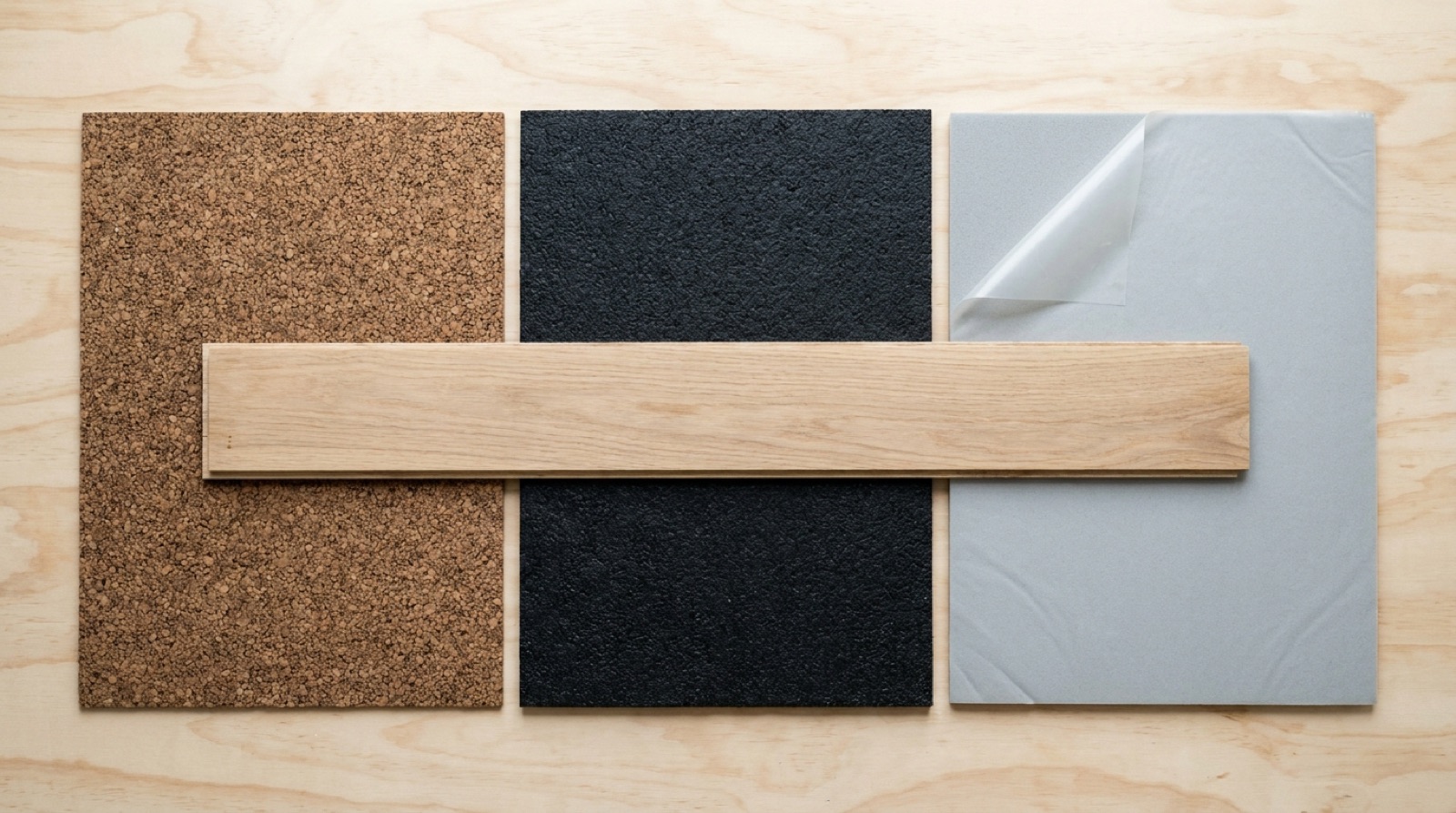
Floor leveling is the quote line item homeowners almost never see coming. The contractor walks the house, hands over a per-sqft number for the new flooring, then mentions "your subfloor is a little out of level, we'll need to add some prep" as a side note. The prep often runs $800 to $4,000 on top of the headline price, depending on how far out of level the floor is and which method the installer uses to fix it. Potomac Floors levels subfloors across Alexandria, Arlington, Fairfax, Falls Church, Tysons, Reston, Ashburn, Springfield, Bethesda, Rockville, DC, and the broader DMV every single week. Below is the real answer on when leveling is actually required, what it costs, and what Potomac includes in the all-in $6.50-$8.50/sqft price versus what we quote separately.
The short answer
Quick answer
Floor leveling is required before any new flooring goes down if the subfloor exceeds the manufacturer's flatness tolerance (industry standard: 3/16 inch deviation in 10 feet for most products, tighter for some). In the DMV the typical cost ranges are $1.50-$2.50 per sqft for self-leveling underlayment (SLU) bag material only, $3-$6 per sqft installed for a full installer SLU pour (material + labor + primer + finishing), and $50-$150 per room for spot shim-and-patch work on a mostly-flat floor with localized dips. Minor leveling on most DMV homes (one or two low spots, a single bag of compound, an hour of labor) is included in Potomac's all-in price. Major leveling (large pour, multiple bags, half-day labor) gets quoted separately and transparently before work starts.
That is the head answer. The body of this guide is the math behind it: what the industry tolerance actually says, why DMV homes drift out of level more than newer builds, what each method costs in real DMV pricing, and what happens to the floor above when an installer skips the leveling step to win a quote.
What floor leveling actually is
Quick answer
"Floor leveling" in the flooring trade does not mean making a floor perfectly level (perpendicular to gravity). It means making it flat. A continuous plane within tolerance, even if that plane has a slight slope. The new flooring sits on a flat plane reliably; it does not sit on a level plane reliably. A 1928 Alexandria colonial with a settled subfloor that drops 1/2 inch from one end of the living room to the other is a candidate for flattening, not for raising the low end back to level. The fix is either a self-leveling underlayment pour (rebuilds the substrate to a new flat plane) or a shim-and-patch (raises individual low spots to match the high spots).
The distinction matters because homeowners often hear "level" and assume the installer is going to raise the low end of the room with structural shims to make the room actually horizontal. That is almost never the goal. Lifting a settled floor structurally requires jacking joists from below, sister-joist repair, and sometimes foundation work. A different project at a different price point. The flooring trade flatness fix takes the existing subfloor as-given and rebuilds the top surface into a flat plane that the new flooring can sit on without flexing, gapping, or cracking. The room may still slope; the floor surface will be flat enough that the new flooring performs the way it is supposed to.
The two methods are pour and patch. A pour is self-leveling underlayment (SLU): a cementitious or gypsum-based liquid compound mixed on-site, poured onto the prepped substrate, and allowed to flow into the low spots. It self-levels to a flat plane in 20-40 minutes and cures hard enough to walk on in 2-6 hours depending on the product. A patch is a thicker, trowel-applied leveling compound used to fill localized dips on a mostly-flat floor without the cost of a full pour. Pour is the right move when the deviation is field-wide; patch is the right move when the deviation is two or three spots in an otherwise flat room.
The 3/16-inch-in-10-feet rule by material
Quick answer
The industry standard flatness tolerance for most flooring is 3/16 inch deviation in 10 feet, measured under a 10-foot straightedge. That number comes from the major manufacturer install instructions (Shaw, Mohawk, Mannington, Bruce, all the big names) and is what most warranty claims test against. Tighter for some products: hardwood nail-down at 1/8 inch in 10 feet (the strictest), large-format tile at 1/8 inch in 10 feet for plank tile 15 inches or longer (TCNA standard), sheet vinyl at 1/16 inch in 6 feet. Looser for some: standard carpet on pad tolerates 1/4 inch in 10 feet because the pad absorbs minor variance.
| Flooring type | Flatness tolerance | Why this number |
|---|---|---|
| LVP click-lock (floating) | 3/16 inch in 10 feet | Click joints unlock under repeated flex over dips |
| LVP glue-down | 3/16 inch in 10 feet | Adhesive bond loses contact in low spots, plank lifts |
| Engineered hardwood (nail or glue) | 3/16 inch in 10 feet | Standard NWFA tolerance for engineered product |
| Solid hardwood nail-down | 1/8 inch in 10 feet (strictest) | Nail tension pulls planks tight to subfloor, magnifies dips |
| Laminate click-lock | 3/16 inch in 10 feet | Same click-joint mechanics as LVP, less forgiving |
| Standard tile (under 15 in) | 1/4 inch in 10 feet | Thinset bed absorbs moderate variance |
| Plank tile (15 in or longer) | 1/8 inch in 10 feet (TCNA) | Lippage shows badly on long plank tile |
| Sheet vinyl | 1/16 inch in 6 feet | Telegraphs every dip and seam through the surface |
| Carpet on pad | 1/4 inch in 10 feet | Pad absorbs minor variance, less critical |
The reason this rule matters at quote time is that two different flooring products on the same subfloor can have wildly different leveling requirements. A 1990s Vienna split-level with a slightly wavy plywood subfloor might pass tolerance for click-lock LVP (3/16 in 10 ft) without any prep, fail tolerance for solid hardwood nail-down (1/8 in 10 ft) and need a full SLU pour, and fail tolerance for 24-inch plank tile (1/8 in 10 ft TCNA) and need either the pour plus a flatness skim coat at the tile threshold. Same floor, three different leveling bills depending on the material chosen.
The other consequence is that warranty claims hinge on this number. A homeowner installs $9,000 of click-lock LVP on a subfloor that deviates 5/16 inch in 8 feet (out of tolerance), the planks unlock at the seams within 18 months, and the manufacturer denies the warranty because the install was outside spec. The check the installer should have run before quoting was the 10-foot straightedge test on the dirty subfloor. The leveling cost that gets skipped to win a cheap quote becomes a denied claim and a re-installation a year later. We cover the broader hidden-cost pattern in our flooring quote hidden charges guide.
How we test for level on a walkthrough
Quick answer
Three quick field tests on every Potomac walkthrough: (1) the marble roll. Drop a marble on the floor and watch where it goes; consistent roll direction means a slope, stopping-and-starting means dips. (2) The 10-foot straightedge. Lay a metal straightedge in three directions across each room and measure the gap at the worst spot with a tape; anything over 3/16 inch flags. (3) The string-line corner walk. Pull a chalk line from one corner to the diagonal corner and measure the gap at the middle. Any one of these is rough; we use all three on a real estimate and quote based on the worst measurement.
The marble roll is the cheap homeowner test you can run yourself today. Get a 1-inch glass marble (a standard playing marble works), set it gently on the floor in the middle of the worst-suspected room, and let go. A flat floor holds the marble in place or lets it drift slowly. A sloped floor sends it rolling in a consistent direction to the low corner. A dipped floor lets it find a local low spot and stop there. The marble roll does not give you a deviation number, but it tells you whether the floor needs the actual straightedge test and roughly where the worst spots are.
The 10-foot straightedge test is the one manufacturers actually spec. We carry a 10-foot aluminum straightedge to every walkthrough, lay it across each room in three directions (corner to corner diagonally, parallel to the long wall, parallel to the short wall), and measure the largest gap between the straightedge and the floor with a tape measure or feeler gauge. The largest reading from any of the three directions in any room sets the leveling requirement for the project. A worst reading of 1/8 inch passes for LVP and engineered hardwood; 1/4 inch fails for everything but carpet; 1/2 inch and we are talking SLU pour, not patch.
The string-line corner walk is the rough-out for larger rooms. A 16-foot living room won't get the full picture from a 10-foot straightedge; we pull a chalk line from one corner to the opposite corner along the floor and measure the gap to the floor at the midpoint. This catches the long-wave subfloor settle that the straightedge misses. Big DMV great rooms (especially the post-2010 open-floor additions) often pass the straightedge test in each direction but fail the diagonal corner walk because the whole field has settled slightly toward the center.
Why DMV homes are out of level
Quick answer
DMV-specific reasons subfloors settle out of level: (1) pre-1950 Old Town Alexandria, Georgetown, Capitol Hill homes have original tongue-and-groove plank subfloors over crawl spaces, 100 years of seasonal humidity cycling produces visible cupping and dips. (2) 1960s-1970s Arlington, Fairfax, Vienna ramblers have 1/2 inch plywood subfloors that have absorbed moisture, swelled, and never returned to flat. (3) Post-2000 additions to older homes pour new slabs that cure flat while the original foundation continues to settle, creating a level mismatch at the join. (4) Basement finish projects often pour gypcrete or concrete on top of existing concrete slabs that already had a slope toward the floor drain, locking the slope in. (5) Townhouses on the eastern half of Fairfax County built on clay-heavy fill have differential settling between party walls.
The historic-home situation is the most common. An 1890 Old Town Alexandria home has original 1x6 tongue-and-groove pine plank subfloor laid diagonally over joists 16 inches on center, with a crawl space underneath that has cycled between 35% and 75% relative humidity every year for 130 years. The planks have cupped slightly at every joint, the joists have settled into the mudsill at slightly different depths, and the result is a subfloor surface that is wavy across the field. Small ripples every 16 inches at the joist lines, plus the long-wave settle of the whole floor system across the room. The straightedge test in those homes routinely reads 3/8 inch or worse, putting them well into SLU pour territory for any flooring stricter than carpet.
The 1960s-1970s rambler situation is the second most common. A 1968 Vienna split-level was built with 1/2 inch CDX plywood subfloor over 2x8 joists 16 inches on center, which was the standard of the day. Sixty years later that subfloor has been wet at least a few times (washing machine overflows, hot water tank leaks, freezer defrost trays overflowing) and the plywood has swelled and never fully recovered. The straightedge picks up the swelled seams as 1/8 to 1/4 inch ridges every 4 feet on center where the plywood sheet edges sit on the joist below. The fix for those floors is usually a thin SLU pour to flatten the swelled seams without rebuilding the whole subfloor.
The added-on-room situation is the trap most homeowners do not see coming. A 1995 Springfield colonial gets a 2010 kitchen-and-family-room addition; the new addition was built on a fresh concrete slab that cured flat and stayed flat, while the original 1995 framed-floor section continued to settle for another decade. By 2026 there is a 3/8 inch step at the door between the addition and the original room, with the new addition sitting high and the original room sitting low. Running a single flooring product across both rooms (especially LVP or hardwood) requires bringing the low side up to the high side with an SLU pour just at the threshold to about 4 feet into the original room, feathered out to match. This is the kind of detail that doubles a quote from one contractor to another based on whether they spotted it.
The basement situation is the one homeowners do see coming. Almost every DMV basement was poured with a slight slope toward the floor drain or to the basement walls, which was the right call from a water-management standpoint and the wrong starting point for a smooth finished floor. Adding flooring on a sloped slab requires either accepting the slope (most click-lock LVP tolerates it fine) or flattening with SLU before install. The decision depends on how steep the slope is and what flooring is going down. The full basement-flooring detail is in our best flooring for basements piece and the slab-specific install detail is in engineered hardwood over concrete slab.
Self-leveling underlayment: how it works
Quick answer
Self-leveling underlayment (SLU) is a cementitious or gypsum-based liquid compound poured onto a primed subfloor, where it flows into low spots and cures to a flat plane. Material cost in the DMV runs $35-$60 per 50-pound bag (Mapei Ultraplan, Ardex K-15, Sika Level, Custom LevelQuick). One 50-pound bag covers about 25 sqft at 1/4 inch thickness, so material alone is roughly $1.50-$2.50/sqft for a 1/4 inch average pour. Installed cost (material plus labor plus primer plus prep) runs $3-$6/sqft DMV. A 200 sqft kitchen needing a 1/4 inch average pour costs $600-$1,200 fully installed.
The mechanical reason SLU works the way it does is that the compound is engineered to flow like syrup for 20-30 minutes after mixing, then snap-set hard. The crew mixes a bag with the spec amount of water in a large mortar mixer, dumps it out across the subfloor, and works it with a gauge rake to spread it within the working window. The compound finds its own level (gravity does the work), fills every low spot, and cures hard enough to walk on within 2-6 hours depending on the product. Cementitious products (Mapei Ultraplan, Ardex K-15) cure to a structural strength similar to concrete; gypsum-based products (Custom LevelQuick) cure softer and are usually used in residential where heavy point loads are not expected.
The labor side of SLU is what surprises homeowners. A 200 sqft kitchen pour is not "dump and walk away." The crew has to fully cover the existing subfloor with a primer (usually a latex-based bonding agent that needs to dry for 2-4 hours before the pour), set up containment dams at every doorway and edge to keep the liquid from flowing into adjacent rooms, mix and pour the bags in sequence within the working window (a 200 sqft job is typically 8-10 bags, mixed and poured in two batches), then come back the next day to verify the cure and grind down any high spots before flooring goes down. That is a half-day to full-day labor commitment for two people, which is most of why the installed cost is 2-3 times the material cost.
The other thing the homeowner does not see is the prep work before the pour. The existing subfloor has to be vacuumed clean, any loose paint or old adhesive scraped, every seam between sheets of plywood taped (sometimes with mesh tape, sometimes with metal lath) to prevent the compound from running through the gap into the basement below, and every penetration (HVAC registers, plumbing stubs, electrical boxes) dammed with foam or tape. The crew that does all that prep produces a clean flat pour; the crew that skips the prep produces a pour with holes from compound running through, edges that crack as they cure, and seams that telegraph through the finish flooring within a year.
Shim-and-patch: when it beats a full pour
Quick answer
Shim-and-patch is the right move when 90% of the room is within flatness tolerance and 10% has localized low spots, usually a single dip in the field, or two or three areas at a doorway and a heat register. Cost: $50-$150 per room for a one-hour patch job with one or two pounds of Ardex Feather Finish or Mapei Planipatch. A full SLU pour on the same room would be $600-$1,200. The trade-off: shim-and-patch only works if the field is otherwise flat. If the field has a 1/4 inch wave across the whole room, patching the dips will not fix it; the floor still fails the straightedge test even with the dips filled.
The patch product itself is a trowel-applied cementitious compound (Ardex Feather Finish, Mapei Planipatch, Henry 549) that comes in 10-pound bags for around $35 each. The crew mixes a small batch in a 5-gallon bucket, troweler-applies it into the low spot, feathers the edges to nothing, and lets it cure for 30-60 minutes before sanding any high spots flat. A typical patch on a 200 sqft kitchen with two known dips is about 30 minutes of actual work. Call it $75-$150 in trade labor at the per-hour rate most installers charge, plus a partial bag of material. Including the patch in an all-in floor install (without a separate quote) is something most experienced installers do as a courtesy on a small job, which is how Potomac handles minor patches in the all-in price.
The trap with patch-only fixes is that they only work on truly local dips. The most common mistake we see on competitor quotes is "we'll just patch the low spots" on a floor where the whole field is wavy by 1/4 inch. After the patch dries and the finish flooring goes down, the field still has the underlying wave and the finish flooring still tells on it. Laminate seams gap, LVP click joints unlock, tile shows lippage. The patches fixed the dips but did not fix the field. The right call on a wavy field is the full SLU pour; the right call on a flat field with localized dips is the patch. Reading which one applies takes 15 minutes with the straightedge.
Cost bands: what leveling runs in the DMV
| Scope | DMV cost | When it applies |
|---|---|---|
| Minor patch (1-3 small dips) | Included in all-in | Mostly flat room, one or two localized lows |
| Spot patch (full room, multiple dips) | $150-$400 per room | Field generally within tolerance, several localized fixes |
| SLU pour, thin (1/8-1/4 inch avg) | $3-$5/sqft installed | Field-wide minor unflatness, 200-400 sqft room |
| SLU pour, medium (1/4-1/2 inch avg) | $4-$6/sqft installed | Settled subfloor, historic homes, big additions mismatch |
| SLU pour, deep (1/2 inch+ avg) | $6-$10/sqft installed | Pre-1930 historic homes, basement re-finish over sloped slabs |
| Subfloor replacement (plywood sheets) | $3-$5/sqft | Water damage, swollen seams beyond patch range |
| Joist sister repair (per joist) | $300-$800/joist | Sagging joists, the structural problem behind the slope |
The minimum charges to keep in mind: most installers carry a one-bag SLU minimum (you pay for the full bag even if the job only needs a partial bag), a half-day labor minimum on any pour day (a 50 sqft pour costs almost the same in labor as a 200 sqft pour because the prep and cleanup time dominate), and a primer/material minimum of one container per job regardless of pour size. The practical implication is that small SLU pours have a high per-sqft cost (because the fixed costs spread over a small area) and large SLU pours have a low per-sqft cost. A 50 sqft single-dip pour might cost $400; a 500 sqft full-kitchen pour might cost $2,500. The same per-bag math, very different per-sqft outcomes.
The deep-pour situation (1/2 inch+ average) is where leveling becomes economically debatable. A 200 sqft historic Old Town living room with 1 inch of total settle across the diagonal needs roughly 4 bags of SLU per 25 sqft of pour at average depth, or about 32 bags total. Material alone is $1,200-$1,900; installed cost is $1,500-$2,500. At that point the homeowner should ask whether the right move is leveling and laying the floor on top, or replacing the original subfloor with new plywood at $3-$5/sqft (which gives a known-flat starting surface and may end up cheaper on a deep-pour job).
What happens when installers skip it
Quick answer
Skipping the leveling step on an out-of-tolerance subfloor produces four common failure modes within 18 months of install: laminate or LVP click-lock unlocking at the seams (planks separate, gaps appear, edges chip), solid hardwood squeaks and gaps (nails pull as the floor flexes over dips, boards rub at the tongue-and-groove), tile lippage and grout cracks (adjacent tiles at different heights produce a trip edge and concentrated stress at the grout line), and sheet vinyl telegraphing (every dip and seam shows through the surface as a visible line within months). All four are warranty-voiding install failures that the manufacturer will refuse to cover because the install was outside spec.
The click-lock unlocking is the most common failure we see on remediation jobs. A homeowner installs $4,000 of click-lock LVP on a subfloor that deviates 1/4 inch across 8 feet (well outside the 3/16 inch in 10 feet tolerance), and the planks unlock at the seams as the floor flexes over the dips with every footstep. The unlocking starts at the worst dips and spreads. By month 12 there are visible gaps at the seams; by month 18 the click joints chip and the planks need to be replaced. The original installer's quote of $4,000 was $1,000 cheaper than the competitor who insisted on a $1,500 SLU pour, but the LVP replacement at month 18 costs another $4,000, and the SLU pour is now needed before the second install too. The cheaper quote cost $2,500 more in 18 months. The mechanics behind why this happens on LVP specifically are in our why your laminate is buckling piece.
The solid hardwood squeak-and-gap failure is the historic-home version of the same problem. A 1930 Arlington colonial with a wavy original subfloor gets new solid 3/4 inch white oak nailed down without any leveling, and the homeowner hears squeaks within six months and sees seasonal gaps within a year. The nails are pulling as the floor flexes over the dips, and the gaps appear because boards on the high spots stay tight while boards on the dips have room to move. The fix is to pull the floor up, level the subfloor properly, and re-install. At a labor cost similar to a fresh install. The right call on Day 1 would have been a 1/4-inch SLU pour at $2,000 to prevent the $8,000 re-install.
The tile lippage failure is the one homeowners notice immediately. Large-format porcelain plank tile (the popular 9x36 and 12x24 sizes used in DMV kitchens and basements) shows lippage badly even on slightly out-of-tolerance substrates. The TCNA spec of 1/8 inch in 10 feet for plank tile is strict for a reason. Tile is rigid and unforgiving. An installer who skips the leveling on a 24-inch porcelain plank install produces a floor with visible height differences at every seam and grout lines that crack as the substrate flexes under load. The remediation is to pull the affected tiles, level the area properly, and re-set with fresh thinset. Practically a full re-tile of the affected zone.
When the joists are the real problem
Quick answer
Floor leveling fixes the top surface of the substrate, not the structure underneath. If the joists are sagging, sistered improperly, undersized for the span, or rotted at the bearing point, the floor will continue to flex and the new flooring will eventually fail again even after a perfect SLU pour. The tell that joists are the real problem: visible deflection when you walk across the room (the floor bounces, dishes rattle in the cabinet), or a long-wave sag from joist mid-span to mid-span. The fix is sister-joist repair at $300-$800 per joist, which has to happen before any flooring goes down on top.
The walkthrough check for joist failure is the bounce test. We walk across the field of the room at a normal stride and watch for visible deflection at every step. A sound joist system produces zero visible motion in the floor surface; a sagging or undersized joist system produces a 1/8 to 1/4 inch dip under each footstep that you can see in the reflection on a glass of water set on the floor. If we see bounce, the leveling conversation pauses until the joist conversation finishes. There is no point pouring SLU on top of joists that will continue to deflect, because the SLU will crack at the high-stress points and the new flooring will telegraph the cracks within a year.
Sister-joist repair adds a second 2x8 or 2x10 joist alongside each undersized or damaged joist, bolted or screwed through the existing joist at 16 inches on center. Done from the basement or crawl space below, it is a half-day job per pair of joists and runs $300-$800 per joist depending on access and length. A typical historic-home floor needing leveling above might need 3-5 joists sistered first, which is a $1,500-$4,000 structural fix before the $1,500-$2,500 leveling fix, before the new flooring goes down. That stack is why deep historic-home flooring projects sometimes carry a $4,000-$6,000 pre-flooring prep bill that no one expected.
The other version of "joists are the real problem" is the bearing-point rot situation. A joist that has been wet at the bearing point on the foundation wall (because of a chronic water issue in the crawl space) has lost structural integrity at the very point where it carries the most load. The bearing-point repair is to lift the joist back to position with a jack, remove the rotted section, install a steel beam or new bearing block, and re-set the joist on the new support. That is a $1,500-$3,000 fix per joist on top of the sister-joist labor. Homes with chronic water intrusion in the crawl space are usually carrying bearing-point rot in 2-4 joists by the time the floor above shows symptoms. The full subfloor surprise list is in our subfloor repair piece.
What Potomac includes vs quotes separately
Quick answer
Potomac all-in pricing ($6.50/sqft LVP, $8.50/sqft hardwood, etc.) includes minor patch leveling: one or two small dips, one bag of compound, an hour of trowel work. Major leveling gets a transparent line item on the quote BEFORE work starts. We measure the deviation with the straightedge at the in-home estimate, give you the number, and you decide. We do not start the job, find the leveling problem on demo day, then surprise you with a $2,000 extra bill at the end. The full quote you get at the estimate is the price you pay, including any leveling work needed.
The way the conversation runs on a Potomac in-home estimate: we walk every room with the 10-foot straightedge, measure the worst deviation per room, photograph any localized dips, and note whether each room needs nothing, patch, thin pour, medium pour, or deep pour. The quote shows the per-sqft flooring price separately from any required leveling, so you can see what each piece costs and decide whether to do all rooms, some rooms, or none. If the leveling number for one room is high enough to change the project economics (a $2,500 deep pour on a 250 sqft room is a real number), we walk through the alternatives with you: change to a more tolerant flooring (carpet from hardwood), defer that room to a later phase, or accept the leveling cost and proceed. Your call on a transparent number, not a surprise on the invoice.
The reason we run it this way is structural to the all-in pricing model. The whole point of "all-in" is that the number you see is the number you pay. Hiding leveling as a Day-1 surprise breaks that promise. A contractor who quotes the cheap LVP number, finds the wavy subfloor on demo day, and then adds $2,000 to the bill is not running all-in pricing. They are running bait-and-switch. Potomac's quote at the estimate either includes the leveling math or explicitly excludes it with a transparent number for the homeowner to decide on. The same logic governs the broader hidden-charges list covered in flooring quote hidden charges.
FAQs about floor leveling cost in the DMV
How do I know if my floor needs leveling before I get a quote?
The marble roll is the homeowner version of the test: drop a 1-inch glass marble in the middle of the room and watch where it goes. A flat floor holds the marble or lets it drift slowly; a sloped floor sends it rolling consistently to one corner; a dipped floor lets it find a low spot and stop there. If the marble rolls visibly, the floor needs at least a straightedge test at the estimate. If you want to pre-check more precisely, lay an 8-foot 2x4 across the room in three directions and see if you can fit a quarter (1/16 inch) under the worst gap. Anything more than 3 stacked quarters (3/16 inch) is likely going to need leveling for hardwood or LVP. We confirm the exact deviation with our 10-foot straightedge at the in-home estimate.
Can I just install thicker LVP to bridge the dips?
No. The flatness tolerance is set by the click-joint geometry, not the plank thickness. Thicker LVP (8mm vs 5mm) is more rigid against denting, not against subfloor unflatness. The click joints still need a flat substrate to lock and stay locked under flex. The manufacturer spec is 3/16 inch in 10 feet regardless of plank thickness, and warranty claims hinge on it. Pay for the leveling once or pay for the re-install twice. The plank-thickness math for LVP wear and performance is in our LVP wear layer guide.
How long does an SLU pour take before flooring can go on top?
Cure times vary by product. Cementitious SLU (Mapei Ultraplan, Ardex K-15) is walkable in 2-4 hours and ready for flooring in 16-24 hours. Gypsum-based SLU (Custom LevelQuick) is walkable in 4-6 hours and ready for flooring in 24-48 hours. We typically pour on Day 1 and start the flooring install on Day 2, which adds one day to the project timeline. The full hardwood install timeline including any required leveling is in our how long hardwood installation takes piece.
Is the floor going to be perfectly level after the leveling work?
It will be perfectly flat to within the manufacturer tolerance (3/16 inch in 10 feet for most products). It will not necessarily be perfectly horizontal. The flooring trade goal is a flat plane that the new flooring can sit on reliably; if the existing room slopes 1/2 inch from one end to the other and we level it without raising the low end structurally, the floor will be flat but still gently sloped. Raising the low end structurally is a different project (joist work, foundation work) that is rarely worth doing just for the flooring install.
What's the cheapest material to install on an unleveled floor?
Carpet on standard pad tolerates 1/4 inch deviation in 10 feet, which is roughly twice the tolerance of LVP or hardwood. Many out-of-level DMV homes get carpet installed without any leveling, which is fine on a 25-year ownership horizon if the slope is moderate. The full per-material carpet pricing is in our carpet installation cost piece. If you want hard flooring but the leveling cost is too high to justify, sheet vinyl (especially the modern click-lock luxury sheet vinyl) is the next most tolerant option after carpet.
Does my floor need leveling if I'm installing tile?
Usually yes, and usually more strictly than for other flooring. TCNA spec is 1/4 inch in 10 feet for standard tile (under 15 inches), and 1/8 inch in 10 feet for plank tile (15 inches or longer). The popular DMV kitchen choice of 9x36 or 12x24 porcelain plank tile triggers the 1/8 inch in 10 feet standard, which is stricter than hardwood. Most DMV subfloors need at least a thin SLU pour or a thinset-bed flatness skim before plank tile. The cost is built into the tile install math in our tile installation cost piece.
Can the leveling work damage the joists or subfloor below?
Done correctly, no. A properly executed SLU pour adds 1/8 to 1/2 inch of cementitious or gypsum material at a weight of roughly 1-3 lbs/sqft, which is well within the load capacity of any sound floor system. Done incorrectly (no primer, no edge dam, no seam tape), the pour can leak through gaps and drip into the basement, soak the existing subfloor, or fail to bond and crack within a year. The prep work is most of why the labor cost is what it is.
Bottom line: get the level number on the quote
Floor leveling is the line item that turns a $5,000 LVP install into a $7,500 LVP install, or, worse, a $5,000 install that fails in 18 months because the leveling was skipped. The right way to think about it: the leveling cost is real and the leveling cost is unavoidable on subfloors that fail the manufacturer flatness tolerance. The choice you have is whether to pay it on Day 1 with the right installer, or pay it on Day 1 plus another $5,000 re-install in year 2 with the cheapest installer.
The right move before you commit to any flooring quote is to ask the contractor what the deviation reading was on their straightedge test and what they are quoting for any required leveling. A contractor who has no answer either skipped the test or is planning to discover the problem on demo day and surprise you with the extra. A contractor who has a number quoted explicitly has done the work and is offering you a real all-in price.
Want a real flatness check on your subfloor with a transparent leveling number? Potomac Floors runs the 10-foot straightedge test on every in-home estimate across Alexandria, Arlington, Fairfax, Falls Church, Tysons, Reston, Ashburn, Springfield, Manassas, Bethesda, Rockville, DC, and the broader DMV. We measure the worst deviation in every room, quote any required leveling separately and transparently, and give you the full all-in price before any work starts. Minor patch leveling is included in the all-in flooring price. Major leveling gets its own line item on the quote, with a number you decide on before we touch the floor. Call 571-341-7247 or request a free in-home estimate. The honest quote is the one that includes the leveling cost on the front page, not on the final invoice.