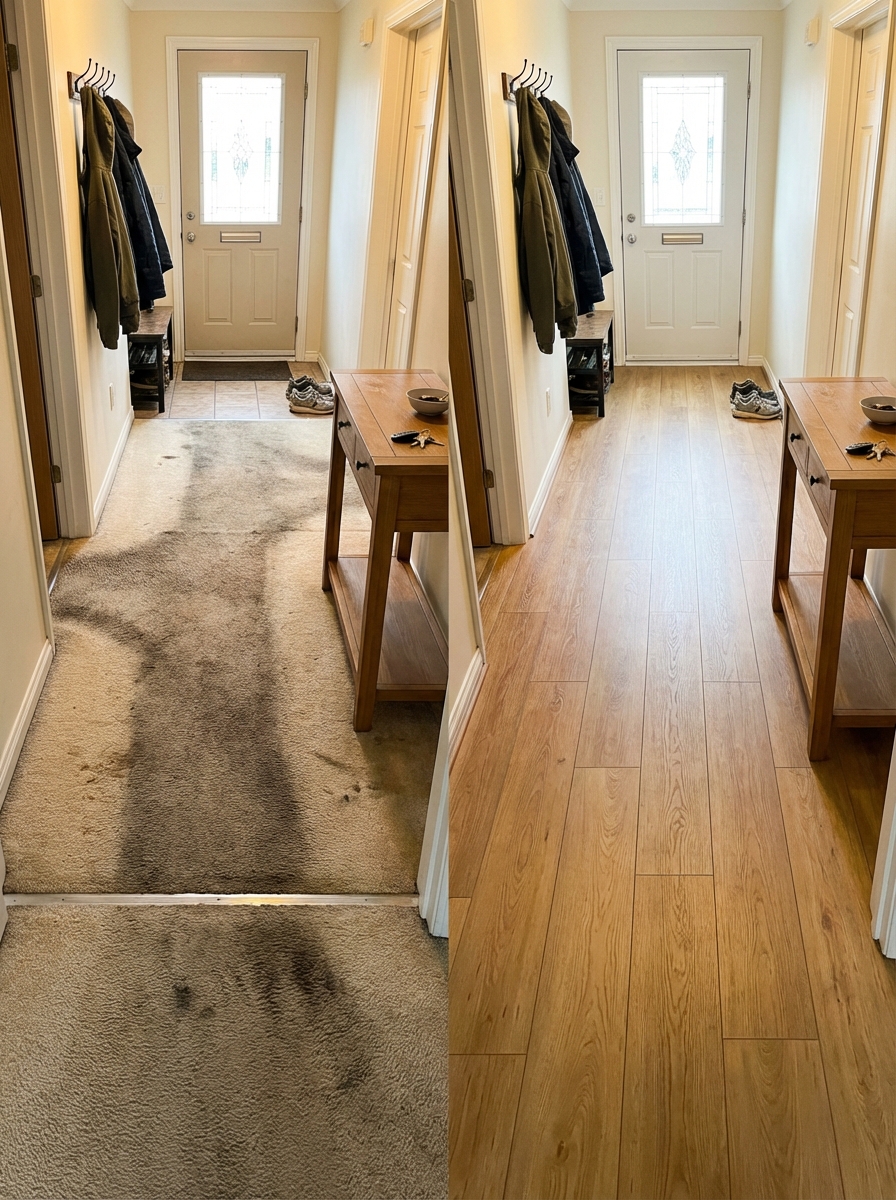

The honest part of flooring installation that most quotes don't talk about: until we tear out the old floor, neither of us knows what's underneath. Most of the time it's fine. Sometimes it's not. This article walks through what we actually find in DMV homes after 20+ years of installing across Alexandria, Arlington, Fairfax, McLean, Bethesda, Silver Spring, and the rest of the metro, and what to expect on your quote when we find something. If you are also budgeting the tear-out itself, our guide to flooring removal cost breaks down what pulling up each floor type runs.
Subfloor surprises in DMV homes: the short answer
Quick answer
In 70% of DMV homes built before 2000, we find at least one of three things during install: water damage under a kitchen or bathroom (35-40% of older homes), squeaky or loose subfloor in high-traffic rooms (50-60% of homes regardless of age), or out-of-level floors that need self-leveling compound (30% of homes over 40 years old). Total subfloor repair on these jobs typically adds $1.50-4 per square foot to the quote, depending on what's found. Honest installers tell you about it the day we find it. Quotes that bury subfloor repair in fine print are how flooring jobs balloon 30% over the original number.
The 3 things we find in 70% of older DMV homes
- Water damage at kitchen and bathroom edges. Slow leaks from dishwashers, refrigerators, ice maker lines, and old toilet seals soak the subfloor for years before anyone notices. We find soft, brown, often moldy plywood when we pull up the old flooring. Fix: cut out the damaged section, sister new joists if needed, replace plywood. Adds $200-1,500 depending on extent.
- Squeaky or loose subfloor. Old construction adhesive failed, nails backed out, plywood seams shifted. New flooring on top of squeaky subfloor will squeak. Fix during install: re-secure the subfloor with screws and adhesive before laying the new floor. Adds $0.50-1.50/sqft depending on severity.
- Out-of-level floors. Old houses settle. By 30-40 years in, most have at least 1/4" variation across a room. The NWFA installation standard for hardwood is 3/16" over 10 feet. Anything more requires self-leveling compound. Adds $2-4/sqft for the affected area.
What's under your floors by home age (1950s to today)
| Home decade | Typical subfloor materials | Common issues we find |
|---|---|---|
| 1950s-1960s | Plank subfloor (real boards), sleeper systems on slab basements | Plank gaps, settled joists, asbestos in old vinyl tile (occasionally), squeaks |
| 1970s-1980s | Plywood subfloor (1/2" to 5/8"), particle board occasionally | Particle board failure under bathrooms, water damage, weak attachment |
| 1990s | Plywood (5/8" to 3/4"), some OSB | Glue/nail failure, occasional water damage at appliances |
| 2000s-2010s | OSB (oriented strand board) standard | Generally solid; squeaks from settling are most common issue |
| 2015+ new construction | OSB or premium plywood, modern fastening | Almost always good condition; occasionally over-glued or under-glued by quick-build crews |
💡 Key takeaway
If you're buying or quoting a flooring job in a home built before 1990, expect at least some subfloor work. It's not a sign anything is wrong with the home. It's normal aging. The question to ask any quote is: "Have you budgeted for subfloor surprises, or will I get a change order?" An honest installer will say "we'll tell you the day we find it" and walk you through the typical line items. See our guide to hidden flooring quote charges for what should already be in your number.
Water damage we find under old kitchens and bathrooms
The water damage we find isn't always from a flood. More often it's a slow leak that's been going for 5-15 years. Common sources in DMV homes:
- Dishwasher seals. Old dishwasher gaskets crack and weep under the unit. Plywood under the dishwasher rots from the bottom up. You see no water, but the subfloor is soft.
- Refrigerator ice-maker lines. Plastic supply lines crack at the connection behind the fridge. Slow drip for years. Subfloor in the alcove is brown and soft.
- Toilet wax seal failures. When a toilet wax seal cracks, water from each flush seeps into the subfloor around the toilet flange. Years of this rots the subfloor in a 2-3 ft circle around the toilet.
- Bathtub overflow drains. If kids overfill the tub or the overflow drain leaks, the subfloor under the tub edge gets soaked. Often invisible until tile or vinyl is removed.
- Roof leaks (upper floors). A roof leak from 10 years ago that was "fixed" but soaked the subfloor. Wood looks fine on top, rotted underneath.
What we do when we find it: photo it, show you, give you the repair scope and price before continuing. The fix usually involves cutting out the soft section, replacing with matching plywood, and sometimes sistering joists if any structural wood is damaged. Cost ranges from $200 (small dishwasher patch) to $1,500+ (full bathroom subfloor). EPA mold remediation guidance applies if visible mold is present. We follow those protocols.
Why your subfloor squeaks (and how to fix it during install)
Subfloor squeaks come from one of three causes:
- Nails backing out. Old nail-down subfloor wasn't glued. Over decades the nails work loose, and when you step on the floor, the plywood moves slightly against the nail shaft, making the squeak.
- Adhesive failure. Construction adhesive applied to joists in the 1980s-90s sometimes degrades. When it fails, the plywood lifts slightly on each step.
- Joist movement. Less common: a joist itself shifts (settling, rot, or original under-engineering). Causes squeak across a wider area.
Fix during install: before the new floor goes down, we walk every square foot looking and listening for movement. We re-secure plywood to joists with deck screws (not nails. Screws don't back out) and add construction adhesive at edges. For severe cases, we can drive screws through the new flooring into joists from above, but that's only for solid hardwood (LVP and laminate float on underlayment, so the squeak fix has to happen at the subfloor level beforehand).
Cost: $0.50-1.50/sqft depending on how much area needs treatment. Most jobs fall in the $0.50-0.75 range. A fraction of total project cost for a noticeable quality improvement.
What subfloor repair actually adds to your quote
| Subfloor work | Typical add to quote | How often we find it (DMV) |
|---|---|---|
| Light squeak repair (re-secure plywood) | $0.50-1/sqft of affected area | ~50% of homes 20+ years old |
| Heavy squeak repair (multiple rooms) | $1-1.50/sqft | ~15% of homes |
| Self-leveling compound (out-of-level) | $2-4/sqft of affected area | ~30% of homes 40+ years old |
| Plywood patch (water damage, small) | $200-500 flat | ~25% of older homes |
| Plywood replacement (water damage, large) | $500-1,500 flat | ~10% of older homes |
| Joist sistering (structural) | $300-800 per joist | ~5% of homes |
| Asbestos abatement (if found in old vinyl) | $8-15/sqft (specialist trade, separate quote) | ~2% of pre-1980 homes |
Asbestos and lead in older DMV homes (rare but real)
⚠️ Watch out
Vinyl floor tiles installed before 1980 sometimes contain asbestos. Mastic adhesives from that era often do. If your home is pre-1980 and the existing floor is original vinyl tile or sheet vinyl, we test before any demo. If positive, we stop and refer you to an asbestos abatement specialist before we can continue. This isn't optional and adds $8-15/sqft for affected areas. Don't let any contractor demo old vinyl in a pre-1980 home without testing.
Lead in old paint isn't a flooring issue but matters when we're working trim. Pre-1978 homes can have lead paint in baseboards and shoe molding. We follow EPA RRP standards when working with lead-painted trim. Cleanup is more careful, dust is contained.
FAQs about subfloor repair in Northern Virginia, DC, and Maryland
How do I know if I'll have subfloor problems before the install?
Walk every room. If you hear squeaks, feel softness, or see uneven transitions to other rooms, plan for at least light subfloor repair. We can give a rough estimate during the in-home quote based on what we feel and see, but the real answer comes when the old floor is up.
Can subfloor work be done after the new floor is installed?
No. Subfloor repair has to happen with the old floor up and the new floor not yet down. Installing first and fixing later means tearing up the new floor. Wasted material, doubled labor.
Is plywood or OSB better as a subfloor?
Both work for finished flooring. Plywood is slightly more moisture-resistant; OSB is slightly stronger. For replacement patches, we match what's already there to keep the floor level uniform.
Do you handle the asbestos abatement yourselves?
No. Asbestos abatement requires licensed specialists in Virginia, DC, and Maryland. If we test and find asbestos, we stop, refer you to a vetted abatement contractor, and resume work after they're done. This protects you and us.
Bottom line: planning for subfloor surprises
If your home is over 20 years old, build a 10-15% buffer into your flooring budget for subfloor work. The work doesn't always show up, but when it does, the difference between an honest installer and a sketchy one is whether you find out the day we tear up the old floor or three weeks later when the bill arrives.
Free in-home estimates across the DMV. We'll walk every room, listen for squeaks, check for soft spots near appliances, and tell you what we'd expect to find. Curious about timelines if subfloor work is needed? See the day-by-day install guide for what additional days look like.
Three more reads that connect to subfloor work: our 2026 hardwood installation cost guide shows where subfloor prep typically lands in the total quote, our hardwood maintenance guide covers how to eliminate squeaks that appear AFTER install (sometimes the subfloor wasn't the cause, sometimes it's a maintenance fix), and our basement flooring guide covers the subfloor-prep work specific to below-grade installs (slab leveling, moisture barriers, sleeper systems) which is genuinely different from upstairs subfloor work.