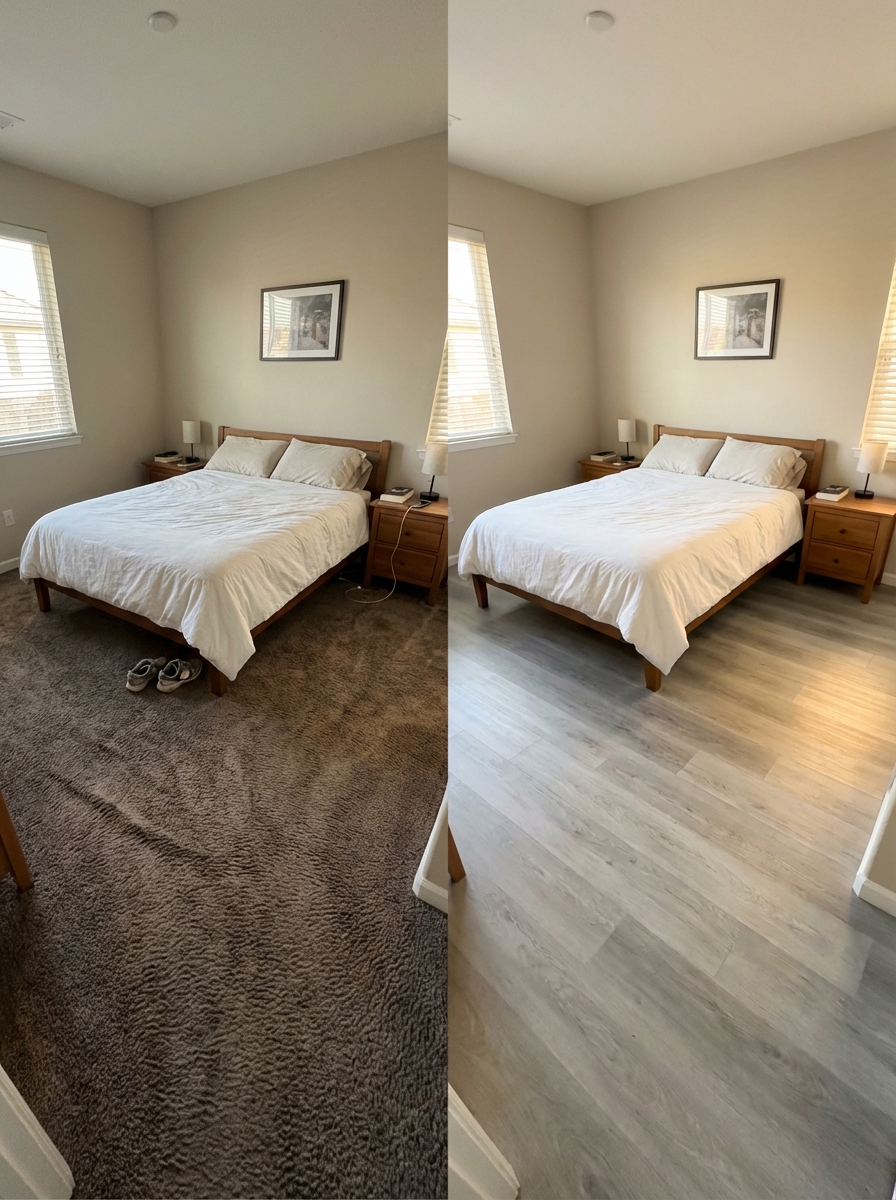

Laminate that's buckling, peaking at the seams, or developing visible high spots is one of the most common calls we get from DMV homeowners. The floor was fine for years, then suddenly something looks wrong. The good news: the cause is almost always one of three specific things, and which one you have determines whether you can fix it cheaply or have to replace the floor. This article walks through the diagnosis.
Buckling laminate: the short answer
Quick answer
Most buckling laminate has one of three causes: no expansion gap left at walls (60% of cases), moisture from below or above (25%), or uneven subfloor underneath (15%). The expansion gap problem can sometimes be fixed by trimming the planks at the wall edges and replacing the shoe molding. Relatively cheap. Moisture damage usually means replacing the affected area or the whole room. Subfloor unevenness requires pulling up the floor, leveling, and reinstalling. Labor-heavy. DMV humidity (70-85% in summer) makes all three more common here than in drier climates.
The 3 causes of buckling laminate (in order of frequency)
Cause #1: No expansion gap (60% of cases)
Laminate is a floating floor. It expands and contracts with humidity changes. Manufacturer specs require a 1/4" to 1/2" expansion gap at every wall, doorway, and vertical fixture (cabinets, fireplaces, stair posts). The shoe molding or quarter round at the wall covers this gap visually.
When the original installer skipped this. Pushed the planks tight against the wall. There's nowhere for expansion to go. Summer hits, humidity climbs, the planks expand, and they push against each other in the middle of the room. Result: a buckle, peak, or hump where the floor lifts off the subfloor.
This is the #1 reason DIY laminate jobs fail in the DMV. Big-box installation crews sometimes skip it too if they're rushing. The World Floor Covering Association installation guidelines are explicit about this requirement.
Cause #2: Moisture (25% of cases)
Laminate has a wood-fiber core (HDF. High-density fiberboard). Wood swells when wet. Sources of moisture in DMV homes:
- Slow leaks from dishwashers, fridge water lines, toilet supply lines
- Mopping with too much water (laminate is NOT supposed to be wet-mopped)
- Vapor migration from a slab without proper vapor barrier
- Sump pump failure or basement flood
- HVAC humidity issues during summer
When the core absorbs water, the planks swell and the seams peak up. This usually shows as a localized buckle near the moisture source (under the dishwasher, near the bathroom door) rather than a whole-room buckle.
Cause #3: Uneven subfloor (15% of cases)
Laminate floats on underlayment. It needs the subfloor to be within 3/16" of level over a 10-foot span. If the subfloor has high spots, low spots, or wide variation, the planks don't sit flat. Over time, the click-lock joints wear out at stress points and the floor starts to peak or sag.
This usually shows as a single localized peak or soft spot where you walk over the same area repeatedly.
How to diagnose which cause you have
| Symptom | Most likely cause |
|---|---|
| Buckling appears in summer, gets worse in heat/humidity, may settle in winter | Cause #1 (no expansion gap) |
| Buckling is in a single area near appliances (kitchen, bathroom, laundry) | Cause #2 (moisture) |
| Plank seams have black or dark stains visible at the joints | Cause #2 (moisture, often advanced) |
| Buckling is at edges of the room, near walls | Cause #1 (no expansion gap, planks have nowhere to go) |
| Buckling is in the middle of a room with no clear water source | Cause #3 (uneven subfloor) |
| Buckling is just one area you walk over a lot | Cause #3 (subfloor wear or weak spot) |
| Floor feels soft or spongy underfoot | Cause #2 (likely moisture damage to core) |
💡 Key takeaway
Pull up the shoe molding at the buckled wall. If the planks are jammed tight against the wall (no visible gap), you've confirmed Cause #1. This is often the cheapest fix. Trim the planks back to create the gap, replace the molding. Watch out for installers who quote a full replacement when the actual problem is a missed expansion gap.
Can buckled laminate actually be saved?
Depends on the cause:
- Cause #1 (no expansion gap): Often yes. Pull shoe molding, trim 1/4-1/2" off the planks at the wall edge with a multitool, replace molding. Floor settles back into place over a few weeks as humidity normalizes. Cost: $200-600 per room.
- Cause #2 (moisture): Usually no. Once the HDF core swells, the click-lock joints are damaged. Even after drying, the planks don't lock back together properly. Replace the affected area or whole room.
- Cause #3 (uneven subfloor): Sometimes yes. Pull up affected planks, level the subfloor with self-leveling compound or shims, reinstall planks. Often the planks themselves are fine. Cost: $3-6/sqft for the affected area.
Why DMV laminate buckles more than other regions
Two climate factors make DMV laminate buckling more common than in drier regions:
- Summer humidity 70-85% for months. Laminate expands ~1/8" per 8 feet of room width with each 30% humidity swing. A room that's 16 feet wide can see 1/4" total expansion summer-to-winter. If the installer didn't leave that 1/4" gap, the floor has nowhere to go.
- Winter dryness drops to 25-35% indoor humidity. This contraction can pull seams apart, then the next summer's expansion peaks them. Year-round cycling stresses click-lock joints.
Premium laminate (AC4 or AC5 commercial-grade) handles these cycles better than budget AC3 residential laminate. If your floor was a basic big-box laminate, the wear rating may be part of the problem.
When to repair vs when to replace
| Situation | Repair or replace? |
|---|---|
| Single buckle, expansion gap missing, planks otherwise fine | Repair (trim + new molding) |
| Multiple buckles, moisture-related, dark stains at seams | Replace at minimum the affected area |
| Soft spots underfoot, advanced moisture damage | Replace the whole room |
| Buckling concentrated over one floor joist or area | Lift planks, level subfloor, reinstall |
| Floor is over 10 years old AND buckling AND any moisture | Replace. Laminate this old won't lock back together cleanly |
| Buckling in a basement laminate floor | Almost always replace. Laminate is not the right material for DMV basements. See our basement flooring guide for what to use instead. |
How to prevent it on your next floor
If you're replacing buckled laminate and want to avoid the same problem:
- Pick LVP instead. LVP is dimensionally stable in any humidity. It's the right answer for DMV homes 90% of the time. Compare LVP to hardwood and engineered hardwood here.
- If you stick with laminate, use AC4 or higher. Better wear rating, denser core, handles humidity cycles better.
- Verify the installer leaves expansion gaps. Ask explicitly. Walk the floor before they install shoe molding to confirm visible gaps at all walls.
- Run a dehumidifier in summer if your home gets humid. Keep indoor humidity between 35-55% year-round per EPA mold prevention guidance.
FAQs about buckled laminate floors
Will my homeowner's insurance cover buckled laminate?
Usually only if the cause is a sudden water event (burst pipe, sump pump failure during storm). Slow leaks and installation errors aren't covered. Document the cause carefully.
Can I just put weight on the buckle to flatten it?
No. The click-lock joints are damaged. Weight may push planks down temporarily but the joint integrity is gone. The buckle returns or the area becomes a loose, squeaky weak spot.
How much does it cost to replace a buckled section vs the whole room?
Section replacement runs $5-8/sqft if matching laminate is still available. Whole-room replacement at $6.50/sqft for new laminate is often cheaper than partial replacement plus matching effort. We'll give you both numbers.
Why did my floor only buckle this year if it's been fine for 8?
Two common reasons: (1) cumulative humidity stress on click-lock joints reached failure point, (2) a small leak started recently and the moisture is finally showing. Diagnose before assuming.
Bottom line: what to do about buckled laminate
If your laminate is buckling, the diagnosis is fast: pull a piece of shoe molding, check the expansion gap, look for moisture stains, and feel for soft spots. We do this for free as part of our in-home estimate across the DMV. Often the fix is a few hundred dollars. Sometimes it's a full replacement. Either way, we'll tell you straight before quoting.
If you have a hardwood floor going through the same kind of damage, the diagnosis is different. See our hardwood floor buckling and cupping guide for the cupping-vs-crowning-vs-buckling walkthrough and the DMV-specific humidity context.
Considering switching from laminate to LVP or hardwood? See the comparison guide for what fits your home.
Two diagnostic reads if your laminate is buckling: what subfloor problems we find in older DMV homes (uneven subfloor is cause #3 of buckling), and why laminate is the wrong call for DMV basements specifically (humidity below grade is unforgiving). If your laminate is already past repair, our replacement decision guide walks through what to install next. Pricing your replacement? Our DMV laminate flooring installation cost breakdown shows real all-in numbers per room and house size.