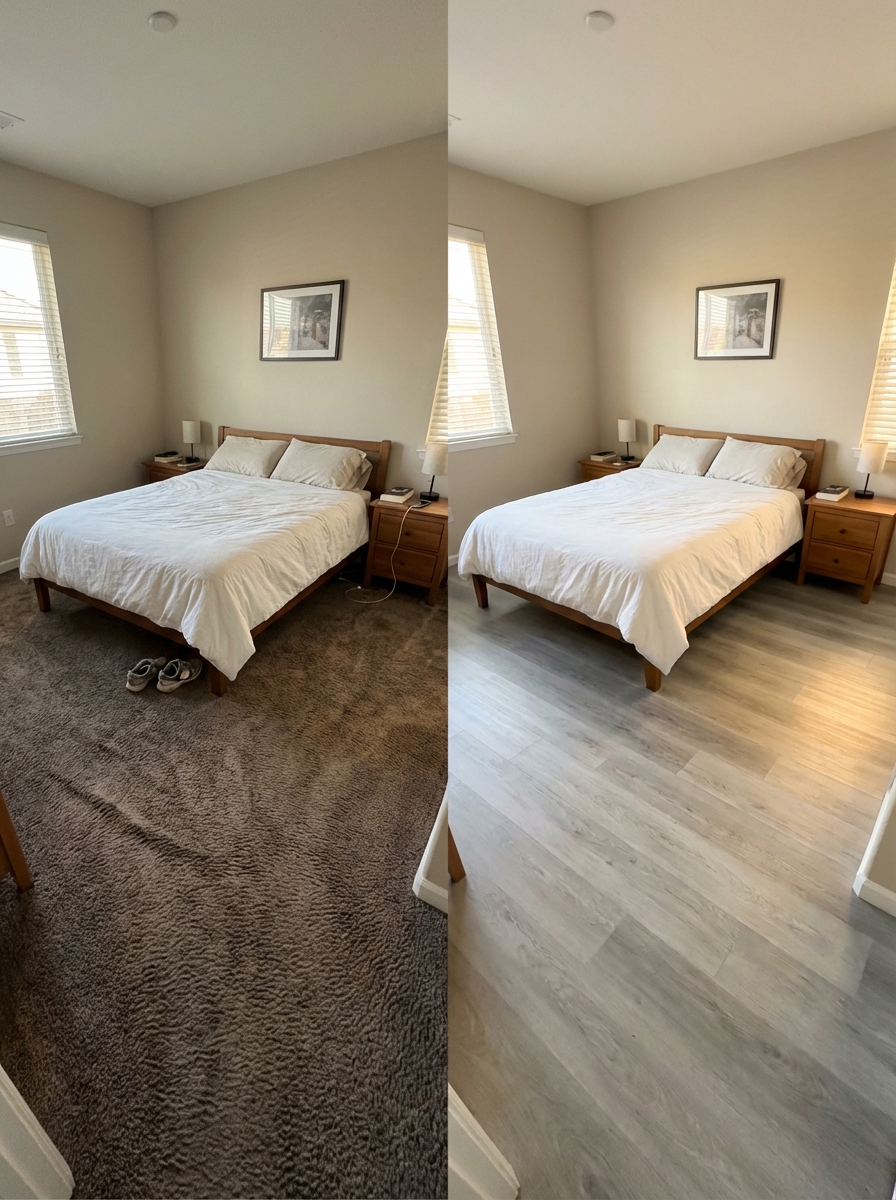

Three materials cover almost every DMV residential flooring decision in 2026: solid hardwood, engineered hardwood, and luxury vinyl plank (LVP). They look similar in photos. They cost very differently. They behave very differently when wet, when scratched, and when refinishing time comes 15 years later.
This article is a working installer's honest comparison. Real per-square-foot costs in the DMV. Real lifespans based on what we see in homes 10-30 years after install. Real guidance on when each material fits, and when it doesn't.
By the end you'll know which one belongs in your basement, which one belongs in your living room, and which one belongs in a rental property where you optimize for durability over resale value.
Solid vs engineered vs LVP: the short answer for DMV homes
Quick answer
For most DMV homes: engineered hardwood at $8.50/sqft all-in. Real wood top, works on slab and over radiant heat, refinishable once or twice. For above-grade rooms in older homes (Old Town colonials, mature trees, low-humidity-swing): solid hardwood at $9-11/sqft. Lasts 50-100 years, refinishable 6+ times. For basements, kitchens, mudrooms, rentals: LVP at $5-7/sqft. Waterproof, scratch-resistant, 15-25 year lifespan, can't be refinished but doesn't need to be.
Side-by-side comparison
| Feature | Solid hardwood | Engineered hardwood | LVP |
|---|---|---|---|
| All-in cost (DMV, 2026) | $9-11/sqft | $8.50/sqft | $5-7/sqft |
| Material composition | One piece of real wood, top to bottom | Real wood top layer (2-4mm) over plywood core | 100% synthetic, vinyl with photo-printed wood-look top |
| Lifespan | 50-100+ years | 20-30 years | 15-25 years |
| Refinishable | 6+ times | 1-2 times (if wear layer ≥ 2mm) | No |
| Works over concrete slab | Not recommended | Yes | Yes |
| Works in basements | No (humidity) | Sometimes (if humidity stays under 50%) | Yes (waterproof) |
| Waterproof | No | No (water-resistant only) | Yes (most LVP rated 100% waterproof) |
| Scratch resistance | Moderate (depends on species + finish) | Moderate | High (top wear layer 12-30 mil) |
| Resale value impact | Adds significantly to home value | Adds to home value | Neutral; doesn't hurt, doesn't always help |
| Installation method | Nail-down only (over plywood subfloor) | Nail, glue, or float | Float (click-lock) or glue |
| Best for | Long-term ownership, above-grade, older homes | Most homes, most rooms | Wet areas, rentals, high-traffic, budget-driven projects |
Real cost breakdown for DMV
The advertised pricing for these three materials is wide. Here's what you actually pay all-in (material + install + demo + removal + disposal + underlayment + trim) in Northern Virginia, Washington DC, and Maryland in 2026:
Solid hardwood: $9-11/sqft all-in
Standard species (red oak, white oak, maple): $9/sqft all-in.
Premium species (hickory, walnut, wide-plank specialty cuts): $10-11/sqft all-in.
Solid hardwood requires a plywood subfloor with proper moisture content (8-12%). Installations over concrete slab are not recommended. The moisture transfer over time will cup, warp, or crack the boards.
Engineered hardwood: $8.50/sqft all-in
This covers most engineered hardwoods on the market, typically a 2-4mm real-wood top layer over a 7-9 layer plywood core. Material alone runs $4-6/sqft at wholesale; the rest is install, demo, removal, disposal, underlayment, and trim.
About 85% of the hardwood we install in DMV homes is engineered. It's the right answer for most situations because it tolerates DMV's humidity swings (wet summers, dry winters) better than solid does.
LVP: $5-7/sqft all-in
Mid-tier LVP (12-20 mil wear layer, 6-8mm total thickness): $5/sqft all-in.
Premium LVP (20-30 mil wear layer, rigid core SPC, 8-12mm total): $6-7/sqft all-in.
The wear layer thickness is the most important LVP spec. 6-12 mil = light residential. 12-20 mil = standard residential. 20-30 mil = high-traffic residential or light commercial. Don't shop on price alone. A thin-wear-layer LVP at $4/sqft will scratch in 3-5 years; a 20-mil wear layer LVP at $6/sqft holds up for 15-20.
For per-square-foot math by project size, see our cost per square foot breakdown.
Lifespan and refinishability
The biggest decision factor for many homeowners isn't the upfront cost. It's how many times the floor can be brought back to new without replacement. Here's the math:
💡 Key takeaway
Solid hardwood is the only material that lasts longer than the homeowner. Properly maintained, a solid oak floor installed in 1950 is still serviceable in 2026 with two or three refinishes along the way. Engineered floors typically need replacement after 20-30 years. LVP gets replaced when the wear layer is gone, usually 15-20 years in.
Solid hardwood
3/4" solid hardwood has roughly 4-5mm of wood above the tongue-and-groove. Each refinish removes about 0.5-1mm. That's 6-8 potential refinishes before you hit the joinery and have to replace boards. Realistically, most solid floors get refinished 2-3 times in a homeowner's tenure and have plenty of life left for the next owner.
Engineered hardwood
Engineered's wear layer is 2-4mm. Each refinish removes about 0.5-1mm. Same as solid. So engineered is refinishable 1-2 times if the wear layer is ≥ 2mm. Below that, sanding cuts through to the plywood core. After replacement.
This is why budget engineered hardwood (1mm wear layer) is usually a false economy. It can't be refinished, so when it wears out you're replacing the whole floor. Premium engineered (3-4mm wear layer) gives you refinishing flexibility.
LVP
LVP can't be refinished. The wear layer is a clear urethane coating over a printed photo of wood. Once that wears through, you can't sand the photo. When LVP wears out, you replace it. Lifespan ranges from 10 years (low-end residential) to 25 years (high-end commercial-grade).
The trade-off is that LVP doesn't really need refinishing the way real wood does. It doesn't dull, fade, or develop scratches the same way. It just gets scratches in the wear layer that look like scratches forever. Until you replace the floor.
Moisture and basement performance
This is where the three materials separate hard. The DMV has wet basements, ground-level garages converted to mudrooms, kitchens with island sinks, and laundry rooms. Material choice matters.
| Room / scenario | Solid hardwood | Engineered hardwood | LVP |
|---|---|---|---|
| Above-grade living room / bedroom (dry, stable HVAC) | ✅ Excellent | ✅ Excellent | ✅ Works fine |
| Above-grade hallway, dining, study | ✅ Excellent | ✅ Excellent | ✅ Works fine |
| Kitchen (occasional spills, dishwasher leaks) | ❌ Avoid | ⚠️ Risky. Protect from standing water | ✅ Best choice |
| Bathroom | ❌ Don't | ❌ Don't | ✅ Standard answer |
| Laundry room | ❌ Don't | ❌ Don't | ✅ Standard answer |
| Mudroom / entryway (snow, rain, salt) | ❌ Avoid | ⚠️ Risky | ✅ Best choice |
| Basement (controlled humidity, dehumidifier running) | ❌ Don't (humidity swing) | ⚠️ Sometimes. Needs <50% RH year-round | ✅ Standard answer |
| Basement (typical, no dedicated dehumidifier) | ❌ Don't | ❌ Don't | ✅ Required |
| Concrete slab on grade (over radiant heat) | ❌ Don't | ✅ Works (verify radiant rating) | ✅ Works (most LVP rated for radiant) |
Why solid hardwood loses below grade: the wood expands and contracts with humidity. Basement humidity swings cup, warp, or crack the boards within 2-5 years. We turn down solid hardwood basement requests because we know how it ends.
Why engineered handles more situations than solid: the plywood core is dimensionally stable. Engineered works over concrete slab, in basements with controlled humidity, in lightly humid areas. But it's NOT waterproof. Standing water for hours will damage the core. Don't use engineered in bathrooms or behind washing machines.
Why LVP is the only real waterproof option: most modern LVP is rated 100% waterproof. You can spill a glass of water, leave it for 24 hours, mop it up, and there's no damage. That's why LVP is the DMV standard for basements, mudrooms, kitchens, laundry rooms, and bathrooms.
⚠️ Watch out
"Water-resistant" and "waterproof" are not the same thing. Water-resistant LVP can handle splashes but will bulge if water sits on it for hours. Waterproof LVP (sometimes called WPC or SPC core) handles standing water. Read the spec sheet. Manufacturer ratings matter for warranty claims.
When to choose each one
Match your situation to the right material. Each row is a real-world scenario; the cells show which material fits best.
| Your situation | Best fit | Why |
|---|---|---|
| Above-grade older home (Old Town Alexandria, Bethesda colonials, McLean / Vienna mature neighborhoods) | Solid hardwood | Maximum resale lift, refinishable 6+ times, fits the era of the home |
| Staying long-term (10+ years), want the floor to outlive you | Solid hardwood | 50-100 year lifespan, refinishable many times |
| Above-grade rooms, stable HVAC, mid-budget | Engineered hardwood | Real wood look at $8.50/sqft, refinishable 1-2 times, more forgiving than solid |
| On slab, over radiant heat, or controlled-humidity basement | Engineered hardwood | Plywood core handles slab and humidity better than solid |
| Townhome, condo, or newer construction | Engineered hardwood | Most DMV new builds use engineered; matches what's already there |
| Kitchen, bathroom, laundry, mudroom | LVP | Only real waterproof option of the three |
| Basement (any DMV basement) | LVP | Below-grade humidity destroys solid; engineered risky without dedicated dehumidifier |
| Rental property, optimizing durability per dollar | LVP | 20-30 mil wear layer holds up to tenants better than wood |
| Pets that scratch, kids that drop things | LVP | Wear layer is purpose-built for scratches; wood shows them |
| Tight budget (under $7/sqft) | LVP | Premium LVP at $5-7/sqft beats budget engineered at the same price |
| Flip / quick renovation | LVP | Clean modern look, fast install, no refinishing maintenance |
| Don't want any maintenance (waxing, refinishing, treating) | LVP | Vinyl doesn't need any of that |
If your situation hits multiple rows with different answers, the room with the worst conditions usually wins. Have a basement and want hardwood upstairs? Mix materials. Engineered upstairs, LVP in the basement, transition strips at the doorways.
DMV-specific considerations
Northern Virginia, DC, and Maryland have specific climate and housing-stock patterns that affect material choice:
Humidity swings. DMV summers run 70-90% humidity outdoors, winters drop to 20-30% indoors with heating. That's a 50-60% swing. Solid hardwood handles it if HVAC is good; engineered handles it more reliably; LVP doesn't care.
Older housing stock. Old Town Alexandria, Georgetown, parts of Arlington, Bethesda, Chevy Chase, McLean, and Vienna have homes from the 1920s-1960s with original or near-original solid hardwood. Refinishing is almost always cheaper than replacing in those homes. See our refinishing vs replacement guide for the decision framework.
Newer construction. Loudoun County, Prince William, parts of Fairfax, and post-2000 construction in Maryland mostly have engineered hardwood or LVP from the original build. Replacing in these homes usually means engineered or LVP again. Going back to solid is unusual.
Townhomes and condos. HOA rules in many DMV townhome communities require sound-dampening underlayment for second-floor installations. LVP and engineered handle this; solid hardwood with proper underlayment also works but adds cost.
Basements. Most DMV basements are partial-below-grade with sump pumps. The flooring decision is almost always LVP unless the basement is fully finished, dehumidified year-round, and the homeowner accepts the risk on engineered. We strongly recommend LVP for any basement where moisture is even a remote possibility.
FAQs about solid hardwood vs engineered vs LVP flooring
Does LVP look fake?
Cheap LVP does. Premium LVP with realistic embossing, varied plank widths, and quality printing is hard to distinguish from real wood at normal viewing distances. The tell is touch. LVP feels colder and slightly hollower than real wood. If you want LVP that looks legitimately wood-like, look for 8mm+ thickness, 20-mil+ wear layer, and high-definition embossed-in-register (EIR) printing.
Will engineered hardwood fool people into thinking it's solid?
To a casual observer, yes. To a contractor or experienced homeowner, no. The seam pattern and the way the boards meet at transitions usually gives it away. But for everyday wear, engineered looks and feels like real wood because the top layer is real wood. The plywood core is what people don't see.
What's the warranty difference between solid, engineered, and LVP?
Solid hardwood typically has lifetime structural warranties (board defect-free) and 25-50 year finish warranties. Engineered hardwood ranges 25-lifetime structural, 10-30 year finish. LVP is usually 15-25 year wear layer warranties for residential use. Read the warranty fine print. Most exclude moisture damage, scratches, and improper installation.
Can I mix materials between rooms?
Yes, and we do this often. The most common pattern: solid or engineered hardwood in living areas, LVP in basements/kitchens/baths, transition strips at doorways. The visual transition between materials is handled by reducer or T-molding strips, often color-matched to the hardwood. Done well, it looks intentional.
Which holds up best with a large dog?
LVP. The wear layer is purpose-built for scratches. Engineered hardwood with a high-quality aluminum-oxide finish is also good. Solid hardwood with a softer finish (oil rather than poly) shows scratches fast, but those scratches refinish out. Trade-off: LVP shows the same scratch forever; solid hardwood costs more but lets you reset.
Does engineered hardwood work over radiant heat?
Yes. It's actually preferred for radiant heat over solid hardwood because the plywood core is more dimensionally stable. LVP also works over radiant heat with manufacturer approval (most modern LVP is rated for radiant up to 81-85°F). Solid hardwood over radiant is risky. Heat dries the wood, increasing cupping risk.
Bottom line: which flooring fits your DMV home
Most DMV homes get the right answer with engineered hardwood at $8.50/sqft for living areas and LVP at $5-7/sqft for basements, kitchens, and baths. Solid hardwood at $9-11/sqft is the right call when you're in an older home, staying long-term, and want the floor that outlives you.
Don't shop on price alone. The cheapest material is rarely the cheapest 10-year ownership cost. Engineered hardwood with a 1mm wear layer that can't be refinished is more expensive over time than premium engineered with a 3-4mm wear layer. Cheap LVP with a 6-mil wear layer scratches in 3 years. Premium LVP with a 20-mil wear layer holds up for 15.
For the current new-floor scope and approved installed rate, start with our hardwood installation service. For specific cost math by room size, see our cost per square foot breakdown. To make sure you're comparing apples to apples between contractors, read what's hidden in a flooring quote. And if you have existing hardwood and aren't sure whether to refinish or replace, our refinishing vs replacement guide walks through the 5-question test. And once LVP is off the table and it's down to the two real-wood options, our engineered vs solid hardwood comparison covers that head-to-head in depth.
Three more decision-stage reads worth your time: carpet installation cost in 2026 (yes, carpet still wins for some rooms despite the wood revival), why laminate buckles in DMV homes (and why we steer most homeowners away from it), and which flooring actually holds up to dogs and cats if pets are part of your daily reality. For long-term ownership cost, see our hardwood maintenance guide. Material choice and maintenance schedule together determine real lifetime cost.