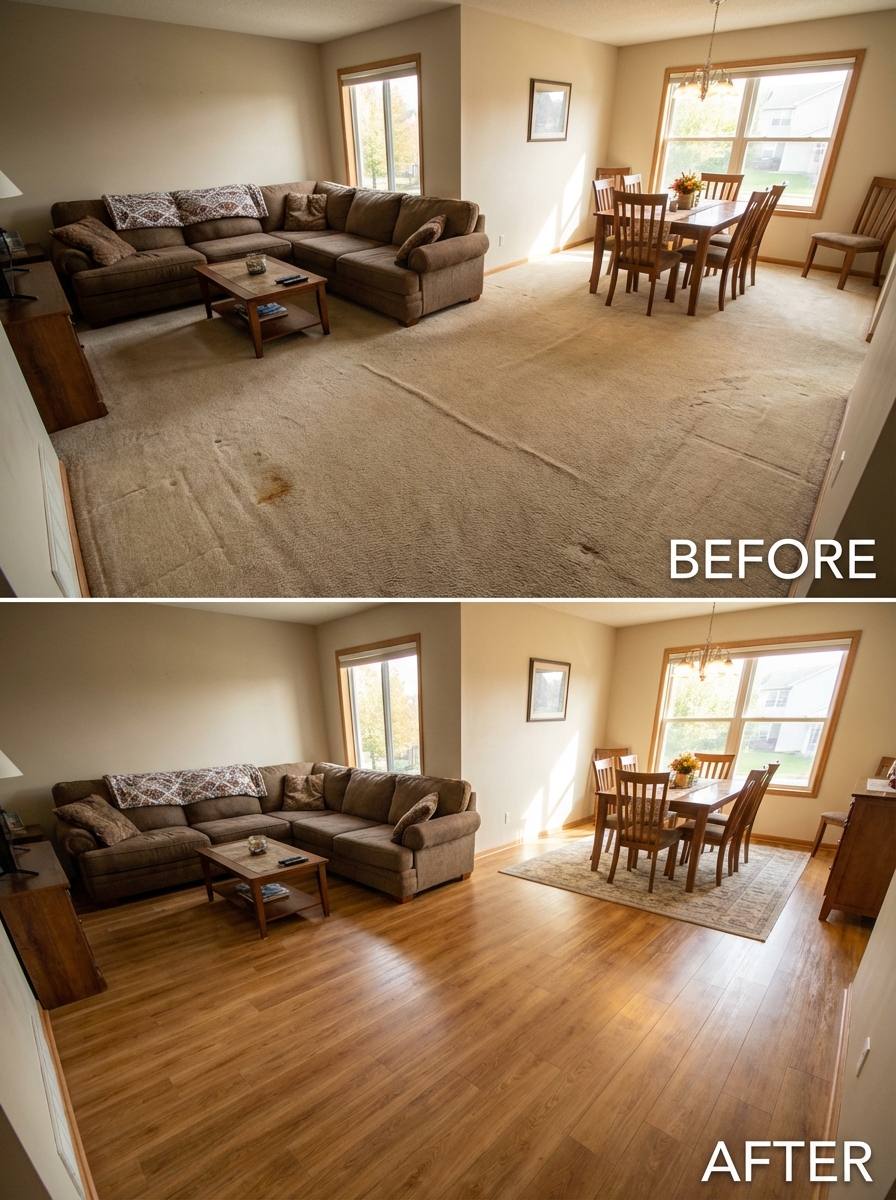

Most homeowners with worn hardwood floors face the same question: do I refinish, or do I rip them out and replace? The answer matters because the price gap is huge. Refinishing costs about half what replacing costs in the DMV ($4.50/sqft vs $8.50/sqft all-in). But refinishing only works on certain floors. The wrong choice either wastes money or leaves you with a half-fixed floor.
This guide gives you a 5-question test to figure out which one your floors actually need, plus what to look for when you check yourself before getting an estimate.
Refinish vs replace: the short answer for DMV hardwood floors
Quick answer
If your hardwood is structurally sound and the wear is on the surface (scratches, dull finish, light staining), refinish for about $4.50/sqft. If the boards are cupped, warped, water-damaged, or the wear layer is gone, replace at $8.50/sqft. The 5-question test below tells you which camp you're in. If you're not sure, a real installer can lift a board in a closet to check the wear layer thickness before committing either direction. For isolated scratch damage that doesn't yet warrant a full refinish, see our hardwood scratch repair decision guide. Most surface scratches can be spot-repaired without sanding the floor.
The 5-question test
1. Are the boards cupping, warping, or do they have visible water damage?
Run your hand across the floor in different rooms. If the boards feel uneven. High in the middle, low at the edges, or vice versa. That's cupping. Cupping happens when the wood absorbs more moisture on one side than the other. Once cupping is severe, sanding it flat removes too much wood.
Cupping or warping → Replace. Surface refinishing won't fix structural deformation.
2. Are sections of the floor missing boards, lifting, or visibly damaged beyond surface scratches?
Walk the whole floor. Look for boards that are loose, popped up, split, or have chunks missing. Tap suspect areas with the heel of your hand. If a section sounds hollow, the underlayment may have failed.
Major board damage → Replace (or partial replace + refinish if it's just a small zone). For minor single-board damage, a good installer can patch a few boards and then refinish the whole floor for a clean uniform look. That works up to about 5-10% of the floor area being patched. See partial replacement + refinishing combo below for how this works.
3. Is your hardwood engineered or solid? If engineered, how thick is the wear layer?
Solid hardwood (¾" thick, one piece of real wood top to bottom) can be refinished 6+ times over its life. If you have solid hardwood, refinishing is almost always an option.
Engineered hardwood is different. It has a real wood top layer (called the wear layer) bonded to a plywood core. The wear layer is typically 2-4mm. You can refinish engineered hardwood, but only 1-2 times maximum, and only if the wear layer is thick enough to survive sanding.
- Solid hardwood → Refinishable in almost all cases
- Engineered with 2mm+ wear layer → Refinishable, 1-2 times in the floor's life
- Engineered with <2mm wear layer → Sanding removes too much; replace
- Unsure of wear layer thickness → A floor installer can lift a board in a closet to measure
For the full comparison of solid vs engineered (cost, lifespan, refinishability), see our engineered vs solid hardwood comparison, or add LVP into the mix with our three-way material comparison.
4. Have your floors been refinished 3 or more times before?
If you bought the home and don't know, ask the previous owner or look for clues. Floors that have been refinished multiple times have less wood left above the tongue-and-groove. Sand them again and you risk cutting into the joinery, which means board replacement anyway.
Refinished 3+ times → Likely replace. A flooring contractor can confirm by measuring the remaining wear thickness during the estimate.
5. Are you changing the floor's layout, color, or species?
- Major layout change (running boards a different direction, expanding or removing rooms) → Replace
- Color or stain change → Refinishing handles this. Sand to bare wood, restain, seal
- Species change (oak to hickory, etc.) → Replace; you can't refinish oak into hickory
- No change → Refinishing handles this
💡 Key takeaway
Pass questions 1-4 with no red flags + question 5 says "no change or color change only" → refinish. Any single red flag in questions 1-4 → likely replace. Use the test as a screen, not a verdict. An in-home estimate confirms the call.
How to check yourself before booking an estimate
Three things you can do in 10 minutes that tell you most of what you need to know.
| Test | What you do | What it tells you |
|---|---|---|
| 1. Lift a vent cover or quarter round | Find a floor vent or remove a section of quarter round near a wall. Look at the cross-section of a board where it ends. | Solid wood from top to bottom = solid hardwood. Thin top layer over plywood = engineered. Take a photo to show the installer. |
| 2. Drop a few drops of water | Pick a less-visible spot. Drop 3-4 drops. Wait 5 minutes. | Water beads on the surface = finish is intact, refinishing is mostly cosmetic. Water absorbs into the wood = finish is gone, wood may already be damaged. |
| 3. Tap test for hollow spots | Walk the whole floor and tap firmly with your heel every few feet. | Consistent sound = solid floor. Hollow spots = subfloor failure or board separation, needs more than refinishing. |
Real cost comparison (DMV, 2026)
| Project | Refinishing | Replacement (engineered) | Savings |
|---|---|---|---|
| 500 sqft (one room) | $2,250 | $4,250 | $2,000 (47% less) |
| 1,000 sqft (main floor of a townhome) | $4,500 | $8,500 | $4,000 (47% less) |
| 2,000 sqft (whole main floor of a colonial) | $9,000 | $17,000 | $8,000 (47% less) |
Refinishing is consistently about 47% less expensive than replacement. The catch is that you can only refinish floors that pass the 5-question test above. If your floors don't qualify, you're not actually saving money. You're getting a half-done repair that needs replacement again sooner.
For full pricing breakdowns including stairs, hardwood vs other materials, and project-size costs, see our 2026 hardwood installation cost guide and our cost per square foot breakdown.
What the refinishing process actually involves
Refinishing takes 2-4 days for most rooms, depending on size and finish type. The process:
- Sand. Three passes with progressively finer grit. Removes the existing finish and any surface damage. Generates a lot of dust; we use HEPA-filtered sanders to keep it contained, but expect some cleanup
- Stain (optional). If you want a different color, this is when it happens. Skip if you like the existing color
- Seal. Three coats of polyurethane. Water-based dries fast and has low odor; oil-based takes longer and smells stronger but is more durable. Most homeowners go water-based now
- Cure. Wait 24-72 hours before walking on it. Wait 7-14 days before putting furniture back to avoid pressure marks
You don't need to leave the house for refinishing, but the rooms being worked on are unusable during the process. Plan for one weekend of inconvenience.
What replacement involves
Replacement takes 1-3 days depending on size. The process:
- Demo. Old flooring is pulled up. Nailed-down hardwood is the slowest because every board has to be separated from the joists
- Subfloor inspection. We check for water damage, level issues, or rot. Minor leveling is included in our all-in price; structural repair is rare but quoted separately if found
- Underlayment. Moisture barrier or sound-dampening underlayment goes down where applicable
- Install. New flooring goes down. Most rooms install in a single day
- Trim and transitions. Quarter round, baseboards, and transition pieces between rooms. Included in the all-in price
You can be in the house during replacement. The rooms being worked on are unusable, but the rest of the house functions normally.
Partial replacement + refinishing combo
Sometimes the right answer is "both." If a small zone of your hardwood is damaged (water-damaged area near a former leak, ~50-100 sqft of cupping near a window) but the rest is structurally fine, you can replace the damaged zone and then refinish the whole floor for a uniform look.
⚠️ Watch out
Matching old and new hardwood is hard. The species needs to match (red oak with red oak, white oak with white oak), the cut style needs to match (rift-and-quartered, plain-sawn, etc.), and the new wood will look slightly different until the whole floor is refinished and stained together. We have access to multiple suppliers and can usually find a match, but for very old or unusual species (heart pine, antique maple), exact matches are sometimes impossible.
Partial replacement plus full-floor refinish typically costs more than refinish alone but less than full replacement. Somewhere in the $5.50-7/sqft range depending on how much area needs patching. If only one or two boards need replacement (cracked, gouged, water-damaged single boards), the cost is much closer to a refinish since the patch work is small.
For when partial replacement makes sense and when you should just bite the bullet on full replacement, this is exactly the kind of question to bring to an in-home estimate. We'll lift a board in the affected area and tell you what we see.
FAQs about refinishing vs replacing hardwood floors
Can I refinish over light pet scratches?
Yes, if the scratches are in the finish only and haven't gouged the wood. Surface refinishing handles light pet damage well. Deep gouges that have penetrated the wood require either spot-replacement of those boards or board-level patching before refinishing.
What if some boards need replacing but most are fine?
Partial replacement plus refinishing is a real option and we do it often. The pattern: replace the damaged boards (matched to the existing species and color as closely as possible), then refinish the whole floor for a uniform look. Cost is somewhere between full refinish and full replacement, depending on how many boards need patching.
How do I know if water damage is just surface or has gone through to the subfloor?
If the boards are cupped, warped, or you can feel softness when you press down, the damage has likely reached the subfloor. We can verify by lifting a board in the affected area during the estimate. Surface water spots that haven't penetrated come out with refinishing.
Can I change the stain color when refinishing?
Yes. We sand to bare wood, then apply your chosen stain before the polyurethane sealer. Most stain options are available. Natural, light, medium, dark, weathered, and grey/whitewashed. Bring color samples to the estimate or pick from ours.
What if the floors fail the 5-question test in some rooms but not others?
You can refinish the rooms that qualify and replace the ones that don't. We've done plenty of mixed projects. Common scenario: living and dining areas refinish fine, but a basement or bathroom-adjacent room needs replacement because of moisture damage.
How can I be sure a contractor's "you need full replacement" recommendation isn't a sales pitch?
Get a second opinion. Most honest contractors will lift a board in a closet during the estimate and physically show you what they're seeing. If a contractor recommends replacement without lifting a board or showing you the wear layer, that's a flag. Cost transparency matters too. See our flooring quote hidden charges guide for what an honest estimate actually looks like.
Bottom line: refinish or replace your DMV hardwood floors
Refinish if your hardwood is structurally sound, has enough wear layer left to sand, and the damage is on the surface. Replace if the boards are deformed, the wear layer is gone, or you're making major changes. The 5-question test above gets you to the right answer most of the time.
If you're stuck between the two, get an in-home estimate. A real installer will lift a section in a closet, measure the remaining wear thickness, and give you an honest recommendation. We've turned down refinishing jobs that couldn't be done well. It's better to tell a homeowner the truth than take their money for a half-done repair.
For deeper pricing context, see our 2026 hardwood installation cost guide and our cost per square foot breakdown by room size. To compare hardwood against LVP and engineered for moisture-prone areas, read our solid vs engineered vs LVP comparison.
Two follow-up reads that change the refinish-or-replace math: our hardwood maintenance guide covers the screen-and-recoat trick that pushes a full refinish out by years and saves thousands. If you're considering swapping to laminate or LVP after replacement, read why laminate buckles in DMV homes first. DMV humidity makes the wrong choice fail fast.
If the damage isn't surface wear but cupping, crowning, or boards lifting off the subfloor, that's a different decision tree before refinish or replace even comes into play. See our hardwood floor buckling and cupping guide for how to read humidity damage and decide whether to wait, sand, or replace.