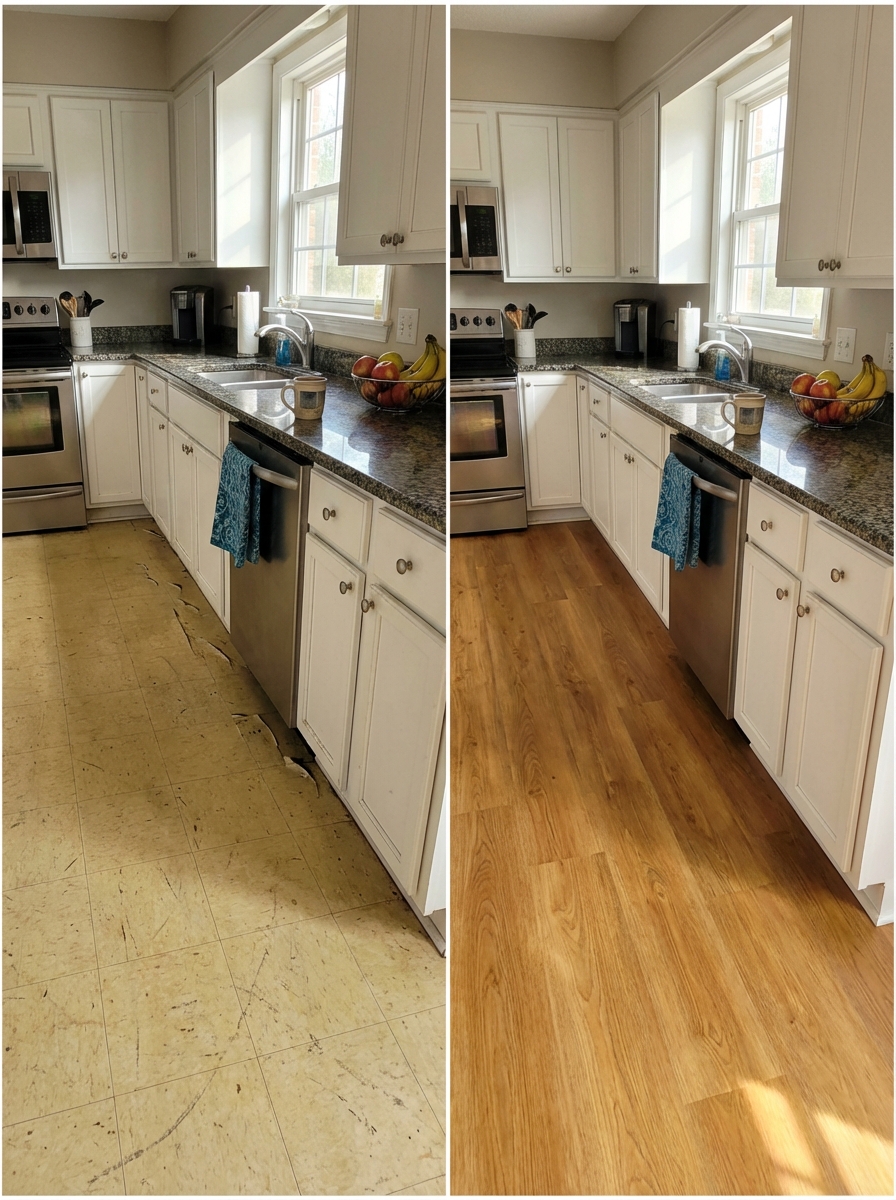

Most flooring quotes are designed to look good on paper. The number you see at the top is real, but it's not what you'll pay. By the time the crew leaves, you've signed off on six or seven add-ons you didn't see coming, and the project that was supposed to cost $5,500 is suddenly $9,200.
This isn't always a scam. It's how the industry prices floors. Most contractors quote material and install separately, then add demolition, removal, leveling, and transitions as line items at the end. Big-box stores do the same thing. The "deal" was never a deal. It just looked like one.
This article walks through the 7 line items that most commonly inflate flooring quotes in the DMV, what they actually cost, and the questions you can ask any contractor (including us) to find out what your final number will really be before you sign.
Hidden flooring quote charges: the short answer for DMV buyers
Quick answer
A flooring quote at $5.50/sqft "installed" usually means $9-10/sqft once you add demolition, removal, disposal, underlayment, leveling, transitions, and trim. The 7 most common hidden line items add $3-5/sqft to the advertised number. True all-in pricing is rare. Ask one specific question to every contractor: "Is the cost to remove and dispose of my existing flooring included in this number?" If the answer isn't a clear yes, you're comparing apples to oranges.
The 7 line items most quotes hide
These are the add-ons that show up between the original quote and the final invoice. Not every project hits all seven, but most projects hit at least four.
| # | Line item | Typical cost | Hits how often |
|---|---|---|---|
| 1 | Demolition of existing flooring | $1-2/sqft | Almost always (unless homeowner DIYs demo) |
| 2 | Removal and disposal | $0.50-1/sqft | Almost always |
| 3 | Underlayment / vapor barrier | $0.30-0.75/sqft | Most projects |
| 4 | Subfloor leveling (when needed) | $0.50-2/sqft | ~30% of projects |
| 5 | Transition pieces and reducers | $30-150 per opening | Multi-room projects |
| 6 | Quarter-round and shoe molding | $2-4 per linear foot | Most projects |
| 7 | Furniture moving | $100-400 per room | Whenever rooms aren't pre-cleared |
On a 1,000 sqft project, these add-ons typically total $3,000-5,000. That's how a "$5,500 quote" becomes a $9,500 invoice. Detail on each line item below.
1. Demolition of existing flooring ($1-2/sqft)
Pulling up your existing carpet, vinyl, laminate, tile, or hardwood is real labor. Pulling up nailed-down hardwood is the slowest. Every board has to be separated from the joists. Tile is usually slower than vinyl. Carpet is the fastest. For a full breakdown of what tear-out runs by material, see our guide to flooring removal cost in the DMV.
Most contracts price install at one rate and "demo" as a separate add-on. Watch for language like "demolition not included" or "prep and removal billed separately."
2. Removal and disposal ($0.50-1/sqft)
Once the old floor is up, it has to leave your house. A 1,000 sqft project produces enough debris to fill a small dumpster. Some contractors haul it themselves; others charge for dumpster rental and dump fees.
⚠️ Watch out
Some contractors leave the debris on your driveway and expect you to dispose of it. Read your contract, "removal" and "disposal" are not the same line item.
3. Underlayment / vapor barrier ($0.30-0.75/sqft)
Most modern flooring requires an underlayment between the subfloor and the new floor. For LVP and engineered hardwood, that's usually a vapor-barrier foam or cork pad. For hardwood over concrete, a moisture barrier is mandatory. The right underlayment varies by floor and by building, and the spec drives a real cost swing; our cork vs foam vs rubber underlayment guide walks through exactly which one each install calls for.
Some quotes include underlayment in the all-in number. Others bill it as a separate item at the cost of the material plus markup. On a 1,000 sqft project, that's $300-750.
4. Subfloor leveling ($0.50-2/sqft, when needed)
If your subfloor is uneven (more than 3/16" variation across 10 feet, per most manufacturer specs), it needs leveling before new flooring goes down. Floor leveler is a self-leveling cement-based product that fills low spots.
Minor leveling. Small dips here and there. Should be included in any honest all-in price. Major leveling on a previously damaged or wavy subfloor is a real cost that adds up. Get this in writing before signing: what counts as "minor" leveling vs "major"?
5. Transition pieces and reducers ($30-150 per opening)
Where new flooring meets a different floor surface (carpet to hardwood, hardwood to tile), you need a transition strip. T-molding, reducers, and end-caps are small but they add up. A typical home with 5-7 doorway transitions costs $150-1,000 in trim alone.
Some contracts list "transitions" as a flat add-on; others charge per linear foot. Check whether the quote includes the trim, or assumes you have it already.
6. Quarter-round and shoe molding ($2-4 per linear foot)
After new flooring is installed, the gap between the floor and baseboard usually needs to be hidden with quarter-round or shoe molding. A 1,000 sqft project has roughly 200 linear feet of perimeter, so that's $400-800 in trim and labor.
Some quotes include this; others don't. If you're keeping the existing baseboards (which is usually the cheaper option), make sure trim is in the number. If you're replacing baseboards entirely, that's a separate project that costs much more.
7. Furniture moving ($100-400 per room)
If your living room has couches, side tables, lamps, and a TV stand, those have to move out before the floor goes in. Some contractors include furniture moving in their service. Others ask you to clear the rooms yourself or charge per item.
For homeowners with appliances on hardwood (kitchens with islands, laundry rooms), the appliance dolly fees can add another $50-100 per appliance. Check the quote, "we'll move furniture" should be specifically listed.
A real quote comparison: $5/sqft vs $8.50/sqft
Here's a real comparison that came up on a recent estimate we did in Alexandria. The homeowner had two quotes for a 1,000 sqft engineered hardwood replacement. Quote A came in at $5,500. Quote B (ours) came in at $8,500. The homeowner was leaning toward Quote A. Until we walked through the line items.
| Line item | Quote A (advertised) | Quote B (Potomac all-in) |
|---|---|---|
| Material (engineered hardwood) | $2,500 | Included |
| Installation labor | $3,000 | Included |
| Demolition of carpet | +$1,000 | Included |
| Removal & disposal | +$500 | Included |
| Vapor-barrier underlayment | +$400 | Included |
| Quarter-round trim | +$600 | Included |
| 5 doorway transitions | +$400 | Included |
| Subfloor leveling (minor) | +$500 | Included |
| Furniture moving (4 rooms) | +$600 | Included |
| Real final invoice | $9,500 | $8,500 |
The $5,500 quote turned into a $9,500 invoice. Our $8,500 all-in quote was $1,500 cheaper than the contractor whose advertised price was $2,500 lower. The all-in price isn't a marketing line. It's how you find out what your floor actually costs.
💡 Key takeaway
A lower per-sqft number doesn't mean a lower final bill. Every line item that's "extra" on Quote A is built into Quote B. Compare the bottom line, not the headline rate. The same logic applies when you're trying to figure out what hardwood floor installation costs per square foot. The per-sqft rate only tells you the truth if you know what's in it, and if you know the square footage it's multiplying. Take your own measurements first: how to measure square footage for flooring.
Questions to ask every contractor (including us)
Print this list. Ask these exact questions on every estimate you get. The answers tell you what you're actually buying:
- Is the cost to remove and dispose of my existing flooring included in this number? (Most important question. If no clear yes, the price will go up.)
- Is underlayment included? What kind? Different floors need different underlayments. Vapor barrier for hardwood over concrete, sound-dampening for upper-floor LVP, etc.
- What does subfloor leveling cost if needed? Get the per-sqft rate in writing so you know the worst case.
- Are quarter-round and transition pieces included? If yes, how many doorway transitions and what's the trim style?
- Will you move my furniture and appliances? If yes, included or extra? If extra, what's the rate?
- What happens if you find subfloor damage during demo? Get the change-order process in writing. Does work pause? What's the per-sqft repair rate?
- What's the warranty on the install? On the material? Material warranties are from the manufacturer (5-25 years typically). Install warranties are from the contractor (1-5 years usually).
- How do I know what I'm paying when the project is done. Same as the quote, or different? A good contractor commits to the quote unless something genuinely unforeseen happens. Watch for vague language about "additional work as needed."
Red flags in a low quote
If a quote is significantly lower than other quotes you've gotten, it's not always because the contractor is faster or cheaper. These are the patterns that almost always mean hidden costs:
- Per-square-foot rate below $4-5 for engineered hardwood, or below $3-4 for LVP. The math doesn't work otherwise. Material alone runs $2-4/sqft at wholesale, plus labor.
- "Material extra" language. The number you're seeing is labor only. You're sourcing material yourself, often from a big-box store at retail markup.
- "Demolition extra" or "prep work billed separately". The base quote excludes the work that takes the most time.
- No specific timeline for the project. Vague timelines often mean the crew is fitting you in around larger jobs.
- Verbal-only quote with no detailed breakdown. Ask for an itemized written estimate. If the contractor refuses, walk away.
- Refusal to do an in-home estimate. Quotes given over the phone or based on photos are guesses. They will change once the crew sees the actual condition.
- "We'll figure out the subfloor when we get there." Translation: hold on tight, this number is going up.
How to spot true all-in pricing
True all-in is rare in this industry. Most contractors quote in pieces because it makes them look cheaper than they are. Here's how to verify a quote is actually all-in:
1. The written estimate uses the phrase "all-in" or "total project cost" with a specific dollar amount that matches the per-square-foot rate × your square footage. Do the math yourself. If the totals don't match, ask why.
2. Demolition, removal, disposal, underlayment, transitions, and quarter-round are explicitly listed as included, not omitted, not asterisked, not buried in fine print.
3. The only common exclusion is structural subfloor repair, which is rare. If found, an honest contractor pauses work, walks you through the issue with photos, and provides a separate quote before continuing.
4. The contract explicitly says the quoted price is what you'll pay barring written change orders signed by you. No "we'll bill you for what we find" language.
5. The contractor will commit to the quote in writing. If you ask "will this number change?" and the answer is anything other than "no, unless you authorize a change," the price will change.
For specifics on how installer-level pricing actually breaks down by square footage, see our cost per square foot breakdown. If you're trying to decide whether to refinish the floors you have or replace them, check our refinishing vs replacement guide. For wet-area projects, our tile installation cost breakdown walks through the cement board, waterproofing, and substrate prep line items that hide most often in bathroom and shower quotes.
FAQs about hidden flooring quote charges
Why don't all contractors quote all-in?
Three reasons: (1) some genuinely don't know their own internal cost structure well enough to commit, (2) some use the lower advertised rate as a marketing tool to win the lead, then upsell during the project, (3) some are subcontracting parts of the work and don't control the line items. The contractors who quote all-in usually have in-house crews and have run the numbers enough times to know.
Is it ever cheaper to source material myself and just hire labor?
Sometimes, but not automatically. Retail and wholesale material prices vary by product and promotion, and labor-only quotes can exclude delivery, waste, removal, or warranty coverage. Compare the total written cost and included scope rather than assuming either buying route is cheaper.
What if I get a flat-rate quote that's already missing demo, like for a new build?
Flat-rate "install only" pricing is legitimate when the situation calls for it. New construction, post-flood reconstruction, or when the homeowner has cleared the room. In those cases, the quote should explicitly say "install only. Site to be ready" with specifics on what "ready" means. If you're a homeowner with existing flooring, a flat-rate "install only" quote is incomplete.
How do I get a written quote that protects me?
Ask for an itemized estimate that lists material, labor, demo, removal, disposal, underlayment, transitions, and trim as separate lines (even if they're all $0 because they're included in the all-in price). Then ask for a contract that explicitly states the total price won't change without your written authorization. Honest contractors are happy to put this in writing because it's already how they operate.
What if a contractor's per-sqft rate seems too good to be true?
It probably is. The DMV market for engineered hardwood installation runs $7-10/sqft true all-in. Anything below $5/sqft "installed" is almost certainly excluding the major work items above. Get the itemized breakdown before signing, and if the contractor pushes back, that's your answer.
Bottom line: how to read a flooring quote and not get burned
Most flooring quotes are designed to look cheap. The advertised rate is real, but it's a piece of the project, not the whole thing. By the time you've added demo, removal, disposal, underlayment, leveling, transitions, trim, and furniture moving, the "$5/sqft installed" quote is closer to $9.
The fix is simple: ask every contractor (including us) the 8 questions in this article. Get the answers in writing. Compare the all-in numbers, not the headline rates. The contractor that quotes you an honest higher number is almost always cheaper than the one that quotes you a misleading lower number.
For the actual all-in pricing on hardwood installs in the DMV, see our 2026 hardwood installation cost guide. For LVP vs hardwood comparisons including which one fits hidden-fee-prone projects (basements, kitchens, multi-room renovations), see our solid vs engineered vs LVP comparison.
Two more buyer-protection reads worth your time: what carpet installation actually costs in 2026 (the same all-in vs misleading-headline trap exists in carpet, even worse), and what subfloor surprises typically add to your quote after demo day. That's the #1 source of post-quote price jumps in older DMV homes. Shopping the cheapest material on the menu? Our laminate flooring installation cost guide breaks down why Home Depot's $4.05/sqft headline is labor-only and what laminate actually costs all-in in the DMV.