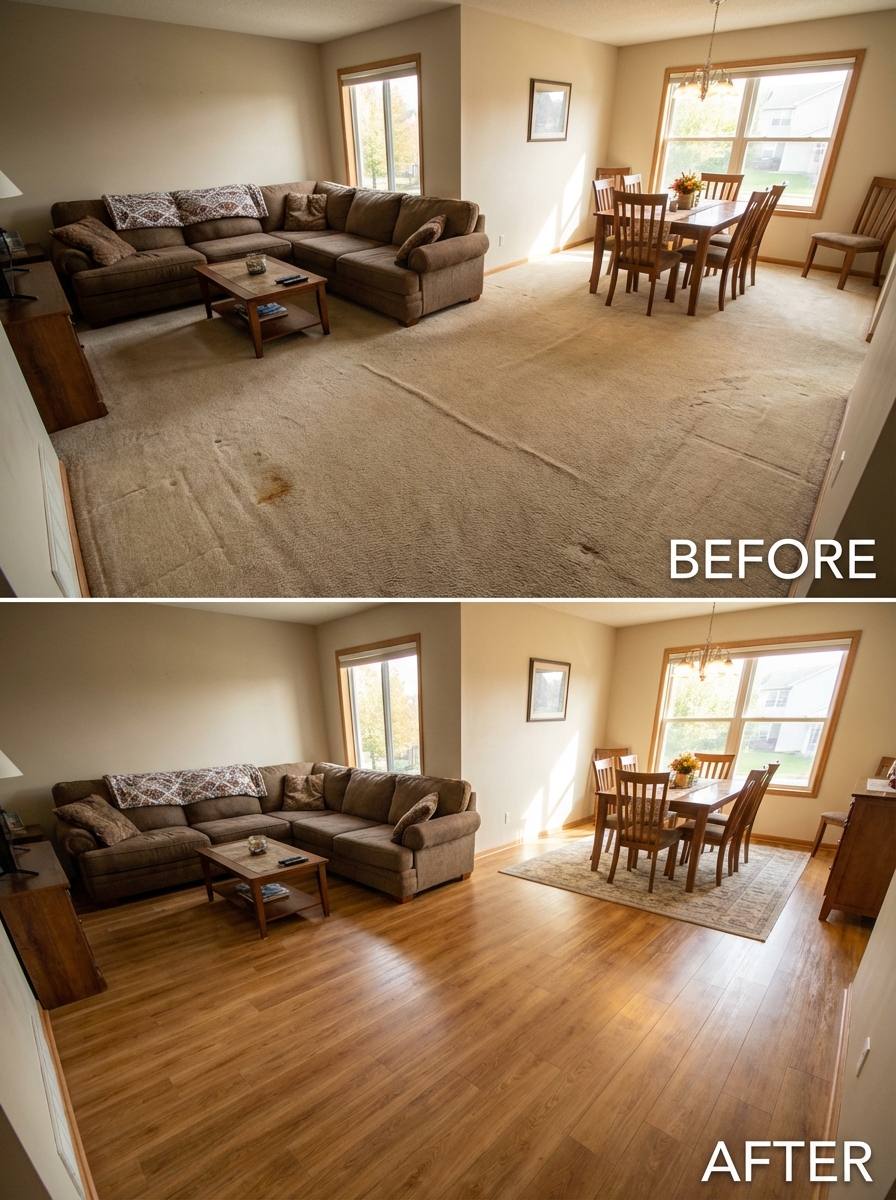

Basement flooring is one of the few decisions where the right answer is genuinely narrow. Most rooms in your house can take any of 5-6 flooring types and look great. Basements punish the wrong choice, sometimes within a year, sometimes after the first big DMV thunderstorm. An unheated sunroom is the other room like this, where moisture and temperature swings rule out most floors. This article walks through why LVP wins for most DMV basements, when tile is the better call, why hardwood is wrong, and what subfloor prep typically adds to your quote.
Start with the broader waterproof flooring comparison if you are still deciding between LVP, tile, and water-resistant alternatives.
Best basement flooring in the DMV: the short answer
Quick answer
For 90% of DMV basements: premium LVP at $6.50-7.50/sqft installed. Waterproof, handles humidity, looks like wood, survives a sump-pump failure if it ever happens. Tile (custom-quoted) makes sense for fully-finished basements with radiant heat or where the look you want is more upscale. Polished concrete ($3-6/sqft) makes sense for unfinished or industrial-aesthetic basements. Solid hardwood and laminate are the wrong call below grade. Both fail under DMV humidity over time. Engineered hardwood with a proper vapor barrier is technically possible but rarely worth the cost.
Why DMV basements are different (humidity + flood risk)
The DMV climate puts unique stress on basement flooring that homeowners moving from drier regions don't always anticipate:
- Summer humidity sits at 70-85% for months. Concrete slabs absorb moisture from the ground year-round. In summer that moisture migrates up through the slab and into anything porous on top of it. Hardwood swells. Laminate buckles. Carpet pads grow mold. LVP doesn't care.
- Spring storms cause sump pump failures. Most older DMV homes have sump pumps that fail occasionally. Even one inch of water across a basement floor over a weekend ruins hardwood, laminate, and most carpets. LVP, tile, and concrete shrug it off. If your sump or main line is already showing trouble, get it fixed before any flooring goes in. Powell's Plumbing & HVAC covers Winchester and the western NoVA reach.
- Older homes (pre-1990) often have inadequate slab waterproofing. If your slab was poured before modern vapor barrier standards, it leaks moisture continuously. EPA's basement moisture guidance recommends impermeable flooring for any below-grade space without confirmed vapor protection.
- Many DMV basements are partial-finish. Concrete walls, exposed ceiling, half-finished. Flooring choices need to work with that aesthetic, not pretend the basement is a living room.
Why LVP wins for almost every DMV basement
Premium LVP (luxury vinyl plank) is the right call for the same reasons it's right for pet households and kitchens. It solves the moisture problem at the material level:
| Stress | How LVP handles it |
|---|---|
| Humidity 70-85% for months | Doesn't expand or contract. Vinyl is dimensionally stable in any humidity. |
| Sump pump failure (1-3" of water) | 100% waterproof. Mop it up, fans dry the slab beneath, floor is fine. |
| Vapor migration through slab | WPC or SPC core blocks vapor. Many premium LVP brands include factory underlayment with vapor barrier. |
| Cool slab temperature year-round | Underlayment provides modest insulation. Floor doesn't feel cold the way tile does. |
| Basement use case (gym, playroom, office) | Soft enough to drop a kettlebell on without cracking. Quiet underfoot. Easy to clean. |
💡 Key takeaway
For DMV basements, the wear-layer thickness on LVP matters less than the core type. Look for SPC (stone-polymer composite) core over WPC for basement use. SPC is denser, more dimensionally stable, and handles temperature swings better. WPC is fine for above-grade rooms. SPC is what you want below grade. See our LVP vs hardwood comparison for full material specs.
When tile or polished concrete makes more sense
Tile (porcelain or ceramic). Call for custom pricing
Tile is the right answer when:
- You want a more upscale finish in a fully-finished basement (basement bar, media room, in-law suite)
- You're putting in radiant floor heat. Tile conducts heat efficiently, LVP partially blocks it
- You're tiling a basement bathroom, laundry, or wet area regardless of the rest of the basement
- You want flooring that lasts 30+ years with zero maintenance other than cleaning
Tradeoffs: tile is hard underfoot (uncomfortable for long standing), cold without radiant heat, and more expensive both in material and labor. The crack-resistance of porcelain holds up better than ceramic for basement applications.
Polished concrete at $3-6/sqft
Polished concrete is the right answer when:
- The basement aesthetic is industrial / loft / minimalist
- The slab is in good condition (no major cracks, level, well-cured)
- You're doing a workshop, gym, or storage space where pure durability + easy cleaning trump comfort
- Budget is tight. Polished concrete uses the slab you already have
Tradeoffs: cold, hard, shows wear over time, requires the existing slab to be in decent shape. Best for basement-as-utility, not basement-as-living-room.
Why solid hardwood is the wrong call below grade
⚠️ Watch out
Some contractors will install solid hardwood below grade. The National Wood Flooring Association explicitly recommends against it. Solid hardwood and below-grade installation are incompatible. If a contractor offers it, ask why they're recommending against the manufacturer warranty and the industry standard. The honest answer is: they shouldn't be.
Solid hardwood fails below grade for three structural reasons:
- Moisture absorption. Solid hardwood is a hygroscopic material. It pulls moisture from the air and from below. In a DMV basement, that moisture cycle never stops. Boards swell, cup, and eventually buckle.
- No vapor barrier compatibility. Solid hardwood requires nail-down installation. You can't reliably install over a vapor barrier on a slab. Workarounds (sleeper systems with subfloor on top of vapor barrier) work but add $4-6/sqft to the job and reduce ceiling height by 1-2 inches.
- Manufacturer warranty void. Most solid hardwood manufacturers explicitly void warranty on below-grade installation. If something fails, you're paying to replace it.
What about engineered hardwood with a vapor barrier?
Engineered hardwood is more dimensionally stable than solid because of its plywood-style core, and many manufacturers approve it for below-grade installation with a proper vapor barrier. Technically possible. Rarely worth it for these reasons:
- Cost. Engineered hardwood at $8.50/sqft + vapor barrier prep is more expensive than premium LVP at $7/sqft. You're paying more for a material that will still take damage from a sump pump failure.
- Damage tolerance. Engineered hardwood is still wood. A flood that LVP shrugs off will warp engineered planks. Insurance might cover it once. They don't love covering it twice.
- Modern LVP looks like wood. Premium LVP at $7/sqft is hard to distinguish from engineered hardwood at conversational distance. The aesthetic gap that justified spending more on wood is mostly closed.
If you're set on the look and feel of real wood and willing to accept the moisture risk, engineered hardwood with vapor barrier is a viable choice for finished basements with verified-dry slabs. Otherwise, premium LVP gets you 95% of the look for 70% of the cost and zero water risk.
What basement subfloor prep actually costs
Basement floors usually need more prep than upstairs floors. Here's what we typically encounter and what it adds:
| Prep work | Typical cost (above material + install) | How common in DMV basements |
|---|---|---|
| Slab cleaning + leveling (minor) | $0.50-1.50/sqft | Almost every job |
| Self-leveling compound (slab is >3/16" out of level over 10 ft) | $2-4/sqft | 30-40% of older homes |
| Crack repair (epoxy fill) | $50-300 per crack | 50% of basements over 30 years old |
| Vapor barrier (poly sheet) | $0.50-1/sqft | Required for hardwood below grade; included with most premium LVP underlayment |
| Sleeper system (for hardwood below grade) | $4-6/sqft | Needed only for solid hardwood, which we don't recommend |
| Old carpet + tackstrip removal | $0.75-1.50/sqft | Almost every retrofit |
Always get an in-person estimate for basement work. We can't quote basements accurately without seeing the slab condition, the moisture readings, and the existing flooring. See our guide to hidden flooring quote charges for what to look for in any quote.
FAQs about basement flooring in Northern Virginia, DC, and Maryland
Do I need a vapor barrier for LVP in a basement?
Most premium LVP includes integrated underlayment with a vapor barrier built in. Check the manufacturer spec. If your LVP doesn't include it, add a 6-mil polyethylene vapor barrier between the slab and the underlayment. Cost is minimal ($0.30-0.50/sqft).
Can I put carpet in a DMV basement?
Technically yes. Practically, only if you commit to having a working dehumidifier running 24/7 in summer and you accept that any flood event ruins it. Carpet pads in DMV basements grow mold within a year if humidity isn't controlled. Most homeowners regret carpet basements within 3-5 years.
What if my basement is currently dry. Is hardwood OK then?
Currently dry doesn't mean reliably dry over the 20-year life of the floor. Sump pumps fail. New construction defects show up years later. Storm sewers back up. Plan for the floor to see water at some point. Pick a material that survives that event.
How long does basement flooring install take vs upstairs?
Usually similar, 1-3 days depending on size, but add 1-2 days for any leveling or moisture remediation. See our install timeline guide for the day-by-day breakdown.
Bottom line: picking flooring for your DMV basement
For most DMV basement scenarios, premium SPC-core LVP at $6.50-7.50/sqft installed is the right call. Tile or polished concrete fit specific use cases. Solid hardwood doesn't belong below grade in this climate, and engineered hardwood is technically possible but rarely the better value than LVP.
We do free in-home basement estimates across Alexandria, Arlington, Fairfax, Falls Church, McLean, Vienna, Reston, Bethesda, and the rest of the metro. We'll measure, check moisture, and quote both the material and the prep before any commitment.
Two more reads that pair with basement projects: why laminate buckles in DMV homes (laminate is the #1 wrong-material call we see in basements. Read this before any contractor sells you laminate below grade), and what subfloor surprises typically add to your quote when we pull up old basement flooring. Both can save you four-figure surprises.