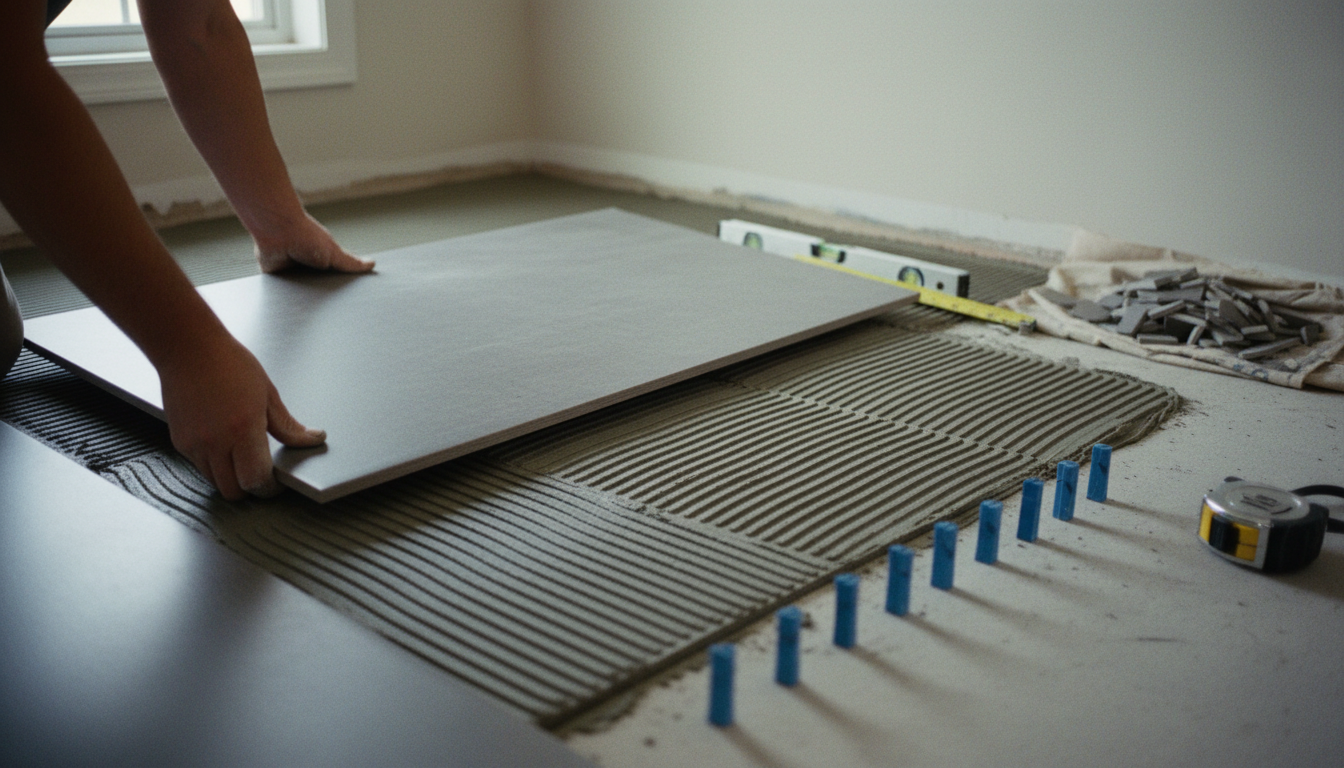
Search "tile installation cost" and Homewyse will tell you $16.38 to $20.21 per square foot. The Spruce gives you a $7 to $30 range. Home Depot leads with a labor-only headline and the rest of the project gets added at the consult. None of these are wrong on the national-average level. None of them tell you what tile installation actually costs in Alexandria, Fairfax, Arlington, McLean, Bethesda, or anywhere else in the DMV — and none break out what's included in the number you get quoted. Tile is the most variable of all the residential floor materials. The same 100 sqft bathroom can come in at $1,200 or $3,500 all-in depending on the tile, the layout, and what's under the existing floor. This article gives you the real installer math: all-in DMV pricing ranges, room and project-size totals, what big-box quotes hide until the final invoice, and the ceramic vs porcelain, simple vs complex, dry vs wet-area decisions that move the price by $5 to $15 per square foot.
Tile installation cost in 2026: the short answer for DMV homeowners
Quick answer
Real all-in tile installation in the DMV runs $10 to $25 per square foot when tile material, professional installation, cement board substrate, thinset, grout, and old flooring removal are all included. A 100 sqft bathroom floor lands between $1,200 and $2,500. A 500 sqft kitchen and dining room lands between $6,000 and $12,500. The exact number inside that range depends on three things: the tile (entry-level ceramic at $2/sqft vs mid-grade porcelain at $5/sqft vs premium porcelain at $10+/sqft), the layout (straight-set adds nothing, diagonal adds 10 to 15 percent, herringbone or chevron adds 20 to 35 percent), and the prep (carpet over plywood is the easiest substrate to demo; existing ceramic over concrete is the hardest). Homewyse's "$16.38 to $20.21 per square foot" national headline is in the right ballpark for an all-in number but doesn't tell you which end of the range your project lands on.
All-in tile pricing vs Homewyse's $16 to $20/sqft national average (the math that actually matters)
The reason tile cost is harder to pin down than laminate, LVP, or carpet is that tile has more independent line items, and any of them can swing the final number. Here's what's in a real DMV tile installation quote, broken down so you know what to ask about:
- The tile itself (entry-level ceramic $0.50 to $2 per sqft, mid-grade ceramic $2 to $5, porcelain $3 to $7, high-end porcelain $7 to $15, natural stone like travertine or marble $5 to $20)
- Cement backer board substrate ($1 to $2 per sqft, required for any floor tile install over plywood or above-grade substrate)
- Waterproofing membrane like Schluter Kerdi or Hydro Ban ($1.50 to $3 per sqft, required for showers and recommended for bathroom floors)
- Thinset mortar and grout (typically rolled into labor, but allow $0.75 to $1.50 per sqft on a line-item quote)
- Installation labor (straight-set $5 to $10 per sqft, diagonal $7 to $12, herringbone or pattern $9 to $18, mosaic $15 to $25)
- Old flooring removal ($1 to $3 per sqft for carpet over plywood, $2 to $5 for existing tile or stone, $3 to $7 for mortar-bed tile that has to be jackhammered)
- Subfloor leveling and prep beyond a basic sweep ($1 to $5 per sqft if floor is out of plane more than 3/16 inch over 10 feet)
- Edge trim and transitions (Schluter metal edge $4 to $8 per linear foot, reducer strips at doorways $30 to $50 each, threshold pieces $30 to $80 each)
- Tile cuts and waste (10 to 15 percent waste on straight-set, 20 to 30 percent on diagonals and patterns — paid by you)
- Trip and measurement fees, often $50 to $200 unless the job exceeds a minimum square footage
💡 Key takeaway
Tile is the one material where a single all-in number per square foot doesn't always work, because the tile selection alone moves the budget by $5 to $15 per sqft. The honest installer model is: pick the tile first, then quote all-in based on labor complexity, substrate, and prep. Be skeptical of any quote that gives you a single $/sqft number without seeing the tile you're putting in. See our guide to the 7 hidden charges in a flooring quote for the full list of line items that show up after the contract is signed.
Real DMV tile pricing by room and project size (with table)
Below are typical all-in price ranges for tile installation across Alexandria, Arlington, Fairfax, McLean, Vienna, Falls Church, Reston, Bethesda, and the rest of the DMV metro. These are total project costs (mid-grade porcelain tile + professional install + cement board + thinset + grout + old flooring removal), not labor-only headline numbers.
| Room or project | Square feet | DMV all-in (mid-grade porcelain) | Big-box quote (typical) |
|---|---|---|---|
| Powder room floor | 30 sqft | $450 to $750 | $600 to $1,100 |
| Standard full bathroom floor | 50 sqft | $650 to $1,250 | $900 to $1,800 |
| Master bathroom floor | 100 sqft | $1,200 to $2,500 | $1,800 to $3,500 |
| Shower walls and floor (60 sqft surround) | 60 sqft | $1,800 to $4,200 | $2,800 to $6,000 |
| Kitchen floor (12x15) | 180 sqft | $2,160 to $4,500 | $3,200 to $6,500 |
| Open kitchen and dining floor | 400 sqft | $4,800 to $10,000 | $7,200 to $14,500 |
| Whole single level (kitchen, hall, mudroom) | 800 sqft | $9,600 to $20,000 | $14,400 to $29,000 |
A few notes on this table. The DMV all-in column reflects what a quality independent installer charges in Northern Virginia for mid-grade 12x24-inch porcelain in a straight-set layout with standard cement board, removal of existing vinyl or carpet, and basic transitions. Move to a high-end natural stone or a herringbone pattern and the top of the range climbs another $4 to $8 per sqft. Add waterproofing membrane (required for showers, smart for bathroom floors) and add $1.50 to $3 per sqft. The "big-box quote (typical)" column reflects what we hear back from homeowners comparing quotes against Home Depot and Lowe's installed-tile programs after retail material markup and the line-item add-ons are totaled.
How much would it cost to tile a 12x12 room? The PAA answer
Quick answer
A 12x12 room (144 sqft) of mid-grade porcelain tile runs $1,750 to $3,500 all-in in the DMV. The low end of that range is entry-level ceramic (around $2/sqft) in a straight-set layout over an easy demo. The high end is mid-grade porcelain in a diagonal or herringbone pattern over cement board with full waterproofing membrane. A 12x12 kitchen floor in mid-grade porcelain at $15/sqft all-in lands around $2,160. The same 12x12 in entry-level ceramic at $12/sqft all-in lands around $1,728. Premium 12x12 — natural stone, herringbone, full waterproofing — can run $4,000 to $5,500.
The 12x12 room is one of the most-asked tile-cost questions because kitchens, breakfast nooks, and small dens are commonly 12x12. The price-per-sqft varies more on tile installs than on click-lock floors because three independent things move the number: tile selection, layout complexity, and what's under the existing floor. A few things that move the price inside that range:
- Tile selection alone — at $2/sqft ceramic vs $7/sqft porcelain vs $15/sqft stone, the material line on 144 sqft swings from $288 to $2,160. That's a bigger swing than any other line item.
- Layout pattern — straight-set adds 10 percent waste. Diagonals at 45 degrees add 15 to 20 percent waste plus 10 to 15 percent labor. Herringbone or chevron add 20 to 30 percent waste plus 20 to 35 percent labor. On a 144 sqft room, pattern alone can add $400 to $900.
- Existing floor demo — pulling carpet off plywood is $150 to $300 on a 12x12. Pulling existing ceramic off a thinset bed is $450 to $900. Mortar-bed tile (older 1950s and 1960s homes in Alexandria, Arlington, Bethesda) takes a jackhammer and adds $700 to $1,400.
- Substrate prep — old plywood subfloors in DMV homes built before 1980 often have soft spots or uneven seams that need plywood replacement before tile can go down. See what we actually find under DMV floors for the full picture. Plan $300 to $1,200 in subfloor prep if the room is older.
How much does it cost to install 500 sqft of tile? The PAA answer
Quick answer
500 sqft of mid-grade porcelain tile installation in the DMV runs $6,000 to $12,500 all-in. That's an open kitchen plus dining room, or a master bath plus walk-in closet plus connected hallway, or a basement family room. At the low end, entry-level ceramic in a straight-set layout over easy substrate lands around $6,000 ($12/sqft). At the high end, mid-grade porcelain in a herringbone pattern with cement board, waterproofing, and demo of existing tile lands around $12,500 ($25/sqft). Home Depot and Lowe's installed quotes on the same 500 sqft project typically run $9,500 to $16,000 once the line items are totaled.
500 sqft is the size where economies of scale start to help. Trip and measurement fees are spread across more square footage, demo is more efficient with a fixed crew already on-site, and material orders qualify for installer-rate pricing from suppliers. That's why the per-sqft floor stays at $12 instead of climbing into the $15 to $20 range you see on smaller jobs. The biggest cost driver at 500 sqft isn't the layout or labor — it's the tile selection. A homeowner who picks $2/sqft ceramic vs $7/sqft porcelain vs $15/sqft natural stone is making a $6,500 swing in the material line before a single tile gets cut.
⚠️ Watch out
Big-box installed-tile programs for jobs over 400 sqft often add a "complex layout" or "multiple room transitions" surcharge of $500 to $1,200 that doesn't appear on the headline price page. Ask any tile installer to break out transition pieces, threshold strips, and pattern surcharges as line items — if they push back or say it's hard to estimate, that's the signal those costs are going to land on your invoice after the contract is signed.
Cost to install 1,000 sqft of tile in the DMV
Quick answer
1,000 sqft of mid-grade porcelain tile installation in the DMV runs $12,000 to $25,000 all-in. At this size you're tiling a whole single-family ground floor (kitchen, mudroom, bathroom, hallway) or a full basement. The math: entry-level ceramic in a straight-set layout over easy substrate lands around $12,000 to $14,000. Mid-grade porcelain in a straight-set or simple offset lands $15,000 to $18,000. Premium porcelain or natural stone in a pattern with full waterproofing lands $20,000 to $25,000. Big-box installed quotes on the same 1,000 sqft project run $18,000 to $32,000.
At 1,000 sqft, tile is more expensive than any other residential flooring material by a wide margin. The same 1,000 sqft in LVP runs $5,500 all-in. In laminate, $4,000. In carpet, $3,250. Tile costs 3 to 6 times more because the labor is 3 to 5 times slower (a tile setter installs 50 to 100 sqft per day vs 200 to 400 sqft per day for click-lock materials), the substrate requires cement board, and the material itself ranges higher than vinyl or laminate. The premium pays for itself in lifespan — quality porcelain tile in a residential setting lasts 50+ years and never needs refinishing — but the upfront cost is a real factor in the material decision. See our honest material comparison if you're weighing tile against other options.
What materials cost: ceramic vs porcelain, tile size, and layout complexity
Three tile-specific decisions determine your material line: ceramic vs porcelain, tile size (which affects waste and labor), and layout pattern. Here's how each one moves the cost per square foot.
| Spec | Material cost (per sqft) | Best for |
|---|---|---|
| Entry-level ceramic, 12x12, glazed | $0.50 to $2 | Budget bathroom floors, rental properties, basement utility rooms |
| Mid-grade ceramic, 12x12 or 12x24 | $2 to $5 | Standard residential bathroom and kitchen floors |
| Mid-grade porcelain, 12x24 or 24x24 | $3 to $7 | DMV sweet spot — durable, water-resistant, modern aesthetic |
| High-end porcelain, large format 24x48 or wood-look planks | $7 to $15 | Premium kitchens, statement floors, wood-look in wet areas |
| Natural stone (travertine, slate, marble) | $5 to $20 | High-end bathrooms, foyers, custom shower designs |
| Glass mosaic and accent tile | $15 to $50 | Shower niches, backsplash accents, decorative borders |
For 80 percent of DMV residential tile jobs, mid-grade 12x24 porcelain in a straight-set or simple offset layout is the right call. It's harder, less porous, and more scratch-resistant than ceramic, holds up in wet areas without sealing, and the larger format installs faster than 12x12. Going to large-format 24x48 makes sense for modern open floor plans because you get fewer grout lines, but it requires a flatter substrate (1/8 inch over 10 feet vs 3/16 inch for standard format), so the prep cost climbs.
On layout: straight-set is the standard. A 45-degree diagonal adds 10 to 15 percent to labor and waste. Herringbone or chevron patterns add 20 to 35 percent because every tile is cut twice and the pattern has to be planned around fixtures and walls. Mosaic patterns (anything smaller than 6x6 individual tiles) double the labor — a tile setter who installs 80 sqft of 12x24 porcelain per day will install 40 sqft of mosaic per day, and the labor line reflects that.
Bathroom floor vs shower wall vs kitchen tile: why each costs different
Within tile installation, the three most common projects price differently because the prep, waterproofing, and labor requirements aren't the same.
| Project type | All-in DMV cost (mid-grade porcelain) | Why the price is what it is |
|---|---|---|
| Bathroom floor (50 to 100 sqft) | $12 to $25/sqft | Cement board substrate, waterproofing recommended at edges and toilet flange, threshold transitions, smaller-format tile around fixtures |
| Kitchen floor (150 to 300 sqft) | $12 to $22/sqft | Larger continuous areas allow large-format tile and faster install, transitions to LVP or hardwood in adjacent rooms, fewer cuts around fixtures |
| Shower walls (60 to 100 sqft surround) | $25 to $50/sqft | Full waterproofing membrane (Schluter Kerdi or equivalent) required, niches and bench require custom build-out, mosaic floor adds cost, plumbing fixture coordination, slower install pace |
| Backsplash (20 to 40 sqft) | $20 to $45/sqft | Smaller-format tile (subway, mosaic, mini-format), more cuts per sqft, outlet and switch cutouts, coordination with countertop edges |
| Mudroom or entryway (40 to 80 sqft) | $15 to $28/sqft | Heavy-duty porcelain recommended for traction and durability, transition to interior floors, snow and salt exposure means slip-resistance matters |
Showers are the expensive outlier because waterproofing is non-negotiable. A failed shower waterproofing job will rot the wall framing within 12 to 18 months and the repair cost is 5 to 10 times the original install. The $25 to $50 per sqft for a shower surround pays for the Schluter Kerdi or Hydro Ban membrane, the proper slope on the shower floor (1/4 inch per foot toward the drain), the bonding flange at the curb, and the slower install pace that quality waterproofing requires. Cutting corners on a shower is the #1 way to end up with a $15,000 mold remediation bill three years later.
Cement board, waterproofing, and substrate prep: the hidden cost driver
What's under the tile costs almost as much as the tile itself, and big-box installed quotes often hide this until installation day. Here's the substrate work that has to happen on most DMV tile jobs:
- Cement backer board ($1 to $2 per sqft) — required for floor tile over plywood subfloor. Provides a stable, non-flexing surface that prevents the tile and grout from cracking. Not optional.
- Plywood subfloor replacement ($2 to $5 per sqft if needed) — older DMV homes with soft spots, water damage, or out-of-plane subfloors need partial or full plywood replacement before cement board can go down.
- Waterproofing membrane ($1.50 to $3 per sqft) — required for showers (full coverage), recommended for bathroom floors (perimeter and toilet flange), optional for kitchens. Schluter Kerdi, Hydro Ban, or equivalent.
- Self-leveling underlayment ($2 to $4 per sqft when needed) — used to flatten subfloors that are out of plane more than 1/4 inch over 10 feet. Required for large-format tile (24x24 or bigger).
- Existing tile removal ($2 to $5 per sqft for thinset-set tile, $3 to $7 per sqft for mortar-bed tile) — older Alexandria and Arlington bathrooms often have mortar-bed tile from the 1950s and 1960s that takes a jackhammer to remove. This is the line item most often surprises homeowners on the final invoice.
- Toilet pull and reset ($150 to $300 per toilet) — required for bathroom floor tile. Sometimes excluded from headline quotes.
💡 Key takeaway
Always ask a tile contractor to inspect what's under your existing floor before signing. A bathroom that needs plywood replacement, cement board, and waterproofing on top of basic install can add $1,500 to $3,000 to a job that looked like $2,500 on paper. The honest installer flags this at the consult. The bait-and-switch installer flags it on day 1 of demo when you're committed.
Home Depot vs Lowe's vs independent installer: real DMV tile quote comparison
Here's a real comparison for a 100 sqft master bathroom tile job in a Fairfax County single-family home, pulled from quotes homeowners shared with us when shopping us against the big boxes. Same square footage, removal of existing vinyl, cement board substrate, mid-grade 12x24 porcelain tile in a straight-set layout, basic waterproofing at perimeter, and reset of one toilet.
| Line item | Home Depot installed quote | Lowe's installed quote | Independent installer all-in |
|---|---|---|---|
| Porcelain tile material (12x24 mid-grade) | $650 | $590 | Included |
| Cement backer board | $180 | $165 | Included |
| Waterproofing at perimeter and toilet flange | $220 | $240 | Included |
| Thinset, grout, and sealer | $140 | $125 | Included |
| Installation labor (straight-set) | $1,150 | $1,250 | Included |
| Vinyl removal and disposal | $280 | $320 | Included |
| Toilet pull and reset | $220 | $200 | Included |
| Threshold and transitions | $140 | $160 | Included |
| Trip and measurement fees | $0 (waived above 75 sqft) | $75 | Included |
| Total | $2,980 | $3,125 | $1,950 to $2,400 |
The $600 to $1,000 difference isn't because independent installers use cheaper material — quality DMV tile shops install the same Daltile, Marazzi, and Florida Tile porcelain the big boxes do. The difference is the retail markup on the material itself (30 to 50 percent above contractor-rate pricing), the installer subcontractor markup (big boxes hire local installers and add 25 to 40 percent on top), and the line-item-by-line-item billing model that exists to keep the headline price page looking competitive while the consult quote climbs.
Tile is one of the materials where the in-house installer advantage shows up most clearly. A crew that handles tile selection, substrate prep, install, and grout in one pass — instead of three different subcontracted trades — produces a cleaner job at a lower price. See our guide to the 7 hidden flooring charges for what to flush out of any tile quote before signing.
FAQs about tile installation cost in Northern Virginia
How much does Home Depot charge to install tile?
Home Depot's installed-tile program in the DMV runs $13 to $25 per square foot all-in for a standard bathroom floor or kitchen tile job, depending on tile selection and complexity. Their headline pricing leads with labor-only numbers in the $7 to $12 per sqft range, but real installed quotes land 60 to 80 percent higher once material, cement board, waterproofing, demo, transitions, and toilet pull-and-reset are added. Independent DMV installers come in at $10 to $20 per sqft all-in for the equivalent project — typically $500 to $1,200 less on a 100 sqft bathroom.
How much should I pay for labor to install tile?
Labor-only for tile installation in the DMV runs $5 to $15 per square foot depending on layout complexity. Straight-set 12x24 porcelain on cement board lands $5 to $10 per sqft. Diagonal layouts add $1 to $3 per sqft. Herringbone, chevron, or pattern installs land $9 to $15 per sqft. Mosaic and small-format tile installation runs $15 to $25 per sqft. These are labor-only numbers — you supply the tile, thinset, grout, and substrate. Most quality installers won't quote labor-only on small jobs under 200 sqft because the trip and material coordination overhead isn't worth it; expect a minimum project size or higher per-sqft rate on smaller spaces.
What's the cheapest tile to install?
Entry-level glazed ceramic 12x12 tile in a straight-set layout over plywood with cement board is the cheapest installed tile in the DMV. Material runs $0.50 to $2 per sqft, all-in install lands $10 to $14 per sqft. For a 50 sqft bathroom floor, that's $500 to $700. The trade-off: entry-level ceramic chips more easily than porcelain, the glaze can wear through in high-traffic areas within 5 to 10 years, and the size and style options are limited to basic stock patterns. For most homeowners, mid-grade porcelain at $14 to $18 per sqft all-in is the better value because the floor lasts 30+ years instead of 10.
Is porcelain tile more expensive than ceramic to install?
Porcelain tile costs more in material ($3 to $7 per sqft vs $1 to $3 per sqft for ceramic) but the installation labor is similar. The total all-in cost difference for a standard bathroom floor is $300 to $700 in favor of ceramic. Porcelain is the better value over a 20-year horizon because it's harder (resists scratching and chipping), denser (won't absorb water), and the wear layer is the same color all the way through the tile (so a chip doesn't show a different color underneath). For wet areas and high-traffic floors, porcelain pays for itself in lifespan. For low-traffic powder rooms or accent walls, ceramic is fine.
How long does tile installation take?
A standard 50 to 100 sqft bathroom floor tile job takes 2 to 3 days in the DMV: day 1 is demo and substrate prep (including cement board), day 2 is tile setting and waiting for thinset to cure, day 3 is grouting, sealing, and toilet reset. A 200 sqft kitchen floor takes 3 to 5 days. A shower surround takes 4 to 7 days because of the waterproofing membrane cure time. Whole-house tile (1,000+ sqft) runs 7 to 14 days. Don't trust any installer who promises a bathroom tile job in one day — proper thinset cure time alone is 24 hours before grouting, and rushing it causes hollow tiles and grout cracking within the first year.
Do I need cement board under tile?
Yes, almost always. Cement backer board (HardieBacker, Durock, or equivalent) is required under floor tile installed over plywood subfloor. It provides a stable, non-flexing surface that prevents tile and grout cracking. The only exception is tile installed directly over a concrete slab in good condition — in that case the slab itself acts as the substrate. Any installer who suggests skipping cement board over a plywood subfloor is cutting a corner that will fail within 2 to 5 years. Plan $1 to $2 per sqft for the cement board itself plus labor to install it.
Why is shower tile so much more expensive than floor tile?
Shower tile installation is 50 to 100 percent more expensive than floor tile (per square foot) because of three things: waterproofing membrane is required on all surfaces, the slope on the shower floor has to be precisely 1/4 inch per foot toward the drain (requires custom mud bed or pre-sloped pan), and the labor pace is slower because everything is at eye level and visible to inspection. A 60 sqft shower surround at $30 to $50 per sqft is normal for quality DMV work. The premium pays for itself — a failed shower waterproofing job destroys wall framing and the remediation cost is $10,000 to $25,000.
Are there hidden costs I should ask about?
Yes. The most common tile-quote add-ons that show up after the contract is signed: existing flooring demo (especially mortar-bed tile in older homes), subfloor leveling or plywood replacement, cement board installation, waterproofing membrane, toilet pull-and-reset, threshold transitions, custom-cut edge pieces and bullnose, and the 10 to 30 percent waste factor on patterned layouts. Ask any tile installer to list each of these as a line item before signing, even if they're rolled into an all-in price. See our guide to the 7 hidden charges in a flooring quote for the full list and how to flush them out before contract.
Bottom line: what tile installation should actually cost you in the DMV
For mid-grade porcelain in a straight-set residential install, $12 to $20 per square foot all-in is the honest DMV installer range. A 50 sqft bathroom floor lands $700 to $1,250. A 100 sqft master bathroom lands $1,200 to $2,500. A 200 sqft kitchen lands $2,400 to $4,500. A 60 sqft shower surround with full waterproofing lands $1,800 to $4,200. Anything quoted above $25/sqft for straight-set work in mid-grade porcelain is paying for retail material markup, subcontractor margin, or à la carte line items the big boxes use to keep their headline number competitive.
Tile is the most variable of the residential floor materials because tile selection alone can swing the budget by $5 to $15 per square foot before a single line item changes. Pick the tile first, then ask for a fully itemized quote that includes cement board, waterproofing, demo, and transitions in a single all-in number. If three quotes vary by more than 30 percent on the same scope, the difference is almost always in what's hidden, not in what's stated.
Potomac Floors installs tile, hardwood, LVP, laminate, and carpet across the entire DMV. In-house crew, no subs, no hidden charges. We quote tile jobs custom because the tile, layout, and substrate move the math too much for a fixed $/sqft. Get your free quote or call us to walk through what your specific tile project should actually cost.

