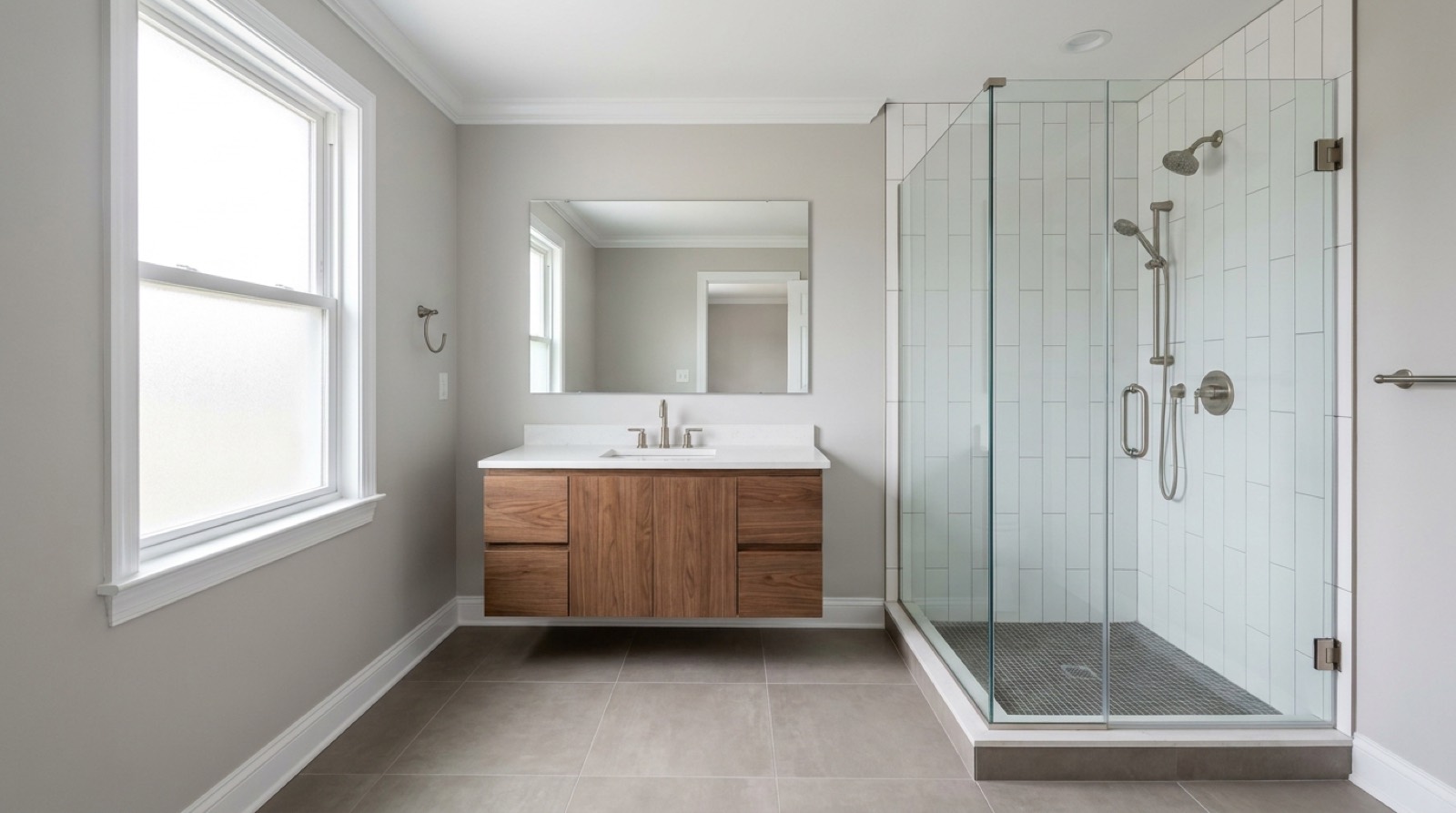
The short answer
Quick answer
A full bathroom remodel that keeps the same layout takes our crew about 5 to 9 working days, spread across 2 to 4 weeks on the calendar. A powder room is 2 to 3 days inside a week. Move a toilet, a tub, or a wall and you are looking at 5 to 8 weeks, because plumbing changes bring permits and inspections. The reason every website gives you a different number is that they quote calendar time without telling you how much of it is actual work.
Search this and the answers do not agree. Two to three weeks. Three to eight weeks. Six weeks to three months. A Reddit thread outranks most of the contractors, which tells you the contractors are not really answering it. All those numbers can be true at once, and that is the problem. They quote the calendar, and the calendar hides the part you want to know.
Here is the version from a crew that does this work across Alexandria, Arlington, Fairfax, and the rest of the DMV. Two clocks run on your bathroom and they do not tick at the same speed. Once you see both, every quote you have been given starts making sense.
Crew days vs calendar days
Quick answer
Crew days are the days someone is in your bathroom working. Calendar days are how long the whole thing takes from demo to done. A typical full bath is 5 to 9 crew days but 2 to 4 calendar weeks. The gap is not idleness. It is cure time, inspections, and glass fabrication, and most of it cannot be shortened.
Almost nobody separates these two numbers for you. Crew days are the days a person is physically working in that room. Calendar days are the span from the morning demo starts to the day you get the room back. On a standard full bath that is roughly 7 crew days and roughly 3 calendar weeks. So for about two of those three weeks, nobody is in your bathroom at all.
Homeowners read that silence as a contractor who took the deposit and moved to a bigger job. Sometimes it is, and being suspicious is fair. But on a well-run bathroom most of the quiet is physics. Waterproofing cures before tile sits on it. Mortar cures before grout goes in. Grout cures before sealing. A pan holds water overnight to prove it does not leak. A crew standing in the room does not speed any of that up.
💡 Key takeaway
Ask any contractor two questions instead of one: how many crew days is this, and how many calendar weeks. A contractor who can answer both has actually planned your job. One who only gives you a calendar range is guessing, and a guess is what turns into a job that stalls in week four.
What happens, day by day
Quick answer
Demo day one. Rough plumbing and electrical day two. Backer board and waterproofing day three. Flood test and floor prep day four. Tile days five and six. Grout day seven. Vanity, toilet, trim and fixtures day eight. Shower glass one to two weeks after that, because it is measured after the tile is finished.
Sequence matters more than speed here, because almost every stage waits on the one before it to be dry, level, or watertight. This is how we run a same-layout full bath with a tile shower.
Day 1, demo. Paper the path, seal the doorway, strip the room to studs and subfloor. Tub or surround, wall tile, vanity, toilet. This is the day that runs long in older DMV homes, and we come back to why below.
Day 2, rough plumbing and electrical. Valve, drain, supply lines, plus any fan, GFCI, or lighting change while the walls are open. If the layout is changing, this is the stage an inspector has to see.
Day 3, backer board and waterproofing. Cement or foam board on the wet walls, then a membrane on the pan, curb, and shower walls. Then it cures, and nothing goes on top of it until it has.
Day 4, flood test and floor prep. The pan gets plugged, filled, and left overnight. If it drops, we know now instead of after the tile is on. While it sits, the subfloor gets leveled and any soft spots found at demo get fixed. Our piece on what we find under floors in DMV homes covers how often that happens.
Days 5 and 6, tile. Walls first, then the floor. The tile you picked drives this, not the room size. Plain field tile goes fast. Large format, a mosaic pan, a herringbone layout, a niche or bench all add hours of cutting. Our tile installation timeline guide breaks that down, and the best tile for a bathroom floor covers picking one that sets cleanly.
Day 7, grout and seal. Mortar cures, grout goes in, grout cures, then it gets sealed. Epoxy grout changes both the working time and the cost, which we cover in our grout types and sealing guide.
Day 8, fixtures. Vanity set and plumbed, toilet in, trim back on, mirror and fixtures hung. The room finally reads as a bathroom. This is also the day the glass gets measured, because custom glass is measured off finished tile, never off a drawing.
Day 9 and after, glass and punch list. The glass is fabricated to that measurement and typically returns one to two weeks later. It is the single biggest reason a bathroom sits at 95 percent done. Paint touch up and the punch list close it out.
⚠️ If it is your only bathroom
You are without that shower for the full calendar span, not the crew days. On a same-layout full bath, plan on 2 to 4 weeks. If the house has one bathroom and nobody can move out, tell us at the estimate. We can sequence a job to compress the unusable window, and there are choices, like a stock glass door instead of custom, that trade a little style for a week of your life back.
The waiting you cannot compress
Quick answer
Waterproofing cure, an overnight flood test, mortar cure before grout, and grout cure before sealing are set by the product manufacturer, not the contractor. Custom shower glass adds one to two weeks after tile. A contractor who offers to skip them is offering you a shower that leaks later.
This is where the two clocks separate. Every wait below is a manufacturer instruction or a lead time, and a bigger crew moves none of them. Exact cure times are product specific, so we follow the data sheet on what we set, but these are the ranges you will see.
| What you are waiting on | Typical wait | Can it be shortened? |
|---|---|---|
| Waterproofing membrane cure | Often 12 to 24 hours | No, it is on the data sheet |
| Shower pan flood test | Overnight, about 24 hours | No, and skipping it is the gamble |
| Tile mortar cure before grout | Often 24 to 48 hours | Only with a rapid-set product |
| Grout cure before sealing | Often 48 to 72 hours | No |
| Custom shower glass fabrication | 1 to 2 weeks after tile is measured | Yes, choose a stock door |
| Permit inspection | The inspector's calendar, not ours | No |
| Special-order tile, vanity or fixtures | Days to weeks, product dependent | Yes, order it before demo starts |
The last row is the one you control. Material lead time is the most common reason a bathroom takes six weeks instead of three, and it is purely a planning problem. We order and physically receive every tile, vanity, fixture, and trim piece before we swing a hammer. A crew that demos first and orders second will leave you sitting in a gutted room waiting on a back-ordered vanity.
How long by scope
Quick answer
A powder room is 2 to 3 crew days inside a week. A full bath in the same layout is 5 to 9 crew days over 2 to 4 weeks. Change the layout and it is 9 to 14 crew days over 5 to 8 weeks. A large master bath with custom tile and glass can run 6 to 10 weeks.
Scope drives the number far more than square footage. A big bathroom with simple finishes and no plumbing changes moves faster than a small one where the toilet shifts three feet. These are the ranges we schedule against.
| Scope | Crew days | Calendar time |
|---|---|---|
| Powder room: floor, toilet, vanity, paint | 2 to 3 | About 1 week |
| Floor only, everything else stays | 1 to 2 | 2 to 4 days |
| Full bath, same layout, tub and surround | 5 to 7 | 2 to 3 weeks |
| Full bath, same layout, tile shower and glass | 7 to 9 | 3 to 4 weeks |
| Layout change: moving toilet, tub or a wall | 9 to 14 | 5 to 8 weeks |
| Large master bath, custom tile and glass | 12 to 18 | 6 to 10 weeks |
The jump from row four to row five is the one to stare at. Keeping fixtures where they are and moving them are two different projects, on the schedule and on the invoice. Our bathroom remodel cost guide for the DMV puts numbers on the same jump.
What actually adds weeks
Quick answer
Four things add weeks: material that was not ordered before demo, moving plumbing, a crew juggling subcontractors, and what gets found at demo. Bathroom size, tile color, and picking a nicer faucet add almost nothing. People worry about the wrong variables.
When a bathroom runs long it is nearly always one of four causes, and only one of them is bad luck.
Material that was not ordered first. Covered above. The most common and the most preventable.
Moving plumbing. A new drain location means opening the floor, and in a two-story house sometimes the ceiling below it. Then it needs an inspection. This is the difference between a three-week bathroom and a six-week one.
Waiting on subcontractors. Most remodelers sub out the tile, the plumbing, or both. Every sub is another calendar you are queued on, and the gaps between trades are where a week disappears with nobody at fault. We run in-house crews, so the tile setter is not waiting on the plumber's other job. It shows up harder on a schedule than anything else we do.
What we find at demo. Rotted subfloor under a leaking pan, a joist notched by whoever ran the old drain, a cast-iron waste line that crumbles when touched, old tile set in a mud bed over wire lath. Any of those adds a day or three, and it is the honest reason no contractor can promise an exact finish date before the walls are open. What we do promise is telling you the same day we find it, with a price, before we keep going. Our piece on the charges that hide in a quote applies to bathrooms too.
Do you need a permit?
Quick answer
Swapping fixtures in the same spots usually does not need a permit. Moving plumbing or altering electrical usually does, and that is what adds calendar time, because your job then waits on an inspector rather than on us. Requirements differ by jurisdiction across Fairfax, Alexandria, Arlington, DC and Maryland, so we confirm before we quote a date.
The rule of thumb across the DMV is simpler than the paperwork. A like-for-like replacement, a new tub where the old one was, a vanity on the same supply lines, new tile on the same floor, is generally treated as a repair or a finish upgrade. Move the toilet flange, add a shower where there was none, move a wall, or run new circuits, and you are altering the plumbing or electrical system. That is when permits and inspections enter.
Every county and city writes its own version, so we check the jurisdiction rather than assume. What matters for your timeline is the shape: a permitted job has a hold point built in. Rough plumbing cannot be closed up until someone from the county has looked at it, and that person's calendar is not something a contractor controls. If a remodeler quotes a hard finish date on a layout change without mentioning inspections, they have not pulled the permit yet.
Condos and high-rises add about a week
Quick answer
Plan on roughly an extra week for a condo or high-rise bathroom. Buildings require an approved contractor insurance certificate, restrict work to certain hours, control elevator and freight access, and schedule any water riser shutoff on their timeline. None of that is work, and all of it is calendar.
In a Tysons or Arlington high-rise, a Reston or Alexandria condo, or a DC building with a front desk, the building becomes part of the schedule. Most associations want a certificate of insurance naming them before anyone starts, and getting it issued and approved is not instant. Many restrict work to weekday business hours, which quietly removes the evenings and Saturdays that make a single-family job flexible. Freight elevator time gets reserved, and in a busy building you take the slot offered.
The one that catches people is the water shutoff. Replacing a shower valve often means shutting a riser that serves other units, so the building has to notice residents and pick a window. That step alone can sit for a week. We handle the certificate and the scheduling, and we would rather build the extra week into the estimate than surprise you with it in week two. If sound rules are also in your building's requirements, our guide to soundproofing for condos and townhomes covers what associations usually ask for.
Older DMV homes: what is under the tile
Quick answer
Bathrooms in mid-century DMV homes often have tile set in a thick mortar bed over wire lath, plus a cast-iron tub and cast-iron waste lines. That demo takes a day or two longer than a modern bathroom, and the mud bed is where hidden subfloor rot usually turns up.
This is the part the generic timelines miss. A lot of housing stock here predates modern building methods: Alexandria and Arlington colonials and Cape Cods, Vienna and Annandale split-levels, older Fairfax ramblers. In those houses the original bathroom floor is often tile set in a thick mortar bed over wire lath, which is tough, heavy, and slow to remove. There is frequently a cast-iron tub that has to be broken up or carried out by two people, and cast-iron drain lines thinner than they look.
Two consequences. First, demo day on a 1950s bathroom is not demo day on a 1998 townhouse, and a crew that quotes them the same has not done many of the former. Second, that mortar bed is where water has been sitting quietly for decades, so it is the likeliest place to find soft subfloor or a compromised joist. We would rather open it, show you a photo, and price the repair than tile over a problem. It is also why a good contractor gives you a range instead of a date until the floor is open. For the flooring side, see the best flooring for a bathroom and whether vinyl plank belongs in one.
Are one-day remodels real?
Quick answer
A one-day bathroom is real, but it is not a remodel. It is an acrylic or composite liner fitted over your existing tub and surround. The install genuinely takes a day. It does not touch your floor, your vanity, your plumbing, or anything behind the old walls, so nothing hidden gets found or fixed.
The one-day and two-day bath ads are not lying about the day. They are describing a different product. A liner system drops a molded acrylic or composite shell over the tub and walls you already have, and a trained crew can do that in a day. If your tile is dated, everything behind it is sound, and you want it to look better cheaply and fast, that is a legitimate option and we will tell you so.
What you trade is access. Everything behind the shell stays as it is, including any leak, soft subfloor, or failing waterproofing. Same layout, same footprint, usually the same floor. A liner also has a service life of its own, so it is a refresh with a clock on it. Put plainly: a liner buys a new-looking surface in a day, a remodel replaces what is behind the wall too. Two different purchases. Be clear which one you want before you take the fast quote.
FAQs about remodel timelines
How long does a bathroom remodel take?
A full bathroom that keeps its existing layout takes about 5 to 9 working days of crew time, spread across 2 to 4 weeks on the calendar. A powder room is 2 to 3 days inside a week. Moving plumbing pushes it to 5 to 8 weeks because permits and inspections get involved.
How long does it take to remodel a small bathroom?
Small does not mean fast. A small full bath still needs demo, rough plumbing, waterproofing, tile, grout, and fixtures, so it runs 5 to 7 crew days over 2 to 3 weeks. Square footage barely changes the schedule. Whether the plumbing moves changes it a lot.
Why is my bathroom remodel taking so long?
Usually one of four reasons: material was ordered after demo instead of before, the plumbing moved and it is waiting on an inspection, the crew is queued behind subcontractors on other jobs, or something was found at demo. Ask which one it is and ask for the next scheduled work date.
How long before a contractor can start my bathroom?
Start dates are usually two to six weeks out for a good crew, because the material has to be ordered and received first. Anyone available tomorrow is either between jobs or plans to demo before ordering. Getting the order placed early is what actually shortens your total timeline.
Can I use the bathroom during a remodel?
No, not that one. Plan on losing it for the full calendar span, so 2 to 4 weeks on a typical full bath. If it is your only bathroom, say so at the estimate. We can sequence the work and pick a stock glass door to shrink the unusable window.
Do you need a permit to remodel a bathroom?
Replacing fixtures in the same locations usually does not require one. Moving plumbing, adding a shower, or altering electrical usually does. Rules differ across Fairfax, Alexandria, Arlington, DC and Maryland, so we confirm with the jurisdiction before quoting a completion date.
Does a tile shower take longer than a tub surround?
Yes, by about two crew days and often a week of calendar time. A tile shower adds waterproofing and its cure, a flood test, more tile and cutting, and custom glass that is measured only after the tile is finished and then takes one to two weeks to fabricate.
Bottom line
A same-layout bathroom is 5 to 9 crew days and 2 to 4 calendar weeks. A layout change is 9 to 14 crew days and 5 to 8 weeks. The gap between the two clocks is cure time, inspections, and glass fabrication, and a contractor cannot compress most of it. What a contractor does control is ordering material before demo instead of after, running in-house crews so you are not queued behind a sub, and telling you the same day something turns up in the floor.
The tell of a schedule you can trust is specificity. A good one names the crew days and the calendar weeks separately, names the hold points, and names what could move them. We remodel bathrooms across the DMV with our own crews and all-in pricing. See what the work includes on our bathroom remodeling page, read the DMV cost breakdown if you are still setting a budget, or get a free estimate and we will walk your bathroom and give you both numbers.