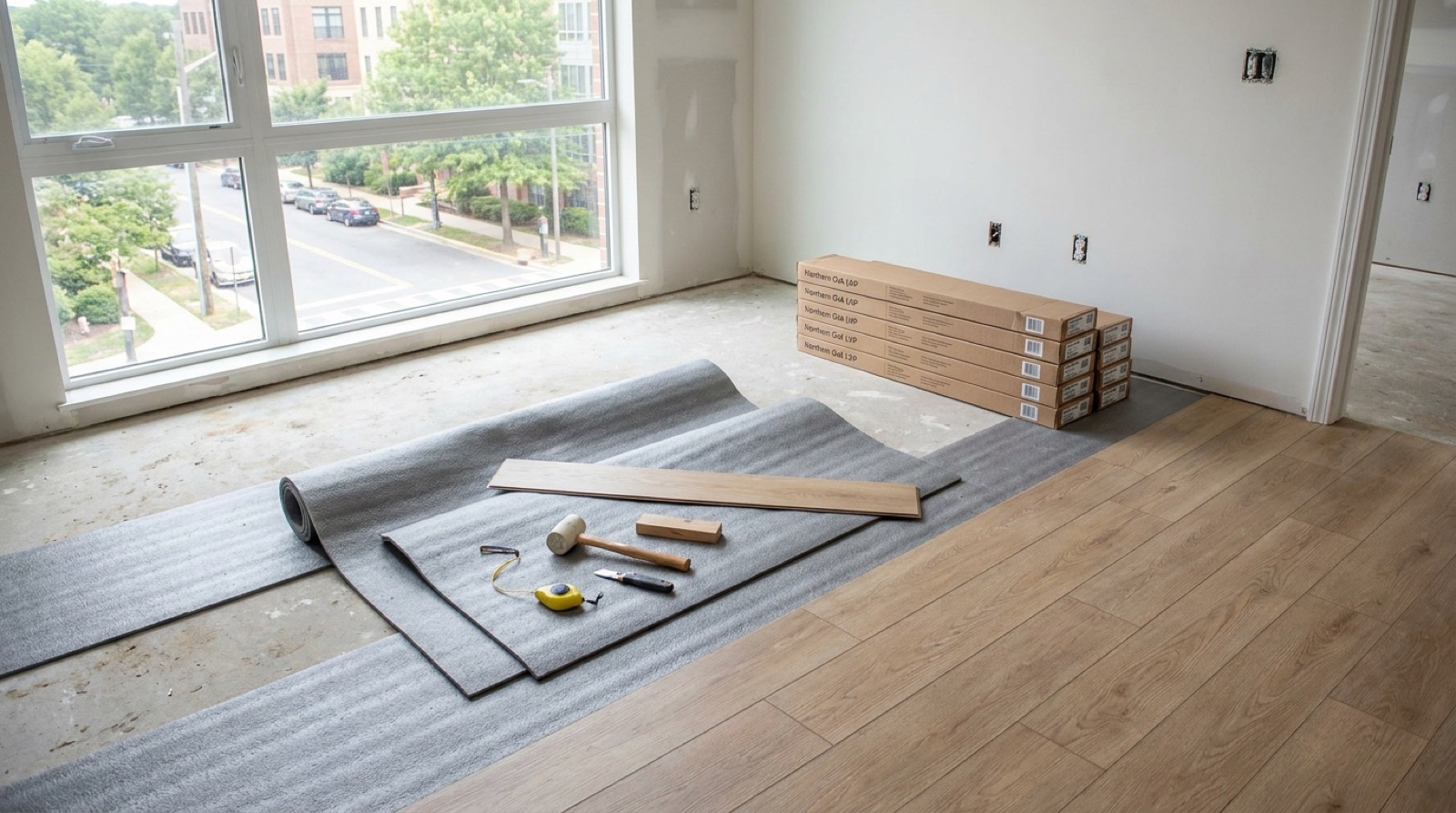

If you live in a DMV condo or a stacked townhome and you're replacing your flooring, you have a problem the homeowner in a single-family house doesn't: someone lives below you, and your HOA cares about what they hear. Pull up the carpet, put down hardwood or vinyl plank, and every footstep, every dropped phone, every dog claw now travels straight into the unit downstairs.
That's why most condo associations in Northern Virginia have flooring rules written into their governing documents, and why a flooring project in a condo is half material choice and half compliance. Get it wrong and you can be ordered to tear the floor out at your own cost.
This is a working installer's guide. We install in condos and townhomes across Alexandria, Arlington, Tysons, Reston, and the rest of the DMV every week. Here's what actually keeps the floor quiet, what your HOA is really asking for, and what it costs in 2026.
Soundproof flooring for DMV condos and townhomes: the short answer
Quick answer
For a DMV condo or stacked townhome, carpet is the quietest floor you can install and needs no special treatment. If you want a hard surface, luxury vinyl plank installed as a floating floor over a rated acoustic underlayment is the practical winner: it's quiet, durable, and easy to bring up to the IIC rating most HOAs require. The flooring material matters less than the underlayment beneath it and the way it's installed. Before you buy anything, get your HOA's flooring rule in writing.
Soundproofing a floor is not one decision, it's three: the material on top, the underlayment underneath, and whether the floor floats or is fastened down. Most homeowners obsess over the first one and ignore the other two, which is backwards. A premium hardwood nailed straight to the subfloor with no acoustic layer will fail an HOA inspection. A mid-grade vinyl plank floating over a good acoustic underlayment will pass it.
The rest of this guide walks through the ratings your HOA uses, what the rules actually say, and how to hit them without overspending.
IIC vs STC: the two ratings that decide whether your floor passes HOA review
Quick answer
IIC (Impact Insulation Class) measures impact noise: footsteps, dropped objects, dog claws. STC (Sound Transmission Class) measures airborne noise: voices, TV, music. For flooring, IIC is the rating that matters. Higher numbers are better, and 50 is the common baseline minimum.
Every condo flooring rule comes down to two numbers, and homeowners mix them up constantly.
STC, Sound Transmission Class, rates how well an assembly blocks airborne sound. Talking, a television, a barking dog heard through a wall or ceiling. Your floor affects STC a little, but STC is mostly a function of the building's construction, not your flooring choice.
IIC, Impact Insulation Class, rates how well an assembly blocks impact sound. Footsteps overhead, a chair scraping, a kid jumping, a dropped pan. This is the one your flooring controls directly, and it's the rating almost every HOA flooring rule is built around.
Both are tested in a lab, both use a scale where a bigger number means a quieter floor for the neighbor below. The federal building code baseline, set by the International Building Code, is IIC 50 and STC 50 for the assembly separating two dwelling units. Many DMV condo associations adopt that 50 figure directly, and some upper-floor or luxury buildings push it higher.
Key takeaway
When your HOA says "your floor must meet IIC 50" or "IIC 55," they're talking about impact noise: footsteps. That number is set by the whole floor-ceiling assembly, not the flooring alone. The flooring and the underlayment are the parts you control, and the underlayment does most of the work.
What DMV condo and townhome HOAs actually require for hard-surface flooring
Quick answer
Most DMV condo associations require hard-surface flooring above ground level to meet a minimum IIC rating, commonly IIC 50, sometimes 55 or higher. Many also require written approval before installation and proof of the underlayment's rating. Rules vary building to building, so always pull your own governing documents.
There is no single rule across the DMV. Each condo association and many townhome HOAs write their own. But the patterns repeat, and after years of condo installs we see the same requirements again and again:
- A minimum IIC rating for hard surfaces above the ground floor. IIC 50 is the most common floor. Newer or higher-end buildings in Arlington, Tysons, and Old Town sometimes specify IIC 55 or 60.
- Ground-floor units are usually exempt. If nobody lives below you, the impact-noise rule typically doesn't apply. You can install almost anything.
- Written architectural approval before work starts. Many associations require you to submit your flooring and underlayment specs, including the product's IIC test data, and wait for sign-off.
- Proof of the underlayment used. Some require a receipt or product cut sheet after install, and a few reserve the right to inspect.
- Carpet is almost always exempt. Soft surfaces pass impact-noise rules without help, so carpet rarely needs approval.
Watch out
The expensive mistake is installing first and asking later. If your association requires pre-approval and you skip it, they can compel you to remove a compliant floor purely because you didn't submit it. We've seen homeowners pay for the same floor twice. Before you order material, get your condo's flooring rule and approval process in writing from the management company.
If you're a landlord or you manage rental units, the same rules apply, and the stakes are higher because a noise complaint from a downstairs tenant can pull the management company into a dispute. For rentals, durability and a compliant install matter more than the look. Our vinyl plank installation cost guide covers why LVP is the default for DMV rental flooring.
Flooring materials ranked from quietest to loudest for impact noise
Quick answer
Carpet is the quietest by a wide margin. Among hard surfaces, luxury vinyl plank is the most forgiving, engineered hardwood is in the middle, laminate sounds hollow underfoot, and tile transmits the most impact noise. Every hard surface needs an acoustic underlayment to perform in a condo.
Here's how the materials we install stack up for the neighbor below, untreated, before any acoustic underlayment is added:
| Flooring | Impact noise (untreated) | Notes for condo use |
|---|---|---|
| Carpet with pad | Quietest | The soft surface absorbs footfall. Passes HOA impact rules with no help. Quietest floor you can buy. |
| Luxury vinyl plank (LVP) | Moderate | Thicker, denser, and a little softer than laminate. Floats easily over acoustic underlayment. The practical condo winner. |
| Engineered hardwood | Moderate | Real wood feel. Floats over underlayment well. A bit more transmission than LVP because the surface is harder. |
| Laminate | Loud, hollow | The rigid fiberboard core resonates. Sounds hollow and clicky underfoot even when it passes the impact rule below. |
| Tile | Loudest | Hard, rigid, bonded to the slab. The worst impact transmitter and the hardest to bring into compliance. |
Two things to read out of that table. First, the gap between carpet and everything else is real: if quiet is the only thing you care about and you don't mind carpet, install carpet and skip the rest of this guide. Our carpet installation cost breakdown has the DMV numbers.
Second, among hard surfaces the differences are smaller than people think. Laminate's reputation for being noisy is mostly the hollow sound you hear in the room, not what travels downstairs. Both can be solved with the right underlayment. If you want the real-wood look, the engineered hardwood comparison explains why engineered, not solid, is the condo answer: it's a floating-floor product, and floating floors are far easier to soundproof.
Acoustic underlayment: the layer that makes a hard floor HOA-compliant
Quick answer
Acoustic underlayment is a thin layer of cork, rubber, foam, or a composite that sits between the subfloor and the flooring. It absorbs impact energy before it reaches the structure. A rated acoustic underlayment is what carries a hard-surface floor up to the IIC 50-plus most HOAs require.
This is the part homeowners underbuy. The flooring you can see is the part everyone shops for. The underlayment you can't see is the part that actually passes the inspection.
Acoustic underlayment comes in a few forms. Cork is a natural performer and dimensionally stable. Rubber and recycled-rubber mats are the strongest performers and the heaviest. Foam composites are the most common under floating LVP and laminate, and good ones include a rubber or dense-core layer. A quality acoustic underlayment will publish a tested IIC number, and that's the spec to ask for.
Watch out
The IIC number printed on an underlayment is assembly-dependent. It's the rating of a specific test sandwich, usually a 6-inch concrete slab with a finished ceiling below. Your floor will perform differently if the ceiling below is different, and very differently over wood joists. An underlayment "rated IIC 60" does not guarantee your finished floor hits 60. Match the test assembly to your building, or have an installer who knows the difference spec it.
One more thing the spec sheet won't tell you: the way the floor is installed matters as much as the underlayment. A floating floor, where the planks lock to each other and rest on the underlayment without being fastened to the subfloor, is the easiest to soundproof, because the acoustic layer is never bypassed. A nailed-down or glued-down floor creates direct paths for impact energy into the structure, around the underlayment. This is why we install almost all condo flooring as a floating floor. The National Wood Flooring Association (nwfa.org) publishes acoustic guidance for wood floors that points the same direction.
Underlayment is also the line item that quietly disappears from cheap quotes. If a bid looks low, check whether a rated acoustic underlayment is actually in it. Our guide to the charges that get hidden in flooring quotes covers this trap in detail.
What soundproof flooring actually costs in the DMV in 2026
Quick answer
In the DMV, expect carpet around $3.25/sqft all-in, LVP around $6.50/sqft, and engineered hardwood around $8.50/sqft. Upgrading from a basic underlayment to a rated acoustic underlayment typically adds roughly $0.50 to $1.50/sqft, depending on the product and the IIC target.
Here's real Potomac Floors pricing for a condo job. All of our pricing is all-in, meaning material, professional installation, and demo and removal of the old floor are in one number. The acoustic underlayment upgrade is the soundproofing-specific cost on top.
| Flooring | All-in installed (DMV, 2026) | Acoustic underlayment upgrade | HOA fit |
|---|---|---|---|
| Carpet with pad | $3.25/sqft | None needed | Passes impact rules as-is |
| Laminate | $6.50/sqft | Add ~$0.50-$1.00/sqft | Compliant with rated underlayment |
| Luxury vinyl plank | $6.50/sqft | Add ~$0.50-$1.25/sqft | Compliant with rated underlayment |
| Engineered hardwood | $8.50/sqft | Add ~$0.75-$1.50/sqft | Compliant as a floating floor with rated underlayment |
| Tile | Call for pricing | Acoustic membrane, custom | Hardest to bring to IIC 50, priced per job |
The underlayment-upgrade ranges are our typical numbers, not a published industry figure. The actual cost depends on the specific product and how high your HOA's IIC target is. A building that wants IIC 50 is an inexpensive upgrade. A building that wants IIC 60 pushes you toward a denser rubber-core underlayment and the higher end of the range.
Key takeaway
For a typical 800 sqft DMV condo, the acoustic underlayment upgrade adds roughly $400 to $1,200 over a basic underlayment. That's the cost of passing HOA review cleanly and not being ordered to tear the floor out. It's the cheapest insurance in the project. Don't shop it down to nothing.
Concrete-slab condos vs wood-joist townhomes: why the build changes the answer
Quick answer
Most DMV mid-rise and high-rise condos sit on concrete slabs, which transmit impact noise efficiently but take underlayment ratings predictably. Stacked townhomes are usually built over wood joists, which flex and resonate, so the same underlayment performs differently. The building's structure changes which underlayment you need.
Two condos in the DMV can need two different soundproofing solutions because they're built differently.
Concrete-slab construction. The high-rises and many mid-rises in Rosslyn, Ballston, Tysons, Crystal City, and Old Town Alexandria are concrete. Concrete is dense and rigid: it transmits impact energy readily, but it's predictable. The good news is that most published underlayment IIC ratings are tested on a concrete assembly, so the number on the box is close to what you'll get. A rated acoustic underlayment under a floating floor is a clean, reliable path to IIC 50 here.
Wood-joist construction. Stacked townhomes and older low-rise condos across Reston, Centreville, Ashburn, and Springfield are often framed with wood joists and a plywood subfloor. Wood flexes. It resonates at different frequencies than concrete, and an underlayment tested on a concrete slab can underperform its printed rating over joists. These assemblies sometimes need a heavier rubber underlayment, and the condition of the subfloor itself matters. If the subfloor squeaks or flexes, that's a noise source the underlayment can't fix. Our guide to what we find under DMV floors covers the subfloor problems that quietly wreck a soundproofing job.
If you're on the ground floor, in a slab or joist building, with nobody below you, none of this is your problem. You can install whatever you like. The same is true for a basement-level unit, where the floor sits on grade. For below-grade and slab-on-grade rooms, the bigger concern is moisture, not sound, and our basement flooring guide covers that decision instead.
The soundproofing mistakes we fix most often in DMV condos
Quick answer
The four mistakes we see most: skipping HOA approval, using a cheap pad instead of a rated acoustic underlayment, gluing or nailing a floor that should float, and ignoring a flexing subfloor. Each one is avoidable and each one is expensive after the fact.
We get called into condos to fix soundproofing jobs that went wrong. The pattern is consistent:
- Installing before getting HOA approval. The floor is fine. The paperwork wasn't done. The association compels removal anyway. This is the most expensive and the most preventable mistake on the list.
- A standard pad instead of a rated acoustic underlayment. The thin foam underlayment that comes attached to budget vinyl plank is not an acoustic product. It will not get you to IIC 50. Buy the rated underlayment as a separate, deliberate spec.
- Gluing or nailing down a floor that should have floated. A fastened floor creates direct sound bridges through the underlayment and into the structure. In a condo, hard surfaces should float unless there's a specific reason not to.
- Ignoring the subfloor. A squeaky, flexing subfloor is its own noise source. No underlayment fixes a structural squeak. Fix the subfloor first, then install over it.
- Chasing the material and ignoring the assembly. Homeowners spend on premium hardwood and save on underlayment. It should be the other way around. The underlayment is what passes the rule.
Key takeaway
A soundproof condo floor is a system: HOA-approved spec, rated acoustic underlayment, a sound subfloor, and a floating install. Get all four right and the floor is quiet for the life of the building. Skip any one and the other three can't save it.
FAQs about soundproof flooring for Northern Virginia condos and townhomes
What does IIC mean for flooring?
IIC stands for Impact Insulation Class. It rates how well a floor blocks impact noise, like footsteps and dropped objects, from reaching the unit below. Higher is quieter. Most DMV condo HOAs require hard-surface flooring above the ground floor to meet IIC 50 or higher.
What is the best flooring for soundproofing between floors?
Carpet with a pad is the quietest by a wide margin and passes HOA impact rules without help. Among hard surfaces, luxury vinyl plank installed as a floating floor over a rated acoustic underlayment is the best balance of quiet, durability, and cost for a DMV condo.
Do I need HOA approval to replace my condo flooring?
Usually yes, if you're going from carpet to a hard surface above the ground floor. Most DMV condo associations require written approval and proof of a rated acoustic underlayment before installation. Get your building's flooring rule in writing before you order any material.
Does acoustic underlayment really work?
Yes. A rated acoustic underlayment absorbs impact energy before it reaches the structure and is the layer that carries a hard-surface floor up to IIC 50 or higher. The standard thin foam pad attached to budget flooring is not an acoustic product and will not pass an HOA rule.
Is luxury vinyl plank good for soundproofing?
LVP is the most practical hard-surface choice for a condo. It's denser and slightly softer than laminate, it installs as a floating floor, and it pairs well with acoustic underlayment. With a rated underlayment underneath, LVP comfortably meets the IIC 50 most HOAs require.
Can you soundproof a floor without replacing it?
Partly. Area rugs with thick pads cut impact noise on an existing hard floor and need no approval. But you cannot add underlayment without lifting the floor. If your floor already fails an HOA rule, soundproofing it properly means a reinstall with a rated acoustic underlayment.
What is the quietest hard-surface flooring?
Cork is the quietest hard surface on its own, because the material itself is soft and absorbs impact. For most condos, though, the bigger lever is the underlayment, not the surface. LVP or engineered hardwood over a strong acoustic underlayment outperforms a bare floor of any material.
How much does soundproof flooring cost in the DMV?
All-in DMV pricing runs about $3.25/sqft for carpet, $6.50/sqft for LVP, and $8.50/sqft for engineered hardwood. Upgrading to a rated acoustic underlayment typically adds $0.50 to $1.50/sqft, so a hard-surface condo floor that meets HOA rules costs roughly $400 to $1,200 more than a non-acoustic install.
Bottom line: how to choose soundproof flooring that passes HOA review
Soundproofing a condo floor is less about the material and more about the system underneath it. Get the four pieces right and the floor stays quiet for as long as the building stands.
The 30-second decision
Step one: get your HOA's flooring rule and approval process in writing before you buy anything. Step two: if you're fine with carpet, install carpet and you're done. Step three: if you want a hard surface, choose luxury vinyl plank or engineered hardwood, installed as a floating floor over a rated acoustic underlayment that matches your building's IIC target; our cork vs foam vs rubber underlayment guide covers which one to pick. Step four: ground floor with nobody below you? Ignore all of this and install whatever you like.
The homeowners who get burned are the ones who shop the floor and skip the underlayment and the paperwork. The homeowners who get a quiet, compliant floor on the first try are the ones who treat it as a system.
Potomac Floors installs in condos and townhomes across the DMV every week, and we know the difference a concrete slab and a wood-joist townhome make. When you're ready, book a free in-home estimate and we'll measure your rooms, ask about your HOA's rule, and give you one all-in number with the right acoustic underlayment already in it. No hidden underlayment line, no surprise at inspection. The number we quote is the number you pay.