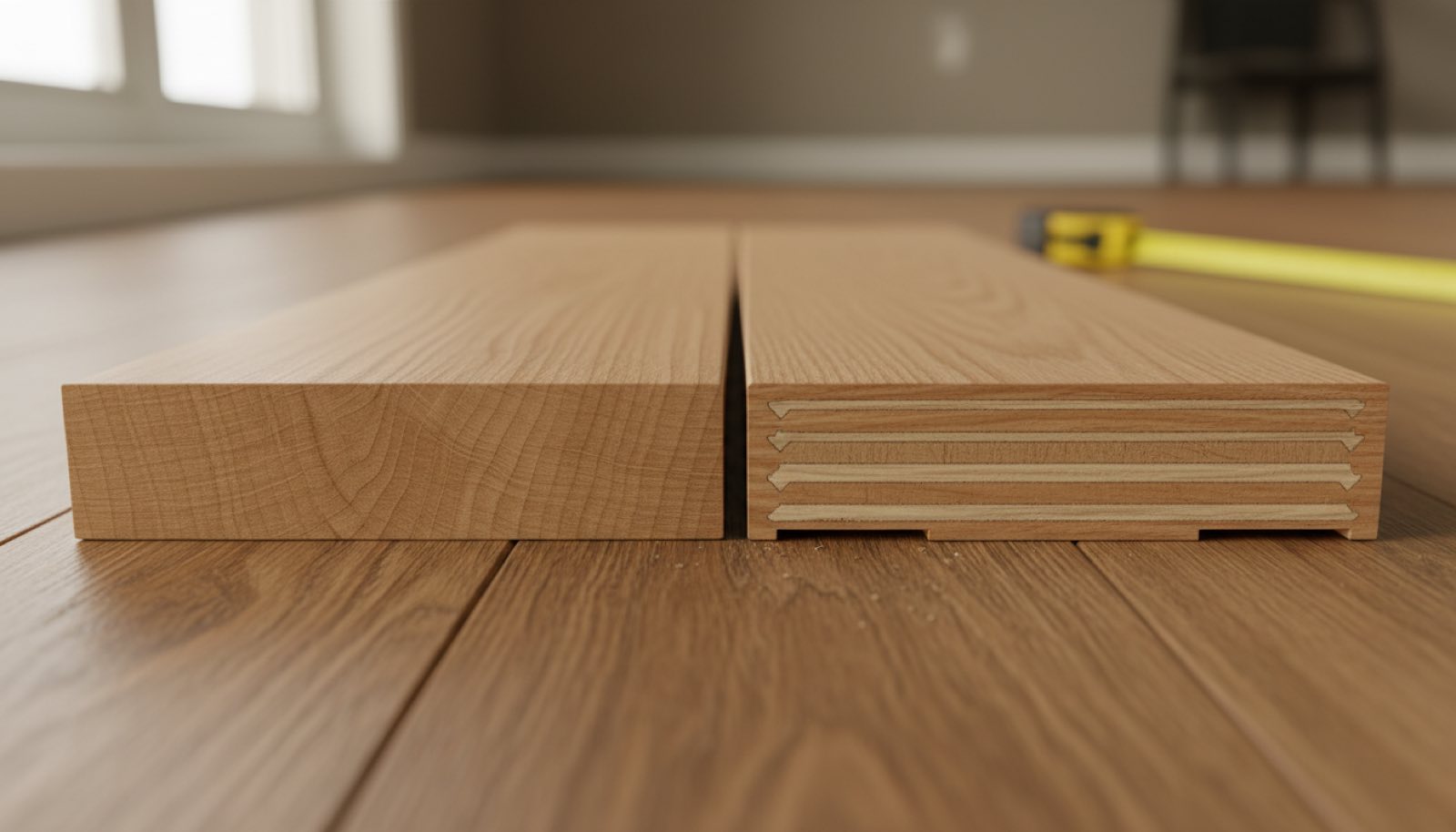

If you're choosing between engineered hardwood and solid hardwood for a Northern Virginia home, you're looking at two materials that end up looking nearly identical on the floor. Same oak grain, same finish options, same warm feel underfoot. The difference is underneath, and it changes the cost, the lifespan, and which rooms each one belongs in.
This is a working installer's comparison. Real all-in DMV pricing, real refinishing math from floors we see 10 to 40 years after install, and honest guidance on when each one is the wrong call. Both are good products. Neither is right for every situation.
By the end you'll know which one fits your subfloor, your humidity, your timeline, and your budget. For most DMV homes the decision comes down to one question, so we cover that first.
Engineered vs solid hardwood: the short answer for DMV homeowners
Quick answer
For most DMV homes, engineered hardwood at $8.50/sqft all-in is the right answer. It has a real wood top layer, works over concrete slab and radiant heat, handles Northern Virginia's humidity swings, and refinishes once or twice. Choose solid hardwood at $9-11/sqft all-in when you have a plywood subfloor above grade, you're staying long-term, and you want a floor that refinishes 6 or more times and outlives the mortgage.
The single question that settles most of this decision: what is your subfloor? If it's plywood over wood joists and the room is above grade, both materials are on the table. If it's a concrete slab, the choice is mostly made for you, because solid hardwood doesn't belong on slab. We walk through that in detail below.
Everything else is a tradeoff. Solid hardwood lasts longer and refinishes more times. Engineered handles moisture and slab better and costs a little less. Neither one is the "premium" choice in every room. The right answer depends on your house, not on which one sounds fancier.
How engineered and solid hardwood are built, and is engineered real wood?
Quick answer
Yes, engineered hardwood is real wood. The top layer you walk on is a genuine hardwood veneer, usually 2 to 4mm thick, bonded over a cross-layered plywood core. Solid hardwood is one piece of milled timber, top to bottom, typically 3/4 inch thick.
Solid hardwood is exactly what it sounds like. Each board is a single piece of oak, maple, hickory, or walnut, milled with a tongue and groove on the edges. A standard board is 3/4 inch thick, and the entire thickness is the same wood you see on the surface.
Engineered hardwood is a layered product. The top is a real hardwood veneer, sawn or sliced from the same oak or maple logs that make solid flooring. That veneer is bonded over a core of 7 to 9 plywood layers, each one running cross-grain to the layer above it. That cross-grain construction is what makes engineered dimensionally stable, and it's the whole reason engineered exists.
So when people ask whether engineered hardwood is "real," the answer is yes. The surface is genuine wood, recognized as wood flooring by the National Wood Flooring Association. It is not laminate, and it is not luxury vinyl plank. Laminate and LVP use a photograph of wood under a clear wear layer. Engineered uses actual wood. If you want LVP in the comparison too, see our three-way breakdown of solid hardwood, engineered, and LVP.
The catch with engineered is that quality varies enormously. A premium engineered board has a 3 to 4mm wear layer and a thick plywood core. A budget engineered board has a 1mm wear layer that's barely thicker than veneer on furniture. They cost very differently and they behave very differently over 20 years. The wear layer thickness is the spec that matters most, and we come back to it in the refinishing section.
Engineered hardwood vs solid hardwood: side-by-side comparison
| Feature | Solid hardwood | Engineered hardwood |
|---|---|---|
| All-in cost (DMV, 2026) | $9-11/sqft | $8.50/sqft |
| Construction | One piece of real wood, 3/4 inch thick | 2-4mm real wood veneer over cross-grain plywood core |
| Lifespan | 50-100+ years | 20-40 years (depends on wear layer) |
| Refinishable | 6+ times | 1-2 times if wear layer is 2mm or thicker; 0 times if 1mm |
| Works over concrete slab | No | Yes |
| Works over radiant heat | Risky | Yes (preferred for radiant) |
| Humidity tolerance | Moderate (needs stable HVAC) | High (cross-grain core resists movement) |
| Waterproof | No | No (water-resistant only) |
| Installation method | Nail-down over plywood subfloor only | Nail, glue, or float |
| Install time / acclimation | Longer (boards acclimate 3-7 days on site) | Shorter (less acclimation needed) |
| Resale value impact | Adds value | Adds value |
| Best for | Above-grade rooms, long-term ownership, older homes | Slab, basements, radiant heat, most rooms in most homes |
Your subfloor decides this before anything else: joists vs concrete slab
Quick answer
Solid hardwood installs by nailing into a plywood subfloor over wood joists. If your room sits on a concrete slab, solid hardwood is not a safe choice, and engineered is the standard answer because it can be glued or floated directly over slab.
This is the question that settles the decision for a large share of DMV homeowners, and most online comparisons skip it entirely. Before you think about cost or finish or refinishing, look at what your floor sits on.
Plywood subfloor over wood joists. This is the typical setup in above-grade rooms of most older Northern Virginia homes. The colonials and bungalows of Old Town Alexandria and Del Ray, the 1920s to 1950s houses across Arlington, the postwar homes in Falls Church and Annandale. Solid hardwood nails straight into that plywood. Both materials work here, so the rest of the article applies.
Concrete slab on grade. Many newer DMV builds in Loudoun County and Prince William sit on a slab. So do basement floors everywhere, slab additions, and a lot of townhome and condo levels. You can't nail solid hardwood into concrete, and floating or gluing solid wood over slab invites the moisture and movement problems it isn't built for. Engineered is the answer here. Its plywood core can be glued or floated over slab with the right moisture barrier.
If you don't know your subfloor type, an installer can tell you in five minutes during an estimate. It's worth knowing before you fall in love with a product that can't go where you want it. While you're at it, ask what's under the existing floor, because what we find under DMV subfloors is sometimes a project of its own.
Real DMV cost: engineered vs solid hardwood installed in 2026
Quick answer
In the DMV in 2026, engineered hardwood runs $8.50/sqft all-in and solid hardwood runs $9-11/sqft all-in. All-in means material, professional installation, demo, removal, and disposal of the old floor. The gap is real but smaller than most homeowners expect.
The advertised pricing for both materials is all over the map because most quotes only show you the material cost, then add labor, demo, removal, disposal, underlayment, and trim as separate line items later. Our pricing is all-in. The number we quote is the number you pay. Here's what each one costs installed in Northern Virginia, Washington DC, and Maryland by room size:
| Project size | Engineered ($8.50/sqft) | Solid ($9-11/sqft) |
|---|---|---|
| Small bedroom (200 sqft) | $1,700 | $1,800-2,200 |
| Living room (350 sqft) | $2,975 | $3,150-3,850 |
| Open main level (1,000 sqft) | $8,500 | $9,000-11,000 |
| Whole upstairs (1,500 sqft) | $12,750 | $13,500-16,500 |
Solid hardwood costs more for two reasons. The material itself is more wood, and the install takes longer because solid boards need to acclimate on site for several days before they go down. Engineered is more forgiving on both counts.
The price spread inside the solid range depends on species. Standard red oak, white oak, and maple land near $9/sqft. Premium species like hickory, walnut, and wide-plank specialty cuts run $10-11/sqft. For per-square-foot math on your exact room dimensions, see our cost per square foot breakdown, and for the full picture of what hardwood installation costs across project types, our hardwood installation cost guide goes deeper.
One warning on cost. Don't choose engineered just because it's cheaper per square foot, and don't choose the cheapest engineered you can find. A budget engineered floor with a 1mm wear layer can't be refinished, so when it wears out you replace the whole thing. That's the most expensive option over 20 years even though it's the cheapest today. Before you compare any two quotes, read what gets hidden in a flooring quote so you're comparing the same thing.
Refinishing reality: how many times you can sand each one
Quick answer
Solid hardwood can be sanded and refinished 6 or more times over its life. Engineered hardwood can be refinished 1 to 2 times if the wear layer is 2mm or thicker, and not at all if the wear layer is 1mm. This is the single biggest functional difference between the two.
Refinishing is sanding off the top layer of wood and finish, then restaining and resealing. It's how a wood floor gets reset to new instead of replaced. How many times you can do it depends entirely on how much wood sits above the tongue-and-groove joint.
Solid hardwood
A 3/4 inch solid board has roughly 4 to 5mm of usable wood above the tongue. Each refinish removes about 0.5 to 1mm. That's 6 to 8 potential refinishes before you reach the joinery. In practice, most solid floors get refinished 2 or 3 times during one homeowner's tenure and still have decades of life left for the next owner. We see original 1950s oak in Arlington and Bethesda homes that's been sanded twice and is still going strong.
Engineered hardwood
Engineered's refinishing budget is its wear layer, the real-wood veneer on top. A premium 3 to 4mm wear layer allows 1 to 2 refinishes. A 2mm wear layer allows one careful refinish. A 1mm wear layer allows zero, because sanding cuts straight through to the plywood core. The question "can engineered hardwood be refinished?" has no single answer. It depends on the board you bought.
Key takeaway
When you shop engineered hardwood, the wear layer thickness is the number that matters. Ask for it in millimeters. A 3-4mm wear layer gives you refinishing flexibility and a 30-40 year floor. A 1mm wear layer gives you a floor that gets replaced, not refinished. If you already have a worn hardwood floor and aren't sure which way to go, our refinishing vs replacement guide walks through the decision.
DMV humidity, basements, and radiant heat: where engineered wins
Quick answer
Engineered hardwood handles moisture and temperature swings better than solid because its cross-grain plywood core resists expanding and contracting. That makes engineered the safer choice for slab installs, radiant heat, and controlled-humidity basements. Solid hardwood needs stable indoor conditions and stays above grade.
The DMV climate is hard on wood. Summers run 70 to 90 percent humidity outdoors. Winters drop to 20 to 30 percent indoors once the heat is running. That's a 50-plus point swing across the year, and wood moves with it.
Solid hardwood is a single piece of wood, so it expands across its width in humid months and contracts in dry months. With good HVAC and seasonal humidity control, a solid floor handles this fine, which is why solid has worked in DMV homes for a century. Without that control, you get summer cupping and winter gaps between boards.
Engineered hardwood barely moves. The cross-grain plywood core means each layer restrains the layers around it, so the board stays dimensionally stable through the same humidity swing. That stability is why engineered works over concrete slab, over radiant heat, and in basements where solid would fail.
Watch out
Engineered hardwood is more stable, but it is still not waterproof. The plywood core swells if water sits on it for hours. Engineered handles humidity and the occasional wiped-up spill. It does not handle standing water, a leaking dishwasher, or a flooded basement. For bathrooms, laundry rooms, and any basement with real moisture risk, the answer is LVP, not engineered. See our guide to the best flooring for DMV basements for that decision.
For radiant heat specifically, engineered is the preferred wood option. The plywood core tolerates the temperature cycling that would dry out and stress a solid board. If you have radiant heat anywhere in the project, plan on engineered for those rooms and confirm the specific product is rated for radiant.
Does solid hardwood add more resale value than engineered hardwood?
Quick answer
Both solid and engineered hardwood add resale value, and most buyers and appraisers see "hardwood floors" without distinguishing the two. The bigger value driver is real wood instead of carpet or laminate, not solid versus engineered.
There's a common belief that solid hardwood commands a big resale premium over engineered. In the DMV market, that's mostly a myth. When a buyer walks a house, they see oak floors with a clean finish. They feel real wood underfoot. They almost never pull up a board to check whether it's solid or engineered, and most couldn't tell from the surface.
What actually moves resale value is the jump from carpet or worn laminate to real wood. Both solid and engineered clear that bar. A well-installed engineered floor in good condition reads as "hardwood floors" on a listing and in a buyer's mind, full stop.
Key takeaway
Where solid hardwood does have a long-term edge is in homes you plan to keep. A solid floor refinished by the next owner, and the owner after that, holds its look across generations. For resale within the next 5 to 10 years, engineered and solid land in the same place. For a forever home, solid's refinishing headroom is the real advantage.
The honest disadvantages of engineered hardwood (and of solid)
Every comparison online tells you what each material does well. Here's the honest other side, because the disadvantages are what actually decide the close calls.
Disadvantages of engineered hardwood
- Limited refinishing. One or two refinishes at best, none if the wear layer is thin. When it wears out, you replace it.
- Quality varies wildly. "Engineered hardwood" covers everything from a 4mm-wear-layer 30-year floor to a 1mm-wear-layer disposable product. The label alone tells you nothing. You have to check the spec.
- Not waterproof. The plywood core swells with standing water. Engineered is water-resistant, not waterproof.
- Shorter lifespan than solid. Even a premium engineered floor is a 30 to 40 year product. Solid can outlast the house.
Disadvantages of solid hardwood
- Subfloor-restricted. It needs a plywood subfloor over joists. No slab, no basements, no exceptions.
- Humidity-sensitive. Without stable HVAC and humidity control, it cups in summer and gaps in winter.
- Higher cost and longer install. More expensive per square foot, plus several days of on-site acclimation before installation.
- Risky over radiant heat. Temperature cycling dries and stresses solid boards. Engineered is the better radiant choice.
Notice that the two lists don't cancel out. Engineered's weaknesses are mostly about longevity. Solid's weaknesses are mostly about where it can physically go. That's the real shape of this decision.
When to choose engineered, and when solid hardwood is the right call
Match your situation to the column that fits. If your situation hits both columns, the most restrictive factor usually wins, and that factor is almost always the subfloor.
| Your situation | Best fit | Why |
|---|---|---|
| Concrete slab on grade (newer Loudoun / Prince William builds, slab additions) | Engineered | Solid can't go over slab; engineered glues or floats over it |
| Radiant heat anywhere in the project | Engineered | Cross-grain core tolerates temperature cycling |
| Finished basement with controlled humidity | Engineered | Handles below-grade conditions solid can't (LVP if moisture risk is real) |
| Townhome or condo level over slab | Engineered | Matches the subfloor and what most DMV builds already use |
| Above-grade rooms, plywood subfloor, staying 10+ years | Solid | Refinishes 6+ times, can outlive the mortgage |
| Older home (Old Town, Del Ray, 1920s-50s Arlington) with original wood | Solid | Matches the era of the home and the existing floors |
| Above-grade rooms, mid-budget, want real wood without fuss | Engineered | Real wood look at $8.50/sqft, more forgiving on humidity and install |
| Forever home, want the floor to outlast you | Solid | 50-100+ year lifespan, refinishable for generations |
FAQs about engineered vs solid hardwood for Northern Virginia homes
Is engineered hardwood real wood?
Yes. The surface layer of engineered hardwood is a genuine hardwood veneer, the same oak, maple, or hickory used in solid flooring, bonded over a plywood core. It is not laminate or vinyl, both of which use a printed photo of wood.
Is engineered hardwood as good as solid hardwood?
For most rooms in most DMV homes, yes. Engineered handles humidity, slab, and radiant heat better than solid. Solid's advantage is longevity and refinishing headroom. Neither is universally better. It depends on your subfloor and how long you're staying.
Can engineered hardwood be refinished?
Sometimes. Engineered hardwood can be refinished 1 to 2 times if the wear layer is 2mm or thicker. If the wear layer is 1mm, it cannot be refinished at all. Always ask for the wear layer thickness before buying.
What is the disadvantage of engineered hardwood?
The main disadvantage is limited refinishing. Most engineered floors can be sanded once or twice at best, so when the wear layer is gone you replace the floor rather than reset it. Solid hardwood refinishes 6 or more times.
Can you put solid hardwood in a basement?
No. Basements are below grade with humidity and slab conditions that cup, gap, or crack solid hardwood within a few years. Use engineered if the basement is dry and humidity-controlled, or LVP if there's any real moisture risk.
Does engineered hardwood scratch more easily than solid?
No. Scratch resistance comes from the finish and the wood species, not from solid versus engineered construction. A red oak engineered floor and a red oak solid floor with the same finish scratch about the same.
Does engineered hardwood add value to a home?
Yes. Real wood floors add resale value, and most buyers and appraisers see "hardwood floors" without distinguishing engineered from solid. The bigger value jump is from carpet or laminate to real wood, which engineered delivers.
How long does each one last?
Solid hardwood lasts 50 to 100 years or more with periodic refinishing. Engineered hardwood lasts 20 to 40 years depending on the wear layer thickness and how well it's maintained.
Bottom line: the engineered vs solid hardwood decision tree
Strip away the marketing and the decision is short. Start with your subfloor, then your timeline, then your budget.
The 30-second decision
Concrete slab, radiant heat, or basement? Engineered, every time. Plywood subfloor above grade and staying long-term in a home you'll keep? Solid hardwood, for the refinishing headroom. Plywood subfloor, above grade, mid-budget, moving within 5-10 years? Engineered at $8.50/sqft is the practical, lower-fuss choice and nobody will know the difference.
Both materials are real wood and both add value. For a condo or stacked townhome, engineered is also the easier floor to soundproof, because it installs as a floating floor over acoustic underlayment, and our guide to what passes condo HOA flooring review covers it. Engineered is the more flexible product and the right call for most DMV homes built in the last 30 years. Solid is the longer-lived product and the right call for older above-grade homes and forever homes. There's no wrong answer if you match the material to the house.
If you want LVP weighed in alongside these two, our solid vs engineered vs LVP comparison covers all three. For pricing, start with the hardwood installation cost guide or the cost per square foot breakdown. And when you're ready for real numbers on your actual rooms, book a free in-home estimate and we'll tell you straight which one fits your home, your subfloor, and your budget. The quote we give is all-in, with demo and removal included, and it's the number you pay.