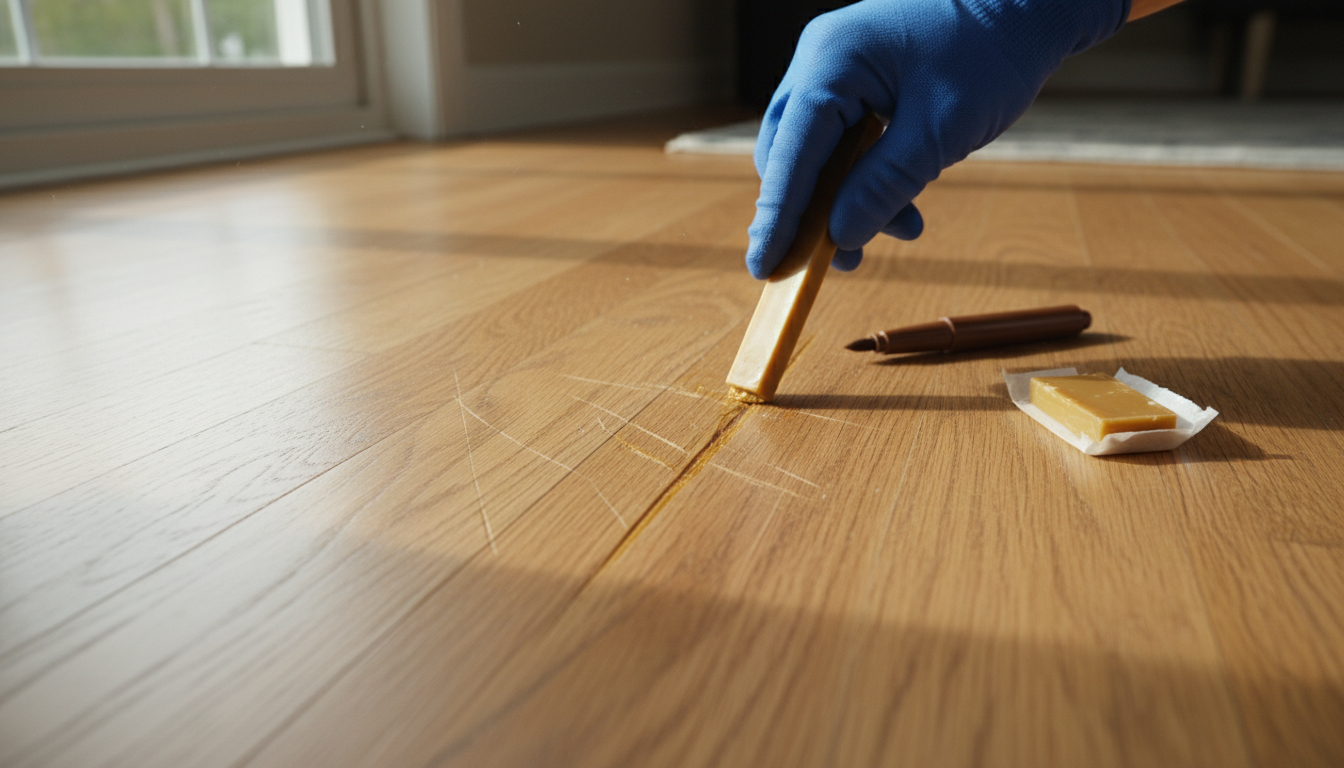

Search "how to repair scratches in hardwood floors" and you get the same five things every time: rub a walnut on it, use a wax stick, try a stain marker, drip in some wood filler, slap on Old English Scratch Cover. None of those articles tell you the one thing that actually matters: which method matches the depth of damage you actually have. A surface scratch in the finish needs a different fix than a gouge into raw wood. A gouge into raw wood needs a different fix than a board with five gouges across it. And a board with five gouges sometimes needs a different fix entirely (replacement, not repair). After 20+ years of fixing hardwood floors across Northern Virginia, this is the decision guide we wish more homeowners had before they spent three weekends and $200 on products that didn't work for their situation. Real DMV pricing for every option, the methods that actually hold up over time, and the two situations where we honestly tell people to stop spot-repairing and refinish the whole floor instead.
Hardwood floor scratch repair in 2026: the short answer for DMV homeowners
Quick answer
Match the fix to the depth of damage. Surface scratches in the finish only (you can't catch a fingernail in them) get fixed with a walnut, a Tibet Almond Stick, or a maintenance recoat. Total cost under $20 DIY. Scratches into the stain layer (you can catch a fingernail, the bottom of the scratch is darker than the surrounding wood) need a stain marker plus polyurethane touch-up. $20 to $80 DIY or $150 to $300 professional spot repair. Gouges into raw wood (the bottom of the scratch is lighter than the finished floor) need wood filler plus stain plus poly. $40 to $120 DIY or $200 to $400 professional. Damage deeper than 1/8 inch, multiple gouges in one board, or splits and chunks missing mean board replacement ($300 to $800 per board professional) or full refinish ($4.50 per square foot all-in DMV pricing). If you have more than 10 deep scratches in a 100 sqft area, or any of the deep damage scenarios above, skip spot repair entirely and refinish the floor.
The 4 levels of hardwood floor scratch damage and how to diagnose yours in 30 seconds
Before you buy a single product, figure out what level of damage you actually have. Run your fingernail across the scratch perpendicular to it. What happens determines which section of this article you need.
| Level | What it looks like | Fingernail test | The right fix | Realistic cost |
|---|---|---|---|---|
| 1. Finish only | White or hazy line on glossy surface, can disappear when wet | Fingernail glides over it, no catch | Buff, walnut, Tibet Almond Stick, or maintenance recoat | Under $20 DIY |
| 2. Stain layer | Dark line slightly below surface, bottom is darker than wood | Fingernail catches lightly | Stain marker plus polyurethane touch-up | $20 to $80 DIY or $150 to $300 pro |
| 3. Raw wood gouge | Light-colored line or divot, bottom is paler than finish | Fingernail catches firmly, can feel depth | Wood filler plus matching stain plus poly | $40 to $120 DIY or $200 to $400 pro |
| 4. Board damage | Split wood, chunk missing, multiple deep gouges, water staining around scratch | Fingernail drops into damage, board is structurally compromised | Board replacement (lace-in from closet) or full refinish | $300 to $800 per board, or full refinish at $4.50/sqft |
The fingernail test takes 30 seconds. Most "I can't get the scratch out" frustration comes from using a Level 1 fix (Old English Scratch Cover, walnut, polish) on Level 2 or Level 3 damage. The product hides the damage for a week and then the dirt works back into the open wood and the scratch looks worse than it started. Diagnose first, then choose the method.
💡 Key takeaway
If you can catch your fingernail in the scratch, it's not a finish-only scratch and the walnut hack won't fix it. You need to fill the depth, not just camouflage the surface. The methods are different and the products are different. See our hardwood maintenance guide for the full DIY-vs-pro decision framework on all hardwood floor issues, not just scratches.
Level 1: Surface scratches in the finish only (and why the walnut hack actually works)
Quick answer
Level 1 scratches are damage to the polyurethane topcoat only. The wood itself is untouched. These show up as white or hazy lines on glossy floors, often from chair legs, vacuum wheels, or grit ground in under shoes. They look worse than they are. Fix them by adding oil or wax to the cracked finish so light refracts through it the same way it does through the surrounding sealed finish. A raw walnut, a Tibet Almond Stick, Howard Restor-A-Finish, or a basic mineral-oil-and-cloth pass will all do this. Total cost: $5 to $20.
The walnut hack (rub a raw walnut across the scratch and the natural oils darken the line) has been circulating on home-improvement TikTok for years. It works on Level 1 scratches because the white appearance isn't paint or chalk; it's micro-cracks in the polyurethane topcoat reflecting light differently than the unbroken finish around them. Walnut oil seeps into those cracks, fills them temporarily, and the light refraction normalizes. The scratch visually disappears. The mechanism is the same as wiping water on a scratched dinner plate. The haze goes away while the water sits in the crack.
The downside: it's temporary. Walnut oil dries out in 2 to 6 months and the scratch comes back. For a permanent Level 1 fix, you have three durable options that we use on real customer floors:
- Tibet Almond Stick ($8 on Amazon). Same mechanism as walnut, but the oil is more stable. Stays put for 6 to 18 months. The best single product for finish-only scratches on dark stained floors.
- Howard Restor-A-Finish ($12 at any hardware store). Comes in colors (golden oak, maple-pine, cherry, walnut, dark walnut, mahogany, ebony). Penetrates the finish and adds tinted oil. Stays put for 12 to 24 months on a properly cleaned floor.
- Maintenance recoat. A fresh thin layer of compatible polyurethane (Bona Traffic HD, Loba Easy Finish, or whatever matches your existing finish) over the entire room. Cost: $1.50 to $2.50 per sqft DIY, $3 to $4.50 per sqft professional. Solves Level 1 scratches across the entire room for 8 to 12 years. The right call if the whole floor is full of finish-only scratches.
The recoat is the option most homeowners don't know exists. It's not sanding. It's not refinishing. It's a screen-and-coat that gets called by a few different names (Bona Pro recoat, screen and recoat, maintenance coat). The crew comes in, lightly abrades the existing finish with a buffer and 120-grit screen, vacuums, then rolls on one fresh coat of poly. The floor is walkable in 4 hours, fully cured in 7 days, and your Level 1 scratches are gone permanently. Cost: $3 to $4.50 per sqft all-in DMV. For a 300 sqft living room that's $900 to $1,350, vs a full sand-and-refinish at $4.50 per sqft. The catch: it only works if the floor hasn't already been recoated with the wrong product (a wax floor can't take poly; some factory-finished engineered floors can't be recoated at all). Have a real installer eyeball it before you go this route.
Level 2: Scratches into the stain layer (when stain markers and wax sticks fix it cleanly)
Quick answer
Level 2 scratches cut through the polyurethane and into the stained surface of the wood, but not into raw wood. The bottom of the scratch is darker than the wood around it (it's wood with stain on top of stain). Fix with a color-matched stain marker (Minwax, Varathane, Old English), wipe off excess after 60 seconds, then dab on a small amount of compatible polyurethane with a fine brush. DIY cost: $20 to $80. Professional spot repair: $150 to $300 per visit for 1 to 5 scratches.
Level 2 scratches are the most common type from dragged furniture and dropped objects on a sealed floor. The bottom of the scratch will appear darker than the surrounding wood because you're looking at wood that absorbed stain on day one (during finishing) plus the stain you're about to apply. The fix is sequential:
- Clean the scratch thoroughly with a damp microfiber cloth (no oil-based cleaners, no Murphy's, no Pledge. Any oily residue will prevent the stain marker from sticking).
- Test stain colors in an inconspicuous spot first. Most homeowners think they have "oak" floors but actually have "golden oak" or "early American". Different colors. Buy two or three markers and pick the closest match.
- Run the stain marker along the scratch in the direction of the wood grain. Wait 60 seconds.
- Wipe off the excess with a clean cloth. The stain should remain in the scratch and have wiped off the surrounding finish.
- Apply one thin coat of water-based polyurethane (Minwax Polycrylic in satin or semi-gloss to match) over just the scratch with a fine artist's brush. Wait 4 hours. Repeat 1 to 2 more times until the sheen matches.
The most common Level 2 mistake: skipping step 5. People apply the stain marker, wipe off the excess, and call it done. The scratch looks better for two weeks. Then dirt and shoe grit work into the open wood (where the polyurethane is gone) and the scratch darkens and widens. You're now repairing a Level 3 scratch with three weeks of ground-in grit. The polyurethane topcoat is what makes the repair durable.
For homeowners who don't want to do the brush work, professional spot repair runs $150 to $300 per visit in the DMV. The pro brings a kit of 12 to 20 stain colors, an exact-match shaker for the polyurethane, and the experience to know which scratches will benefit from spot repair vs which ones will look obvious six months later (more on that in the white-scratches section below). For a single dining room with two or three Level 2 scratches, this is usually the right call. The time you'd spend buying products and testing colors isn't worth the savings.
Level 3: Gouges into raw wood (when wood filler is the right call, and when it's not)
Quick answer
Level 3 gouges expose raw wood. The bottom of the scratch is paler than the finished surface. Caused by dropped tools, dog claws on the run, heavy furniture dragged across the floor without sliders. Fix with a color-matched wood filler (Minwax Stainable, Timbermate, or DAP Plastic Wood), let it cure 24 hours, sand the patch flush with the surrounding floor using 220-grit paper, apply stain, then polyurethane. DIY cost: $40 to $120 for supplies. Professional: $200 to $400 per visit for 1 to 5 gouges.
The decision point at Level 3 is whether to use wood filler at all. Filler works well when the gouge is narrow (less than 1/4 inch wide) and shorter than 4 inches. On wider or longer damage, the filler will telegraph. You'll see the outline of the patch even after staining because the filler accepts stain differently than the surrounding wood grain. Three rules for Level 3:
- Use stainable filler, not pre-colored filler. Pre-colored fillers are mixed to common stain colors at the factory but they almost never match your floor's actual aged stain. A stainable filler dries to a wood tone and accepts the same stain marker you'd use for Level 2. The match is far closer.
- Sand flush, not below flush. Hand-sand with 220-grit paper folded over a small flat block. If you sand into the surrounding finish, you've now added Level 2 damage around your Level 3 repair and your repair area just doubled.
- Three thin layers of polyurethane, not one thick layer. A thick layer of poly over a filled patch will look glossy and wrong against the dulled aged finish around it. Three thin layers, lightly sanded between coats, produces a finish that visually disappears.
For gouges over 1/4 inch wide, more than 4 inches long, or with rough splintered edges, wood filler won't produce a clean result no matter how careful the technique. Those go straight to Level 4 (board replacement or full refinish). The honest installer answer: if you've got a single small gouge from a dropped wrench, fill it. If you've got a 6-inch gouge from a furniture-mover's dolly across the foyer, replace the board or refinish the floor.
⚠️ Watch out
Crayon and wax-stick repairs are sold as Level 3 fixes but they're really just Level 1-and-a-half fixes that fail at Level 3. The wax fills the depth visually but it stays soft, picks up grit, and washes out with the first cleaning cycle. We pull half-fixed crayon repairs out of customer floors every time we go in to refinish. The wax leaves a stained ring around the original gouge that's harder to refinish than the gouge alone. Skip the crayon. Use stainable filler.
Level 4: Damage too deep for spot repair (board replacement or full refinish)
Quick answer
Level 4 means the board itself is structurally damaged. Splits, chunks missing, water staining around a scratch (water got in and the board is now warped or rotted), 5+ deep gouges within a single board, or scratches deeper than 1/8 inch. Spot repair won't produce a clean result. Two real fix paths: lace in a replacement board from a closet or under-furniture pull ($300 to $800 per board professional), or refinish the whole floor ($4.50 per sqft all-in DMV). The right call depends on how many boards are damaged and the floor's overall condition.
Lacing in a replacement board is the technique most DIY blogs skip because it's the hardest scratch repair to pull off well. The pro pulls a matching board from a hidden area (inside a closet, under a future-replacement appliance, under the refrigerator, under a sofa) and uses it to replace the visible damaged board. The closet then gets a slightly mismatched new board, but nobody sees it. Done right, the replaced board in the visible room looks identical to the surrounding floor because the wood, age, oxidation, and finish all match.
Done wrong, the replaced board looks obvious because the installer used a brand-new piece of oak (or whatever species) and it's lighter than the aged surrounding floor. Wood oxidizes. That 1965 white oak floor you have isn't the color of new white oak anymore. Lacing in fresh material guarantees a visible mismatch unless the installer then sands and refinishes the entire room to even out the color. At which point you've paid for board replacement AND a refinish. The lace-from-closet method avoids that.
The break-point math: if you have 1 to 3 Level 4 boards in a room of 200 sqft or less, lace-in replacement is usually cheaper than full refinish ($300 to $2,400 vs ~$900 to $1,500 for a 200 sqft refinish at $4.50/sqft). If you have 4+ Level 4 boards, or any Level 4 damage across multiple rooms, full refinish is almost always cheaper and produces a better-looking result. We walk through this decision in detail on our refinish vs replacement guide, including the question of when to replace the floor entirely instead of refinishing.
How to repair hardwood floor scratches without sanding the whole floor
"How do I fix this without sanding?" is the highest-volume search around hardwood scratches because nobody wants to move out of the house for 5 days and pay $1,500 to handle a single dining room scratch. The honest answer: 80 percent of hardwood scratches don't need a full sand-and-refinish.
| Scratch situation | Right fix (no sanding required) | When you DO need to sand |
|---|---|---|
| 1 to 5 scratches, all Level 1 or 2 | Stain marker + spot polyurethane touch-up | Never. Spot repair handles this cleanly |
| 1 to 3 gouges, all Level 3, narrower than 1/4 inch | Wood filler + stain + spot polyurethane | Never. Spot repair handles this cleanly |
| Whole room of fine surface scratches (Level 1) | Bona Pro recoat (screen and coat) | Never. Recoat is the no-sand option that solves this |
| 1 to 3 Level 4 boards, room otherwise good | Board lace-in from closet | Sand the laced boards only, then spot-stain to blend |
| 10+ scratches across the room, mixed levels | Full sand-and-refinish | Yes. Spot repair won't visually match across that volume |
| Whole floor looks dull plus scratches | Full sand-and-refinish | Yes. The finish itself is at end of life, not just scratched |
The professional spot-refinish technique deserves its own callout because most DIY guides skip it. A pro spot-refinish goes like this: tape off the damaged area, lightly hand-sand just the scratch and a 2-inch perimeter with 220-grit, apply stain to match the surrounding color, build up 3 thin coats of polyurethane in the affected zone, then feather the edges of the new poly into the existing finish with a fine abrasive pad. Done well, the repair is invisible. The video embedded above shows the cross-grain spot-refinish technique applied to a real customer floor that had been scratched during a TV install. Same method we use on DMV customer calls.
White scratches on wood floors: what they actually are and why most repair products fail on them
Quick answer
White scratches on hardwood floors are almost always damage to the polyurethane topcoat only, not the wood underneath. The white color is the optical effect of micro-cracks in the clear poly. Products designed for stain-layer repair (Old English Scratch Cover, Howard Restor-A-Finish, stain markers) won't permanently fix them because there's no stained wood to color-match. The right fix is to restore the poly's clarity: either an oil-based blend (Tibet Almond Stick, walnut, mineral oil) for a temporary 6 to 18 month fix, or a polyurethane recoat for a permanent fix.
This is the most-misdiagnosed scratch type in DMV homes. Homeowners see white lines on their floor and assume they need a stain repair. They buy stain markers, apply them carefully, and the marker either disappears entirely (because there's no porous wood to absorb the pigment) or it leaves a smudged dark line where the white was, making the problem look worse.
The diagnostic test for white scratches: spray a tiny amount of water on the scratch. If the white disappears when the scratch is wet and reappears when it dries, you have a Level 1 finish-only scratch and you need an oil-based fix or a recoat. No stain marker required.
The exception: on dark-stained floors (ebony, espresso, dark walnut), some white scratches are actually Level 2 stain-layer scratches that look white because the bare wood underneath the stain is lighter than the heavily-pigmented finish. In that case water won't make them disappear, and a dark walnut stain marker plus poly touch-up is the right call. Test with water first. It tells you in 10 seconds which fix to use.
DIY methods that actually work in 2026 (and the 3 that wreck your next refinish)
After 20+ years of pulling out failed DIY repairs before we can refinish a floor, here's the honest practitioner take on the most-recommended DIY methods:
| DIY method | Verdict | Notes |
|---|---|---|
| Tibet Almond Stick | ✅ Works on Level 1 | Best single product for finish-only scratches. Stays put 6 to 18 months. |
| Walnut rub | ✅ Works on Level 1 (temporary) | Free, fast, dries out in 2 to 6 months. Useful for pre-listing photos. |
| Howard Restor-A-Finish | ✅ Works on Level 1 and light Level 2 | Tinted oil. Pick the right color or skip it. Stays put 12 to 24 months. |
| Stain marker (Minwax, Varathane) | ✅ Works on Level 2 if topped with poly | Skipping the poly topcoat is the #1 reason these repairs fail by month 3. |
| Stainable wood filler | ✅ Works on Level 3 narrow gouges | Color-match the stain after, not before. Hand-sand flush, never below flush. |
| Bona Pro recoat | ✅ Best whole-room fix for Level 1 | $3 to $4.50/sqft DMV. Permanent. Floor walkable in 4 hours. |
| Vinegar plus olive oil | ❌ Wrecks the finish | Acetic acid breaks down poly. Olive oil oxidizes and turns yellow. Leaves a sticky film that all future products will fail to adhere to. |
| WD-40 | ❌ Wrecks the finish | Silicone in WD-40 prevents poly from bonding. We can't refinish a floor that's had WD-40 on it without an extra chemical-strip step ($1.50/sqft extra). |
| Crayon and heat gun | ❌ Looks bad in 2 weeks | Wax stays soft, picks up grit, washes out. Leaves a colored ring around the original scratch. |
| Old English Scratch Cover (dark woods only) | ⚠️ Works on dark Level 1 but stains adjacent finish | OK if your floor is already very dark. On medium oak it leaves dark smears that don't wipe off. |
| Coconut oil, mayonnaise, banana peel | ⚠️ Works briefly, then fails | Same mechanism as walnut. Stay with walnut or Tibet Almond Stick. They're tested for this. |
💡 Key takeaway
Vinegar and olive oil, WD-40, and Pledge are the three DIY methods that make a future professional refinish harder and more expensive. If there's any chance you'll refinish in the next 5 years, skip these completely. Use a Tibet Almond Stick or stain marker plus poly instead. Those don't contaminate the surface for future work.
Pet scratches: when spot repair works and when it's time to refinish the whole floor
Dog claws are the #1 cause of hardwood floor scratches we see in DMV homes, by a wide margin. The damage pattern is distinct: many shallow parallel scratches running in random directions, concentrated in the rooms the dog uses most (entry hall, kitchen, the path between front door and back door). Cats also scratch but the pattern is different: concentrated near sofas and windowsills, with some deeper isolated gouges where they jump down from height.
The decision tree for pet scratches:
- Under 5 scratches per 100 sqft, all Level 1 to 2: spot repair with stain marker plus poly is fine. Total cost: $20 to $80 DIY or one $150 to $300 pro visit. Trim the dog's nails monthly and add rugs in high-traffic paths to prevent recurrence.
- 10+ scratches per 100 sqft, mostly Level 1: Bona Pro recoat handles the whole room. $3 to $4.50 per sqft DMV. Adds a fresh poly layer that resists the next 12 to 18 months of paw traffic.
- 10+ scratches per 100 sqft, mixed Levels 2-3: full sand-and-refinish. Spot-repairing this volume will show. Your repaired patches will be a different finish age than the surrounding floor, and the result looks like a quilt. $4.50/sqft all-in DMV.
- Deep claw gouges over time on softer woods (pine, fir, soft maple, basement oak with low-quality original finish): refinish AND consider upgrading the finish to a harder commercial-grade poly (Bona Traffic HD, Loba Easy Finish). Standard residential poly won't hold up to a 70-pound dog's daily traffic.
The pet-specific advice we give to DMV customers: schedule a Bona Pro recoat every 3 to 5 years if you have an active dog. It's preventative. The recoat refreshes the wear layer before the dog's claws get through to the stain or wood. Recoats every 3 to 5 years at $1,000 to $1,500 per room is cheaper than a full refinish every 8 to 10 years at $1,500 to $3,000 per room, and the floor never looks bad. See our pet-friendly flooring guide for the breed-specific considerations and finish-type comparisons.
Real DMV pricing: DIY supplies vs professional spot repair vs full refinish cost
Here's what the four real fix paths actually cost in 2026 across Alexandria, Arlington, Fairfax, McLean, Falls Church, Reston, and the rest of the DMV metro:
| Fix path | DIY supply cost | Professional cost (DMV) | How long it lasts |
|---|---|---|---|
| Tibet Almond Stick (Level 1, 1 to 10 scratches) | $8 plus a microfiber cloth | Not offered. DIY only | 6 to 18 months |
| Stain marker plus poly (Level 2, 1 to 5 scratches) | $20 to $80 (2 to 3 markers plus poly plus brush) | $150 to $300 per visit | 5 to 10 years if no traffic concentration |
| Wood filler plus stain plus poly (Level 3, 1 to 5 gouges) | $40 to $120 | $200 to $400 per visit | 5 to 10 years |
| Board lace-in (Level 4, 1 to 3 boards) | Not practical DIY (matched material plus tool rental plus skill) | $300 to $800 per board | Permanent (board is replaced) |
| Bona Pro recoat (whole room, Level 1 dominant) | $300 to $500 for 200 sqft DIY | $600 to $1,400 for 200 sqft pro (at $3 to $4.50/sqft) | 8 to 12 years |
| Full sand and refinish (10+ damaged areas or end of finish life) | Not recommended DIY | $4.50/sqft all-in DMV (Potomac pricing). 300 sqft = $1,350. 600 sqft = $2,700. | 15 to 25 years before next refinish |
Two things to know about our $4.50/sqft refinish pricing. First, it's all-in: sanding, staining (if you want a color change or refresh), three coats of polyurethane, dust containment, baseboards taped and protected, walkable in 24 hours, fully cured in 7 days. Second, the floor has to have at least 1/16 inch of solid wood remaining over the tongue for a refinish to work. Engineered floors with thin wear layers (less than 1/8 inch) can only be refinished once or twice; some can't be refinished at all. We assess this for free at the consult. More on the math at our hardwood installation cost guide and per-square-foot pricing breakdown.
The two situations where we tell DMV homeowners to stop repairing and refinish instead
About 1 in 5 customers who call about scratch repair are better served by skipping spot repair entirely and going straight to a full refinish. The math works out cheaper, the result looks better, and they get 15 to 25 years before they have to think about it again. Two situations where this is the honest answer:
Situation 1: The whole-floor density problem. If you have more than 10 visible scratches per 100 sqft, spot-repairing each one produces a patchwork. The repaired areas look slightly different than the surrounding floor: different finish age, slightly different sheen, slightly different stain saturation. From standing height it's invisible. From sitting on the couch it's obvious. The floor goes from "scratched but uniform" to "patched and uneven." A full refinish at $4.50/sqft removes everything to bare wood and lays down a fresh uniform finish. For a 300 sqft living room, that's $1,350, vs $1,500+ in spot repair visits that don't look as good.
Situation 2: The finish is at end of life anyway. Polyurethane finishes last 8 to 25 years depending on traffic, finish quality, and dog-or-no-dog. If your floor is dull across the whole room (no longer reflective when wet), or the scratches are visible because the surrounding finish has worn down to bare wood in some spots, or the stain color looks faded compared to where the rug used to sit, you're at end-of-life. Spot-repairing scratches on a worn finish is like patching the holes in a worn-out shirt. The patches will outlast the shirt. Refinish the floor. You'll get 15 to 25 years out of the new finish.
⚠️ Watch out
Some contractors will quote spot repair on a floor that's clearly at end-of-life because it's an easier sell ($300 vs $1,500). Six months later you call back about new scratches that surfaced, and again, and again. After 18 months you've spent $1,800 on repeated spot repairs and you still need a refinish. The honest installer tells you on the first visit whether your floor is a candidate for spot repair or whether it's refinish time. Ask for an opinion on the overall floor condition before they quote the scratch.
FAQs about hardwood floor scratch repair in Northern Virginia
How do you get scratches out of hardwood floors without sanding?
For surface scratches in the polyurethane only (you can't catch a fingernail in them), use a Tibet Almond Stick, Howard Restor-A-Finish, or a walnut rub. For scratches into the stain layer (fingernail catches), use a color-matched stain marker followed by a thin polyurethane brush-on touchup. For a whole room of fine scratches, a Bona Pro recoat at $3 to $4.50 per sqft DMV restores the finish without sanding. Sanding is only required for deep gouges into raw wood, multiple damaged boards, or end-of-life finish.
Can scratches in hardwood floors be fixed?
Yes. Every level of scratch damage on a solid hardwood floor is fixable. Surface scratches in the finish are fixed by oil-based products or a recoat. Stain-layer scratches are fixed by stain marker plus polyurethane touch-up. Raw wood gouges are fixed by stainable wood filler plus stain plus poly. Board-level damage is fixed by lacing in a replacement board or refinishing the whole floor. The only case where a scratch is truly unfixable is if the board itself is rotted or split through to the subfloor, in which case board replacement is required.
Does vinegar and olive oil fix wood scratches?
No. The internet recipe of vinegar plus olive oil is one of the most damaging DIY methods we encounter on customer floors. Vinegar's acetic acid breaks down polyurethane finishes over time, leaving the floor more vulnerable to future damage. Olive oil oxidizes and turns yellow within 6 to 12 months, leaving a sticky discolored film that's hard to remove and impossible to refinish over without a chemical strip. The walnut hack works for the same reason (oil in the cracks) but walnut oil is more stable and doesn't oxidize. Use walnut, Tibet Almond Stick, or Howard Restor-A-Finish. Skip the vinegar.
How much does it cost to repair a deep scratch in a hardwood floor?
A single deep scratch (Level 3, narrow gouge into raw wood) costs $200 to $400 for professional spot repair in the DMV. That includes a color-matched filler, stain matching, three coats of polyurethane, and feathering the edges so the patch doesn't show. DIY supplies for the same fix run $40 to $120 (stainable filler, two or three stain markers to find the match, a small can of poly, brushes). The pro premium covers color-match expertise and the brush technique that makes the patch invisible. Most homeowners spend the same total over a weekend and end up with a patch that's slightly visible.
How to make scratches on wood floor less noticeable?
For finish-only scratches, oil-based products (Tibet Almond Stick, walnut, mineral oil) make the scratch optically disappear by filling the micro-cracks in the polyurethane so light refracts evenly. For stain-layer scratches, a color-matched stain marker is the start, but skip the polyurethane topcoat at your own risk. Without the topcoat, the repair looks great for two to four weeks and then dirt works into the open wood, darkening the scratch and making it look worse than the original. For a quick same-day camouflage before a real estate showing or photos, walnut works on every floor. It's not permanent but it lasts 6 to 10 weeks.
What is the best hardwood floor scratch repair kit?
For most DMV homes, a 6-color stain marker set ($25 to $35 on Amazon: Minwax, Varathane, or Furniture Clinic) plus a small can of Minwax Polycrylic ($12) is the best DIY scratch kit because it handles Levels 1 through 3 with one set of supplies. Brand-name scratch repair kits (Old English, Howard, ScratchHide) are usually optimized for one specific finish color and don't match well across different floors. If your floor is dark-stained (ebony, walnut, espresso), Howard Restor-A-Finish in dark walnut color is a strong single-product pick. For raw wood gouges, add a small tube of Minwax Stainable Wood Filler ($6). That completes the kit at around $50 total.
When should I refinish my hardwood floors instead of repairing them?
Three triggers tell you it's refinish time, not repair time. First, if you have more than 10 visible scratches per 100 sqft: spot repair will produce a patchwork. Second, if the finish itself is at end of life (dull across the room, worn through to bare wood in traffic paths, faded stain color around the perimeter). Third, if any of the scratches are deeper than 1/8 inch with rough splintered edges or multiple gouges within one board. The economic break-even on a 300 sqft room is around 10 to 15 spot-repair instances. At the cost of $200 to $400 each, full refinish at $4.50/sqft ($1,350) becomes cheaper and looks better.
Do white scratches on hardwood floors go away with water?
If a white scratch disappears when you spray water on it, you have a Level 1 finish-only scratch. Only the polyurethane is damaged, not the wood. The fix is an oil-based product (Tibet Almond Stick, walnut) for a 6 to 18 month temporary solution, or a polyurethane recoat for a permanent solution. If the white scratch stays white when wet, you likely have a Level 2 stain-layer scratch on a dark-stained floor (the wood under the dark stain is lighter than the surface), and you need a color-matched stain marker followed by a polyurethane brush touchup. The water test takes 10 seconds and tells you which fix to use.
Will a Bona recoat fix scratches?
A Bona Pro recoat (screen and recoat) fixes Level 1 surface scratches across an entire room and adds 8 to 12 years of fresh wear surface. It does NOT fix Level 2 stain-layer or Level 3 raw-wood scratches. Those need to be spot-stained and filled before the recoat goes down. A typical DMV Bona recoat for a 300 sqft living room runs $900 to $1,400 and includes the screen-and-coat, basic furniture moving, and walkability in 4 hours. Recoats can only be done on floors with a compatible polyurethane finish (most polyurethaned floors qualify; waxed floors and some factory-finished engineered floors don't). We diagnose this at the free consult.
Bottom line: the hardwood scratch repair decision tree
The 30-second decision
Do the fingernail test first. If your fingernail glides over the scratch, it's Level 1: use a Tibet Almond Stick or walnut, or schedule a Bona Pro recoat if the whole room is affected. If your fingernail catches lightly and the scratch is darker than surrounding wood, it's Level 2: stain marker plus thin polyurethane topcoat. If your fingernail catches firmly and the scratch is lighter than the finish, it's Level 3: stainable wood filler plus stain plus poly, or pay $200 to $400 for a pro spot repair. If the board is split, has a chunk missing, or has 5+ deep gouges in one board, it's Level 4: lace in a replacement board ($300 to $800) or refinish the whole floor ($4.50/sqft all-in DMV). And if you have more than 10 scratches per 100 sqft, or your finish is dull across the room, skip spot repair and refinish instead. You'll save money and the floor will look better when it's done.
Most homeowners spend more on the wrong scratch repair than they would have spent on the right one. The fix isn't expensive; the cost is buying the wrong products for the wrong damage level three times in a row before you find what works. If you're in Alexandria, Arlington, Fairfax, McLean, Vienna, Falls Church, Reston, Bethesda, or anywhere else in the DMV metro, we'll come look at your floor in person for free and tell you exactly which level your scratches are at, which fix path is right for your situation, and what it actually costs. No upsell to a refinish if spot repair is the right call. No spot repair quote if your floor is at end-of-life anyway. Schedule a free quote here or call the shop directly. Honest math, no surprises.