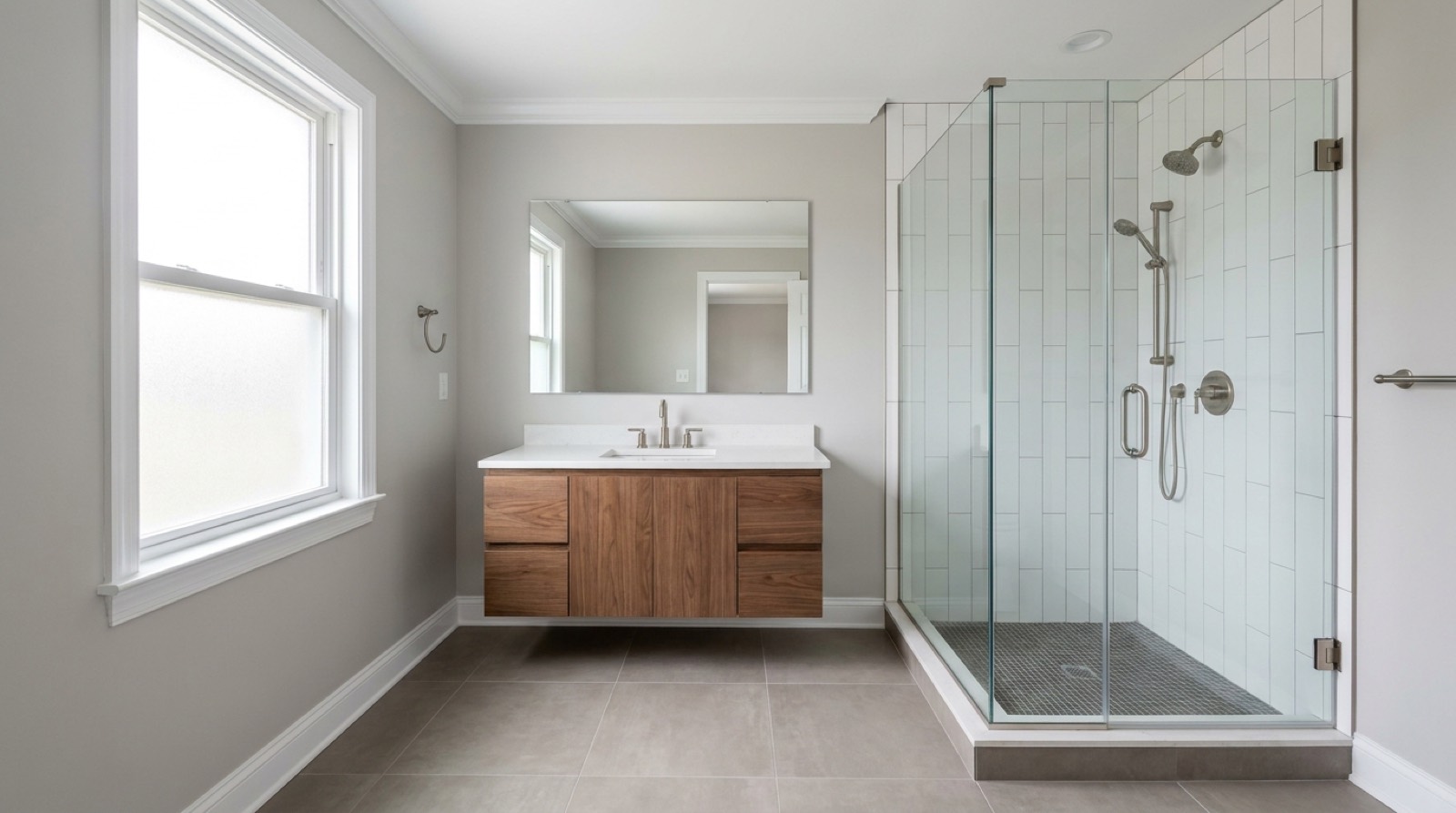
The short answer on bathroom remodel cost
Quick answer
In the DMV in 2026, a bathroom remodel typically runs about $8,000 to $15,000 for a cosmetic refresh, $18,000 to $35,000 for a full mid-range remodel, and $40,000 and up for a large or high-end master bath. Labor is the largest single share of that number, and the one decision that moves it most is whether you keep the existing layout or move the plumbing. These are DMV market estimates; the real price comes from the actual room, its condition, and the finishes you pick.
Bathroom remodel cost is the question everyone asks first, and it is the hardest one to answer with a single number, because two bathrooms of the same size can be very different jobs. What follows is how the money actually breaks down in Northern Virginia, DC, and Maryland: the real cost ranges by size and scope, where every dollar goes, what pushes the number up or down, and the old-home and condo realities that catch people off guard. We quote bathroom remodels custom for a reason, and by the end of this you will understand why, and roughly where your project lands. For the room-by-room material decisions that feed into this, our DMV bathroom flooring guide is the companion piece.
What a DMV bathroom remodel costs in 2026
Quick answer
Three broad tiers cover most DMV bathrooms: a cosmetic refresh (new vanity, toilet, fixtures, paint, keep the layout) at roughly $8,000 to $15,000; a full mid-range remodel (new tile, tub or shower, vanity, everything replaced, same footprint) at roughly $18,000 to $35,000; and a high-end or master remodel (large space, custom tile, curbless shower, moved plumbing) at $40,000 to $75,000 or more. DMV labor runs higher than the national average, so national "average cost" numbers usually read low here.
| Tier | DMV cost estimate | What it includes |
|---|---|---|
| Cosmetic refresh | $8,000 - $15,000 | New vanity, toilet, faucet, light, mirror, paint, sometimes new floor tile. Same layout, existing tub/shower kept or reglazed. |
| Full mid-range remodel | $18,000 - $35,000 | Everything replaced: floor and wall tile, new tub or tiled shower, vanity, toilet, fixtures, lighting. Same footprint, no moved plumbing. |
| High-end / master | $40,000 - $75,000+ | Larger room, custom tile work, curbless or frameless shower, double vanity, heated floor, moved plumbing or a reconfigured layout. |
The national figures you will see quoted (often $6,600 to $16,500 as an "average") are real, but they average in low-cost-of-labor markets that do not reflect the DMV. Skilled trade labor here (plumbers, tile setters, electricians) costs more, and our older housing stock tends to add prep work, so a straight national average usually reads low for Alexandria, Arlington, Bethesda, or DC. The tiers above are calibrated to what these jobs actually run locally. Where you land inside a tier comes down to size, finishes, and how much of the plumbing and framing you disturb, which the rest of this guide walks through.
Powder room, full bath, and master: what each runs
Quick answer
Size sets the floor of the budget. A small powder room (no tub or shower) is the cheapest remodel; a standard full hall bath is the most common and the mid-range numbers above apply; a large primary or master bath is the most expensive because of the square footage, the shower build, and the higher-end finishes people choose for it. Cost per square foot actually rises in bigger baths because the expensive elements (shower, tile) grow with the room.
| Bathroom type | Typical DMV cost | Why |
|---|---|---|
| Powder room / half bath | $6,000 - $14,000 | No tub or shower to build. Vanity, toilet, floor, fixtures, paint. Small space, but plumbing and finish quality still drive it. |
| Full hall bath (~40-60 sqft) | $18,000 - $32,000 | The most common DMV remodel. Tub or tiled shower, floor and wall tile, vanity, toilet, everything new. |
| Primary / master bath (~80-120+ sqft) | $35,000 - $75,000+ | Larger tiled area, often a separate shower and tub, double vanity, and higher-end finishes. The shower build is the big line item. |
People expect a big bathroom to cost more, but they are often surprised that the cost per square foot climbs too. A powder room might run $250 to $350 per square foot; a master bath can run $450 to $650 per square foot or more. The reason is that the expensive parts of a bathroom (the tiled shower, the waterproofing, the plumbing fixtures) do not shrink much in a small room and grow a lot in a big one. A master bath usually adds a second sink, a separate tub, more tile, and nicer finishes, so both the total and the per-foot number go up together. If you are weighing where to spend, our DMV resale value guide covers which upgrades actually return money when you sell.
Where the money actually goes
Quick answer
Labor is the biggest slice of a bathroom remodel, usually 40 to 55 percent of the total, because a bathroom packs plumbing, tile, electrical, and carpentry into a tiny room. Tile and materials are next, then fixtures (vanity, toilet, tub, shower), then plumbing and electrical, then permits and demo. Most of your money is buying skilled labor, not the parts you can see in a store.
| Line item | Typical share | Notes |
|---|---|---|
| Labor / installation | 40-55% | Tile setting, plumbing, electrical, carpentry, waterproofing. The single largest cost, and where DMV rates run above the national average. |
| Tile & materials | 15-25% | Floor and wall tile, waterproofing membrane, backer board, grout, thinset. Swings widely with tile choice. |
| Fixtures | 12-20% | Vanity, countertop, sink, toilet, tub or shower base, faucets, glass. The easiest place to spend or save. |
| Plumbing & electrical rough-in | 8-15% | Higher if you move any fixture. New lines, valves, venting, GFCI, exhaust fan, lighting. |
| Permits, demo, disposal | 5-10% | Permit fees, tear-out labor, dumpster/haul-away, and any unexpected repair reserve. |
The number that surprises people is labor. A bathroom is the most trade-dense room in a house: in a space the size of a large closet you have plumbing, waterproofing, tile, electrical, ventilation, and finish carpentry, and each of those is skilled work that has to be done in the right order and pass inspection. That is why you cannot meaningfully cut the cost of a good bathroom by shopping for a cheaper vanity. The vanity is a small slice; the labor to set tile flat, waterproof a shower so it never leaks, and rough in plumbing to code is the majority of the bill, and it is the part you are actually paying a contractor for. Fixtures are where you have real control, because the gap between a builder-grade vanity and a designer one is entirely your choice.
What drives the price up or down
Quick answer
The biggest cost drivers are, in order: whether you move the plumbing, the shower type (prefab base vs fully tiled vs curbless), the tile choice and amount, the fixture grade, the room's size, and the condition of what is behind the walls. Keep the layout, use a quality prefab shower base, and pick mid-grade fixtures, and you stay in the mid-range. Change any of those and the number climbs.
| Driver | Budget choice | Cost-adding choice |
|---|---|---|
| Layout | Keep fixtures where they are | Move toilet, shower, or sink (opens the floor, reroutes drains) |
| Shower | Acrylic or tiled shower on a prefab base | Fully tiled pan, curbless/zero-entry, frameless glass, bench, niche |
| Tile | Standard porcelain, straight lay, floor only | Large-format, mosaic, floor-to-ceiling walls, patterns, natural stone |
| Fixtures | Stock vanity, mid-grade faucets | Custom vanity, designer fixtures, heated floor, smart toilet |
| Condition | Sound subfloor and plumbing | Rot, mold, old cast-iron drains, out-of-level floor to fix |
Notice that the two cheapest ways to control cost are the two decisions you make before anyone picks up a tool: keep the layout, and pick the shower type. Everything downstream of those, tile and fixtures, is a dial you can turn up or down to taste. The two most expensive surprises, moved plumbing and bad conditions behind the wall, are exactly the ones a homeowner cannot see when they get a low bid over the phone. That is why the honest number only comes from someone walking the actual room. The next two sections cover the plumbing multiplier and the tile variable, because those are the two that move the budget the most.
The biggest multiplier: moving plumbing
Quick answer
Keeping every fixture where it is keeps a remodel affordable. The moment you move the toilet, shower, or sink to a new spot, you open the floor, reroute drain and supply lines, re-vent, and add a plumbing inspection, which commonly adds $3,000 to $8,000 or more. A "same layout" remodel and a "new layout" remodel of the same size are two different price classes.
This is the single decision that most often turns a $25,000 bathroom into a $40,000 one. When fixtures stay put, the plumber connects new fixtures to existing rough-in, and the job moves fast. When you move a toilet even a couple of feet, someone has to open the floor, cut and reroute the drain line at the correct slope, add or move venting, and get it re-inspected before the floor closes back up. In an older DMV home that can mean cutting into a finished ceiling below, and if the existing drain is cast iron (common in Old Town Alexandria, older Arlington, and DC rowhouses), disturbing it often means replacing a section that cracks when touched. None of that is visible on a floor plan, which is why moving plumbing is the classic "the bid came in way over what I expected" driver. If you love a new layout it can be worth it, but go in knowing it is a real cost step, not a small tweak. The behind-the-wall realities that make this pricier in old homes are covered in our subfloor guide.
Why tile is the biggest variable
Quick answer
Tile is where two bathrooms of the same size split apart on price, because both the material and the labor scale with how much tile you use and how hard it is to set. A floor-only porcelain job is modest; floor-to-ceiling walls, a mosaic shower pan, large-format tile that needs a leveled substrate, or a herringbone pattern all add material and hours. Tile is usually the second-biggest line after labor, and much of the labor is tile-setting.
Tile is the part of a bathroom where your taste has the most direct effect on the bill. The material itself ranges from a few dollars a square foot for standard porcelain to well over ten for stone or specialty tile, but the bigger swing is labor. A straight-lay floor is quick; a floor-to-ceiling tiled shower with a mosaic pan, a niche, and a bench is many more hours of skilled setting, plus the waterproofing behind it that you never see but absolutely pay for. Large-format tile, which reads modern and minimizes grout lines, needs a flatter substrate (roughly 1/8 inch of variation over 10 feet), and a lot of DMV bathroom floors fail that until they are leveled, which is its own line item. The tile-body decision (porcelain vs ceramic vs stone) is walked through in our porcelain vs ceramic guide, the floor-specific pick is in our best tile for a bathroom floor guide, and the grout and sealing choices that affect long-term maintenance are in our grout guide.
DMV cost realities: old homes and condos
Quick answer
Two DMV factors change the price beyond finishes: old housing stock and condo rules. Pre-1960 homes in Old Town, Arlington, and DC often have cast-iron drains, galvanized supply lines, plaster walls, and undersized joists that add prep. Condos and high-rises add building water-shutoff scheduling, HOA work-hour and insurance rules, and sound and waterproofing requirements that a house does not have.
The DMV is not a uniform market, and the house type changes the job. In the region's older homes, a lot of cost lives behind the walls: cast-iron waste lines that are near the end of their life and crack when disturbed, galvanized supply lines that should be replaced while the wall is open, plaster-and-lath walls that are messier to demo than drywall, and framing that predates modern spans, so an old floor may need reinforcing before heavy tile goes down. None of that is optional once it is exposed, and it is why an Old Town rowhouse bath and a 1990s Ashburn colonial bath of the same size can price differently. Condos and high-rises in places like Tysons, Ballston, and downtown DC add a different layer: the building controls the water shut-off and often requires scheduling it in advance, HOAs limit work hours and require the contractor to carry specific insurance and file a certificate, and many buildings have sound-transmission and waterproofing rules for any work over another unit. These are not huge line items individually, but they add coordination and time, and a contractor who has not worked in DMV condos before tends to underbid them and then run over.
The behind-the-wall surprises to budget for
Quick answer
Budget a 10 to 15 percent contingency on top of the quote for what demo uncovers. The common finds in DMV bathrooms are hidden water damage and rot around the tub and toilet, mold behind old tile, failed or missing waterproofing, corroded cast-iron or galvanized pipe, and out-of-level or damaged subfloor. A good contractor flags the likely risks up front; the reserve covers the ones nobody can see until the wall is open.
⚠ Watch out
Beware the bid that is thousands below the others. Bathrooms are the room where hidden damage is most common, because water has been sitting behind tile and under the toilet for years. A lowball bid often means the contractor either has not accounted for what they will find, or plans to hit you with change orders once the wall is open and you are committed. A realistic quote that names the likely surprises is worth more than a cheap one that ignores them.
Almost every bathroom demo turns up something, because water is patient and a bathroom has had years of it. The usual finds are soft, rotted subfloor around the toilet flange and the tub, mold or mildew behind old tile that was never properly waterproofed, and, in older homes, pipe that should be replaced while it is accessible. This is not a reason to fear a remodel; it is a reason to budget for it. We build a realistic picture on the estimate by telling you what we expect to find based on the age and type of your home, and we recommend keeping a 10 to 15 percent reserve for the things that only show up once the old bathroom is out. The homeowners who get blindsided are usually the ones who took the cheapest bid, which had no room in it for reality.
How we price a bathroom
Quick answer
We quote bathroom remodels custom because the honest number depends on the actual room. We walk the space, look at the layout, the shower, the tile you want, and the condition of what we can see, and we give you an all-in price: demo, prep, materials, professional installation by our in-house crew, and cleanup, with the likely surprises named up front. No phone-quote guesses, no bait price that grows mid-job.
Bathroom remodeling is the one service we do not put a single per-square-foot number on, and that is on purpose: it would be a guess, and a guess is how homeowners get burned. A 35 square foot powder room with a sound subfloor and a stock vanity is a fundamentally different job from a 100 square foot master with a curbless tiled shower and moved plumbing, so a real quote has to start with the real room. What stays constant is how we price it: all-in, with demo and disposal, prep, materials, and professional installation by our own in-house crew (no subcontractors) in one number, and the risks we expect flagged before you sign, not sprung on you halfway through. That is the same all-in, no-surprises approach behind every quote we write, which we lay out in our guide to the hidden charges in a flooring quote. If you want the flooring side of the decision first, the best flooring for DMV bathrooms guide covers what goes on the floor.
FAQs about bathroom remodel cost
How much does a bathroom remodel cost in the DMV?
In 2026, expect roughly $8,000 to $15,000 for a cosmetic refresh, $18,000 to $35,000 for a full mid-range remodel with the same layout, and $40,000 and up for a large or high-end master bath. DMV labor runs above the national average, so national "average cost" figures usually read low here. The real number depends on the room, the finishes, and whether you move any plumbing.
Why is a bathroom remodel so expensive?
Because a bathroom is the most trade-dense room in a house. In a small space you have plumbing, waterproofing, tile, electrical, ventilation, and carpentry, all skilled labor that has to be done in order and pass inspection. Labor is 40 to 55 percent of the bill, so most of your money buys expertise, not the fixtures you see in a store.
What is the most expensive part of a bathroom remodel?
Labor overall, and within the work, the tiled shower and any moved plumbing. A fully tiled shower with waterproofing, a mosaic pan, and glass is many hours of skilled work. Moving a toilet or shower to a new spot opens the floor and reroutes drains, which commonly adds $3,000 to $8,000 or more.
Does moving the toilet or shower add a lot to the cost?
Yes. Keeping fixtures where they are lets the plumber connect to existing rough-in and keeps the job affordable. Moving them means opening the floor, rerouting drain and supply lines, re-venting, and a plumbing inspection, often $3,000 to $8,000 or more, and more in older homes with cast-iron drains that crack when disturbed.
How much should I budget for surprises?
Keep a 10 to 15 percent contingency on top of the quote. Bathroom demos commonly uncover rotted subfloor, mold behind old tile, failed waterproofing, and old pipe that should be replaced while the wall is open. A good contractor names the likely risks up front, but the reserve covers what nobody can see until demo.
How long does a bathroom remodel take?
A cosmetic refresh can be a few days. A full mid-range remodel usually runs about two to three weeks of work, longer if plumbing is moved, custom materials are on order, or inspections and condo scheduling add time. Tile setting and waterproofing have required cure times that cannot be rushed without risking the job.
Bottom line: how to budget yours
Budget by scope, not by a single average. A cosmetic refresh in the DMV runs roughly $8,000 to $15,000, a full same-layout remodel $18,000 to $35,000, and a large or high-end master $40,000 and up, with labor as the biggest slice of every one of those. The two decisions that move your number the most are made before any work starts: keep the layout instead of moving plumbing, and choose the shower and tile scope you actually want. Then keep a 10 to 15 percent reserve for what demo uncovers, because in DMV bathrooms it usually uncovers something.
We remodel bathrooms across the DMV, and every quote is all-in: demo and disposal, prep, materials, and professional installation by our in-house crew with no subcontractors, with the likely surprises named before you sign, not after. Because the honest price depends on your actual room, the right next step is a real look at it. Request a free estimate or call us at 571-341-7247 and we will walk the space, talk through the layout and finishes, and give you a straight number. The full service is on our bathroom remodeling page.