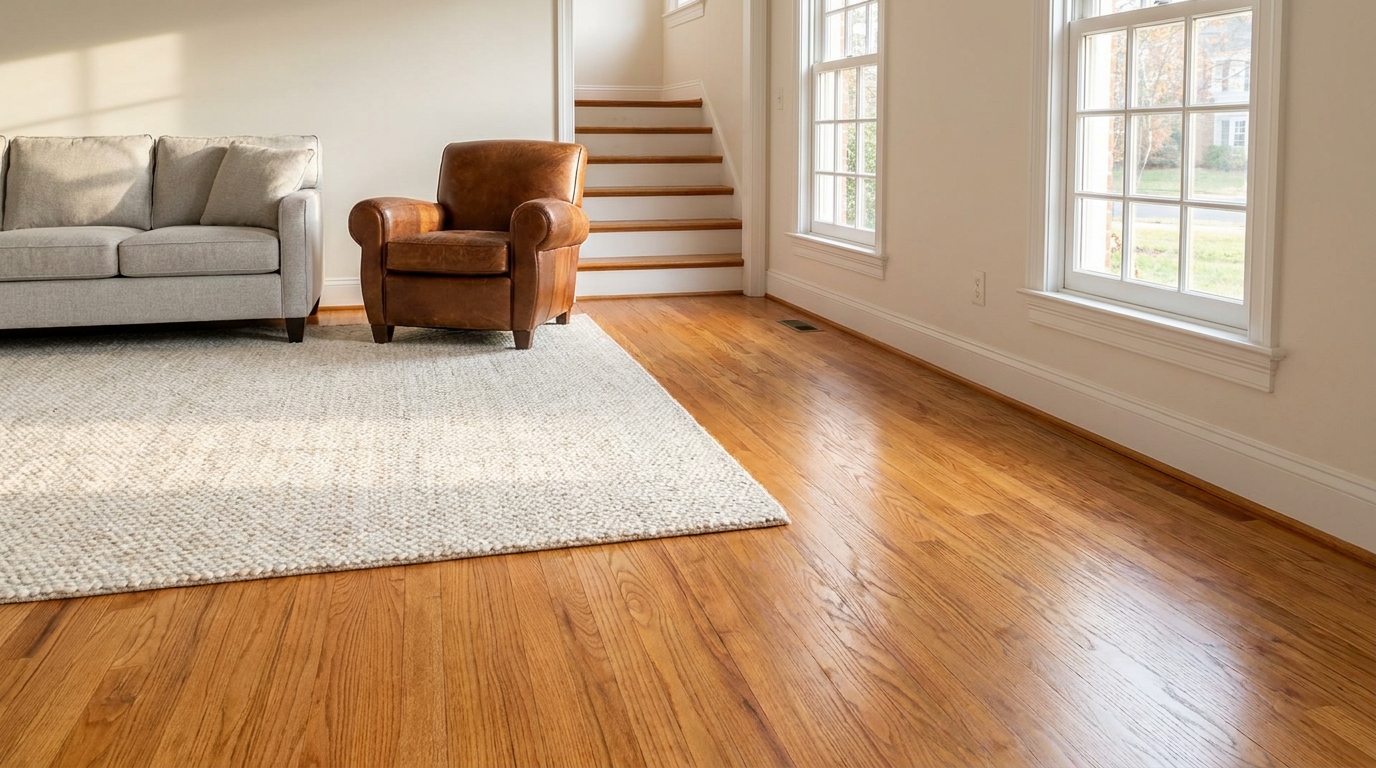
Every spring and fall a DMV homeowner calls us 30 days before listing and asks the same question: should I do something about the floors before the photos go up. The honest answer changes with the house, the neighborhood, the price band, the current floor condition, and the buyer the listing agent is targeting. There's no single "best flooring for resale" answer that works across a $385k Reston condo, a $675k Vienna split-level, and a $1.4M Old Town colonial. But there is a small set of rules that reliably separates the moves that return money from the moves that burn money before sale. After 20+ years of installing and refinishing floors across Alexandria, Arlington, Fairfax, Falls Church, Bethesda, Reston, Old Town, Vienna, and the rest of the DMV metro, here's the honest pre-listing playbook. What returns, what doesn't, the price-band rule that prevents overspending, and the room-by-room priority order when budget is tight.
The short answer for DMV sellers
Quick answer
For most DMV homes, the highest-ROI flooring move before listing is refinishing existing hardwood, not installing new floors. Refinishing returns ~140-150 percent of cost at sale per NAR's Cost vs Value tracking; new hardwood installation returns ~100-118 percent. For homes with worn carpet in the main living areas, replacing it with LVP ($5.50/sqft all-in) or hardwood ($8.50/sqft all-in) recovers most of the spend and usually closes the listing 2-4 weeks faster. For tired LVP or laminate, the answer is usually no replacement — buyers don't price-penalize neutral-condition modern floors. The biggest mistake we see in the DMV is overspending: putting $25,000 of premium hardwood into a $450,000 condo where buyers expect LVP. The price-band rule below is what prevents it.
That's the head answer. The body walks through the three truths most agents won't say, what DMV buyers actually want, the refinish-vs-replace decision, the price-band rule, ROI by material, and the room-by-room priority order when budget is tight.
Three flooring-and-resale truths most agents won't say
Quick answer
Three things drive the flooring-and-resale math. (1) Floors are a top-three first-impression decision in every showing; buyers form a price anchor in the first 30 seconds on the main floor. (2) ROI is rarely linear with spend — the first $5,000 returns more per dollar than the next $5,000. (3) Bad floors lower offers more than good floors raise them; the asymmetry is the real reason pre-listing flooring work pays.
The math we see across hundreds of DMV pre-listing jobs:
- Floors are a first-impression vote. The DMV buyer walks through the front door, takes ~30 seconds on the main floor before forming an offer-band estimate. Visibly worn carpet, scratched hardwood, dated laminate, or chipped tile shifts the buyer's offer anchor downward by 2-5 percent of list price, often more than the cost of fixing it. Realtors confirm this anecdotally; the National Association of Realtors' 2022 Remodeling Impact Report quantified it: 26 percent of buyers cited flooring as the reason they walked from a property.
- ROI is non-linear. The first move (refinish hardwood, replace worst-room carpet) returns 130-150 percent. The next move (premium upgrade beyond what the price band supports) returns 50-80 percent. Stacking moves doesn't compound; it dilutes. Pick the one or two highest-leverage interventions and stop.
- Bad floors lose more than good floors gain. A $5,000 carpet replacement that lifts an offer by $9,000 isn't earning $9,000 — it's recovering the $9,000 buyers were going to discount. Most pre-listing flooring math is loss prevention, not value creation. Frame the spend that way.
These three are the operating frame. The rest of this article is which moves to make given them.
What DMV buyers actually want underfoot
Quick answer
DMV buyer preference is consistent across price bands. Main floor and dining room: hardwood (refinished or new), or premium LVP at lower price bands. Bedrooms: carpet (yes, still — buyers in the DMV still prefer carpet in bedrooms by a ~60/40 margin), or hardwood if the rest of the house is hardwood. Bathrooms and kitchens: tile or LVP, never hardwood (humidity), never carpet. Basements: LVP or carpet, never hardwood directly on slab. The buyer ranking is condition over material — a well-maintained, scratch-free 10-year-old engineered hardwood beats brand-new builder-grade LVP every time.
| Room | DMV buyer preference (in order) | What to avoid |
|---|---|---|
| Main floor / living / dining | Refinished hardwood > engineered hardwood > premium LVP > laminate | Visibly worn carpet, dated patterned tile, chipped vinyl sheet |
| Bedrooms | Carpet (still preferred ~60/40 in DMV) > hardwood (if rest of home is hardwood) > LVP | Worn carpet with pet stains; mismatched carpet patches |
| Kitchen | Hardwood/engineered (with rugs) > tile > LVP > vinyl sheet | Worn laminate, dated patterned tile, gaps at cabinet base |
| Bathrooms | Tile (porcelain or ceramic) > luxury LVP rated wet | Carpet (never), vinyl sheet at any price band |
| Basement | LVP (waterproof) > commercial-grade carpet tile > finished concrete with rugs | Solid hardwood (humidity failure), wall-to-wall plush carpet (mold risk) |
| Stairs | Hardwood treads matching main floor > carpet runner over hardwood | Fully carpeted stairs in homes priced above $700k (looks dated) |
The DMV is slightly more carpet-tolerant in bedrooms than other major metros, especially in homes priced under $800k. Don't rip out bedroom carpet to install hardwood just to "modernize" unless the carpet is visibly worn or pet-stained. Save the budget for the main-floor refinish or replacement, which moves the offer band more. See our pet-friendly flooring guide for the pet-household nuance and our basement flooring piece for the slab-and-humidity layer.
Hardwood refinishing: the highest-ROI flooring move
Quick answer
If the home has existing solid hardwood with at least one refinish cycle remaining, refinishing is almost always the highest-ROI pre-listing flooring move. Cost: ~$4.50/sqft at Potomac (sand, stain, two coats of poly). On a 1,200 sqft main floor, that's ~$5,400. NAR's 2022 Remodeling Impact Report tracked hardwood refinishing at a 147 percent cost recovery and a Joy Score of 10/10 (the highest of any home project tracked). On a $5,400 spend, that's a $7,938 expected lift at sale. The math wins because the existing wood is the most valuable layer; refinishing is reset, not replacement.
Why refinishing beats new install for ROI:
- The material is already on the floor. You're paying for sanding, stain, and seal, not for new oak. The cost-per-sqft is about half of a new install ($4.50/sqft vs $8.50/sqft).
- Buyers respond to the look, not the age. A well-refinished 80-year-old red oak floor in Old Town Alexandria reads as "original character" and commands the same offer as new hardwood. A well-refinished 30-year-old red oak in a Vienna split-level reads as "well-maintained" and removes a buyer objection. Either way, the visual result is what moves the offer.
- Refinishing closes the sale faster. Listings with refinished floors typically close 1-3 weeks faster than listings with worn floors at the same list price. Time-on-market reduction is part of the ROI math agents don't always quantify but always feel.
When refinishing doesn't win: when the wood has been refinished so many times the boards are too thin to sand again (we check this on the free estimate), when the species is engineered with a wear layer too thin to refinish (typically anything under 2mm — see our engineered hardwood thickness guide), or when the damage is structural (water-damaged boards, severe gapping, pet-urine staining through the wood). In those cases, replacement is the right call. See our refinishing vs replacement decision guide for the diagnostic.
💡 Key takeaway
Before any pre-listing flooring spend, pull up a corner of carpet in the main hallway and bedrooms. Many DMV homes built between 1955 and 1985 have original 2-1/4" red oak strip flooring under the carpet that's never been refinished. We've reset hardwood underneath 50-year-old carpet in Vienna, Annandale, Springfield, Falls Church, and Bethesda. Discovery cost: $0. Refinish cost: $4.50/sqft. The before-and-after on those jobs is the highest-ROI pre-listing move in the DMV. See our refinishing cost breakdown for what's actually included at Potomac all-in pricing.
When LVP beats hardwood for resale
Quick answer
LVP is the right resale call in three DMV scenarios. (1) Condo or townhouse priced under $500k where buyers expect LVP and won't pay the hardwood premium. (2) Basement or below-grade space where solid hardwood would fail (humidity and moisture). (3) Rental conversion or short-hold flip where durability and waterproofing matter more than the premium look. In every other DMV resale scenario, hardwood (refinished or new) outperforms LVP at the offer table. The exception is when budget forces a choice: $5,400 of LVP across 1,000 sqft is better than $5,400 of partial hardwood replacement that leaves visible transitions or unfinished rooms.
The DMV buyer comp data is consistent on this: above $600k list price, hardwood (real or refinished) commands a measurable offer-band premium over LVP, typically 1-3 percent. Below $450k list price, the premium evaporates — buyers in lower price bands often prefer LVP because they associate it with low maintenance and modern aesthetic. The $450k-$600k band is the gray zone where neighborhood and home age matter more than the material choice.
| DMV scenario | Resale winner | Reasoning |
|---|---|---|
| Old Town Alexandria colonial, $1.2M+ | Refinish existing hardwood | Buyers expect period-appropriate hardwood; LVP reads as cheap |
| Arlington Cape Cod, $850k-1.1M | Refinish or new hardwood | Hardwood is the neighborhood standard; LVP discount-flags the listing |
| Vienna/Falls Church split-level, $750k-950k | Refinish hardwood (often original under carpet) | Existing red oak underneath; refinish unlocks original character |
| Reston/Herndon townhouse, $500k-700k | Refinished or new engineered hardwood | Engineered is HOA-friendly + appearance-matches buyer expectation |
| Tysons/Pentagon City condo, $400k-650k | Premium LVP (5-6mm wear layer) | Buyer expects LVP; hardwood premium isn't recovered at offer |
| Burke/Springfield ranch, $450k-600k | LVP on main floor, refinish hardwood if present in bedrooms | Mid-market preference for LVP; refinish where wood already exists |
| Basement or below-grade, any price band | Waterproof LVP | Solid hardwood fails on slab humidity; LVP is the only safe spec |
| Pre-listing rental conversion or flip | LVP across the whole floor | Lower install cost + waterproof + scratch-resistant; ROI math works |
The full LVP-vs-hardwood lifetime math is in our LVP vs hardwood lifetime cost guide, and the three-way LVP vs engineered vs solid hardwood comparison is in our material comparison piece. For DMV homeowners considering LVP specifically, the wear-layer spec matters for resale appearance; see our LVP wear layer guide.
Carpet: the resale call most homeowners get backwards
Quick answer
The right carpet decision before listing isn't "rip it all out and put in hardwood." It's a two-part diagnostic. (1) Is the carpet visibly worn, stained, or smelly? If yes, replace it — buyers price-discount it more than the replacement costs. (2) Is the carpet in a bedroom or a main living area? Bedroom carpet is still preferred by ~60 percent of DMV buyers, so fresh neutral carpet is fine. Main-floor and dining-room carpet should usually be replaced with hardwood or LVP, because buyers downgrade those rooms otherwise. Don't replace carpet that's in good condition unless the material is wrong for the room.
The bedroom-vs-main-floor distinction is the key. Carpet-replacement decisions go wrong in two directions:
- Overreaction: ripping out bedroom carpet to install hardwood. In homes priced under $900k, DMV bedroom buyers still slightly prefer carpet for warmth, sound-dampening, and bare-feet comfort. Replacing fresh bedroom carpet with hardwood costs $8.50/sqft, and the offer band doesn't move. Don't do it unless the existing carpet is worn.
- Underreaction: leaving worn main-floor carpet. Visible main-floor carpet wear is the single biggest first-impression discount in DMV showings. Buyers walk in, see worn carpet, and silently subtract $15-25k from their offer. Replacing 800 sqft of main-floor carpet with LVP at $5.50/sqft costs $4,400, and the offer-band shift typically recovers 1.5-2x the spend.
If the carpet is recent and clean, leave it. If it's worn, replace it with the room-appropriate material (hardwood/LVP for main floor and dining; new neutral carpet for bedrooms). For the full carpet replacement math, see our 2026 carpet installation cost guide and our carpet-to-hardwood replacement breakdown for the room-by-room math.
Price-band rule: match material to home value
Quick answer
Match the flooring material to the home's price band — overspending on premium hardwood in a sub-$500k condo doesn't recover at sale, and undertspending on builder-grade LVP in a $1M+ home discount-flags the listing. The simple rule: under $500k = LVP or refinished hardwood; $500k-$800k = engineered or refinished hardwood; $800k-$1.2M = solid hardwood or premium engineered; $1.2M+ = solid hardwood or refinished original. Mismatches are the most common pre-listing mistake we see in the DMV. The price-band rule prevents both directions of overcapitalization.
| Home price band | Buyer expectation | Right material spend | Anti-pattern |
|---|---|---|---|
| Under $450k | LVP, fresh carpet, clean tile | $5.50/sqft LVP, fresh neutral carpet, refinish hardwood if present | $8.50/sqft hardwood (overspend, no recovery) |
| $450k-$700k | Engineered hardwood or premium LVP | $5.50/sqft LVP main, refinish or engineered $8.50 | Cheap laminate or worn carpet (discount-flag) |
| $700k-$1M | Solid or engineered hardwood | Refinish existing or install solid hardwood $8.50/sqft | LVP in main living areas (discount-flag at this band) |
| $1M-$1.5M | Solid hardwood, often refinished original | Refinish original or install solid hardwood; tile in bathrooms | Engineered hardwood reads as cheaper material at this band |
| $1.5M+ | Premium species or wide-plank solid hardwood | Solid hardwood, premium species (American walnut, white oak) | Standard 2-1/4" red oak strip reads as builder-grade at this band |
The biggest overspending mistake we see in the DMV: homeowner installs $25,000 of premium solid hardwood in a $475k Reston condo to "boost resale value," and the offer comes in roughly the same as comparable condos with builder-grade LVP. The $25,000 doesn't recover. The buyer pool in that price band wasn't going to pay the hardwood premium. The biggest underspending mistake: $1.1M Vienna single-family with worn 1990s carpet across the entire main floor; seller skips the flooring spend, lists, and the offer comes in $40k-60k below comps that have refinished hardwood. Both anti-patterns are preventable by matching the price band before the spend.
ROI by material: what each move actually returns
Quick answer
NAR's 2022 Remodeling Impact Report and field data from DMV pre-listing jobs give consistent ROI bands by flooring move. Hardwood refinishing: ~147 percent (highest ROI of any tracked home project). New hardwood installation: ~118 percent (when matched to price band). Carpet replacement (worn → fresh neutral): ~80-100 percent recovery plus faster days-on-market. LVP replacement of worn carpet in main areas: ~85-105 percent. Premium upgrades beyond price-band expectations: 50-75 percent (loss). The honest framing is that the first move on the right material returns at or above 100 percent; stacking premium moves dilutes the return.
| Flooring move | Approximate cost recovery at sale | Days-on-market effect | Best fit |
|---|---|---|---|
| Refinish existing solid hardwood | ~140-150% (NAR-tracked) | 1-3 weeks faster | Any DMV home with refinishable wood |
| Refinish existing engineered hardwood (2mm+ wear) | ~120-135% | 1-2 weeks faster | Engineered floors over 8 years old in good structural shape |
| New solid hardwood install (price-band matched) | ~100-118% (NAR-tracked) | 1-2 weeks faster | $700k+ DMV homes without existing wood, or wood beyond refinish |
| Replace worn main-floor carpet with LVP | ~85-105% | 2-3 weeks faster | $400-700k homes with worn main-floor carpet |
| Replace worn main-floor carpet with hardwood | ~90-110% | 1-2 weeks faster | $700k+ homes with worn main-floor carpet |
| Replace worn bedroom carpet with new carpet | ~75-95% | 2-3 weeks faster | Any DMV home with visibly worn bedroom carpet |
| Replace functional LVP with hardwood (no condition issue) | ~60-80% (loss) | No effect | Almost never the right move pre-listing |
| Premium species or wide-plank upgrade above price band | ~50-75% (loss) | No effect | Don't do this pre-listing |
| New tile in bathrooms (dated → modern neutral) | ~85-100% | 1-2 weeks faster | Bathrooms with dated 1990s-2000s patterned tile |
The recovery percentages assume the move is matched to the price band and the home's other systems. A perfectly refinished hardwood floor in a $475k condo where the rest of the home reads as builder-grade still recovers — but the percentage compresses, because the buyer pool is more material-agnostic at that band. NAR's full Remodeling Impact Report data is the methodological anchor; DMV-specific recovery tends to run slightly higher than the national average for hardwood refinishing because the regional buyer pool over-indexes on hardwood preference.
Two anti-patterns: overspending and underspending
Quick answer
The two pre-listing flooring mistakes that cost DMV homeowners the most money are mirror images. Overspending: installing premium materials beyond what the home's price band recovers, treating flooring as the listing's lead value-add. Underspending: leaving visibly worn or dated flooring because "the buyer will replace it anyway," ignoring that buyers discount the offer by more than the fix would cost. The honest framing is that pre-listing flooring is loss prevention, not value creation. Treat it that way.
The five overspending moves we routinely talk DMV sellers out of:
- Premium 5"-wide plank solid hardwood in a $450k condo. The buyer pool prefers LVP at this band. The hardwood premium ($3-4k more than premium LVP) doesn't recover.
- Replacing functional 6-year-old LVP because "buyers want hardwood." Functional LVP under 8 years old is a neutral. Replacement returns 50-70 percent at best.
- Refinishing all hardwood when only the main floor shows. Buyers don't credit refinishing in rooms they can't see in the photos. Skip the closet, the laundry room, and the storage room.
- Installing premium species (walnut, hickory) in a price band that expects red oak. The species premium doesn't read at the offer table below $1.2M list.
- Whole-home re-flooring 30 days before listing because "it'll look nicer in photos." Mixed materials in good condition photograph well. Identical materials throughout don't compound the offer.
The five underspending moves that cost more than they save:
- Leaving visibly worn main-floor carpet to "let the buyer pick their own." Buyers discount the offer by 2-4x the replacement cost. Worst pre-listing mistake.
- Skipping hardwood refinishing because "the floor still works." Scratched and dulled hardwood reads as "deferred maintenance" to buyers, who extrapolate to the rest of the home.
- Painting over chipped tile or wood-floor scratches. Buyers spot it in 30 seconds and assume worse problems behind it.
- Leaving 1990s patterned tile in bathrooms because "the buyer will renovate." A $3,000 tile refresh recovers $8-10k in offer-band lift in homes priced above $600k.
- Ignoring carpet pet stains because "the agent said they're not that bad." Pet odor is the single most common offer-killer in pet-household DMV listings.
For the broader pre-listing prep frame and what hidden charges to watch in any flooring quote you're considering pre-listing, see our flooring quote hidden charges guide.
Room-by-room priority order before listing
Quick answer
When budget is tight (most pre-listing scenarios), allocate flooring spend in this priority order. (1) Main-floor entry, living room, and dining room — the first 30 seconds of every showing. (2) Kitchen floor — second-most-photographed surface after the cabinets. (3) Master bedroom — the second emotional vote after the main floor. (4) Primary bathroom — high-influence on the offer if visibly dated. (5) Other bedrooms and bathrooms. (6) Basement and finished lower-level. (7) Closets, laundry, utility (almost never worth pre-listing flooring spend).
| Priority | Area | Why it matters at sale | Move |
|---|---|---|---|
| 1 | Main floor entry + living + dining | 30-second first-impression vote drives the offer band | Refinish hardwood if present; replace worn carpet/LVP/laminate with price-band-matched material |
| 2 | Kitchen floor | Photo coverage + buyer scrutinizes during showings | Tile if dated/cracked; LVP if hard surface needed; refinish if hardwood |
| 3 | Master bedroom | Second emotional vote; influences offer at all price bands | Fresh neutral carpet if worn; hardwood if matches main floor at $800k+ |
| 4 | Primary bathroom | Strong influence on offer at $600k+ if visibly dated | Tile refresh if patterned/dated; LVP wet-rated if budget-constrained |
| 5 | Other bedrooms + secondary bathrooms | Lower individual impact but compounds across multiple rooms | Fresh carpet if visibly worn; otherwise leave |
| 6 | Basement + finished lower-level | Visible but lower priority unless used as photographed living space | LVP or carpet tile if worn; refinish if hardwood (rare basement install) |
| 7 | Closets, laundry, utility, storage | Rarely photographed; buyers tolerate condition | Skip unless severely damaged |
The priority order is the budget-allocation guide. With $5,000-$7,000 to spend, fix priorities 1 and 2. With $10,000-$15,000, add 3 and 4. Don't dilute the spend across all rooms — concentrating the budget on the highest-influence rooms returns better than spreading.
💡 Key takeaway
If you're listing in 30 days and just discovered the floors need work, the highest-leverage move is almost always: refinish the main-floor hardwood if you have it, OR replace worn main-floor carpet/LVP with a price-band-matched material. Skip the bedrooms, skip the closets, skip the basement unless they're showstoppers. Concentrating $5,000 on the rooms buyers see first beats spreading $5,000 across seven rooms every time.
Timeline: how long these projects take pre-listing
Quick answer
Pre-listing flooring timelines at Potomac DMV all-in pricing. Hardwood refinishing (1,200 sqft main floor): 4-5 days total, including 24-48 hours dry-cure before furniture returns. New LVP installation (1,200 sqft): 2-3 days. New hardwood installation (1,200 sqft): 4-7 days depending on subfloor prep and acclimation needs. Carpet replacement (whole house): 1-2 days. The two-week buffer between project complete and listing-photo day is the safe margin for any flooring move.
| Project | 1,200 sqft timeline | Buffer before listing photos |
|---|---|---|
| Hardwood refinishing | 4-5 days (3-4 install + 24-48hr cure) | 3-5 days minimum, 1 week recommended |
| LVP installation | 2-3 days | 1-2 days; LVP is walkable immediately |
| Solid hardwood installation (nail-down) | 4-7 days (acclimation + install + finish if site-finished) | 2-4 days if prefinished; 7-10 days if site-finished |
| Engineered hardwood installation | 3-5 days (floating fastest, glue-down slower) | 1-3 days |
| Carpet replacement (whole house) | 1-2 days | Same-day photo OK |
| Tile installation (bathroom) | 3-5 days including grout cure | 3-5 days minimum for grout sealing |
For sellers planning a 45-60 day pre-listing window, the order we recommend: schedule the flooring work in the first 2 weeks (so any surprises are caught early), then the painting and staging in the next 2 weeks, then the listing photos and on-market launch in the final week. See our hardwood-install timeline piece here for the full project-by-project timeline breakdown.
FAQs about flooring and resale value
Does new flooring actually increase home value?
Yes, but the recovery is non-linear and depends heavily on the price band and the move. NAR's 2022 Remodeling Impact Report tracks hardwood refinishing at ~147 percent cost recovery and new hardwood installation at ~118 percent — both above breakeven. LVP replacement of worn carpet typically recovers 85-105 percent. Premium upgrades beyond price-band expectations recover 50-75 percent (a loss). The honest framing is that the first right-fit flooring move recovers above breakeven; stacking premium moves dilutes the return.
Should I refinish or replace my hardwood floors before selling?
Refinish if the wood has at least one refinish cycle remaining and the damage is cosmetic (scratches, dullness, surface wear). Replace if the boards have been refinished past their limit (the tongue is exposed when you look at a transition), there's structural water damage, or the species is engineered with a wear layer too thin to sand. Refinishing returns ~147 percent; replacement returns ~118 percent. Default to refinish whenever it's mechanically possible. See our refinishing vs replacement decision guide for the diagnostic.
Is LVP good for resale value in the DMV?
LVP works for resale in DMV homes priced under ~$500k, in basements regardless of price band, and in rental/flip scenarios. Above $700k list price, premium LVP underperforms hardwood at the offer table by 1-3 percent — DMV buyers in that band expect real wood. The honest call: LVP is the right resale spec when buyers in the price band expect it (sub-$500k condos, basements, pet households, short-hold investors) and the wrong call when they expect hardwood.
Should I replace my carpet before listing?
If the carpet is visibly worn, stained, dated, or smelly, replace it — buyers discount the offer by more than the replacement costs. If the carpet is recent and clean, leave it. The bedroom-vs-main-floor distinction matters: bedroom carpet is still preferred by ~60 percent of DMV buyers, so fresh neutral carpet is fine; main-floor and dining-room carpet should be replaced with hardwood or LVP, because buyers downgrade those rooms otherwise. See our carpet-to-hardwood breakdown for the room-by-room math.
What's the ROI on hardwood floor refinishing?
~140-150 percent cost recovery at sale per NAR's 2022 Remodeling Impact Report (it scored a Joy Score of 10/10, the highest of any tracked home project). On a $5,400 refinish job (1,200 sqft at Potomac DMV pricing), expect ~$7,500-8,000 offer-band lift plus 1-3 weeks faster days-on-market. The ROI is among the highest of any pre-listing home project, flooring or otherwise. Refinishing wins because you're paying for finishing labor, not new wood — the existing material is the most valuable layer.
What flooring do home buyers prefer in 2026?
DMV buyer preference in 2026 is consistent: refinished or new hardwood on the main floor, dining, and entry; carpet (still) in bedrooms by a ~60/40 margin; tile in bathrooms; tile or LVP in kitchens; LVP or carpet tile in basements. Engineered hardwood is buyer-accepted across all price bands above $400k. Premium LVP is buyer-preferred at sub-$500k condos and rental conversions. Laminate is buyer-tolerated but never preferred. Vinyl sheet is a discount-flag at any price band.
How much does flooring add to home value in the DMV?
Flooring's contribution to home value in the DMV runs ~2-5 percent of list price for the right-fit move on a high-influence room (main-floor refinish or LVP replacement of worn main-floor carpet). The recovery is asymmetric — bad flooring discount-flags the listing by more than good flooring premium-flags it. Most pre-listing flooring math is loss prevention, not value creation. Treat the spend that way: you're protecting the comp, not exceeding it.
Is it worth installing hardwood floors before selling?
Yes in three scenarios: (1) the home is priced above $700k and currently has worn carpet, dated laminate, or no main-floor hardwood; (2) the home matches a hardwood-expected neighborhood (Old Town Alexandria, Arlington Cape Cods, Vienna split-levels, Bethesda colonials, McLean) where comps with hardwood out-sell comps without; (3) the existing main-floor surface is visibly damaged beyond cosmetic refinish. No in three scenarios: (1) the home is priced under $500k where buyers prefer LVP; (2) the existing hardwood can be refinished (refinish first); (3) the budget would force partial-room install with visible transitions.
How long before listing should I install new floors?
Schedule the install 3-6 weeks before listing photos for any hardwood, LVP, or carpet work. The install itself takes 1-7 days depending on material and square footage (see the timeline table above). The buffer accommodates dry-cure time on refinished hardwood (24-48 hours minimum, 1 week recommended), grout cure on tile (3-5 days), surprise subfloor prep work, and the painting + staging that usually follows the floor. The two-week minimum buffer is the safe margin.
Should I refinish the hardwood floors in the bedrooms too?
Only if you're refinishing the main floor and there's visible color or sheen mismatch when the bedroom doors are open in the listing photos. Otherwise, no. Bedroom carpet (when present) is acceptable in DMV homes through ~$1M list price, so refinishing bedroom hardwood doesn't drive offer-band lift the way main-floor refinishing does. The exception is homes above $1M where buyers expect hardwood throughout; in those cases, full-home refinishing is the right call.
Bottom line: the 60-second pre-listing decision
The 60-second pre-listing call
Three questions, in order. What's the price band? (Determines material spec.) What's underfoot today? (Determines refinish-vs-replace.) What's the buffer before photos? (Determines what's mechanically possible.) Default highest-ROI move for ~70 percent of DMV pre-listing jobs: refinish the existing main-floor hardwood. Default for homes without refinishable hardwood: replace worn main-floor carpet with a price-band-matched material (LVP under $500k, engineered hardwood $500k-$900k, solid hardwood $900k+). Skip the bedrooms unless the carpet is visibly worn. Skip the closets and storage rooms entirely. Concentrate the budget on the first 30 seconds of every showing — that's where the offer band moves.
If you're in the DMV (Alexandria, Arlington, Fairfax, Falls Church, Bethesda, Reston, Old Town, Vienna, McLean, Springfield, Burke, or anywhere else in our service area) and you're 30-90 days from listing a home, give us a call at 703-307-4555 or request a free in-home estimate. We walk every room with you, identify what's already there (most DMV homes built between 1955 and 1985 have original 2-1/4" red oak under the carpet — discovery is free), match the recommended spec to the home's price band, and quote refinish-vs-replace options on the rooms that move the offer band. All-in pricing (material + installation + demo + removal in one number), in-house crew, no subs, and the walkthrough is free whether you book the work or not. See our LVP vs hardwood lifetime cost guide for the long-hold math, the refinishing vs replacement decision guide for the existing-floor diagnostic, and the rental property flooring guide if the home is heading to the rental market instead of sale.
