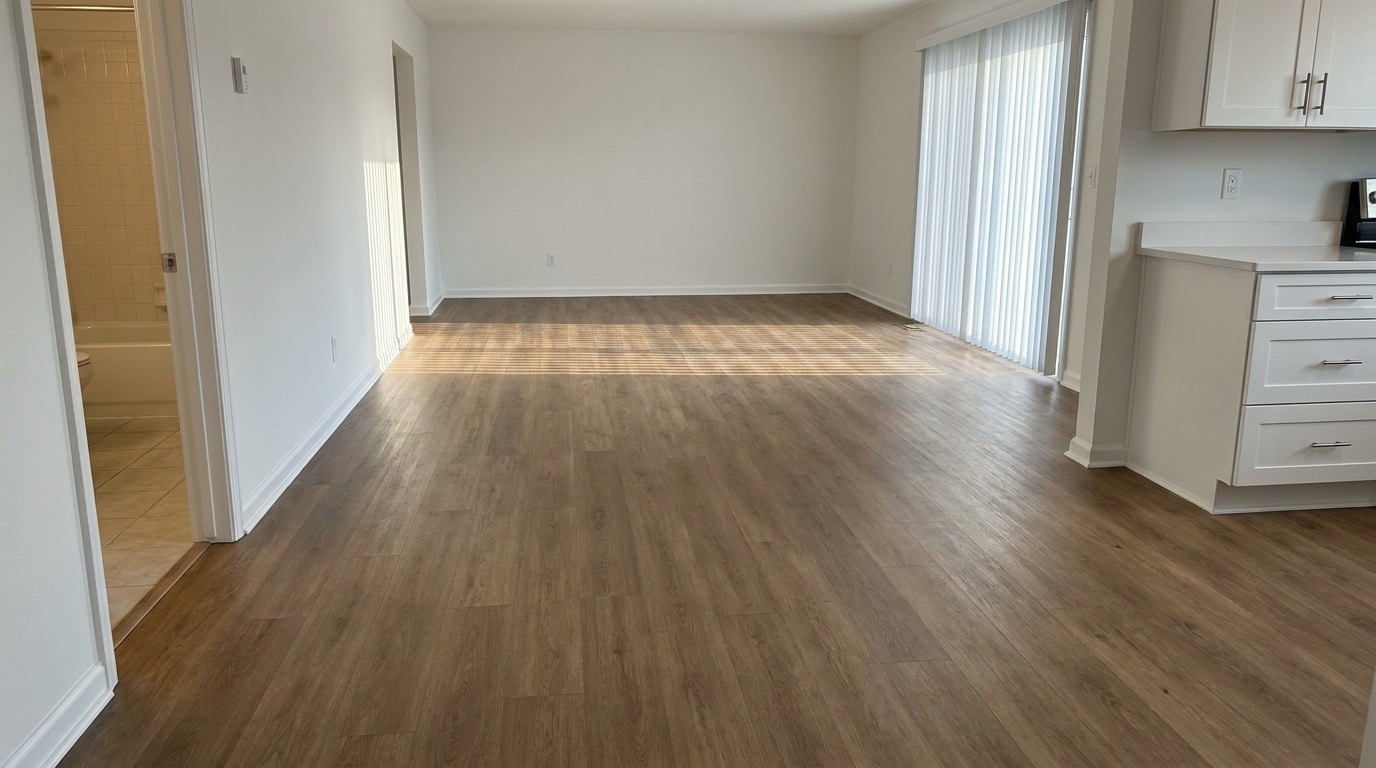

The landlord call usually comes the same way. A tenant is moving out, the old carpet is past saving, and the owner wants to know what to put down before the next showing. The budget is tight, the timeline is short, and the floor needs to take a beating from people who don't own the place. Hardwood is out. Carpet keeps failing every 2 to 3 years. So what actually works for a DMV rental in 2026?
Here is the honest installer answer, with real numbers, the specs that matter, and the per-room calls we make on rentals from Alexandria walk-ups to Loudoun townhomes.
Best flooring for a DMV rental: the short answer
Quick answer
Luxury Vinyl Plank (LVP) in every traffic area, tile in full bathrooms, no carpet anywhere except bedrooms in lower-end units. A 20-mil-wear-layer waterproof LVP at $6.50/sqft all-in installs in 1 to 2 days between tenants, takes pet claws, spills, and a missed mop-up, and goes 12 to 15 years before the next replacement. Laminate is the same installed price but fails on a single water event. Hardwood looks great but pays you back too slow for a rental. Carpet runs $3.25/sqft to install and lasts 2 to 4 years in a rental, so you replace it 3 to 5 times in the same window LVP needs once.
This isn't a controversial call. Every landlord we work with in the DMV ends up here once they run the math past the first tenant turnover. The interesting question is which LVP, what spec, and where carpet still earns a spot.
The 4 real options for a DMV rental, ranked
Quick answer
LVP wins for almost every rental scenario in the DMV. Tile is the right call for full bathrooms and tiled-shower wet rooms. Laminate is a dry-room option that works in a low-moisture single-family but loses on any first-floor or basement unit. Carpet earns a place only in bedroom-only zones of lower-end units where bedroom-only carpet drops the install cost and the turnover labor is short. Solid hardwood almost never makes sense for a rental.
Here are the four options that actually compete, in rental-fit order.
1. Luxury Vinyl Plank (LVP). The rental default. Waterproof, scratch-resistant, click-installs over almost any flat subfloor, looks like real wood at 6 feet of viewing distance, holds up to dogs and toddlers, and survives a tenant who lets the dishwasher leak for two weeks before calling. The 20-mil wear-layer specs go 12 to 15 years in rental conditions. At our all-in DMV rate of $6.50/sqft (material plus installation plus old flooring demo and removal), it's the single most boring, reliable rental floor we install. See our vinyl plank installation cost guide for the full pricing breakdown by room size.
2. Tile (ceramic or porcelain). Bathrooms and wet rooms only. The only material that genuinely beats LVP in a full bathroom. Waterproof for real, not "moisture resistant for 24 hours" like LVP. Lasts 20+ years in a rental. Cold underfoot and harder to install over wood subfloors, which is why we don't use it in the rest of the rental. Tile pricing depends heavily on the tile, layout, and substrate prep. Call for a rental-spec quote. For a basement laundry, half-bath, or full bath, this is the right call.
3. Laminate. A dry-room option with a real downside. At the same $6.50/sqft all-in rate as LVP, laminate can fit a dry second-floor rental room where scratch resistance matters. The catch: most laminate is not waterproof, and the HDF core swells on contact with standing water. A leaky toilet, a tipped pet bowl, or a hot-water heater that lets go and you're replacing 200 sqft of floor on a rental that was supposed to last 8 years. It is not workable in basements, kitchens, or laundry rooms. Our laminate installation cost guide breaks down where laminate is and isn't worth it.
4. Carpet. Bedroom-only on lower-end units. At $3.25/sqft installed (material plus pad plus install plus old-carpet removal), carpet is the cheapest material per square foot. The problem is the replacement cycle. Rental carpet lasts 2 to 4 years before stains, traffic lanes, or pet damage make it tenant-rejectable. Replace it twice and you've spent more than one LVP install that would have lasted the full 12 years. The only place carpet still earns a spot is bedrooms in lower-priced units where the unit price won't support LVP everywhere and bedrooms see less traffic. See our carpet installation cost guide for the rental-specific spec.
What we don't recommend for rentals: solid hardwood (refinishing between tenants is $4.50/sqft and a 5-day project), engineered hardwood (better than solid but still pays back too slow), polished concrete (cold and reads as unfinished in residential), and any luxury bamboo or cork product (the maintenance assumes an owner-occupant who cares).
Key takeaway
If you're a landlord and somebody is pitching you hardwood, bamboo, or "luxury" anything for a rental, they're selling you their margin, not your return. The rental-flooring decision is a return-on-cost decision, not an aesthetic one. LVP is the default for a reason.
What each option actually costs all-in (DMV 2026)
Quick answer
For a typical 1,000 sqft rental unit in the DMV, all-in: LVP $6,500, laminate $6,500, carpet $3,250, tile call-for-quote (figure $9 to $14/sqft installed for ceramic, more for porcelain or pattern work). All numbers include material, professional installation, and old flooring demo and removal. Hidden charges are what blow up rental jobs that came in cheap on paper, so make sure the quote is genuinely all-in.
Here is the real Potomac Floors pricing for a rental-spec install in 2026 DMV dollars. All-in includes material, labor, demo and removal of the existing floor.
| Option | Material spec | All-in DMV rate | 1,000 sqft unit total | Install timeline |
|---|---|---|---|---|
| LVP (20-mil wear layer) | Click-lock waterproof LVP, attached underlayment, 5-7mm total thickness | $6.50/sqft | $6,500 | 1-2 days |
| Tile (ceramic/porcelain) | 12x24 porcelain, standard layout, modified thinset | Call for quote (typically $9-14/sqft installed) | $9,000-$14,000 (only used in baths/wet rooms, so a small portion of a unit) | 2-3 days for a bathroom |
| Laminate | 12mm AC4-rated, HDF core, attached pad | $6.50/sqft | $6,500 | 1-2 days |
| Carpet | Mid-grade nylon loop or cut pile, 6lb rebond pad | $3.25/sqft | $3,250 | 1 day |
Quoted prices vary by installer. Two things to watch on a rental quote: the "all-in" language and whether old-flooring demo and removal is included. We've seen landlord quotes from competitors come in $1 to $2 lower per square foot, then add $400 to $800 for demo, $300 for haul-away, $200 for "floor prep," and $150 for transition strips. The on-paper savings disappear by signing day. Our flooring quote hidden charges guide is the line-by-line list of what should and shouldn't be a separate line item.
The 10-year cost: cheap material times tenant turnover
Quick answer
Over 10 years on a 1,000 sqft rental, LVP installed once costs about $6,500. Carpet installed three times (every 3 years) costs about $9,750 plus three days of vacancy each time. Laminate installed once costs $6,500 but can need a mid-cycle water-damage replacement. The cheapest material upfront is rarely the cheapest material over the hold period. This is the math the landlord-flooring decision actually comes down to.
Rentals turn over. The average tenant in the DMV stays 18 to 30 months, and every turnover surfaces whatever damage the previous tenant did. Material lifespan in a rental is shorter than the same material in an owner-occupied home, sometimes much shorter, because tenants don't have the same skin in the game as an owner. The 10-year math is what matters.
| Option | Realistic rental lifespan | Replacements in 10 years | 10-yr total (1,000 sqft) | Vacancy days during install |
|---|---|---|---|---|
| LVP 20-mil | 12-15 years | 1 (the original install) | $6,500 | 2 days, once |
| Tile (bathroom) | 20+ years | 1 | $1,200-$2,800 (one bathroom) | 3 days, once |
| Laminate | 6-8 years rental, less with water damage | 1-2 (50% chance of mid-cycle water failure) | $6,500-$13,000 | 2 days, possibly twice |
| Carpet | 2-4 years rental | 3-4 | $9,750-$13,000 | 1 day each, 3-4 times |
The vacancy column is the cost landlords forget to count. Every flooring replacement means 1 to 3 days the unit can't be shown, which at $2,000/month rent is $65 to $200 per day of lost income on top of the install cost. Carpet's "cheap" install becomes expensive once you add the four turnover vacancies it generates in the same window LVP needs zero.
Watch out
If a landlord-targeted flooring quote has the words "investor special," "rental-grade laminate," or "builder-grade LVP" without a wear-layer number on the spec sheet, ask for the wear layer in mils before signing. Cheap LVP can be 6-mil or 8-mil, which is fine in an owner-occupant home and burns through in 2 to 3 years in a rental. The whole rental-LVP case rests on the 20-mil spec; below that, the math gets worse.
The LVP spec to ask for on a rental quote
Quick answer
For a DMV rental, ask for: 20-mil wear layer minimum, 100% waterproof rigid core (SPC or stone-polymer composite), attached underlayment pad, 7-inch or 9-inch plank widths, low-sheen matte finish, and click-lock floating install. Material cost should land at $2.50 to $3.20/sqft if you're buying it yourself; all-in installed at $6.50/sqft is the right Potomac DMV rate.
Most landlord-flooring problems come from buying the wrong LVP spec, not from picking LVP wrong. Here's the spec sheet a landlord should ask any installer to confirm in writing on a rental quote.
- Wear layer: 20 mil minimum. The wear layer is the clear plastic coating on top that takes the abuse. 6-mil and 8-mil are residential entry-level (think starter homes, low-traffic owner-occupied). 12-mil is mid-grade owner-occupied. 20-mil is commercial-light and is the right call for any rental. 28-mil and 30-mil are full commercial and overkill for residential rentals.
- Core: SPC (stone-polymer composite) rigid core. Waterproof, dimensionally stable in humidity swings, doesn't telegraph subfloor imperfections the way thinner LVT does. Avoid WPC (wood-polymer composite) for rentals. It's softer and more forgiving on imperfect subfloors but less durable under heavy traffic.
- Attached underlayment. Most rental-grade LVP ships with a pre-attached IXPE or cork pad. This saves an install line item ($0.30 to $0.60/sqft for separate underlayment) and gives a quieter floor underfoot, which matters in stacked condos and townhomes. For multi-story units with sound-transmission requirements, see our soundproof flooring for condos and townhomes guide.
- Plank width: 7 inches or 9 inches. Narrow planks (4 to 5 inches) read as cheaper and dated. 7 to 9 inches reads contemporary and photographs better for the listing. Anything over 9 inches starts to look like a builder's model home, which has its own problems.
- Finish: low-sheen matte. Low-sheen hides scratches and footprints. High-gloss looks great on day one of the showing and shows every scuff by month three.
- Install method: click-lock floating. Faster install (saves labor), easier to spot-replace a damaged plank later, doesn't bond to the subfloor so you preserve flexibility if you ever change the unit's flooring again. Glue-down is only worth it in commercial-grade applications or over heated slab.
Most installers will hand you a spec sheet for whatever they have inventory on. Ask specifically: what wear layer in mils, what core type, attached pad yes or no. If the installer can't answer fast and confidently, that's a tell.
Per-room call: kitchen, bath, bedroom, basement
Quick answer
LVP in living room, dining, hallway, bedrooms, kitchen. Tile in full bathrooms. LVP in half-baths and laundry rooms. Tile or LVP in basements with a confirmed vapor barrier (basement walkouts are LVP only if dry; flood-prone basements need tile and sealed concrete). One material across most of the unit unless the layout includes a tiled wet bathroom.
Most DMV rental units we floor end up with two materials: LVP through 90 percent of the unit and tile in the full bathroom. The per-room logic:
Living room, dining room, hallway, bedrooms: LVP. Continuous flooring across the unit reads larger in showing photos and on walk-throughs. Eliminates transition strips that collect dirt and trip vacuum cleaners. Bedrooms used to be carpet by default; for any rental at or above the median DMV unit price, LVP wins because the next tenant won't see stained carpet.
Kitchen: LVP. The waterproof core handles dishwasher overflows, fridge ice-maker leaks, and the kind of spills tenants don't always clean up. The continuous flooring from the kitchen into the living area helps the unit feel more open. Tile in the kitchen is unnecessary and adds cold underfoot.
Half bathroom (powder room): LVP works fine. The bathroom has a toilet and a sink, not a shower or tub, so the waterproof LVP rating handles realistic moisture. Saves the cost of switching materials for one 25-sqft room.
Full bathroom (with shower or tub): Tile. The wet zone around a shower or tub is the one place where LVP's "waterproof rating" gets tested by daily standing water at the threshold. Tile is the safer 20-year choice. Use a porcelain at $3 to $5/sqft material plus install for a rental-spec finish.
Laundry room: LVP. Same logic as the kitchen. Standing water under the washer would be tile-worthy, but in a typical rental laundry closet the LVP holds up fine and matches the rest of the unit.
Basement (above-grade or walkout, dry): LVP with a slab vapor barrier underneath. Same spec as the rest of the unit. See our best flooring for basements guide for the basement-specific install details, especially around slab moisture and humidity.
Basement (below-grade, history of moisture): Tile or sealed concrete. Don't put LVP in a basement that has ever flooded; the LVP itself survives, but the foam pad and any organic matter underneath does not, and you end up tearing it all out anyway.
Key takeaway
Continuous LVP across the full unit, broken only by tile in the full bath, is the simplest and most reliable DMV rental layout. It photographs better, shows larger, takes tenant abuse, and turns over fast between leases. The two-material call is the right call most of the time.
Single-family vs apartment vs condo: what changes
Quick answer
Single-family rentals: full LVP plus full-bath tile, no HOA constraints. Apartments: usually owner-occupied or owner-furnished, same spec. Condos: check the HOA's sound-transmission requirement (most DMV condos require IIC 50 or higher), which usually means upgrading the underlayment to acoustic pad. Townhouses on shared walls have similar requirements between unit floors. The base material call doesn't change; the underlayment under it does.
The property type changes the underlayment, the HOA paperwork, and almost nothing about the surface material call.
Single-family rental house. Maximum flexibility. Full LVP across the unit, tile in the full baths, basement waterproofing if applicable. No HOA approval, no acoustic requirement beyond what you'd choose anyway. Most landlord-spec installs we do in Fairfax and Loudoun fall into this category.
Garden-style apartment unit. Same spec as single-family. The ground floor and walk-up units don't have a unit below them to soundproof against, so a basic attached-pad LVP works fine.
Condo or stacked townhouse on an upper floor. Most DMV HOAs require an IIC (Impact Insulation Class) rating of 50 or higher on any hard-surface flooring above another unit. The HOA usually requires an underlayment spec and proof of install. We add an acoustic underlayment (cork or rubber, 3 to 6mm) under the LVP, which adds about $0.80 to $1.40/sqft to the all-in. The HOA approval paperwork is a one-time hassle but should not be skipped. Installing without it can get you a stop-work order and a tear-out demand from the HOA. Our condo soundproofing guide covers the HOA spec walkthrough in detail.
Old DMV brick rowhouse (Alexandria, DC, parts of Arlington). Worth a subfloor inspection before the install quote. These houses are often on the original tongue-and-groove or plank subfloors which can be loose, squeaky, or rotted in spots. Subfloor repair is the line item that surprises landlords on first-time conversions; budget another $1 to $3/sqft for the affected areas if the inspection turns up problems. See our subfloor repair we find in DMV homes piece.
Basement walkout unit (a separate rental basement). Treat as a single-family rental with extra moisture caution. LVP over a confirmed vapor barrier works for dry basements; tile is the safer call if there's any history of seepage.
FAQs about flooring for rental properties
What is the cheapest flooring to install in a rental property?
Carpet at $3.25/sqft installed is the cheapest material upfront for a 1,000 sqft unit ($3,250 total). The catch is the 2 to 4 year replacement cycle in rental conditions. Over 10 years you'll install carpet 3 to 4 times, total spend $9,750 to $13,000, plus 3 to 4 days of vacancy each turnover. LVP at $6.50/sqft installed costs more on day one ($6,500) but lasts the full 10 years on one install. Cheapest upfront is rarely cheapest over the hold period. Our full carpet vs vinyl plank comparison lays out the room-by-room call.
Is LVP or laminate better for a rental property?
LVP almost always wins for a rental. Laminate costs the same installed but is not waterproof; one toilet leak or appliance failure and you're replacing 200 sqft of laminate flooring two years into an 8-year cycle. LVP's waterproof rigid core handles realistic rental moisture events without flooring damage. The narrow case where laminate makes sense is a dry second-floor unit in a single-family house with no kitchen-area flooring on that floor, where moisture exposure is genuinely minimal.
What is the best vinyl flooring for a rental property?
Click-lock SPC (stone-polymer composite) LVP with a 20-mil wear layer, attached underlayment, 7-inch or 9-inch plank widths, and a low-sheen matte finish. Material cost at this spec should land around $2.50 to $3.20/sqft if you're buying directly, and all-in installed should land at $6.50/sqft in the DMV. Below the 20-mil wear layer the durability math gets worse fast in rental conditions; above 20 mil is commercial overkill for a residential rental.
Should I install hardwood in a rental property?
Almost never. Solid hardwood scratches under tenant traffic, dents under furniture moves, swells with the first water event, and costs $8.50/sqft to install. Refinishing between tenants is $4.50/sqft and a 5-day project, not viable on a turnover schedule. Engineered hardwood is marginally more rental-friendly but still loses to LVP on durability per dollar. The one exception is a high-end luxury rental at well above median market price where hardwood is part of the rent justification; even then, expect higher turnover damage costs. Our engineered vs solid hardwood guide covers the broader tradeoff.
What is the best color of LVP for a rental property?
Mid-tone neutral oak or walnut. Dark planks (espresso, dark walnut) show dust and pet hair and look smaller in listing photos. Light planks (white-washed, gray) show dirt and stains. Mid-tone warm oak or natural walnut hides everyday wear best, photographs well in listings, and appeals to the widest tenant pool without committing to a strong design direction. Avoid trend colors (true gray, blonde, weathered driftwood) which date quickly.
Glue-down or floating LVP for a rental?
Floating click-lock for almost every rental. Faster install (cuts a half-day off labor), easier spot-replacement of damaged planks later, and preserves the subfloor in case the next renovation changes the floor again. Glue-down LVP is the right choice for commercial high-traffic applications, slab-on-grade installations with heated floors, and rentals in flood-prone basements where you want the floor bonded down. Most DMV residential rentals do not need glue-down.
How fast can you replace flooring between tenants?
For a 1,000 sqft LVP install on an empty unit with an existing flat subfloor: 1 day for demo and removal of the old floor, 1 day for the LVP install. Realistic vacancy hit is 2 days. Add a day for subfloor repair if the demo reveals problems. Carpet is fastest, often same-day install of 1,000 sqft. Tile is the slow one. A single full bathroom takes 2 to 3 days because of substrate prep, thinset cure, and grout cure.
Do I need to use the same flooring throughout the rental?
One material across living areas plus a different material in the full bathroom is the standard call. Don't mix more than two flooring types per unit; it reads as renovated-in-pieces and trips up showings. Continuous flooring across the kitchen and living areas is a strong listing-photo signal and a real comfort improvement for tenants who hate stepping over transition strips.
Bottom line: how to spec a rental floor once and forget it
The right rental-flooring decision is a return-on-cost call, not an aesthetic one. Spec a 20-mil wear-layer waterproof LVP in mid-tone matte, install it continuously through every room except the full bathroom, put tile in the bathroom, and forget about flooring for the next decade. Replace the LVP once around year 12 to 15 when the wear layer is genuinely showing through, not because the new tenant doesn't like the plank width.
The case for LVP is boring on purpose. Boring is what a rental needs. Bored floors don't generate emergency calls at 11pm, don't get destroyed by a leaky dishwasher, don't have to be refinished between tenants, and don't make the next showing read as worn-out. If you want a real read on what your DMV rental should have, send the address and the unit type; we'll tell you the rooms to LVP, the rooms to tile, and the all-in number to plan for. Same Potomac Floors number that's on every page.