The short answer
Quick answer
The best laundry room floor for almost every DMV home is waterproof luxury vinyl plank (LVP), and our all-in price is $6.50 per square foot including material, underlayment, professional installation, and demo and removal. It is fully waterproof, warm underfoot, quiet under a spinning washer, and easy to live with. Tile is the more durable upgrade if you want the toughest surface and don't mind the higher cost and the cold floor. The one hard rule: never put hardwood, laminate, or carpet in a laundry room. A washer overflow or a slow supply-line drip will ruin all three. Pick the floor for the day the appliance leaks, not the day it doesn't.
Compare the wet-room tradeoffs, then compare the flooring services that fit the room.
Compare the material choices and wet-room tradeoffs in our waterproof flooring guide.
A laundry room is a small floor with one big job: survive water. It holds a washing machine that pumps gallons through rubber hoses, sits over a drain, and floods more often than any other room in the house. After 20-plus years installing floors across Alexandria, Arlington, Fairfax, and the rest of the DMV, the pattern is simple. The floors that fail in laundry rooms are the ones people picked for looks. The floors that last are the ones picked for water. Here is the real ranking, with our actual pricing, not a national retailer's $2-to-$25 range.
Why waterproof is the only rule that matters
Quick answer
A laundry room floor will get wet. Washer hoses burst, drain pumps back up, supply lines drip, and nobody notices until the floor is soaked. So the single question that decides the material is: does standing water ruin it? Waterproof materials (vinyl and tile) pass. Water-sensitive materials (hardwood, laminate, carpet) fail. Everything else is secondary.
Every other feature comes after this one. Washing machines are the number-one source of water damage claims in homes, and the failure is rarely dramatic. It is a hose that weeps behind the machine for weeks, or a drain that backs up while you are at work. By the time you see it, the floor has been wet for days. A waterproof floor shrugs that off. A water-sensitive floor swells, warps, and grows mold under it, and the fix is a full tear-out. So we start every laundry room conversation with one filter: waterproof or not. That instantly narrows the whole field down to vinyl and tile.
Laundry room flooring, ranked
Quick answer
Luxury vinyl plank is the best all-around pick for most DMV laundry rooms: waterproof, warm, quiet, and affordable. Tile is the most durable and the best over a basement slab, at a higher cost. Sheet vinyl is a budget backup. Hardwood, laminate, and carpet don't belong in the room at all.
| Material | Waterproof? | Laundry room verdict |
|---|---|---|
| Luxury vinyl plank (LVP/SPC) | Yes | Best all-around pick for most homes |
| Ceramic / porcelain tile | Yes | Most durable, best over a slab, costs more |
| Sheet vinyl | Yes | Cheapest waterproof option, less premium look |
| Laminate | No | Avoid: swells at the seams when wet |
| Hardwood | No | Avoid: standing water destroys it |
| Carpet | No | Avoid: traps water, grows mold, holds odor |
Our top pick: luxury vinyl plank
Quick answer
Luxury vinyl plank is waterproof all the way through, so a laundry flood wipes up instead of ruining the floor. It is warmer and quieter than tile, looks like real wood, installs in a day, and runs $6.50 per square foot all-in with us. For a laundry room, choose a rigid-core SPC plank: it holds flat under the weight and vibration of a washer better than a softer plank.
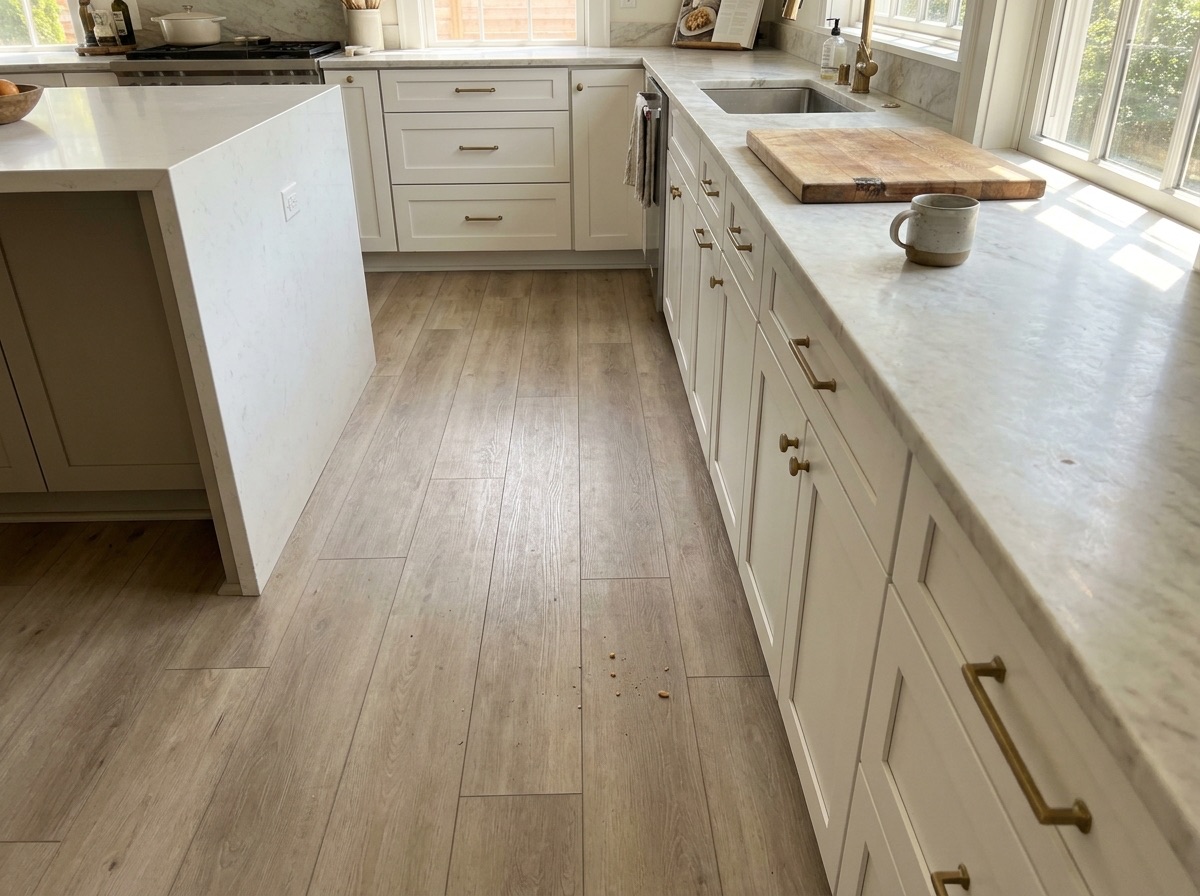
For most DMV laundry rooms, LVP is the floor we recommend and the one we install most. It is 100 percent waterproof (not just water-resistant), so a leak is a mop-up, not a claim. It is warmer and softer underfoot than tile, which matters in a room you stand in to fold and sort. It is quieter under a spinning washer. It looks like wood or stone, comes in dozens of styles, and if a plank ever gets damaged you can swap that plank instead of redoing the room. Our waterproof vinyl in a wet room breakdown shows how it performs in the same conditions a laundry room throws at it.
💡 Key takeaway
For a laundry room specifically, ask for a rigid-core SPC (stone-plastic composite) plank rather than a softer WPC. A washer is heavy and it vibrates, and the denser SPC core stays flatter and resists dents from the machine feet and any dropped tools. We cover the difference in our WPC vs SPC guide. Everyday care is just a damp mop, see our vinyl plank cleaning guide.
Tile: the most durable upgrade
Quick answer
Porcelain or ceramic tile is the toughest, most waterproof laundry floor there is, and it is the best choice over a basement slab. It handles standing water, heat, and dropped detergent jugs without a mark. The trade-offs are a higher installed cost, a harder and colder surface, and a multi-day install. If maximum durability is the goal, tile wins.
If you want the most bulletproof laundry floor and cost is not the deciding factor, tile is the upgrade. It is fully waterproof, it will not dent under a washer, and it is the natural match for a laundry room that sits on a concrete slab, which is common in DMV basements. A good tile floor lasts 30 to 50 years. The downsides are real, though: it is harder and colder to stand on, a dropped glass jar can crack a tile, and the install takes several days because the mortar and grout have to cure. If you like the idea of tile, our best tile for a wet floor guide covers which types hold up, and tile can be paired with radiant heat to solve the cold-floor problem.
What to avoid in a laundry room
Quick answer
Skip hardwood, laminate, and carpet. Hardwood and laminate are not waterproof, so one washer leak swells and ruins them, and laminate is the worst of the two because it puffs up at every seam the moment water sits on it. Carpet traps water against the subfloor, grows mold, and holds detergent and mildew odor. None of the three belong in a room built around an appliance full of water.
People ask about these three because they already have them elsewhere in the house and want a match. Here is the honest reason each one fails. Hardwood is real wood, and standing water destroys it: it cups, buckles, and stains, and it is the wrong floor for any wet room. Laminate looks like a safe middle ground but it is not, its fiberboard core swells and crumbles at the seams the first time water sits on it, and once it puffs up it cannot go back, which we explain in our is laminate waterproof guide. Carpet is the worst pick of all: it soaks up a leak, holds it against the subfloor, and turns into a mold and odor problem you cannot clean out. If you want the vinyl-versus-carpet reasoning in full, our carpet vs vinyl plank comparison lays it out.
What each costs installed in the DMV
Quick answer
Our all-in luxury vinyl plank price is $6.50 per square foot, including material, underlayment, install, and demo and removal of the old floor. A professionally installed tile floor in the DMV usually runs about $12 to $20 per square foot once you add substrate prep, labor, and grout. Because a laundry room is small, expect a labor minimum on either material rather than a pure per-foot price.
Laundry rooms are small, often 30 to 60 square feet, so the total job cost is modest either way, but the way pricing works changes at that size. At $6.50 per square foot all-in, an LVP laundry floor is one of the most affordable upgrades in the house, and that number already covers tearing out and hauling away the old floor, which big-box quotes bill separately along with underlayment and disposal. Our hidden charges guide shows exactly where those add-ons hide, and our vinyl plank cost breakdown covers what moves the number. Tile costs more per foot because it is a labor-heavy install with substrate prep and cure time.
⚠ Watch out
Because the room is small, don't be surprised by a small-job labor minimum. A crew still has to show up, prep, cut around the washer hookups and the drain, and finish clean edges, and that base labor is roughly the same whether the room is 40 square feet or 60. The per-foot rate on a tiny room can look high for that reason. The smart move is to do the laundry room at the same time as an adjacent space (a mudroom, hallway, or basement) so the mobilization cost is shared across more floor.
The DMV stuff: basements, slabs, and closets
Quick answer
Two DMV realities shape the laundry choice. Many local laundry rooms sit in a basement on a concrete slab, where tile or glue-down LVP over a moisture barrier both work but solid wood never does. And in condos and townhomes the laundry is often a stacked closet, where the floor height and the transition into the hallway have to be planned so the doors and the machines still fit.
Start with the slab, because so many DMV laundry rooms live in the basement. On a concrete slab you have moisture coming up from the ground, so the material has to tolerate it. Tile over a properly prepped slab is a classic, durable answer. LVP also works well on a slab, glued down or floating over the right underlayment, and it is the warmer option down there. Solid hardwood is off the table below grade, full stop. If your laundry shares the basement with a finished area, our best flooring for basements guide covers the whole space.
The other DMV pattern is the stacked laundry closet in Reston townhomes, Tysons condos, and newer builds, where a washer and dryer stack into a closet off a hallway. There the floor height matters: build the floor up too high with a thick tile-and-mortar bed and the closet doors bind or the machines no longer slide in. LVP is the easy answer here because it is thin, waterproof, and transitions cleanly into the adjoining hallway floor without a big step. Planning that transition is part of doing the job right, not an afterthought.
The details a good installer plans for
Quick answer
A laundry floor is more than the plank or tile. It means cutting cleanly around the water hookups and the floor drain, running the waterproof floor under where the washer sits (not just up to it), planning the transition height into the next room, and making sure the finished floor still lets the machines and any pedestal or drain pan sit level. These details are where a rushed job goes wrong.
The material is only half of a good laundry floor. The rest is the install. We run the waterproof floor under the footprint of the washer and dryer, not just up to the front of them, so a leak under the machine still lands on a waterproof surface. We cut clean around the supply valves, the drain, and any recessed washer box. If the home has a drain pan under the washer (a smart, cheap insurance policy against exactly the leaks this whole article is about), the finished floor height has to let the pan and the machines sit flat and level. And we plan the transition into the adjoining room so there is no trip lip and the doors still clear. None of this is exotic, but it is the difference between a floor that quietly does its job for decades and one that fails at the first drip.
FAQs about laundry room flooring
What is the best flooring for a laundry room?
Waterproof luxury vinyl plank is the best choice for most laundry rooms. It is fully waterproof, warm, quiet under a washer, looks like real wood, and installs affordably at $6.50 per square foot all-in with us. Tile is the more durable upgrade if you want the toughest surface and don't mind the higher cost and colder floor.
Can you put vinyl plank flooring in a laundry room?
Yes, and it is the top recommendation for the room. Luxury vinyl plank is 100 percent waterproof, so a washer leak wipes up instead of ruining the floor. For a laundry room, choose a rigid-core SPC plank, which stays flat and resists dents under the weight and vibration of a washing machine better than a softer plank does.
Is laminate okay in a laundry room?
No. Laminate is not waterproof. Its fiberboard core swells and puffs up at the seams the first time water sits on it, and once it swells it cannot be flattened back out. In a room built around an appliance full of water, laminate is one of the worst choices you can make. Use waterproof vinyl or tile instead.
Should a laundry room floor be tile or vinyl?
Both are waterproof and both are good. Choose vinyl plank for a warmer, quieter, more affordable floor that installs in a day, which suits most main-level and upstairs laundry rooms. Choose tile for maximum durability and for laundry rooms on a basement slab, accepting the higher cost, colder surface, and multi-day install.
What flooring is best for a basement laundry room in the DMV?
Tile or glue-down luxury vinyl plank over a moisture barrier. Both handle the moisture that rises through a concrete slab, which solid hardwood and laminate cannot. Tile is the most durable and vinyl is the warmer option. Solid hardwood should never go in a below-grade laundry room in our climate.
How much does laundry room flooring cost to install?
Our all-in luxury vinyl plank price is $6.50 per square foot, including material, underlayment, install, and demo and removal. Because a laundry room is small, expect a labor minimum rather than a pure per-foot price. Doing the laundry room alongside an adjacent space spreads that base labor over more floor and lowers the effective rate.
Bottom line
A laundry room is the one room where you should pick the floor for the day the appliance leaks. That makes the choice easy: go waterproof. Luxury vinyl plank is the best answer for most DMV homes, waterproof, warm, quiet, and affordable at our all-in $6.50 per square foot including demo and removal. Tile is the more durable upgrade and the right call over a basement slab, at a higher cost. Hardwood, laminate, and carpet do not belong in the room, no matter how nicely they match the rest of the house. If you are in Alexandria, Arlington, Fairfax, or anywhere in the DMV and want a straight recommendation and a real number for your laundry room, we install luxury vinyl plank and tile across the whole metro. Get a free in-home quote and we'll tell you exactly what fits.