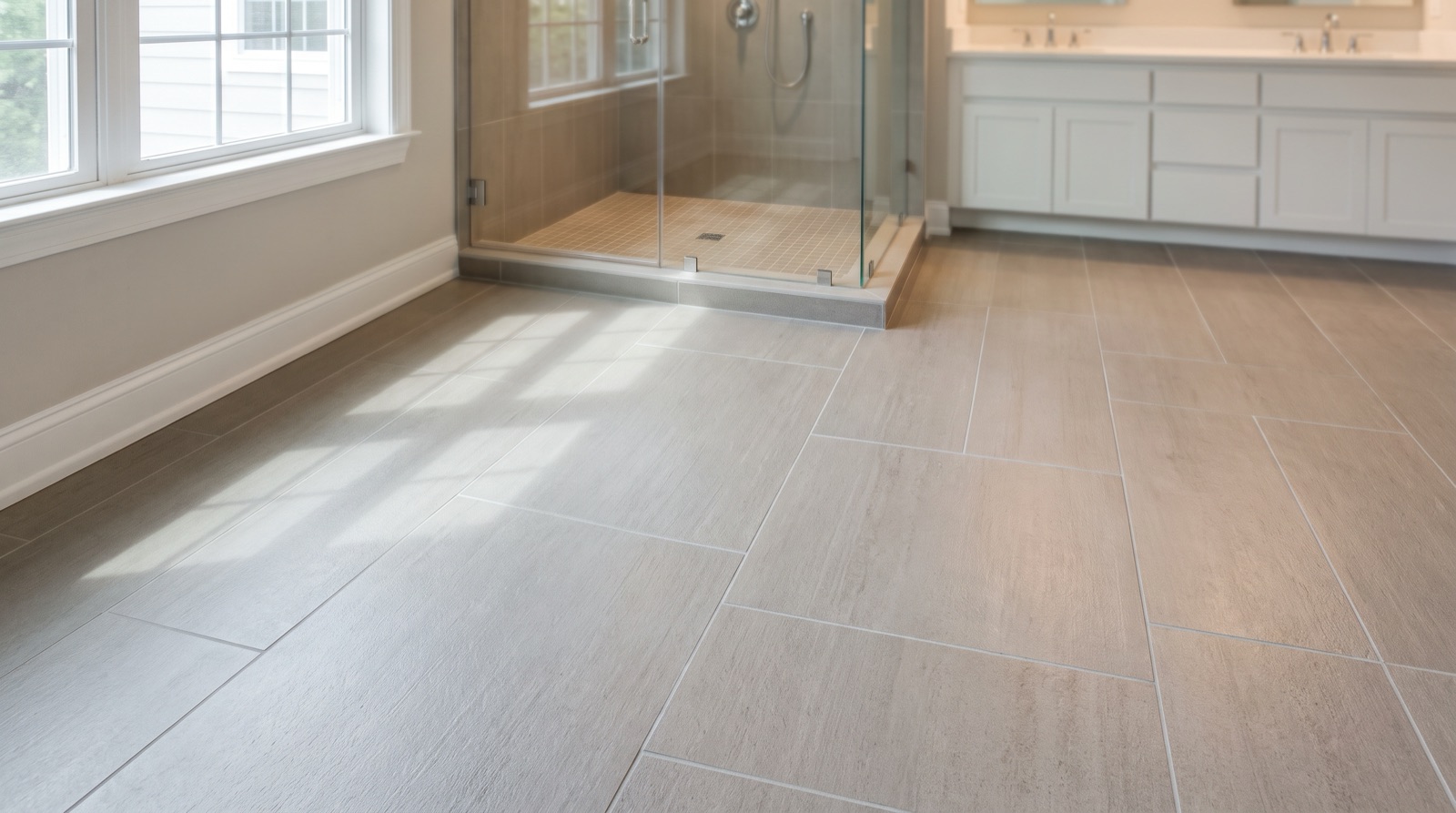
"What tile should I put on the bathroom floor?" comes up on almost every bath job we scope in the DMV, whether it is a tight powder room in an Old Town Alexandria rowhouse, a primary bath in a McLean rebuild, a kids' bath in a Vienna split-level, or a condo bathroom in Tysons. The honest answer is that the tile body matters less than three things people rarely check: how slippery it gets when wet, how big it is relative to the room, and how the grout is sealed. After 20+ years tiling bathrooms across this metro, here is the real buying guide: the best tile material for a bathroom floor, the wet slip-resistance number to demand, the right tile size for a DMV bathroom, why shower floors play by different rules than the rest of the bathroom, grout and sealing for our humid summers, whether to pair tile with a heated floor, honest install cost, and the failures we get called back to fix.
See how those material decisions fit the scope of our bathroom floor remodeling service.
The short answer for DMV bathrooms
Quick answer
For a DMV bathroom floor, buy porcelain, PEI 3 or 4, with a matte or textured surface rated DCOF 0.42 or higher for wet use, in a 12-by-24 or smaller format, set with quality grout that gets sealed. Porcelain for the water resistance, matte or textured for grip when the floor is wet, a smaller tile so a small DMV bathroom has fewer awkward cuts and a flatter result, and sealed grout so our summer humidity does not grow mildew in the joints. The shower floor is the one spot that needs a different, smaller tile (usually a 2-by-2 mosaic) so it can pitch to the drain and give your feet grip. Everything else in the bathroom can run the same field tile.
The rest of this guide explains each of those calls: which material, the slip spec almost no homeowner is shown, the right size for the room, the shower-floor exception, the grout that actually keeps water out, the heated-floor question, real DMV pricing, and the mistakes that send us back to redo a floor.
The best tile material for a bathroom floor
Quick answer
Porcelain is the right material for almost every DMV bathroom floor. Ceramic is acceptable only in a low-traffic powder room that stays dry. Natural stone (marble, slate, travertine) looks beautiful but needs sealing and babying, so we only recommend it to clients who want the look and accept the upkeep. Porcelain absorbs 0.5 percent water or less, so it shrugs off standing water, steam, and the daily wet floor in a family bathroom without soaking it up.
| Material | Best for | Watch out |
|---|---|---|
| Porcelain | Any bathroom floor: primary, family, kids', powder | Make sure the finish is matte/textured, not polished |
| Ceramic | Low-traffic powder rooms that stay dry, walls | Softer and more porous; not ideal for a wet family bath floor |
| Natural stone (marble, slate, travertine) | High-end baths where the owner wants the look and the upkeep | Porous, needs periodic resealing, can etch and stain |
| Glass / glossy decorative | Accent and walls only | Slippery when wet; never use as the main floor surface |
The body decision is the same one we walk through in detail in our porcelain vs ceramic tile guide: for a floor that gets wet, porcelain wins on water resistance and durability, and the material upcharge over ceramic is usually only $2-4 per square foot. Stone is the only material where we slow the conversation down, because a marble or travertine floor in a busy DMV bathroom means resealing on a schedule and being careful with anything acidic. If you want stone, we will install it right and tell you the maintenance honestly. If you want the look without the upkeep, a stone-look porcelain gets you 90 percent of the way there with none of the babysitting.
Slip resistance: the spec nobody checks (DCOF)
Quick answer
The number to demand for a bathroom floor is DCOF (dynamic coefficient of friction) of 0.42 or higher when wet. That is the industry threshold for a floor expected to get wet, and it is printed on the tile spec sheet. A beautiful polished tile can be well under that, which is why a glossy bathroom floor is slick and dangerous the moment it gets a splash on it. Matte and structured finishes carry higher DCOF numbers and are the right call for a wet room.
This is the single most-skipped spec in a bathroom job. Homeowners pick a tile in the showroom for the look, nobody mentions slip resistance, and the floor turns into a hazard the first time someone steps out of the shower onto it. The fix is free: ask for the DCOF rating before you buy, and choose 0.42 wet or higher for any bathroom floor. If a tile does not publish a DCOF number, treat that as a no for a wet floor. The tradeoff is small. A matte porcelain looks just as good as a polished one in a bathroom and reads as more current anyway, and the slight texture you can feel underfoot is the grip doing its job. For households with kids or older adults, we push the slip spec harder and lean toward smaller tile with more grout lines, because grout joints add grip.
⚠ Watch out
"Polished porcelain" is still slippery when wet, even though it is durable porcelain. Durability and slip resistance are two different specs. A tile can be true porcelain, PEI 4, and rated for floors, and still be dangerously slick wet because its surface is polished. Check the DCOF number separately from the porcelain rating. They are not the same thing.
Tile size for a DMV bathroom
Quick answer
For most DMV bathroom floors, a 12-by-24 porcelain plank is the workhorse, and a small powder room often looks best with a 12-by-12 or a smaller pattern. The shower floor is the exception and needs a 2-by-2 mosaic or smaller. Bigger is not automatically better in a small bathroom. A 12-by-24 covers a floor with clean lines and fewer grout joints, but the floor has to be flat enough to set it without lippage. In a tiny powder room, a huge tile means awkward cuts at every wall.
DMV bathrooms run small, especially in Old Town rowhouses, older Arlington Cape Cods, and condo conversions. In a 30 to 40 square foot powder room, a 24-inch tile can leave a thin sliver cut along one wall that looks like a mistake, so a 12-by-12 or a 12-by-24 laid to balance the cuts usually looks cleaner. In a larger primary bath, 12-by-24 planks or large-format tile read modern and minimize joints. The catch with large-format is flatness: anything 15 inches or larger needs a flatter substrate (roughly 1/8 inch of variation over 10 feet), and a lot of DMV bathroom subfloors, especially over old joisted floors and in mid-century homes, fail that until they are leveled. We measure the floor before we recommend a tile size, because the size you can install flat depends on the floor you actually have. Our DMV floor leveling cost guide covers what that prep runs.
Shower floor vs bathroom floor: different rules
Quick answer
The shower floor needs small tile, usually a 2-by-2 mosaic or smaller, for two reasons: small tiles flex to follow the slope down to the drain, and the extra grout lines give bare feet grip on a constantly wet surface. The main bathroom floor outside the shower can run your larger field tile. You can use the same tile look in both by buying the field tile in a large format for the floor and a mosaic version for the shower pan.
People assume the whole bathroom takes one tile, then wonder why the shower floor is its own product. A shower pan slopes in two directions toward the drain, and a large rigid tile cannot follow that compound slope, so it has to be cut into small pieces or set as a mosaic that bends around the pitch. Small mosaic tile also means more grout lines, and on a surface that is wet every single day, those joints are what keep you from slipping. Most tile lines now sell a coordinating mosaic of the same color and finish as the larger field tile, so the shower floor and the bathroom floor read as one material even though they are two sizes. The shower also needs real waterproofing under the tile (a pan and membrane), which is priced by the scope of the shower, not by the square foot of the floor.
Grout and sealing in DMV humidity
Quick answer
In a DMV bathroom, the grout is what fails first, not the tile. Use a quality grout, seal a cementitious grout after it cures, and reseal it every year or two, or use an epoxy grout that needs no sealing. Our humid summers grow mildew in unsealed joints fast. The tile body is nearly waterproof; the grout lines are the porous part, and they are where water and mildew get in if the grout is cheap or unsealed.
| Grout type | Best for | Sealing |
|---|---|---|
| Cementitious (standard) | Most bathroom floors, budget-friendly | Must be sealed after cure, reseal every 1-2 years |
| Epoxy | Showers, heavy-use family baths, anyone who hates resealing | No sealing needed; stain and water resistant |
| Single-component (pre-mixed urethane) | Walls and low-traffic, easier DIY | Varies by product; check the label |
For a DMV main or family bath, we usually recommend epoxy grout in the shower and on the floor if the budget allows, because it never needs sealing and it shrugs off the steam and standing water that define a bathroom here in July and August. If a cementitious grout is used to save money, it has to be sealed once it cures and resealed on a schedule, or the joints darken, stain, and grow mildew. The single most common bathroom call we get is not a cracked tile. It is failing grout: stained, soft, or letting water behind the tile. That is a sealing and grout-quality problem, decided before the first tile went down.
Pairing tile with a heated floor
Quick answer
Tile is the ideal surface for a heated floor, and a bathroom is the single best room to add one in a DMV home. An electric mat under the tile takes the cold-tile shock out of winter mornings and dries the floor faster. It adds to the install but is far cheaper to do during a tile job than after. Tile conducts heat well, so a warmed tile floor in a primary bath is one of the highest-comfort upgrades for the money.
If you are already tearing out and retiling a bathroom, that is the moment to decide on a heated floor, because the electric mat goes down as part of the tile assembly and cannot be added later without pulling the floor back up. In our climate, the winter payoff is real: a tiled bathroom floor is cold from roughly November through March, and a thin electric mat under the tile turns that into a warm floor on a timer. It also helps the floor dry between uses, which is a small mildew-prevention bonus in a humid summer. The compatibility details (mat type, thermostat, which tile and membrane work over heat) are in our radiant heat flooring compatibility guide. The short version: porcelain tile is the best-case surface for radiant heat, so a bathroom retile is the natural time to add it.
What a DMV bathroom floor actually costs
Quick answer
A tiled DMV bathroom floor typically lands around $9-18 per square foot all-in, and the tile body is the smallest variable in that number. Prep, waterproofing, layout, and grout drive the cost more than porcelain vs ceramic. A small powder room floor with a simple grid is a different job from a primary bath with a tiled shower pan, leveling, and a heated mat, which is why we quote tile custom rather than one flat per-square-foot number.
| Cost component | Typical DMV range | Notes |
|---|---|---|
| Porcelain floor tile material | $3-8/sqft | Matte/textured, DCOF 0.42+ for a bathroom |
| Tile labor (setting + grout) | $7-12/sqft | Higher for mosaic, diagonal, herringbone, large format |
| Demo + removal of old floor | $1.50-4/sqft | Old tile, vinyl, or a rotted subfloor under a leaking toilet |
| Self-leveling / uncoupling membrane | $1.50-4/sqft | Common on uneven bathroom subfloors and large-format |
| Shower pan + waterproofing | By the job | Pan, membrane, niche, curb priced per scope |
| Electric heated mat (optional) | By the job | Best added during the tile install, not after |
The reason tile is quoted custom is that two bathrooms of the same square footage can be very different jobs. A 35 square foot powder room with a straight-lay grid over a sound subfloor is quick. A 90 square foot primary bath with a curbless tiled shower, a mosaic pan, leveling over an old joisted floor, and a heated mat is a multi-day job with a lot more material and labor (our tile installation timeline breaks down how long a bathroom floor actually takes, cure time and all). What stays constant is the all-in promise: the quote includes material, professional installation by our in-house crew with no subcontractors, demo and removal of the old floor, and any prep we flag up front, with no surprise line items mid-job. The quote traps we built our pricing to avoid are in our DMV hidden-charges guide, the broader tile picture is in our tile installation cost guide, and the full service is on our tile and ceramic page.
Bathroom tile mistakes we get called to fix
Quick answer
The bathroom redos we get called for are almost always one of five things: polished tile that is slippery wet, unsealed grout growing mildew, large tile set over an unleveled floor, a shower floor tiled in pieces too big to follow the slope, and ceramic used where the floor needed porcelain. Every one of them is a selection or prep decision made before the first tile went down.
The five we see most in DMV bathrooms:
- Polished tile on the floor. Gorgeous in the showroom, slick and dangerous the moment it gets wet. We redo these in a matte or textured porcelain rated DCOF 0.42 or higher.
- Unsealed or low-grade grout. Stains, softens, and grows mildew in our humid summers, and lets water work behind the tile. The fix is regrouting, often with epoxy.
- Large-format tile over an unleveled floor. Lippage on every joint that you feel with bare feet. The substrate was the problem, not the tile, so the fix is leveling and a reset.
- A shower floor tiled too big. Tile that cannot follow the slope to the drain ponds water and feels slippery. Shower pans need a small mosaic.
- Ceramic where the floor needed porcelain. A soft ceramic in a wet family bath wears and chips faster than the owner expected. Porcelain was the right body.
The thread through all five: choosing porcelain is necessary but not sufficient. The slip rating, the size matched to the room, the level substrate, the waterproofing, and the sealed grout are what make a bathroom floor last 20 to 30 years instead of getting redone in three.
FAQs about bathroom floor tile
What is the best tile for a bathroom floor?
Porcelain, PEI 3 or 4, with a matte or textured finish rated DCOF 0.42 or higher for wet use, in a 12-by-24 or smaller format. Porcelain handles the water, the matte finish gives grip when the floor is wet, and a smaller tile fits a typical DMV bathroom with cleaner cuts. Seal the grout or use epoxy grout.
Is porcelain or ceramic better for a bathroom floor?
Porcelain for any bathroom floor that gets wet daily, which is most of them. Ceramic is acceptable only in a low-traffic powder room that stays dry. Porcelain's near-zero water absorption and harder body make it the safer choice for a family or primary bath, and the material upcharge over ceramic is usually only $2-4 per square foot.
What size tile is best for a small bathroom?
For a small DMV powder room, a 12-by-12 or a 12-by-24 laid to balance the cuts usually looks cleanest, and a smaller patterned tile can work well too. Very large tiles in a tiny room leave awkward sliver cuts at the walls. The shower floor is the exception and needs a 2-by-2 mosaic or smaller so it can pitch to the drain.
Why is my bathroom tile so slippery?
It is almost always a polished or glossy tile with a low slip rating. Durability and slip resistance are separate specs, so a tile can be durable porcelain and still be slick when wet. The fix is a tile rated DCOF 0.42 or higher with a matte or textured surface. For a wet room, never use polished tile on the floor.
Do I need to seal the grout in my bathroom?
Yes, if it is a standard cementitious grout. It must be sealed after it cures and resealed every one to two years, or our humid summers will grow mildew and stain the joints. Epoxy grout needs no sealing and is the lower-maintenance option for showers and busy bathrooms, which is why we often recommend it.
Can I put a heated floor under bathroom tile?
Yes, and a bathroom is the best room in a DMV home to add one. An electric mat under porcelain tile takes the cold out of winter mornings and helps the floor dry. It has to be installed as part of the tile job, not added later, so a retile is the time to decide.
How much does a tiled bathroom floor cost in the DMV?
Most tiled DMV bathroom floors run about $9-18 per square foot all-in, with the prep, waterproofing, layout, and grout driving the number more than the tile body. A small simple powder room is at the low end; a primary bath with a tiled shower, leveling, and a heated mat is a larger, multi-day job. We quote tile custom for that reason.
Bottom line: how to choose
For a DMV bathroom floor, the rule is short: porcelain, PEI 3 or 4, matte or textured at DCOF 0.42 or higher, sized to the room (12-by-24 or smaller, with a 2-by-2 mosaic for the shower pan), set over a level substrate with sealed or epoxy grout. Pick the slip rating before you fall in love with a look, demand the spec sheet, and remember that the grout and the prep are what fail first, not the tile body. If a bathroom retile is on the table, that is also the right moment to add a heated floor, because it cannot be done after the tile is down.
We tile bathrooms across the DMV, and every quote is all-in: material, professional installation by our in-house crew with no subcontractors, old flooring demo and removal, and any prep flagged up front with no surprise line items. If you want a straight answer on which tile your bathroom needs and what it will actually cost, request a free estimate or call us at 571-341-7247 and we will walk the space with you. Pricing a full renovation and not just the tile? Our DMV bathroom remodel cost guide covers the whole budget.