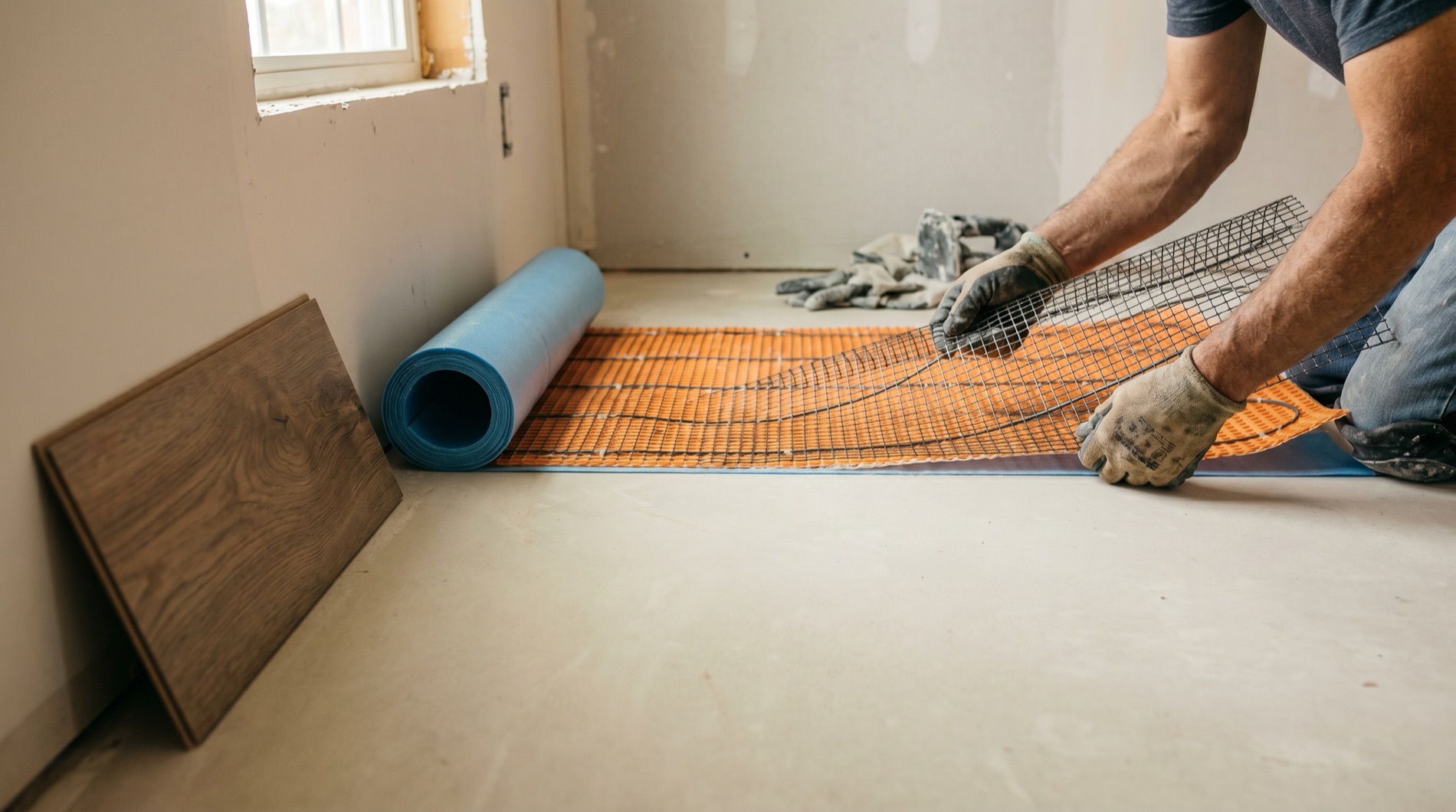
Radiant heat under the floor is one of the most-requested upgrades in DMV bathroom remodels and finished basements right now. The pitch is simple. Warm tile underfoot in February. A finished basement that does not feel like a basement. A primary bathroom that holds heat without running the whole house furnace at 5am. The pitch is real. What is also real is that the floor on top of the heat is the part that decides whether the system works for 25 years or fails inside 3.
This is the working guide Potomac Floors gives homeowners who ask "can I put my flooring over heated floors?" during a consultation. We install over both electric mats and hydronic tubing in Alexandria, Arlington, Fairfax, Tysons, Reston, and across the broader DMV. Below is what works, what does not, the temperature ceiling each manufacturer actually publishes, what the heat system adds to the install bill (our heated bathroom floor cost guide breaks the numbers down by size), and the five field mistakes that turn a premium remodel into a callback.
The short answer by material
Quick answer
Tile and natural stone are the default and the best thermal match. LVP and vinyl plank work if the product is rated for radiant heat (the spec sheet will name a max floor surface temperature, usually 80F / 27C) and the system is set up to never exceed it. Engineered hardwood works floating or glued, only with stable species (white oak, walnut, hickory) and a moisture-managed setup. Solid hardwood we recommend against in almost every case, especially over hydronic. Laminate works in theory, fails in practice over time. Carpet blocks the heat and defeats the point. The choice is driven by the room, the subfloor, and which heat system is going in, not by your taste in flooring.
If you take nothing else from this piece: pick the heat system and the flooring together, not in sequence. Most of the install problems we get called to fix come from someone choosing the floor first, the heat system second, and discovering at install day that the two are not rated for each other.
The two systems: electric mats vs hydronic
Quick answer
Electric mats are a thin cable heating element embedded in a mesh, set in thinset on top of the subfloor under the finish flooring. Best for single rooms (bathrooms, mudrooms, small kitchens). Lower install cost, higher operating cost. Hydronic is warm water pumped through PEX tubing in the subfloor or in a poured layer, driven by a boiler or a heat pump. Best for whole-floor or whole-basement coverage. Higher install cost, lower operating cost. Electric is comfort heat. Hydronic is comfort heat plus primary heat.
Almost every electric system you will see in a DMV bathroom is a mat product: Warmup, NuHeat, SunTouch, Schluter DITRA-HEAT. The mat sits in modified thinset over the subfloor, a thermostat with a floor sensor controls it, and the finished flooring goes on top. Heat output is around 12 watts per square foot. Surface temperature usually tops out around 85F to 90F at the thermostat setting, with most homeowners running it at 78F to 82F for comfort.
Hydronic is a different animal. PEX tubing is either stapled to a wood subfloor from below (joist-bay installs), laid in a slab that gets poured, or set in aluminum heat-transfer plates under the subfloor. A boiler or heat pump sends warm water (rarely above 120F at the source, often 90F to 110F at the loop) through the tubing. Floor surface temperature is more controlled and the system can carry a whole basement or addition. The trade-off: install cost runs several times higher, and the flooring above sees a slower, more sustained heat that some materials handle worse over years than a thermostatically-cycled electric mat.
Why this matters for the flooring decision: electric mats heat fast, cycle on and off, and reach a clear thermostat-set ceiling. Hydronic heats slow, runs longer, and the floor sees a more constant warmth. Materials that fail under sustained warmth (drying out, shrinking, gapping) fail faster over hydronic than over an intermittent electric mat in the same house. Solid hardwood is the cleanest example, which is why we treat the two systems separately throughout this guide.
Tile and stone: the default, and why
Quick answer
Porcelain tile, ceramic tile, and natural stone are the strongest match for radiant heat. They conduct heat efficiently (you feel the warmth fast), they hold no fear of temperature (no max surface temp from the flooring side), and they expand and contract minimally with the heat cycle. This is what every manufacturer warranty assumes and why the heat-system spec sheets almost always show tile as the reference install. If you want the best version of heated floors for the money, tile is it.
Thermal conductivity is the reason tile dominates this category. The heat moves through tile and stone in seconds, so the floor feels warm shortly after the system kicks on. The same physics works against insulators like carpet and against poorly-spec'd vinyl, which absorb heat slowly and leave you with a system that runs constantly without ever feeling warm.
The install pattern is also clean. Electric mat in modified thinset, uncoupling membrane on top if the substrate is wood (Schluter DITRA-HEAT pairs the heat mat and the uncoupling membrane in one product), then tile set in thinset over the membrane. Hydronic in a poured layer (gypcrete or concrete topping slab), or in panels with aluminum transfer plates under the subfloor; tile installs over the cured substrate as a normal tile install. No special flooring-side considerations beyond standard tile prep.
Where tile gets ruled out in the DMV is rarely the heat system. It is the room. Tile in a primary bedroom is cold to the bare foot when the heat is off, hard on knees and feet for long stands, and acoustically bright. Same for a basement family room. Heated tile in those rooms is the best heated floor you can buy and the wrong choice for daily use. That is why the LVP and engineered hardwood sections below exist.
LVP and vinyl: works if you read the spec sheet
Quick answer
Most modern rigid-core LVP (both SPC stone-polymer and WPC wood-polymer) is rated for radiant heat, with a published maximum floor surface temperature of 80F to 85F (27C to 29C). The system must include a floor-mounted temperature sensor, not just an air sensor, and the thermostat must enforce that ceiling. Glue-down vinyl needs an adhesive rated for heat. Click-lock LVP needs an expansion gap at every wall and obstruction. Done right, the floor lasts. Done wrong, the floor cups, gaps, or releases from the adhesive within 1 to 2 heating seasons.
The technical question with LVP over radiant heat is dimensional stability. PVC, the base polymer in vinyl, expands and contracts with temperature. SPC (stone polymer composite) holds its dimensions better than WPC under heat because of the higher mineral content; the deep technical breakdown of the two cores is in our WPC vs SPC vinyl plank piece. For radiant heat installs, we default to SPC unless the room is fully climate-controlled year-round.
The spec sheet number to find is the maximum floor surface temperature. It will say something like "do not exceed 80F (27C) at the floor surface" or "maximum 85F (29C)." That is the number your heat-system thermostat must enforce, not the air temperature in the room. The sensor that does this is a floor-embedded probe wired into the thermostat, set during the install. A radiant heat system controlled only by air temperature will overshoot the floor surface limit during long cold snaps, void the LVP warranty, and produce a cosmetic floor failure (gaps in winter, cupping in summer) within a few years.
The other LVP-specific item: floating click-lock floors need a real expansion gap at every wall, doorway, and obstruction (1/4 inch is the spec for most products over radiant heat). The floor moves with the heat cycle. If the boards run tight to a baseboard or a tub flange, they buckle in the middle of the room when the heat runs. We hold the gap with spacers during install and hide it with quarter-round or a shoe mold rather than skipping it.
Glue-down LVP works too, often better in commercial-style installs over a poured hydronic slab. The adhesive must be rated for radiant heat (most are now, but check the label). Install temperature for the adhesive is also a spec: many require the heat system to be off and the floor at room temperature during cure (24 to 72 hours), then ramped up slowly over a week. Skipping the ramp causes adhesive failure and lifted planks. Real DMV pricing for LVP itself sits at $6.50 per square foot all-in at Potomac Floors; the radiant heat system is the separate line item and we break that out in the cost section below.
Engineered hardwood: yes, with rules
Quick answer
Engineered hardwood works over radiant heat when the species is stable (white oak, walnut, hickory, certain maples), the construction is multi-ply with a thick wear layer (5-ply, 9-ply, or 11-ply preferred over 3-ply), the install is glued or floated (not nailed into a subfloor sitting over hot tubing), and the system never exceeds 81F (27C) at the floor surface. Wide-plank engineered (7 inches or wider) is more prone to gapping than narrow plank over the same heat. Pre-acclimate the wood in the room for 5 to 10 days before install with the heat running at the planned setpoint. Done right, engineered hardwood over radiant heat is a beautiful, durable floor. Done wrong, it gaps every winter and cups every summer.
Engineered hardwood is dimensionally stable in a way solid hardwood is not, which is why it earns the radiant heat slot. The plywood-style cross-grain core resists the seasonal movement that destroys solid planks over heat. The hardwood wear layer (the top piece of real wood, usually 2mm to 4mm thick) gives you the look, the refinishability (with the thicker wear layers), and the long life. The construction details matter: 5-ply or 9-ply cores with white oak, walnut, or hickory wear layers hold up; 3-ply economy products with red oak or hard maple wear layers move more and we have replaced a few of those installs.
The install method shifts over radiant heat. Nail-down is usually out (the nails interfere with electric mats and you do not want fasteners near hydronic tubing). Glued direct to the subfloor with a polyurethane adhesive rated for radiant heat is the cleanest install for tight, gap-free performance, and is what we use over poured hydronic slabs. Floating with a moisture-resistant underlayment works on top of an electric mat with a rated underlayment, and is the install path most often used in DMV bathrooms and powder rooms. Full breakdown of the three install methods is in our nail vs glue vs float install methods piece.
The species choice is not aesthetic, it is structural. White oak is the DMV default because it sits in the middle of the Janka hardness range and has a stable cell structure. Walnut works and ages beautifully but costs more. Hickory works and is harder on the saw blade. American cherry and maple are riskier (more seasonal movement), and we steer away from exotic species (Brazilian cherry, tigerwood) over radiant unless the manufacturer specifically warrants the product for it. The fuller species comparison for the DMV climate is in our best hardwood species piece.
The acclimation step gets skipped often and causes most of the callbacks. Engineered planks that come off the truck at warehouse humidity (often 50% to 60% RH) hit a heated DMV room in February at 25% to 30% RH and shrink. If they were installed before they finished shrinking, gaps appear in the first cold snap. The fix is to stage the boxes in the room, open them, run the heat system at the planned winter setpoint, and let the wood reach equilibrium with the conditioned space for 5 to 10 days before install. We schedule the delivery a week before the install date specifically for this. Our all-in hardwood pricing of $8.50 per square foot covers engineered and solid both; radiant heat installs trend slightly higher labor (the acclimation, the slow ramp, the substrate prep) and we quote that on site.
Solid hardwood: almost never, and here is why
Quick answer
Solid hardwood is the one material we actively recommend against installing over radiant heat in the DMV, especially over hydronic. The plank is one continuous piece of wood, all-grain in one direction, and the seasonal movement under a heated subfloor is too large to manage. You get visible gaps every winter and cupping every summer that no install technique fully prevents. There are narrow exceptions (quartersawn white oak, narrow plank, electric mat only, climate-controlled room with a humidifier), and they still come with risk. If the room is heated and you want real wood, install engineered hardwood. That is the right answer in 95% of DMV jobs.
The mechanics here are not a matter of opinion. Solid hardwood loses dimension across the grain as it dries. A 5-inch plank of red oak loses roughly 1/16 inch of width going from summer humidity (around 50% RH) to a heated winter house running at 25% RH. Across a 12-foot room with 30 planks, that is most of two inches of cumulative shrinkage. The boards either gap visibly between every plank, or they put differential stress on the nailing pattern and lift, cup, or split. Radiant heat under the floor accelerates the drying, exaggerates the seasonal swing, and concentrates the problem.
Quartersawn lumber moves less than plain-sawn (the grain orientation makes the dimensional change smaller), and narrow planks gap less visibly than wide ones. So a quartersawn 2-1/4 inch white oak strip over an electric mat in a humidified house is the install pattern that has the best chance of working. We still tell homeowners straight up that the risk is real, the warranty paths are narrow, and engineered is the better answer for the same look. If a homeowner insists on solid hardwood over heat, we install per spec and put the moisture and temperature ranges in writing so the expectations are clear.
Over hydronic specifically, we will not install solid hardwood. The sustained warmth and the slow cycle is the worst case for any wood plank, and any callback is going to be a tear-out and replacement. That is a conversation we prefer to have at the quote stage, not after a $14,000 floor has cupped in July.
Laminate and carpet: the edge cases
Quick answer
Laminate is rated for radiant heat by most manufacturers (max floor surface 82F to 85F), conducts heat reasonably, and is the cheapest path to a heated finished surface. The catch: the HDF core swells if any moisture reaches it from a subfloor leak, a system fitting failure, or a bathroom spill, and the heat accelerates the swelling. We see it fail more often than LVP at the 7 to 10 year mark. Carpet insulates the heat. R-value over R-2 (combined carpet and pad) defeats the system; the manufacturer-recommended ceiling is about R-1.5 combined. That means low-pile carpet and the thinnest dense pad. The system runs constantly and feels barely warm. We do not recommend carpet over radiant for residential rooms.
Laminate over radiant heat is the value option, particularly for a finished basement zone where tile is too cold and engineered hardwood is over budget. Modern AC4-rated laminate with a thick HDF core and a tight click-lock joint is more durable than the laminate reputation from 2008. We install it where it makes sense at our $6.50 per square foot all-in. The risk we flag is moisture. A laminate plank with a swollen edge from a single bathroom overflow looks fine for a week and then telegraphs visibly within a month, and the radiant heat speeds that up. In a bathroom or laundry room, LVP is the safer call. In a dry basement family room, laminate over radiant is fine.
Carpet over radiant is a question we get most often in primary bedrooms. The honest answer is that the math works against it. R-value adds insulation between the heat source and the room. A typical 1/2 inch carpet pad runs R-1.0 to R-1.5 by itself. Even short-pile commercial carpet adds another R-0.5 to R-1.0. The combined R-value approaches or exceeds R-2, which is the rough ceiling above which the heat just cannot get through usefully. The room takes hours to warm, the bill runs constantly, and the warmth never feels like heated floors. If you want a bedroom with warm floors, switch to a low-loft area rug over an exposed engineered or LVP surface and put the rug where the bed sits but leave the perimeter exposed.
The temperature rules that protect your warranty
Quick answer
Every flooring manufacturer publishes a maximum floor surface temperature for radiant heat installs. Exceeding it voids the warranty and damages the floor. The number is enforced by a floor-embedded temperature sensor wired into the thermostat, not by air temperature. The number is also enforced during the first power-up: most manufacturers require a slow ramp (raise the setpoint 5F per day from 65F up to the operating temperature) so the flooring acclimates rather than shocks.
The published maximum floor surface temperatures we encounter most often in DMV installs:
| Material | Max floor surface temp | Notes |
|---|---|---|
| Porcelain / ceramic tile | No flooring-side limit | Heat-system thermostat limit applies (usually 85F to 90F) |
| Natural stone | No flooring-side limit | Same as tile |
| SPC vinyl plank (rigid) | 80F to 85F (27C to 29C) | Spec sheet must say "radiant heat rated" |
| WPC vinyl plank | 80F (27C) | More movement than SPC under heat |
| Engineered hardwood | 81F (27C) | Stable species only; acclimate before install |
| Solid hardwood | 75F to 80F (24C to 27C) | Not recommended; warranty risk regardless |
| Laminate (HDF core) | 82F to 85F (28C to 29C) | Moisture-sensitive; avoid wet rooms |
| Carpet (low pile + thin pad) | R-1.5 combined ceiling | Not really a heat limit, an insulation limit |
The numbers above are the spec sheet rule, not the marketing rule. Always look up the specific product before install. Manufacturers occasionally publish tighter or looser specs and the spec sheet is the document that controls warranty enforcement. The floor sensor is non-negotiable on any installs of LVP, engineered hardwood, or laminate over radiant heat. We will not install over a system that lacks one.
The slow-ramp protocol on first power-up matters and gets skipped most often. The system has been off through the install. The floor is at room temperature, the wood or vinyl is at moisture equilibrium with the cool conditioned space, and the heat has not started yet. Manufacturers want you to start the heat at 65F to 70F setpoint, raise it 5F every 24 hours, and reach your target operating temperature over a week. Cranking the system from 0 to 78F on day one is what produces the early callbacks (cupping, gapping, adhesive release).
What it actually costs in the DMV
Quick answer
Radiant heat is a separate line item from the floor itself. Electric mat systems in DMV bathrooms run $10 to $14 per square foot installed (mat material, thermostat, electrical work, thinset bed). Hydronic systems in finished basements or whole rooms run $14 to $20 per square foot installed for a retrofit (PEX tubing, manifold, mixing valve, controls; boiler not included). The flooring is added on top of that at our published all-in rates. A 100 square foot bathroom with electric mat and LVP runs roughly $1,100 to $1,400 for the heat plus $550 for the LVP, all-in.
Heat-system pricing is the question most homeowners do not know how to ask. They get a flooring quote at $6.50 per square foot LVP and forget that the mat, thermostat, and electrical work is another $10 to $14 per square foot. Our quotes break this out as a separate line so the math is clear, and we coordinate with the electrician on permits and panel capacity for the electric installs.
Electric mat economics: a Warmup or NuHeat mat at 12 watts per square foot, on a 100 square foot bathroom, draws roughly 1,200 watts when running, cycles on and off, and adds an estimated $5 to $15 per month to the electric bill at DMV winter rates. Comfort heat, not primary heat. Hydronic economics: higher upfront cost, lower operating cost (water heat is cheaper than electric resistance heat), and the system actually carries the room's heat load if sized right. The choice between electric and hydronic is not about preference, it is about whether you need primary heat or comfort heat in that room.
The flooring itself is unchanged from our standard pricing. Tile is by-job (the substrate prep and layout vary too much for a per-square-foot quote), LVP is $6.50 per square foot all-in, engineered hardwood is $8.50 per square foot all-in, laminate is $6.50 per square foot all-in, and refinishing existing engineered hardwood after a heat install is not advised (we replace, not refinish, on heat installs). All-in at Potomac Floors means material, professional install, and demo / removal of the old flooring. No surprise charges, which is what we explain in the hidden charges piece.
Five mistakes that ruin radiant heat installs
Watch out
Every callback we run on a radiant heat install traces back to one of these five mistakes. Most are committed before the install crew arrives, at the spec stage, the buy stage, or the demolition. Catch them up front and the install runs clean.
Mistake 1: Picking the floor first. The homeowner falls in love with a specific solid oak plank, the heat system gets designed around the floor, and the math does not work. The right order is room use, then heat system, then flooring rated for that combination. Reversing the order is the most common reason a remodel goes back twice.
Mistake 2: No floor sensor, only an air sensor. Some contractors install a basic line-voltage thermostat that reads room air temperature only. The floor surface overshoots during cold snaps because the air is still cool while the floor is already at 85F. By spring the LVP is gapping. Always install a floor-embedded sensor and confirm the thermostat reads from it in floor-limit mode, not air-only.
Mistake 3: Skipping the slow ramp on first power-up. Install day finishes, the homeowner cranks the thermostat to 78F that night, and the floor sees a 13F temperature spike in hours. Wood acclimated to a 65F room cannot handle that. Start the system at 65F, raise 5F per day, reach setpoint over a week.
Mistake 4: Using non-rated adhesives or underlayments. A standard LVP glue or a foam underlayment not rated for radiant heat will release, melt, or off-gas under sustained warmth. The product spec sheet must say "for use over radiant heat." We carry the rated ones and use only those on heat installs.
Mistake 5: No expansion gap on floating floors. The LVP or engineered hardwood goes down tight to every wall, the heat runs in January, the floor has nowhere to expand, and the planks buckle in the middle of the room. Hold a 1/4 inch expansion gap at every wall, doorway, tub flange, and toilet flange. Hide it with shoe mold or quarter round. This is non-negotiable.
FAQs about radiant heat flooring
Quick answer
The seven questions DMV homeowners ask most during a heated-floor consultation, with the straight answer in 60 words or less.
Can I put radiant heat in an existing floor without tearing it up?
Only with hydronic from below, into the joist bay between heat-transfer plates, if the joists are accessible from an unfinished basement underneath. Electric mats are an in-the-floor install and require pulling up the current flooring. Above-floor hydronic panels exist but raise the floor height by 1/2 inch or more, which usually does not work in existing rooms.
Will heated floors damage my existing hardwood?
If the existing floor is solid hardwood and we add hydronic from the joist bay below, yes. Gapping and cupping within 1 to 2 heating seasons. If the existing floor is engineered hardwood, the answer is "probably not, if the joist-bay system has a floor temperature sensor and runs at 80F max." We do an in-person check before quoting.
How long does electric radiant take to feel warm?
Five to fifteen minutes from a cold start, depending on the floor material. Tile feels warm fastest (3 to 5 minutes), LVP and engineered take 10 to 15. The right move is to put the system on a programmable thermostat that runs from one hour before you wake up, not to switch it on at the moment you walk in.
Is radiant heat worth it in a finished basement?
Yes, if the basement is genuinely conditioned space (drywall, finished ceiling, dedicated HVAC zone or supplemental heat). Concrete basement slabs are cold to the touch year-round and a radiant system makes a finished basement actually usable in winter. We pair it with LVP or engineered hardwood most of the time.
Can I install radiant heat in just part of a room?
Electric yes (most common in a "wet area" zone of a bathroom around the vanity and shower entrance), hydronic no (the loop pattern is room-wide by design). The transition between heated and unheated zones needs an expansion joint in tile installs to prevent cracking, and a careful flooring layout to avoid visible color or wear differences over time.
What is the lifespan of an electric radiant system?
25 to 30 years for the heating mat itself if installed correctly (uncoupling membrane underneath, no kinks or splices in the cable, thermostat with floor sensor). The thermostat usually fails first at 10 to 15 years and is a swap-in repair. Failure of the mat in-floor is rare but requires tearing up the floor to replace.
Does radiant heat work with a heat pump?
Hydronic radiant works very well with a heat pump as the heat source. Low-temperature heat is what air-to-water heat pumps deliver best, and matches the floor's needs. Electric mats are independent of your heat source. Pairing a heat pump with hydronic radiant in a new basement or addition is one of the most efficient heating setups available in the DMV.
Bottom line: what we spec on most DMV jobs
For a primary bathroom remodel: electric mat under porcelain tile (or under SPC LVP if the homeowner wants warmer underfoot during the daily routine), floor-sensor thermostat, programmable to run from 5am to 9am and 6pm to 10pm. The math works, the install is clean, the comfort is real.
For a finished basement: hydronic radiant in a poured topping slab if the project budget supports it, electric mats zone-by-zone if not. SPC LVP or engineered hardwood on top. The basement runs 65F all winter without forced air, the floor is comfortable in bare feet, and the system delivers real ROI on a finished space that gets used.
For a kitchen: electric mat in the high-traffic zones (in front of the sink, the range, the breakfast island), under porcelain tile or SPC LVP. We avoid heating the entire kitchen because cabinet runs do not benefit. Targeted comfort heat, lower install cost, predictable performance.
For a primary bedroom: usually a hard pass. The cost-to-benefit ratio is the worst in the house, you sleep under blankets so the floor heat is not relevant overnight, and the floor materials that make sense in a bedroom (engineered hardwood, carpet) are the worst materials for the heat system anyway. If the homeowner is set on it, engineered hardwood over an electric mat with a floor sensor is the install we will quote.
If you are planning a bathroom remodel, basement finish, or kitchen reno in the DMV and want a real quote that breaks out the radiant heat from the flooring line by line, call Potomac Floors at 571-341-7247 or request a free in-home estimate. We install over both electric mats and hydronic across Alexandria, Arlington, Fairfax, Tysons, Reston, Ashburn, Falls Church, McLean, and the broader DMV. The quote is all-in. That covers material, install, demo, and removal. The heat system is its own line so you can see exactly what you are paying for.