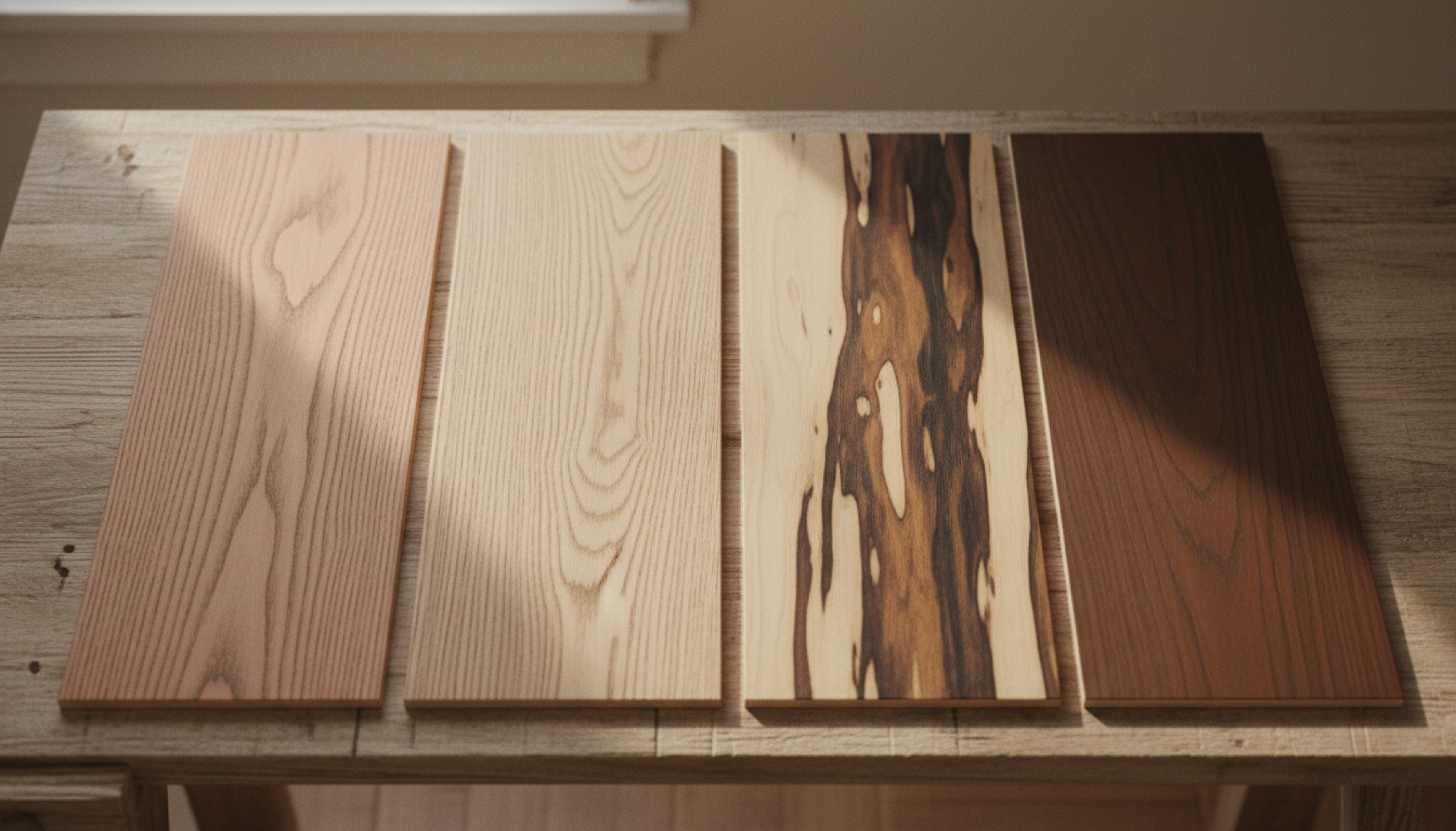
"What kind of wood should I put down" is the question every homeowner asks once they've decided to install hardwood and before they've picked a stain color. The answer matters more than most national flooring blogs let on. Two floors that look identical in a magazine photo behave completely differently across the 30 years they'll spend on a DMV subfloor. Different hardness, different humidity stability, different cost, different forgiveness for scratches and dents, and a different look after a dog and two kids have lived on them for a decade.
What follows is the working species list we use across Northern Virginia, DC, and suburban Maryland refinishes and installs: which species we install most, which we steer homeowners toward and away from, and how each one behaves in our 70 to 80 percent summer humidity. The honest answer is that 80 percent of DMV homes are best served by one of two species, and the other three are situational picks for specific houses or specific aesthetics.
The short answer on hardwood species
Quick answer
Five species cover 95 percent of DMV hardwood installs. White oak is the modern premium pick: stable in humidity, takes any stain cleanly, the species most new construction and high-end remodels use today. Red oak is the historical DMV default. It's what's already in every house built before 1990 and is still a great fresh install at a lower cost. Hickory is the toughest and busiest-grained. Pick it if you have large dogs or commercial-grade traffic and you're okay with dramatic color variation. Maple is the cleanest, brightest grain but the hardest to stain evenly. Best left natural in modern sports-floor aesthetics. Walnut is the luxury softwood: beautiful, dark, expensive, dents under heels. Skip pine, bamboo, and exotic imports unless you have a specific reason.
If you want the shortest possible decision: install white oak if you're starting from scratch and want timeless modern. Refinish red oak if you already have it and it's structurally sound. Install hickory if you have a big dog or a busy family and don't mind contrast. Avoid walnut unless you're committed to a luxury aesthetic and accept the maintenance. Everything else is a niche call. The detail below is what makes the difference between a floor you love at year 1 and a floor you still love at year 20.
Why species matters more than most homeowners think
Quick answer
Species controls four things at once: hardness (how easily the floor dents), stability (how much the boards move with DMV humidity swings), how the floor takes a stain color, and how visible the grain pattern is. National blogs treat species as an aesthetic preference. In a humid mid-Atlantic climate, species is also an engineering decision. A 2,000 square foot install in DMV humidity will gain or lose roughly an inch of total board width across a year. The species choice determines whether that movement shows up as cupping, gaps, or stays invisible.
The DMV has one of the harder hardwood climates in the country. Summer indoor humidity routinely sits at 60 to 70 percent without active dehumidification, and winter indoor humidity can drop to 20 to 25 percent with the heat running. That 40-point swing makes wood expand and contract more than it does in San Diego or Phoenix. Some species handle that swing gracefully and some don't. We cover the full mechanism in the hardwood floor buckling and cupping piece, but the short version is: species is the first variable in whether a floor stays flat for 20 years.
Key takeaway
If you've ever walked into a DMV house and seen a floor that "looks cheap" without being able to put your finger on why, the cause is usually one of three things: the wrong species for the house era, a stain that fights the species, or a board width that doesn't match the room scale. Getting the species right is the upstream choice that makes the other two easier.
Red oak: the DMV default
Quick answer
Red oak is what's already under most DMV floors built between 1920 and 1990. Janka hardness 1,290. Pink-salmon undertone in the raw wood, with open, stretched grain lines. Takes warm stains beautifully (Special Walnut, Provincial, Jacobean). Pulls pink under cool stains, so don't pair it with Classic Gray or Weathered Oak. As a fresh install it runs about a dollar per square foot cheaper than white oak. The species we still recommend for traditional colonials, Cape Cods, and any homeowner whose budget benefits from $1 to $2 per square foot in savings versus white oak.
If your house was built before 1990 in Alexandria, Arlington, Falls Church, Fairfax, Vienna, Bethesda, Chevy Chase, or anywhere else in the inner DMV, you almost certainly have red oak. It was the standard residential species across the entire mid-Atlantic from the 1920s through the late 80s, and millions of square feet of it are still in homes today, often hiding under carpet installed in the 70s. The first thing we do on most refinish consultations is pull up an HVAC vent cover or peel back a corner of carpet to confirm what species is underneath. About 70 percent of the time, it's red oak in good enough condition to refinish for $4.50 per square foot all-in versus $8.50 per square foot for a fresh install. The math on saving an existing red oak floor versus installing new is covered in the refinishing cost piece.
Red oak gets unfairly dismissed in modern design blogs as "dated" because the pink undertone clashes with the cool-modern aesthetic that has been dominant for 10 years. But red oak with a Special Walnut or Jacobean stain is timeless. It's the look in most Federal-style and colonial homes in Old Town and Georgetown, and it has never gone out. The mistake is staining red oak gray. The right move is staining red oak warm, or leaving it natural under oil-based polyurethane for that classic 1950s amber.
| Property | Red oak |
|---|---|
| Janka hardness | 1,290 |
| Stability rating | Good. Moderate dimensional change |
| Best stains | Natural (oil-based poly), Special Walnut, Provincial, Jacobean, Dark Walnut |
| Avoid stains | Classic Gray, Weathered Oak, whitewash. All pull pink |
| Cost (installed all-in, Potomac) | $8.50/sqft (same as white oak through us, we don't penalize species) |
| Best for | Refinishing existing floors, traditional colonials, budget-aware new installs |
White oak: the modern premium
Quick answer
White oak is what almost every new high-end DMV install uses in 2026. Janka hardness 1,360, slightly harder than red oak. Cream to tan undertone with tight, shorter grain and visible ray fleck. Takes any stain cleanly, including cool grays and whitewash. More dimensionally stable than red oak in DMV humidity swings. Comes in plain-sawn (the default), rift-sawn (cleaner grain), and quarter-sawn (most stable, highest cost). The species we install on roughly 60 percent of new DMV hardwood installs today.
White oak became the dominant new-install species around 2010 and hasn't slowed down. Three things drove the shift: it pairs cleanly with cool-modern aesthetics (the wood is naturally neutral, not pink), it's slightly harder and more stable than red oak, and the supply chain shifted so that wide-plank white oak became readily available at reasonable cost. A typical white oak install at Potomac is 5-inch or 7-inch wide plank, plain-sawn or rift-sawn, stained natural or Classic Gray under matte water-based polyurethane.
The stain flexibility is the single biggest reason white oak wins for new construction. You can install raw white oak and stain it gray, warm brown, dark traditional, or leave it natural, and all four look intentional. Red oak only looks right in warm or natural finishes. White oak's neutrality is why design-build firms across Bethesda, Tysons, McLean, and DC condos default to it. They can show the homeowner three completely different aesthetic options on the same species without re-sourcing wood. The relationship between species and stain choice is laid out in detail in the stain colors guide.
| Property | White oak |
|---|---|
| Janka hardness | 1,360 |
| Stability rating | Very good. Best of the common residential species |
| Best stains | Natural with matte water-based poly, Classic Gray, Weathered Oak, Special Walnut, Jacobean, custom blends |
| Avoid stains | None really. The flexibility is the whole point. |
| Cost (installed all-in, Potomac) | $8.50/sqft |
| Best for | Modern new construction, condos, high-end remodels, any house where you want gray or cool floors |
Watch out
Quarter-sawn and rift-sawn white oak cost roughly 30 to 50 percent more than plain-sawn at the lumberyard because they yield less usable wood per log. For most residential installs, plain-sawn is the right call. The cathedral grain pattern looks beautiful and the cost savings are real. Quarter-sawn is worth the premium only when you specifically want the linear ray-fleck pattern of an Arts and Crafts or Mission-style aesthetic, or when you need maximum dimensional stability for a sunroom or radiant-heated floor.
Hickory: the toughest residential wood
Quick answer
Hickory is the hardest common North American flooring species. Janka 1,820, roughly 40 percent harder than oak. Dramatic color variation, with cream-colored sapwood streaks running through chocolate-brown heartwood in the same board. The right pick if you have large dogs, lots of kids, or you specifically want a rustic, busy-grained look. Wrong pick if you want a calm, uniform floor. The visual contrast is more than most homeowners expect from a photograph. Stains okay but the natural color variation tends to show through any stain, which is part of the look.
Hickory is the species we recommend when a homeowner tells us they have a Great Dane, a Bernese Mountain Dog, three boys under 10, or any combination of high-traffic conditions that would dent a softer floor within a year. Hickory's hardness rating is real. It genuinely takes more abuse than oak before showing dents, and it shows scratches less because the natural grain variation hides them.
The tradeoff is the look. Hickory boards have wild color variation board-to-board and even within a single board. One board can run from pale cream to dark chocolate across its length, and the next board can be almost uniformly dark. This is not a defect. It's the species. We've had homeowners ask us to "sort out the dark ones" thinking they were getting a uniform floor, and that's not how hickory works. The variation is the aesthetic, and you either love it (cabin, rustic, mountain-house feel) or you find it busy.
| Property | Hickory |
|---|---|
| Janka hardness | 1,820 |
| Stability rating | Good, but high color variation can highlight any cupping |
| Best stains | Natural (lets the variation show), light-medium amber, occasionally a uniform mid-brown |
| Avoid stains | Pure black (looks muddy on the lighter boards), Classic Gray (fights the warm sapwood) |
| Cost (installed all-in, Potomac) | $8.50/sqft |
| Best for | Large dogs, busy families, rustic or cabin aesthetics, mountain-style new construction |
Maple: the cleanest grain, hardest to stain
Quick answer
Maple is the brightest, most uniform-grained common species. Janka 1,450, harder than oak, softer than hickory. Almost no visible grain pattern compared to oak, so it reads as clean and modern. The catch is that maple's tight, closed grain doesn't absorb stain evenly, and dark stains on maple tend to blotch. Best left natural with a clear water-based polyurethane. Common in sports flooring, bowling alleys, and modern minimalist homes. Not a great fit for traditional DMV colonials but excellent in a modern condo or new build where you want a bright, almost-blonde floor without the orange undertone of oak.
Maple is the species we install when a homeowner specifically wants a clean, blonde, modern floor and white oak feels too "grainy" for the aesthetic they're after. It's also the species used in athletic flooring (the floor in basketball gyms is almost always rock maple) and bowling alleys because of its hardness and clean appearance. In a residential DMV install, maple shows up most often in modern condos in Tysons, Pentagon City, and DC infill where the homeowner has seen Scandinavian or minimalist designs and wants something that fits that aesthetic.
The honest tradeoff with maple is the stain limitation. Maple's grain is so tight that stain pools on the surface rather than soaking in, which means dark stains often look blotchy and uneven. Professional refinishers can apply a conditioner pre-stain to mitigate this, but the safest approach is to install maple specifically because you want a natural, light, clean floor, not because you want a "blank canvas" for any stain color.
| Property | Maple |
|---|---|
| Janka hardness | 1,450 |
| Stability rating | Good |
| Best stains | Natural with water-based poly. Period. |
| Avoid stains | Dark stains (Jacobean, Ebony). They blotch on maple's tight grain |
| Cost (installed all-in, Potomac) | $8.50/sqft |
| Best for | Modern condos, minimalist aesthetics, sports-floor or Scandinavian looks |
Walnut: luxury, soft, and expensive
Quick answer
American black walnut is the luxury hardwood species. Janka 1,010, softer than oak, softer than pine in some metrics. Naturally rich chocolate-brown with subtle grain, no stain required (and stain often muddies it). Beautiful in formal living spaces and high-end remodels. The catch is the softness. Walnut dents under heels, dog nails, and dropped objects more readily than any other common species. Plan for visible wear within 5 years even with careful living. The species we install when a homeowner specifically wants the look and accepts the maintenance reality.
Walnut is a beautiful floor and almost nobody should put it in a high-traffic room. The species itself is gorgeous: naturally dark, naturally subtle, requires no stain, and reads as old-world luxury in a way no other domestic species matches. The problem is hardness. At Janka 1,010, walnut is significantly softer than oak, meaning it dents under loads that oak shrugs off. A dropped knife, a dog standing in one spot, a high heel: all leave marks in walnut that wouldn't show on oak.
Where walnut works in DMV homes: formal dining rooms in older Georgetown and Old Town homes, primary bedrooms where foot traffic is light and shoes come off at the door, and as a decorative inlay border around an oak or maple field. Where walnut doesn't work: kitchens, hallways, family rooms, any room with kids or large dogs, and any rental property. The cost premium also doesn't help. Walnut runs roughly $4 to $6 per square foot more than oak at the lumberyard, which translates to a meaningfully higher all-in installed price.
| Property | Walnut |
|---|---|
| Janka hardness | 1,010 |
| Stability rating | Good, but the softness shows wear that masks any stability issues |
| Best stains | Natural. The wood color is already what you want |
| Avoid stains | Anything. Staining walnut usually obscures what makes it beautiful |
| Cost (installed all-in, Potomac) | $12-14/sqft (significant premium) |
| Best for | Formal rooms, primary bedrooms, decorative borders, luxury-aesthetic homeowners who accept the maintenance |
Watch out
If you're considering walnut because you want a dark floor: don't. Install white oak or red oak with a Jacobean or True Black stain instead. You'll get the dark aesthetic at half the cost, with double the hardness, and the same depth of color under a real installer's finish. Walnut is the right species when you specifically want the natural walnut grain and color and you accept the softness, not when you just want a dark floor.
Cherry, pine, and the period-correct exceptions
Quick answer
American cherry (Janka 950) and heart pine (Janka 1,225 for old-growth, much less for new) are the two species we install when a DMV homeowner wants period-correct authenticity in a pre-1900 home. Cherry is reddish, ages to a deep amber, and dents almost as easily as walnut. Heart pine is golden-orange, dramatically figured, and only authentic in pre-1900 homes. New pine plantation flooring looks nothing like the original. Both are niche picks for specific historic homes in Old Town Alexandria, Georgetown, and Capitol Hill. For everyone else, skip them.
The case for cherry and heart pine is almost always architectural authenticity. If you own a 1830s row house in Old Town Alexandria with original heart pine subfloors, refinishing those rather than replacing them with oak is the right call. They're part of the house's character and they're nearly impossible to replicate authentically with new wood. Same logic for the rare DMV home with original cherry. We've done a handful of these, all in historic-district properties, and the result is beautiful when the homeowner understands they're caring for a 150-year-old floor, not installing a new performance floor.
The case against cherry and heart pine in any other DMV home: they're soft, they're expensive to source as new wood (for the rare cases where reclaimed isn't available), and they read as a deliberate "old house" aesthetic that doesn't fit a 1970s split-level or a 2020s townhome. Don't install heart pine in a Reston colonial because you saw it on Instagram. It'll look fought.
Janka hardness vs DMV humidity stability
Quick answer
Janka hardness measures dent resistance only. It doesn't measure dimensional stability under humidity, which is the more important number in the DMV. The two metrics often disagree. Brazilian cherry (Jatoba) has a Janka of 2,820 (twice as hard as oak) but is dramatically less stable in humidity swings, which is why it cups and gaps in our climate. White oak is moderately hard (1,360) but very stable, which is why it stays flat in DMV homes for 30 years. Pick stability first, hardness second.
| Species | Janka hardness | DMV stability | Net DMV grade |
|---|---|---|---|
| White oak | 1,360 | Very good | A |
| Red oak | 1,290 | Good | A- |
| Hickory | 1,820 | Good | A- |
| Maple | 1,450 | Good | B+ |
| Walnut | 1,010 | Good | B (softness drags it down) |
| Cherry | 950 | Fair | C (soft + amber-shift) |
| Brazilian cherry (Jatoba) | 2,820 | Poor in humidity swings | C (cups badly in DMV) |
| Bamboo | varies wildly (1,300-3,000+) | Poor | D (don't install in DMV) |
The takeaway: in a humid mid-Atlantic climate, white and red oak are the safest defaults precisely because they're stable, not because they're the hardest. Exotic ultra-hard species like Brazilian cherry look attractive on a hardness chart but consistently fail in DMV homes because they were grown in tropical climates and don't tolerate our 40-point humidity swings. The same buckling and cupping problems documented in the DMV humidity piece show up at three to four times the rate on exotic species versus domestic oak.
Real DMV cost per species
Quick answer
At Potomac Floors, red oak, white oak, hickory, and maple are $8.50 per square foot all-in (material + installation + demo and removal). Walnut runs $12 to $14. Cherry runs $11 to $13. Heart pine (reclaimed) runs $14 to $18 depending on source. These are all-in prices for solid hardwood. Engineered versions of each species run slightly less for the material and slightly less for install because they're often nail or glue down to plywood. Pricing is a known number, not a per-quote variable. See the full hardwood installation cost piece for room-size math.
| Species (solid hardwood) | All-in installed (Potomac) | Cost note |
|---|---|---|
| Red oak | $8.50/sqft | Same as white oak through us. We don't penalize the more affordable species |
| White oak | $8.50/sqft | The default modern install |
| Hickory | $8.50/sqft | Same all-in rate as oak |
| Maple | $8.50/sqft | Same all-in rate as oak |
| Walnut | $12-14/sqft | Significant material premium |
| Cherry | $11-13/sqft | Material premium, limited supply |
| Heart pine (reclaimed) | $14-18/sqft | Sourcing-driven, varies by lot |
The price spread between oak and the premium species is real. For a 1,500 square foot main level, the gap between oak and walnut is roughly $6,000 of extra material and installation. That money goes further in stain choice flexibility on oak than in species choice on walnut. We tell homeowners considering walnut on a budget that they'll have a more beautiful, more durable floor for less money if they install white oak with a Jacobean or True Black stain.
Which species fits which DMV house
Quick answer
DMV houses cluster into era-and-style buckets, and each one has species that look intentional and species that look fought. Pre-1990 colonials, Cape Cods, and ranches: red oak (often already there) or white oak. 1990s-2000s suburban colonials: white oak default, hickory if the family is hard on floors. 2010+ modern townhomes and condos: white oak with cool stain or maple. Pre-1900 historic homes: heart pine or cherry if original, white oak if not. Rentals: red oak or LVP (see rental flooring piece).
| House type | Common DMV neighborhoods | Species that fit |
|---|---|---|
| 1900s-30s Federal / Georgian colonial | Old Town Alexandria, Georgetown, North Arlington | Red oak refinish, white oak new install, walnut accents in formal rooms |
| 1940s-50s Cape Cod / brick rambler | Arlington, Falls Church, Bethesda, Hyattsville | Red oak (almost certainly already there) refinish, or white oak fresh install |
| 1960s-70s ranch / split-level | Vienna, Annandale, Springfield, Burke, Rockville | Red oak refinish, white oak or hickory new install |
| 1980s-90s center-hall colonial | McLean, Great Falls, Potomac MD, Reston, Centreville | White oak or hickory for high-traffic family rooms |
| 2000s+ townhome / new-build colonial | Ashburn, South Riding, Loudoun, Stafford | White oak (plain or rift-sawn), hickory for big-dog families |
| High-rise condo / loft | Tysons, Crystal City, Pentagon City, DC NW, Rosslyn | White oak (often engineered over concrete, see engineered over slab piece), maple for ultra-modern |
| Pre-1900 historic row house | DC NW, Old Town Alexandria, Petworth, Capitol Hill, Georgetown | Heart pine if original (preserve), cherry if original (preserve), red or white oak if not original |
FAQs about hardwood floor species
What is the most popular hardwood species for new installs in 2026?
White oak by a wide margin. Roughly 60 percent of our new DMV solid hardwood installs are white oak, with red oak around 20 percent, hickory around 10 percent, and maple, walnut, and others splitting the remainder. The shift to white oak has been steady since around 2010 and has not slowed. The driver is stain flexibility. White oak takes cool stains cleanly, while red oak does not.
How do I tell if my existing floors are red oak or white oak?
Look at the grain pattern. Red oak has long, stretched, "rivered" grain lines that flow in clear directions. White oak has tighter, shorter grain with visible ray fleck) small lighter or darker dashes running across the grain. The undertone is also a tell: red oak has a pink-salmon cast in the raw wood, white oak has a yellow-tan or slightly green-gray cast. If you sand a small test patch on an unfinished area (under a vent cover, in a closet) and the raw wood looks pinky-tan, it's red oak. Cream-tan with ray fleck means white oak.
Is hickory worth the cost premium over oak?
If you have large dogs, very active kids, or you specifically want the dramatic color variation, yes. The hardness is real and the floor genuinely takes more abuse than oak. If you want a calm, uniform floor or you have small children who will outgrow the high-traffic stage in a few years, hickory's busy grain may not age well aesthetically. For most DMV families, white oak with a careful finish (the water-based polyurethane piece covers the durable options) is a better balance of cost, hardness, and timeless looks.
Can I mix species in different rooms?
You can but it's harder to do well than most homeowners realize. Mixing species across a clean visual break (a doorway threshold, a stair landing, a finished basement that's clearly separate) reads fine. Mixing species in an open-concept main level looks unintentional almost always. The cleaner move is a single species across the main level and a different choice for the basement or upstairs bedrooms if you want variety. The same logic applies to mixing stain colors across rooms, covered in the stain colors piece.
What about exotic hardwoods like Brazilian cherry or teak?
Avoid them in DMV homes. Exotic tropical species are bred for stable tropical climates and consistently move, cup, and gap when installed in our 40-point humidity swing. Brazilian cherry (Jatoba) is the most common example. It's beautiful on a showroom floor and looks dramatic for two years before cupping shows up. The hardness numbers on exotics are real but stability is the more important DMV variable. Stick with domestic oak, hickory, maple, or walnut.
Are engineered hardwoods available in all these species?
Yes. Every species in this article (oak, hickory, maple, walnut, cherry) is available as engineered hardwood, often at lower cost than solid. Engineered is the right call for installations over concrete slabs (most DMV condos), basements, and any situation where dimensional stability matters more than maximum refinish potential. See the engineered vs solid hardwood piece for the full tradeoff, and the engineered over concrete slab piece for slab-specific installs.
Will I regret picking the cheaper species?
Almost certainly not, if "cheaper" means red oak over walnut. Red oak is a fantastic floor and the reason it's the historical DMV default. The species that homeowners regret are the ones that don't fit the house (walnut in a kid-heavy family room, Brazilian cherry in DMV humidity, maple stained dark) or the species installed because of an aesthetic trend that ages out. The cost-conscious pick is rarely the regret pick. Spec the floor for the house and the life it'll see, not the magazine photo.
Bottom line: what we'd install in your house
If you live in a pre-1990 DMV home with red oak already in place and the floor is structurally sound: refinish what you have. Red oak with Special Walnut or Jacobean stain is timeless and costs roughly half what a fresh install costs. The refinishing cost piece covers the math.
If you're installing fresh in a 1990s-2010s suburban colonial, townhome, or new build: white oak. Plain-sawn 5-inch or 7-inch plank, natural finish or Special Walnut or Classic Gray depending on the aesthetic you're after. This is the default that fits 70 percent of DMV homes.
If you have large dogs, three boys under 12, or your family room sees commercial-level traffic: hickory. Accept the dramatic color variation as the cost of a floor that genuinely takes abuse.
If you have a high-end formal dining room or a primary bedroom and you want the luxury look without compromise: walnut. Accept the maintenance reality.
If you have a modern condo and you want a clean, blonde, almost-Scandinavian look: maple natural with matte water-based polyurethane.
If you have a pre-1900 row house with original heart pine or cherry: preserve what's there. Don't replace it with oak.
Whatever species you pick, the install method, finish, and stain choice are downstream decisions that matter almost as much. The installation methods piece covers how each species can be installed, and the prefinished vs site-finished piece covers whether you finish on site or buy pre-finished planks.
Potomac Floors installs solid and engineered hardwood across the DMV (Alexandria, Arlington, Fairfax, Falls Church, McLean, Vienna, Reston, Ashburn, Bethesda, Rockville, DC, Stafford, Fredericksburg) at all-in pricing: material, professional installation, and demo and removal of the old floor included in one number. If you want to walk through species choice for your specific house, request a free in-home consultation through our contact page and we will bring sample boards of every species in this article to show on your actual subfloor in your actual light.