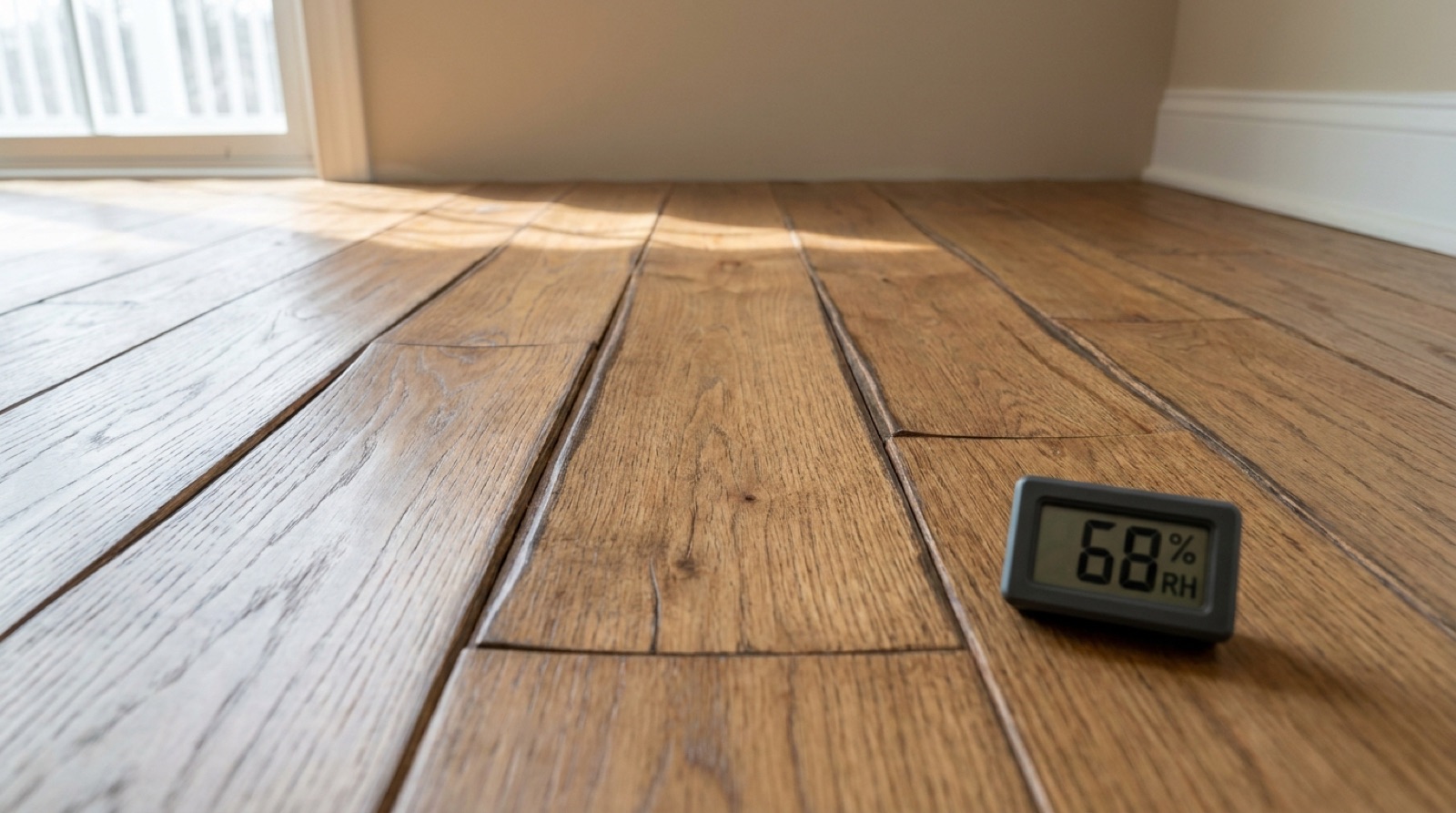

Late spring through August, the calls come in. A homeowner walks into their kitchen and the hardwood floor doesn't look right. The boards are bowed up at the edges, or curled up in the middle, or one section is lifting clean off the subfloor. They ask the same question every time: is the floor ruined, or is it going to settle back down on its own?
Both answers exist. Some DMV floors come back the next winter without a single repair. Others have to be sanded, partially replaced, or torn out completely. The difference comes down to the type of damage, what caused it, and how long the moisture has been sitting in the wood. Here is the honest installer walkthrough.
Hardwood buckling and cupping in the DMV: the short answer
Quick answer
Cupping (board edges raised, center low) is the most common DMV summer issue and usually reversible with HVAC and time. Crowning (board center raised, edges low) is cupping that got sanded too early. Buckling (boards lifting off the subfloor) is a moisture emergency, never normal, and means a leak or vapor barrier failure. Gapping (visible cracks between boards) is the winter version, usually normal seasonal movement. Identify the type first, fix the moisture source second, then decide whether the floor needs a sand, a partial board replacement, or full removal.
This is the call we make on hundreds of DMV floors a year, from 1920s row houses in Old Town Alexandria to slab-on-grade townhomes in Loudoun. Almost every case fits one of the four patterns. The fix path follows directly from which one you have.
Cupping vs crowning vs buckling vs gapping: tell them apart
Quick answer
Lay a straight edge across a few boards. If the straight edge rocks on the edges with a gap under the middle, that's cupping. If it rocks on the middle with gaps at the edges, that's crowning. If boards are lifted off the subfloor or peaking into a tent shape, that's buckling. If you can slide a credit card between boards that used to be tight, that's gapping. Each one tells you a different story.
The four patterns are different damage mechanisms even though they all come from moisture imbalance. Identifying the right one is the entire diagnosis.
| Pattern | What it looks like | What it means | Reversible? |
|---|---|---|---|
| Cupping | Board edges raised higher than the center, washboard ripple across a wide area | Bottom of the board absorbed more moisture than the top. Usually summer humidity or a slab without a vapor barrier. | Often yes, once HVAC pulls humidity back down. Give it a full season before sanding. |
| Crowning | Board center raised, edges low. Looks like the opposite of cupping. | Either a top-side spill that swelled the surface, or a cupped floor that was sanded flat before it dried out. | Rarely. Almost always needs sanding and refinishing. |
| Buckling | Boards lifting off the subfloor, peaking into a tent shape, or pulling away from the wall | Extreme moisture event. Burst pipe, dishwasher leak, slab vapor barrier failure, or a flood. The wood has expanded beyond the expansion gap. | The lifted boards almost always need replacement. The rest of the floor is often salvageable after dry-out. |
| Gapping | Cracks between boards wide enough to drop a quarter into. Worst in winter. | Wood lost too much moisture and contracted. Winter heating without humidification is the usual cause. | Often closes back up in summer. Permanent if the floor went through repeated extreme dry cycles. |
Key takeaway
The straight-edge test takes about 30 seconds and tells you which of the four you have. Anything beyond cupping is harder to fix. A floor that's already crowning has been sanded too soon at some point; a floor that's buckling has a moisture source still active. Fix the source before you touch the floor.
The 4 root causes we see on DMV hardwood floors
Quick answer
In the DMV, almost every cupping or buckling call is one of four causes: HVAC turned off or undersized during summer humidity, an active plumbing or appliance leak, a concrete slab moving water vapor up through the floor, or an install where the wood never acclimated to the home before it was nailed down. Diagnose the cause before you spend a dollar on the fix.
HVAC off, undersized, or set too high. Northern Virginia summers run 70 to 90% outdoor humidity. A house that's vacant for two weeks, has the AC set to 80, or has an HVAC system that's undersized for the square footage will let indoor humidity drift up into the 60% range. Hardwood acclimated for a 35 to 50% indoor environment absorbs that extra moisture from the air, expands, and cups. This is by far the most common cupping call we get, especially on vacation homes and recently bought houses where the new owner doesn't realize the dehumidification setting matters.
Active plumbing or appliance leak. Slow dishwasher leaks, ice maker line drips, refrigerator water lines, toilet supply lines, radiator condensation, and bathroom plumbing failures are the second-biggest source of moisture into a hardwood floor. The damage often shows up under the appliance first as cupping, then spreads outward over weeks to months. By the time it's visible, the leak may have been running for a long time. The fix here always starts with finding and stopping the leak before any flooring work.
Concrete slab moisture without a vapor barrier. A lot of newer DMV townhomes and condos sit on concrete slabs that release water vapor for years after they're poured. If a hardwood floor was glued or floated over the slab without a proper 6 mil poly vapor barrier underneath, the slab acts like a steady moisture source from below. The bottoms of the boards stay wet, the tops stay dry, and the floor cups. We see this on Loudoun and Prince William slab-on-grade builds, and on Rosslyn-Ballston, Tysons, and Crystal City condo conversions. For more on the right install over a slab, see our engineered hardwood over concrete slab guide.
Install error: no acclimation. Hardwood needs to sit in the home it's being installed in for 5 to 14 days before nailing or gluing, so the wood reaches equilibrium with the indoor humidity. A crew that skips acclimation, or that installs wood pulled out of a humid warehouse and into a dry winter house, builds the cupping problem into the floor on day one. The floor looks fine at install, then cups the first humid week or gaps the first cold snap. This is the avoidable one, and it's why our installs include a documented acclimation step on the schedule.
Watch out
If you have cupping and you also have an unexplained increase in your water bill, that's a leak signal. Pull the dishwasher out, look behind the fridge, check the toilet base for staining, and look at the ceiling below if there's a bathroom over the cupped area. A floor that's cupping while the leak is still active won't dry out. Stop the source first.
Wait for the seasonal swing or act now? The decision
Quick answer
Mild summer cupping with no active leak: wait through one full heating season before sanding. Many DMV floors come back flat once indoor humidity drops back to 30 to 40% in winter. Severe cupping, any crowning, any buckling, or a floor with an active leak underneath: act now. Pulling moisture out fast and replacing or refinishing damaged boards before the dry season saves money long-term.
This is the call homeowners get wrong most often. They either panic and sand a cupped floor in July, which crowns it the next winter, or they ignore an active leak under buckled boards and let the damage spread.
Wait through a full heating season when:
- Cupping is mild (under 1/16" rise from center to edge) and even across the room.
- There's no active leak, the dishwasher is dry, the toilet seals are good, and the appliance lines all check out.
- Indoor humidity has been or is being brought back into the 35 to 50% range with AC, dehumidification, or both.
- The floor is solid hardwood (not engineered) and over a wood subfloor (not a slab).
Act now when:
- Cupping is severe (over 1/16" rise) or growing visibly week over week.
- Any board has lifted off the subfloor (buckling) or is showing tent peaks.
- The floor is crowning, meaning someone already tried to fix this and the damage has gone the other direction.
- There is an active leak (still wet to the touch, growing wet spots, or a known appliance failure).
- The floor is engineered hardwood, which can delaminate under prolonged moisture and is rarely salvageable.
- The floor is over a concrete slab without a confirmed vapor barrier underneath.
The "wait" call works for two reasons. Wood that has cupped from absorbing humidity will release that moisture back into a drier indoor environment. As it dries, the boards return toward their original shape. We've watched mild summer cupping in Vienna and Falls Church colonials come back to nearly flat by February. The savings are real: a sand and refinish on 800 sqft is about $3,600 at our $4.50/sqft rate; if the floor self-corrects, that's $3,600 you didn't spend.
The "act now" call works because moisture damage is progressive. A buckled board that's left for six months can warp adjacent boards, lift the fasteners, and expand the failure zone from a few square feet to the whole room. Engineered hardwood is the worst case because its plywood core can delaminate, and once it delaminates the boards have to come out.
What each fix actually costs in the DMV in 2026
Quick answer
Dry-out and wait (no labor cost, just time and HVAC): $0. Sand and refinish if cupping doesn't fully release: $4.50/sqft, about $3,600 on an 800 sqft floor. Partial board replacement (lace-in repair of buckled boards): $200 to $400 per repair area. Full hardwood replacement when the floor is unsalvageable: $8.50/sqft all-in, $9 to $11/sqft for solid hardwood. Knowing which tier the floor needs is the actual money decision.
Here is the real Potomac Floors pricing for the four common fix paths, in 2026 DMV dollars. All-in numbers include material, labor, demo and removal where applicable.
| Fix tier | What's involved | DMV 2026 cost | When it's the right call |
|---|---|---|---|
| Dry-out only | Stop the moisture source. Run AC or a dehumidifier to pull indoor humidity to 35-50%. Wait one heating season. | $0 to $300 (dehumidifier rental if needed) | Mild cupping, no leak, solid hardwood on wood subfloor, willing to wait 6-9 months |
| Sand and refinish | Drum sand the whole floor flat once it's stable, stain, and reseal. Same process as a routine refinish. | $4.50/sqft all-in (about $3,600 on 800 sqft) | Cupping that mostly released but left a visible ripple. Solid hardwood with at least 2mm wear layer remaining. |
| Partial board replacement (lace-in) | Pull individual damaged boards, weave in new boards that match the species and width, refinish the affected area to blend. | $200 to $400 per repair area; $800-$1,500 if multiple areas blend into a partial refinish | Localized buckling or water damage under a fixture (dishwasher, fridge ice line). Rest of the floor is sound. |
| Full replacement | Demo the existing hardwood, prep the subfloor (including adding a vapor barrier if missing), install new hardwood, finish. | $8.50/sqft engineered all-in; $9-11/sqft solid all-in | Engineered floor that delaminated. Solid hardwood with no wear layer left. Floor over a slab without a vapor barrier (rip and re-install with the barrier). |
For the broader pricing context on a new install, our hardwood floor installation cost and hardwood cost per square foot guides break down what goes into the all-in number. The refinish-versus-replace decision is the same one we walk through in our refinishing vs replacement guide, which includes the wear-layer test that tells you if the floor can take another sand.
Key takeaway
The cheapest fix is often patience. We've sent more than one homeowner home with "run your AC at 50% relative humidity until February and call us back" instead of taking a job. Most of the time they don't call back, because the floor self-corrects. That's not a sales pitch missed; that's the right answer for the floor.
The HVAC setpoints that prevent this in the first place
Quick answer
Keep indoor relative humidity between 35% and 50% year-round. In DMV summers, that means running AC consistently and using a whole-house or stand-alone dehumidifier if your AC alone can't pull humidity below 55%. In winter, run a humidifier if the air drops below 30%. A $20 hygrometer in the main living area is the only equipment you need to know where you stand.
Hardwood manufacturers spec the same range across the board: keep the home at 60 to 80°F and 35 to 50% relative humidity for the life of the floor. That is the band the wood was kiln-dried to and the band it stays dimensionally stable in. Outside the band in either direction, the floor moves.
What this looks like in practice for a DMV home:
- April through October: Run the AC. Setpoint matters less than humidity, but most homes with cooling below 75°F naturally pull humidity into range. If the AC short-cycles in mild summer weather and humidity creeps over 55%, a stand-alone dehumidifier ($200-400) in the main living area solves it.
- Vacant for more than a week in summer: Don't set the AC to 80. Set it to 75 with a "humidity hold" setting if your thermostat supports it, or run a dehumidifier on a smart plug. We've seen $20,000 floors damaged by a homeowner trying to save $50 in electricity during a two-week vacation.
- November through March: Forced-air heating dries the air down to 15-25% relative humidity. That's outside the band for hardwood and causes gapping. A whole-house humidifier on the furnace is the right fix; a couple of console humidifiers can also work in smaller homes.
- Hardwood over a slab: Add the vapor barrier at install (6 mil poly), or expect to add it later as part of a full replacement. The slab will keep releasing vapor for a decade or more after the pour.
The $20 hygrometer is the most useful piece of equipment for any hardwood floor owner. Put it in the main living area. Check it monthly. If it reads outside 35-50% for more than a few days, your floor is taking damage you can't see yet.
Warranty, insurance, or out of pocket: who pays for the fix
Quick answer
If the damage came from an install error within the installer's warranty window, the installer pays. If it came from a sudden plumbing or appliance leak, homeowner's insurance often covers it. If it came from HVAC mismanagement, slow long-term humidity, or a slab vapor barrier failure on an older install, it's out of pocket. Document the damage with photos and a hygrometer reading before you call anyone.
Three buckets, and they don't overlap as often as homeowners hope.
Installer warranty. A reputable installer warranties the install (not the wood itself) for at least one year, often longer for premium work. If cupping or buckling shows up within the warranty window AND there's no active moisture source we missed, the install is suspect (no acclimation, missing vapor barrier, wrong expansion gap) and the installer should make it right. Our installs include a documented acclimation step and slab vapor barrier where required, exactly so this conversation doesn't become a guessing game.
Homeowner's insurance. Most policies cover "sudden and accidental" water damage: a pipe bursts, a dishwasher fails, a roof leaks. They generally do not cover slow leaks left to drip for months, humidity damage, or maintenance issues like a failing seal you should have caught. The line between sudden and slow is where the insurance fight happens. Take photos the day you notice the damage; the date stamps matter.
Out of pocket. The unglamorous category covers most of what we see: HVAC turned off during vacation, a humidifier never installed, a slab vapor barrier never put in 15 years ago when the floor was first installed, accumulated seasonal swings that finally caught up. Nothing to claim, nothing to fight, just the cost of the fix.
FAQs about hardwood floor buckling and cupping
Can you fix buckled hardwood floors?
Sometimes. Buckled boards (boards that have lifted off the subfloor) almost always need to be removed and replaced. The boards on either side that are still attached but pushed up against each other may settle back down once the moisture source is stopped and the wood dries out. The whole floor rarely needs full replacement just because one area buckled; lace-in board replacement plus an area refinish handles most cases for $800 to $1,500.
Will cupped hardwood floors go back to normal?
Mild cupping (under 1/16" rise from center to edge) on solid hardwood over a wood subfloor often releases on its own once indoor humidity drops back into the 35 to 50% range. We've seen DMV floors that looked rough in August come back to nearly flat by February with no work beyond running the AC properly. Severe cupping (over 1/16") usually leaves a visible ripple even after dry-out and needs a sand and refinish. Engineered floors are less likely to fully recover because the plywood core can delaminate under prolonged moisture.
Why would new hardwood floors buckle?
Almost always an install error: no acclimation, missing or inadequate expansion gap at the walls, missing slab vapor barrier, or wood installed at the wrong moisture content for the home. Cupping or buckling on a floor less than 1 year old should trigger a call to the installer. A floor that buckled this fast did so because the install didn't account for moisture properly, not because something the homeowner did caused it.
How do I tell cupping from crowning?
Lay a 2-foot straight edge across several boards. If the straight edge rocks on the board edges with a visible gap under the middle, that's cupping. If the straight edge rocks on the middle with gaps at the edges, that's crowning. Cupping is the original damage from absorbing moisture from below; crowning is what happens when a cupped floor was sanded flat before it dried out, leaving the dried wood raised in the middle.
Is there a way to flatten warped hardwood floors without sanding?
For cupping caused by humidity, time and HVAC are the answer. The floor will release moisture and the cup will mostly come out. For severe cupping that won't release, sanding is the only real option; weighting the boards down does not work and risks breaking the tongue-and-groove. For crowning, sanding is required. For buckling, the affected boards must be removed and replaced.
How long do I wait before sanding a cupped hardwood floor?
One full heating season. Get the indoor humidity to 35-50% by running AC or a dehumidifier through summer, and let the floor go through a winter heating cycle. By March or April the floor is at its driest point of the year. If it's still cupped at that point, sand. If it's flat, leave it alone. Sanding while the wood is still releasing moisture is the single biggest cause of crowning, which is much harder to fix than cupping.
Will a dehumidifier alone fix a cupped floor?
A dehumidifier will lower indoor humidity, which is the right first move. Whether that alone "fixes" the floor depends on how far it cupped and how long the moisture sat. For mild cupping caught early, yes, a 50-pint dehumidifier in the affected room running until indoor humidity is in the 35-45% range will let most of the cup release. For severe cupping or any buckling, the dehumidifier is necessary but not sufficient. Get a hygrometer reading first, then make the call.
Does engineered hardwood cup and buckle the same way as solid?
Engineered hardwood is more dimensionally stable through normal humidity swings, which is why it's the better pick over a concrete slab. But under severe or prolonged moisture, engineered can delaminate, meaning the wear layer separates from the plywood core. Delaminated boards are not salvageable. So engineered cups less in normal use but recovers worse from real water damage. For the broader comparison, see our engineered vs solid hardwood guide.
Can subfloor problems cause cupping?
Yes. A subfloor that's gotten wet from below (vapor through a slab, basement humidity, crawl space moisture) will release that moisture up into the hardwood for years. Same goes for an old subfloor with rotted areas or insufficient fastening. We commonly find subfloor work needed during cupping diagnosis; our notes on subfloor repair we find in DMV homes cover what to look for.
Bottom line: how to read your floor and decide next steps
Three steps cover almost every DMV cupping or buckling call. First, identify which of the four damage patterns you have using the straight-edge test: cupping, crowning, buckling, or gapping. Second, find and stop the moisture source: leak, HVAC, slab, or install. Third, decide between dry-out, refinish, partial replacement, or full replacement based on the severity and the type of floor.
The fix path follows from the diagnosis, not the other way around. We won't sand a cupped floor in July, and we won't tell you to wait on an actively buckling floor. If you want a real read on your specific floor, send a few photos and a description of when you first noticed it; we'll tell you whether it's a wait, a sand, or a tear-out. Same number that's on every other page of this site.