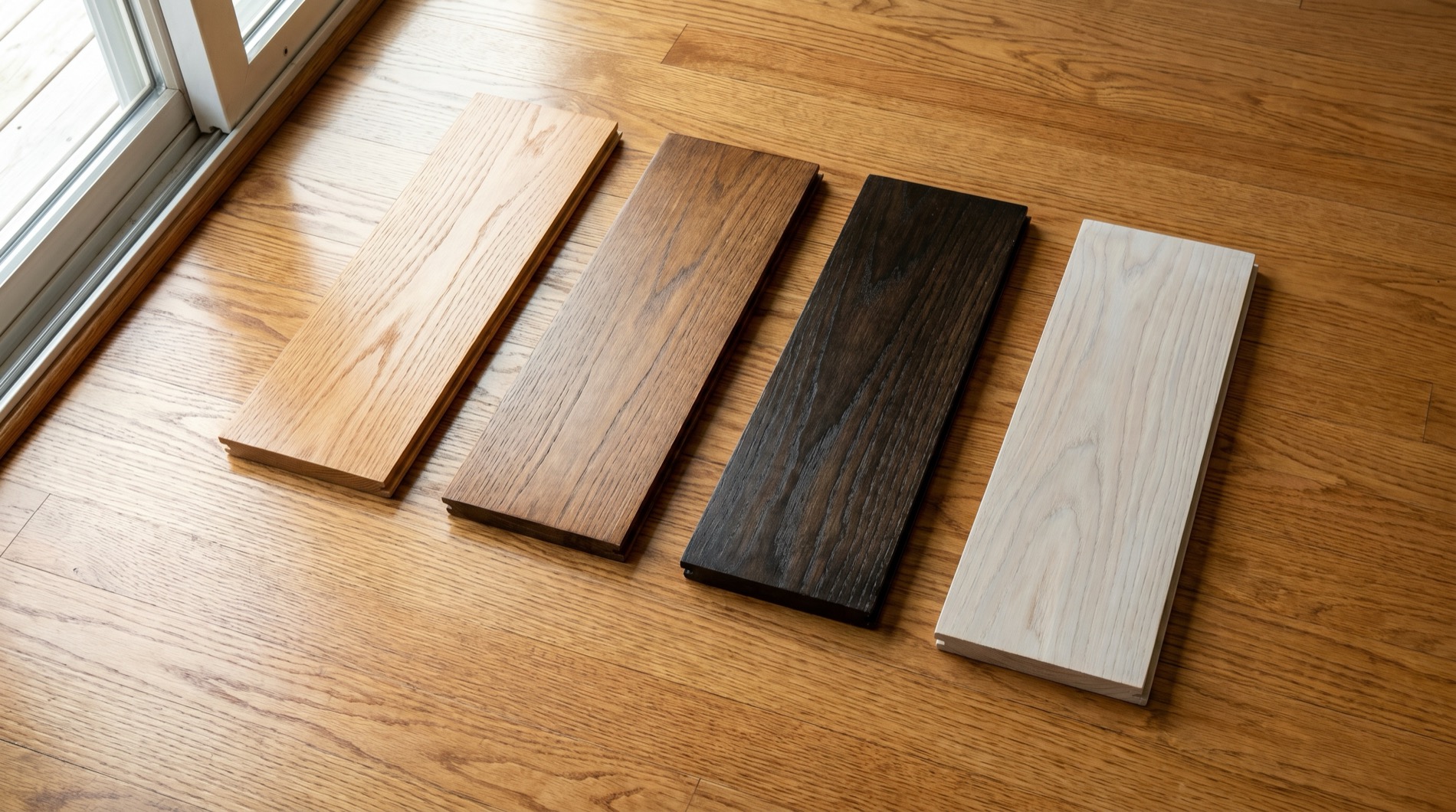
"What color should I stain my floors" is the single most-asked question between the sanding day and the finish day on every hardwood refinish we do in the DMV. The honest answer is that there are about eight stain colors that account for 90 percent of every refinish we install in Northern Virginia, DC, and suburban Maryland, and the right pick depends on three things: what species of wood you have (red oak versus white oak makes a bigger difference than most blogs admit), the era and style of the house you live in, and how much you want the floor to age into a different look over the next 10 years.
What follows is the working stain palette we use in DMV homes, what each color actually does on the wood you have, how the same stain can look completely different in a 1920s Federal in Old Town Alexandria versus a 1980s split-level in Vienna versus a glass-walled high-rise condo in Arlington, and the stains we steer homeowners away from because they age into something nobody intended.
The short answer on hardwood floor stain colors
Quick answer
The eight stains we install most on DMV hardwood refinishes are: Natural (no stain), Special Walnut, Provincial, Early American, Jacobean, Dark Walnut, Ebony, and Classic Gray. Special Walnut and Provincial are the warm-medium workhorses for colonials and Cape Cods. Jacobean is the dark-traditional standard for Federal-style homes and formal dining rooms. Classic Gray and Weathered Oak are the modern-cool choices for condos and contemporary remodels. Natural with a water-based finish is the cleanest, most timeless pick for white oak. Avoid: pure black, pure red mahogany, and any orange-toned stain (Golden Pecan, Honey). They all age badly on DMV floors.
The shortest possible version of the decision: if you want timeless and forgiving, pick Natural or Special Walnut. If you want traditional and dark, pick Jacobean. If you want modern and cool, pick Classic Gray on white oak. Everything else is a variation on those three poles. The detail below is what makes the difference between a stain you love at year 1 and a stain you still love at year 10.
Red oak vs white oak: why the same stain looks different
Quick answer
Red oak has pink and salmon undertones in the raw wood; white oak has yellow, tan, and slightly green-gray undertones. The same can of MinWax Jacobean looks warm-red-brown on red oak and cool-gray-brown on white oak. Cool stains (Classic Gray, Weathered Oak, whitewash) only look "right" on white oak; on red oak they pull pink and look dirty within a year. Warm and medium stains work on both, but red oak reads warmer and white oak reads more neutral. If you do not know what species you have, the easiest tell is the grain: red oak has long, open, "stretched" grain lines; white oak has tighter, shorter ray fleck patterns.
This is the single most important thing to understand before picking a stain color, and almost no national blog covers it. The species under the stain changes the final color more than the stain choice itself.
| Stain | On red oak | On white oak |
|---|---|---|
| Natural (no stain) | Pink-tan warmth, ambers slowly under oil-based | Honest tan-yellow, stays cool and clean under water-based |
| Special Walnut | Warm medium brown with red undertone | Warm medium brown with neutral or slightly green undertone |
| Provincial | Light-medium reddish brown, "traditional oak floor" look | Light-medium tan-brown, more neutral and modern |
| Jacobean | Dark warm brown with red and burgundy depth | Dark cool brown with gray and olive depth |
| Ebony | Very dark brown, never fully black, slight warmth | Closest to true black, slight cool gray undertone |
| Classic Gray | Pulls pink and looks "dirty gray" within months. Wrong choice. | Clean gray, the modern condo look. Right choice. |
| Weathered Oak | Looks faded and salmon-ish. Wrong choice. | Looks driftwood-gray and contemporary. Right choice. |
Key takeaway
If you live in a DMV home built before 1985, you almost certainly have red oak. Red oak was the standard residential floor species from the 1920s through the 80s. White oak became the popular choice around 2010 and is what most new construction and high-end remodels install today. Knowing which species is under your existing finish is the first step before picking a stain color. We sand a 2 by 2 inch test patch and identify species before we even pull stain samples.
Natural (no stain): the underrated DMV default
Quick answer
Natural means we sand the floor, skip the stain coat entirely, and apply only polyurethane. On red oak with oil-based polyurethane, the floor looks honey-amber and warms further over time. On white oak with water-based polyurethane (Bona Traffic HD, Loba 2K), the floor looks clean and neutral and stays that color for the life of the finish. Natural is the most timeless pick because there is no specific stain trend to age out of. It is also the cheapest because we skip the stain labor day. Roughly 25 percent of our DMV refinishes are natural and that share is growing.
The case for natural is that the wood itself is beautiful. Stain is a layer on top that hides some of the grain depth. A natural floor shows everything the species has to offer, which on a clean cut of white oak is a lot. The case against natural is purely a "what color do I want my floors to be" question. If you specifically want dark, traditional, or gray floors, natural is not your answer.
For most modern white oak installs in Arlington, Tysons, Bethesda, and DC condos, we install natural with two coats of water-based polyurethane. For traditional red oak refinishes in older Alexandria, Falls Church, and Fairfax colonials, natural plus oil-based polyurethane gives that warm 1950s look that homeowners often remember from their grandparents' houses. Both look intentional. Neither looks "unfinished." See the full oil-based vs water-based polyurethane breakdown for which top coat fits which wood.
Warm mediums: Special Walnut, Provincial, Early American
Quick answer
Special Walnut is the warm medium-brown workhorse. The single most-installed stain color across DMV refinishes. Provincial is a half-shade lighter, slightly redder, and reads as "classic oak floor." Early American is between the two, leaning slightly more orange. All three look great on red oak, work fine on white oak, and forgive variations in board color and grain. They are the safest non-natural pick for any home built between 1900 and 2000.
If you cannot decide and you do not want to commit to dark or gray, Special Walnut is the answer. It is medium-brown enough to feel intentional, warm enough to read as "wood," neutral enough to not fight whatever paint color you pick later. We install Special Walnut on roughly 30 percent of our refinishes in the DMV and have never had a homeowner regret it.
| Stain | Reads as | Best for |
|---|---|---|
| Special Walnut | Warm medium brown, slight grayish-brown depth | Most colonials, Cape Cods, ranches, and split-levels. Pairs with cream, gray, or sage walls. |
| Provincial | Lighter, redder, more "classic oak" | 1920s-50s homes that want to keep a traditional feel without going dark |
| Early American | Medium-warm, slight orange-amber undertone | Cape Cods and country-style colonials. Reads slightly more rustic. |
| English Chestnut | Reddish-brown, between Provincial and Sedona Red | Tudor-style homes, rare in the DMV; mostly we steer clients away because it ages orange |
Watch out
Early American looks great in the can and on a small sample. On a whole-house install with 700 square feet of red oak in direct sun, the orange undertone amplifies and the floor can look noticeably more pumpkin-toned than the sample. If you want a warm medium and you want safety, pick Special Walnut. If you specifically want the warmer slightly-rustic look, ask us to put a 4 by 4 foot Early American test patch in the sunniest room before committing.
Dark traditionals: Jacobean, Dark Walnut, Ebony
Quick answer
Jacobean is the single most-installed dark hardwood stain in the DMV. It is a rich, dark-brown stain with red and burgundy depth on red oak and gray-olive depth on white oak. Dark Walnut is one shade lighter and slightly cooler than Jacobean. Ebony is the darkest commercial stain, very close to black on white oak. A common high-end pick is Jacobean plus Ebony at a 50/50 blend, which goes by names like "True Black" or "Espresso" depending on the installer. Dark floors are dramatic and beautiful and show every speck of dust, every dog hair, every footprint. Plan for daily sweeping.
Dark stains have come back hard in DMV refinishes since around 2020. The look is timeless. Federal-style homes in Old Town Alexandria, Georgetown brownstones, and 1990s formal dining rooms all wear dark floors well. The downside is purely maintenance. A dark floor shows everything. If you have a golden retriever, a white cat, or two kids under 8 tracking in mulch from the backyard, dark floors will look "dirty" 20 minutes after you sweep. They are not actually dirty. The dust is just visible.
| Stain | On red oak | On white oak | Notes |
|---|---|---|---|
| Jacobean | Dark warm brown, slight burgundy | Dark cool brown, gray-olive depth | The most popular dark stain in the DMV. Hides scratches well, shows dust badly. |
| Dark Walnut | One shade lighter than Jacobean, more brown-gray | Slightly muted dark brown | Good middle-ground for homeowners who think Jacobean is "too dark" |
| Ebony | Very dark warm brown, never fully black | Nearly true black with cool undertone | The "espresso" or "black floor" look. Shows everything, but stunning when clean. |
| True Black (Jacobean + Ebony blend) | Deep black-brown with warm undertone | Deep black-brown with cool undertone | What we recommend when a client says "I want black floors." Reads more intentional than straight ebony. |
The honest tradeoff with any dark stain: it ages slightly lighter over 10 years (UV bleaches the surface layer of stain), which means at year 10 you may see a slightly different shade where an area rug has been sitting versus the exposed floor. This is normal and not a refinish failure. A light buff-and-recoat at year 7 or 8 evens it back out.
Cool modern: Classic Gray, Weathered Oak, whitewash
Quick answer
Classic Gray, Weathered Oak, and any whitewash or limewash stain only work on white oak. On red oak, they all pull pink and look dirty within 6 to 12 months. On white oak, they read as clean, modern, Scandinavian, and pair beautifully with white kitchens and modern fixtures. All cool-toned stains require water-based polyurethane on top. Oil-based polyurethane will yellow the stain into a muddy color regardless of how good the stain coat itself was.
The "modern white oak floor" look that dominates Instagram and Pinterest right now is almost always one of three things: natural white oak with matte water-based polyurethane, white oak with Classic Gray or a custom gray blend, or white oak with a true whitewash. All three look great in the right house. None of them look right in a 1920s Federal colonial.
| Cool stain | Best house type | Watch out |
|---|---|---|
| Classic Gray | Tysons / Arlington / DC condos, modern Bethesda new builds, contemporary Reston townhomes | Pulls pink on red oak, period. Verify species before committing. |
| Weathered Oak | Coastal / driftwood aesthetic, white-oak townhomes, beach-house feel | Lighter than Classic Gray. Reads almost natural after 2 years. |
| Whitewash (limewash blend) | Modern minimalist condos, Scandinavian-style remodels | Requires a custom blend (white pigment in water-based sealer). Not a stock MinWax color. |
| Custom "warm gray" or "greige" | Homeowners who want gray-ish but think Classic Gray is too cold | Mix on site, usually 70 percent Classic Gray + 30 percent Special Walnut. Read by eye. |
Key takeaway
Gray floors are not a trend that is "going out of style" in the DMV in 2026 the way some national blogs claim. In condos and modern new construction they remain the most-requested look. What IS going out is the cool-gray-on-red-oak install that was popular from 2014 to 2019, where the stain quickly pulled pink and the floors started looking unintentional within two years. Those are the floors we now strip and refinish with either natural water-based on the original red oak or a Special Walnut redo.
Custom blends and why we mix on site
Quick answer
About 20 percent of our DMV refinishes use a custom blend rather than a single stock stain. The most common blends are: 50/50 Jacobean + Ebony (deep "true black"), 70/30 Special Walnut + Jacobean (richer warm medium), 60/40 Classic Gray + Special Walnut (warm greige), and 50/50 Provincial + Early American (forgiving warm medium between the two). We mix in 1-quart batches on site, apply a 3 by 3 foot test patch, let it dry overnight, and let the homeowner approve before going whole-floor. Custom blends add no labor cost. Stain is roughly 5 percent of the total refinish bill, so blending two costs the same as one.
The reason to blend is that no MinWax stock color is exactly the color you want. Special Walnut might be too brown and Jacobean might be too dark. A 70/30 of Walnut to Jacobean is exactly between them. Classic Gray might pull too cold for your sunlight. Adding 20 percent Special Walnut warms it into a greige that fits a Tysons condo with east-facing windows but no harsh western sun.
The reason to NOT trust a single internet photo as your color reference is that every photo was taken in a different light, on a different camera, with a different white balance. A Jacobean floor that looks "almost black" on Pinterest may look "rich brown" in your dining room. A Classic Gray that looks "clean light gray" in a Houzz photo may look "blue-gray" in your basement with LED lighting. The only way to know is the test patch.
Matching stain color to your DMV house type
Quick answer
DMV houses cluster into about six era-and-style buckets, and each has stain colors that look intentional and stain colors that look fought. Federal and Georgian colonials (Old Town Alexandria, Georgetown) want dark traditional stains. Mid-century Cape Cods and ranches (Arlington, Falls Church, Bethesda) want natural or warm-medium. 1980s and 90s split-levels and large colonials (Vienna, McLean, Reston) work with almost anything. 2000s+ new-construction townhomes and condos (Tysons, Ashburn, DC infill) want cool modern. Older row houses and brownstones (DC, Old Town) want dark traditional or natural.
| House type | Common DMV neighborhoods | Stains that look intentional |
|---|---|---|
| 1900s-30s Federal / Georgian colonial | Old Town Alexandria, Georgetown, North Arlington | Jacobean, Dark Walnut, True Black, Natural on red oak with oil-based poly |
| 1940s-50s Cape Cod / brick rambler | Arlington, Falls Church, Bethesda, Chevy Chase, Hyattsville | Natural, Special Walnut, Provincial, Early American |
| 1960s-70s ranch and split-level | Vienna, Annandale, Springfield, Burke, Rockville | Special Walnut, Provincial, Jacobean, occasionally natural |
| 1980s-90s colonial / center-hall | McLean, Great Falls, Potomac MD, Reston, Centreville | Anything. The most flexible house type in the DMV. |
| 2000s+ townhome / new-build colonial | Ashburn, South Riding, Loudoun, Tysons, Stafford | Natural white oak, Classic Gray, Weathered Oak, Special Walnut |
| High-rise condo / loft | Tysons, Crystal City, Pentagon City, DC NW, Rosslyn | Natural white oak with matte water-based, Classic Gray, custom gray-greige blends |
| Row house / brownstone | DC NW, Old Town Alexandria, Petworth, Capitol Hill | Jacobean, True Black, Natural red oak, Dark Walnut |
These are not rules. They are defaults. A modern homeowner can absolutely put Classic Gray white oak in a 1920s colonial and make it look stunning, but they have to commit to a fully modern interior design vocabulary around it (no Persian rugs, no traditional crown molding, no formal dining room). The conflicts come when a stain color and an interior style point in different directions.
Stains that age badly in DMV homes
Quick answer
Stains we steer DMV homeowners away from: Golden Pecan and Honey (age orange within 18 months), Red Mahogany and Sedona Red (read pink and clash with most paint colors), Cherry (orange-red ages into a 1980s look fast), Puritan Pine (ages yellow-orange), and any "color-tinted" stain that is not a stock brown, gray, or natural. Pure white pickling stain on red oak yellows quickly. Pure black ebony on red oak ends up looking like a dirty Jacobean rather than a true black. Trendy "ocean blue" and "moss green" tinted stains we have only seen requested by social media but have refused on every job because the resale impact when a client moves is brutal.
The honest framing on this is that every stain that ages badly is one that fights either the species below it or the natural UV behavior of polyurethane on top. Golden Pecan on red oak amplifies pink and yellow at the same time. Red Mahogany pulls the natural salmon undertone of red oak into actual pink. Cherry adds orange to wood that already has warmth. The stains that age WELL are the ones that work with the wood: Natural, Special Walnut, Provincial, Jacobean, and the white-oak grays. There is a reason these are the ones we install most.
Does stain color change the refinish cost?
Quick answer
Almost no. Stain is roughly 5 percent of the total refinish cost. A custom blend costs the same as a single stock color. The exceptions are: dark stains add one extra coat (about $0.25 per square foot) because the first coat absorbs unevenly into oak open grain, and whitewash or limewash blends require a special sealer process that adds about $0.50 per square foot. Potomac Floors hardwood refinishing is $4.50 per square foot all-in (sanding plus staining plus 2 to 3 finish coats), and that price covers any standard MinWax stock color or a basic 2-color custom blend.
The places where stain cost CAN add real money are: a whitewashed or limewashed floor (a sealer-and-pigment process, not a standard stain), a multi-color decorative inlay or border (custom labor), or a "water popping" pre-stain treatment that opens the grain for darker absorption (rare on residential, common on commercial). Standard Jacobean, Special Walnut, Classic Gray, or any single-color custom blend is all priced the same as natural. See the full refinishing cost breakdown for the line-by-line numbers.
Key takeaway
Do not let any installer tell you a "premium" or "designer" stain color costs an extra $1.50 per square foot unless they can show you the actual labor or material difference. The 8 stains we install most are all standard MinWax stock colors that retail for under $40 a gallon. The labor to apply Jacobean is identical to the labor to apply Special Walnut. Anyone upcharging for stain color is upcharging for nothing.
The installer's decision tree for picking a stain
Here is the actual decision tree we walk through with DMV homeowners on the consultation:
- What species is the wood? Sand a 2 by 2 inch test patch and identify red oak versus white oak versus other. Most pre-2000 DMV homes are red oak.
- Do you want dark, medium, or light/cool floors? This is the only color question that matters at the start. Pick one of three buckets.
- If dark: default to Jacobean. If you want darker, consider a 50/50 Jacobean + Ebony "True Black" blend. Set expectation that dust will show.
- If medium: default to Special Walnut. If you want warmer, Provincial. If you want slightly more contemporary, ask about a 70/30 Walnut + Jacobean blend.
- If light/cool: verify the wood is white oak (not red oak). If yes, pick Classic Gray or natural with water-based matte. If the wood is red oak, do not pick cool. Pick natural instead.
- Test patch. We apply the candidate stain to a 3 by 3 foot patch in the room with the most natural light, let it dry overnight under a coat of poly, and let you approve before we apply to the rest of the house. This adds a day to the schedule and prevents 100 percent of "I do not love this color" calls after the job.
- Finish layer. Cool stains require water-based polyurethane. Dark and warm stains can use either, but we default to water-based for the dry-time and smell reasons covered in the polyurethane breakdown.
The test patch is the single piece of this process that nobody can skip without regretting it. Stain reads completely differently on a sanded floor under polyurethane than it does on a MinWax brochure photo or a paint chip in your kitchen. Always test on the actual floor in the actual room before committing.
FAQs about hardwood floor stain colors
Can I change the stain color on my existing hardwood floors?
Yes. A full refinish sands off the existing stain and finish back to bare wood, then applies any new stain color you want. This is the same process as a refinish for any reason. Cost is $4.50 per square foot all-in. The only stain change that has limits is going from a very dark stain to a very light stain on red oak, because some residual dark pigment can remain in the open grain even after sanding. White oak handles light-to-dark and dark-to-light changes equally well. Engineered hardwood may or may not be refinishable depending on wear-layer thickness. See engineered vs solid hardwood.
What is the most popular hardwood floor stain color in 2026?
By volume across DMV refinishes, Special Walnut and Natural are tied at roughly 25 percent each. Jacobean is around 15 percent. Classic Gray on white oak is around 10 percent. Provincial, Dark Walnut, custom blends, and Early American account for the remaining 25 percent. The "most popular" label depends on what house type and demographic you are sampling. Across the DMV as a whole, Special Walnut wins for safety and Natural wins for timelessness.
Will my hardwood floor stain color age and change over time?
All stains shift slightly under UV exposure. Warm stains (Special Walnut, Provincial) get slightly warmer and richer over the first 2 years, then stabilize. Dark stains (Jacobean, Ebony) lighten very slightly over 5 to 10 years, mostly in direct-sun spots. Cool stains (Classic Gray) stay remarkably stable under water-based polyurethane. Natural finishes amber slightly under oil-based polyurethane (especially red oak) and stay clear under water-based. Plan for a buff-and-recoat at year 7 or 8 to refresh the surface and even out any sun-induced shade differences.
Can I stain my hardwood floor different colors in different rooms?
You can, and it almost always looks like a mistake. The exception is when each "room" is fully visually separated from the next by a wall or doorway threshold. An open-concept main level with kitchen flowing into living room flowing into dining room should always be one continuous stain color. Splitting the kitchen darker than the rest "for contrast" looks unintentional in every DMV home we have seen it tried. The cleaner move is a single color throughout the main level and a different choice for finished basements or second-floor bedrooms where there is a clean break.
Do I need to pick the stain before the sanding starts?
No. We always sand first, then sample stains on the actual sanded floor before applying. This is standard. Anyone who pressures you to commit to a stain color before the sanding day is rushing the process. The cheapest insurance against a regretted color is the test patch, and the test patch requires the floor to be sanded first.
How long do stain colors stay "in style"?
Natural, Special Walnut, and Jacobean have been the three most popular DMV stains for 30+ years and show no sign of going out. Classic Gray and Weathered Oak have been popular for about 8 years and still feel current in modern homes. The stains that "go out of style" are the ones that were never timeless to begin with: Golden Pecan in the 80s, Honey Pine in the 90s, Red Mahogany in the early 2000s, and the orange-toned "country" stains throughout. Pick a stain that works with your house era and your own taste, not one a magazine called trendy. Timeless beats trendy on a floor that will be in your house for 30 years.
What stain hides scratches and dents best?
Medium-warm stains hide scratches best because the wood under the scratch is similar in color to the stained surface. Special Walnut, Provincial, and Early American on red oak hide damage well. Dark stains hide deep scratches well but show light surface scratches more because the white wood underneath contrasts against the dark top. Natural floors show every scratch clearly because there is no stain layer to mask. If you have large dogs or heavy traffic and you want maximum forgiveness, Special Walnut is the answer.
Bottom line: what we recommend most often
If you have red oak from a 1940s to 80s DMV home and you want a safe, forgiving, timeless floor: Special Walnut with water-based polyurethane. About 30 percent of our refinishes land here for a reason.
If you have white oak in a modern condo or new build and you want a clean, contemporary, low-maintenance look: Natural with matte water-based polyurethane. The floor reads as intentional minimalism and matches anything you put on top of it.
If you have any species and you want dark, traditional, and dramatic: Jacobean with water-based polyurethane. Plan to sweep daily.
If you have white oak and you want modern-cool floors that read as 2026, not 2014: Classic Gray or a custom warm-gray blend, again with water-based polyurethane.
Whatever you pick, do the test patch. Every stain that gets installed without a test patch is a coin flip. Every stain that gets installed with one is a known outcome. The day of sanding-and-sampling is the most important day of any refinish.
Potomac Floors does hardwood refinishing across the DMV (Alexandria, Arlington, Fairfax, Falls Church, McLean, Vienna, Reston, Ashburn, Bethesda, Rockville, DC, Stafford, Fredericksburg) at $4.50 per square foot all-in (sanding, staining, three coats of polyurethane) regardless of stain color. If you want to walk through stain options for your specific house, request a free in-home consultation through our contact page and we will bring stain samples to show on your actual floor.