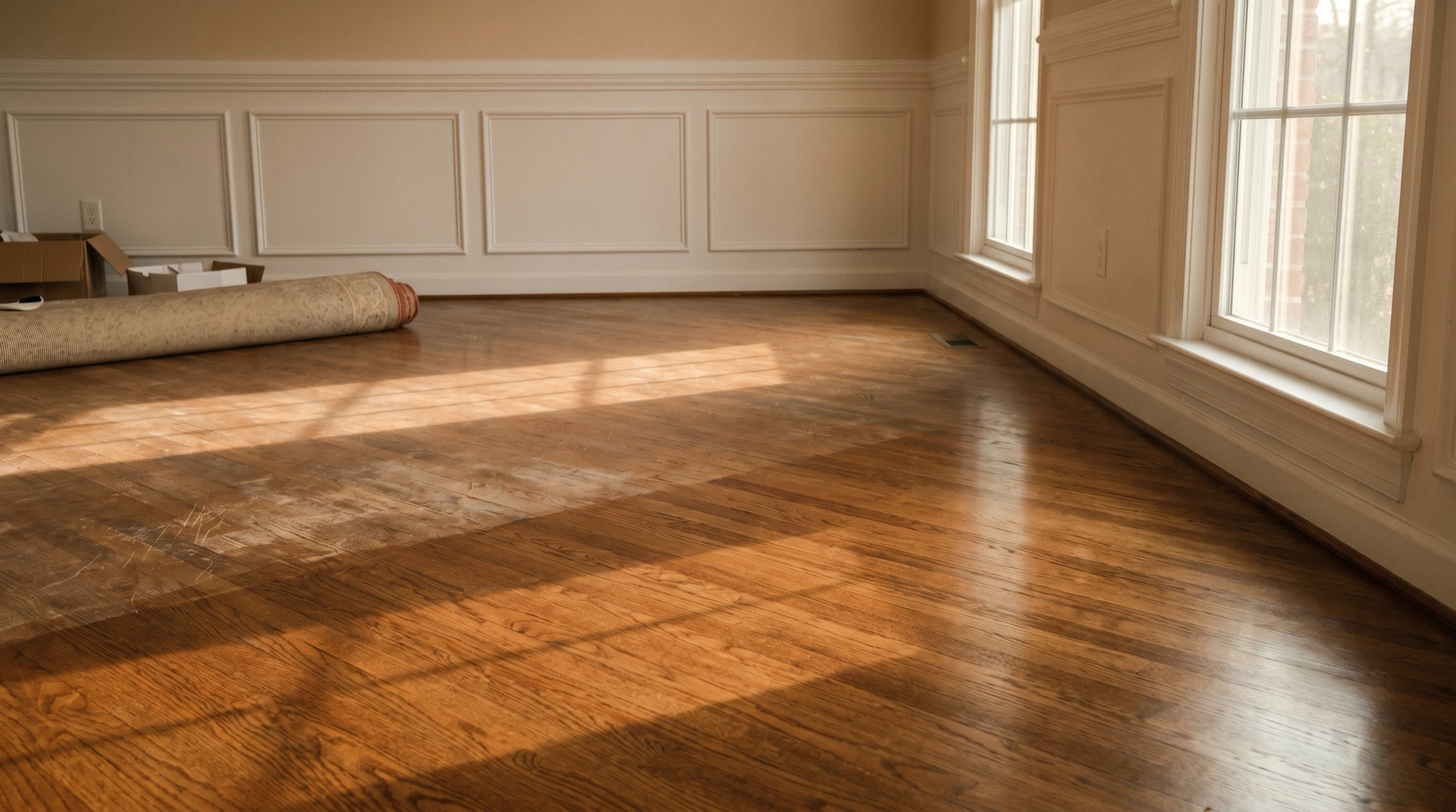
The honest answer to "what does it cost to refinish hardwood floors" is that the national averages you read online are almost never the number you will pay in the DMV. Angi and HomeAdvisor put the national range at $3 to $8 per square foot. Bob Vila quotes $1,800 to $4,500 for a typical job. Those numbers fold in everything from a $2/sqft Midwestern screen-and-recoat to a $12/sqft Manhattan herringbone with custom stain. Neither is the number a Northern Virginia or DC homeowner will see when a real installer walks the house.
This is what hardwood refinishing actually costs in 2026 in the DMV, from an installer who quotes and runs these jobs. Real per-square-foot pricing, real room-by-room examples, what changes the price up or down, and the parts of the bid that homeowners get surprised by when other companies write the quote.
Hardwood floor refinishing cost: the short answer
Quick answer
Potomac Floors charges $4.50 per square foot all-in for hardwood refinishing in the DMV, which covers sanding, staining, and three coats of sealer. A typical 800 sqft main level runs $3,600. A whole-house 1,800 sqft refinish runs $8,100. The national $3 to $8 range exists because some bids include only sanding and one coat of finish while others include stain, multiple sealer coats, and trim. Our number is the all-in number with no surprises at the end.
The most useful thing to know going in is what makes one quote $3.50/sqft and another quote $7/sqft for what looks like the same job. The short version: some companies bid the sand-and-seal only, then charge add-ons for stain color, extra coats, and stairs. We bid the all-in number because the homeowner cannot meaningfully shop a refinish without it.
What our $4.50/sqft all-in refinish actually includes
Quick answer
All-in at $4.50/sqft includes three sanding passes (rough, medium, fine), edge-and-corner sanding with a separate edger, water-popping the grain if a stain color is chosen, one coat of stain in the color you select, three coats of water-based or oil-based polyurethane sealer, and full clean-up. It does not include floor patches for board replacement, subfloor repair, or stair treads (those are quoted separately per the breakdown below).
A refinish is not a single step. It is a sequence of six to eight passes over the floor, and skipping any one of them shows up in the finished result. Here is what each piece is doing and why it lives inside the all-in number.
| Step | What it does | What happens if it's skipped |
|---|---|---|
| Rough sand (36-grit) | Removes the existing finish and the top 1mm of wood. Levels minor cupping and old scratches. | Old finish still shows through new sealer. Old scratches still visible. |
| Medium sand (60-grit) | Removes the rough-grit scratch pattern. Cleans up the surface before final pass. | The new sealer settles into 36-grit scratches and you can see them in raking light. |
| Fine sand (100-grit) | Final smooth pass. Sets the wood's grain receptiveness for stain. | Stain absorbs unevenly. Sealer feels rough underfoot. |
| Edger pass | Sanding the perimeter and corners where the big drum sander cannot reach. | You see a 4-inch dark border around every room where the old finish remains. |
| Water-popping (if staining) | Light mist of water that raises the wood grain so it accepts stain evenly and darker. | Stain reads splotchy and lighter than the sample. Common DIY failure. |
| Stain (one coat) | Color goes in. Wiped, not flooded, so the grain shows through. | If skipped, the floor goes back to natural wood tone, which may not match the rest of the house. |
| Sealer coat 1 | First polyurethane coat. Soaks into the grain. | Bare wood. Floor wears in months. |
| Sealer coats 2 and 3 | Build coats. The wearing surface for the next 10 to 15 years. | One-coat sealer is a five-year floor at best. |
Three sealer coats is the spec we install at $4.50/sqft. Some lower bids include only two. The difference is the floor's real life: two coats wears noticeably by year 5 to 7; three coats holds through year 10 to 15 with normal residential use. Industry standard per the National Wood Flooring Association (NWFA) is three coats for residential and four for commercial.
Key takeaway
An "all-in" refinish quote is only honest if it includes three sanding passes, edge work, the stain step if you want color, and at least three sealer coats. If a quote is at $3 to $3.50 per square foot, ask which of those eight steps are not included. The answer is almost always two: either the second sealer coat or the water-popping step before staining.
Refinishing cost by room size and whole-house scope
Quick answer
At our $4.50/sqft DMV rate: a single bedroom (150 sqft) is around $675. A typical living room (250 sqft) is $1,125. A main-level open plan (800 sqft) is $3,600. A whole-house 1,800 sqft refinish is $8,100. Per-sqft price stays flat across job sizes (no volume discount because the machine setup is the same on a small or large job, but no premium either).
Refinishing is one of the few jobs where per-square-foot pricing is genuinely flat across scope. The drum sander, edger, and stain process take the same setup and the same number of passes whether the area is 200 sqft or 2,000 sqft. The variable is days on site, not per-foot price.
| Scope | Square footage | All-in cost | Typical timeline |
|---|---|---|---|
| Single bedroom | 120 to 180 sqft | $540 to $810 | 2 to 3 days |
| Master bedroom | 220 to 300 sqft | $990 to $1,350 | 2 to 3 days |
| Living room only | 200 to 320 sqft | $900 to $1,440 | 2 to 3 days |
| Living + dining | 400 to 550 sqft | $1,800 to $2,475 | 3 days |
| Main level open plan (LR + DR + hall + kitchen if hardwood) | 700 to 900 sqft | $3,150 to $4,050 | 3 to 4 days |
| Upstairs bedrooms (3 bedrooms + hallway) | 600 to 800 sqft | $2,700 to $3,600 | 3 to 4 days |
| Whole house single floor | 1,200 to 1,500 sqft | $5,400 to $6,750 | 4 to 5 days |
| Whole house both floors | 1,800 to 2,400 sqft | $8,100 to $10,800 | 5 to 7 days |
The kitchen line is worth flagging. Most DMV homes built before 1990 have hardwood under the kitchen tile or vinyl, and refinishing under and around cabinets and a kitchen island is real work. If the kitchen layout is staying the same, refinishing the existing kitchen hardwood is included at our normal rate. If cabinets are being pulled or replaced, we usually time the refinish for after the cabinet work so the new hardwood line is set against the new cabinet footprint, which is the same logic we use on a fresh hardwood install.
What changes the price (and what doesn't)
Quick answer
Things that raise the price: board replacements (cracked or water-damaged boards, $30 to $80 per board including matched wood), stairs (separate $40 to $75 per tread, see breakdown below), oil-based vs water-based finish (oil is slightly cheaper, water-based dries faster and lets you live in the house sooner), and complex stain matching to an existing room. Things that do not change the price: floor color you choose, room shape, normal cleaning before sanding, dustless system on or off.
The single biggest variable on a refinish quote is what is hiding under the existing finish. Once we get the old polyurethane off, sometimes we find boards that need replacement: water-damaged areas under a window or near a kitchen sink, deep gouges that go below the 1mm sandable layer, or a cracked board from settling. These get quoted as an add-on at $30 to $80 per board including the matched wood. On a typical DMV refinish we replace 0 to 4 boards. On a 1960s Arlington bungalow we have done with a leaky bay window, we replaced 18.
| Variable | Direction | Typical impact |
|---|---|---|
| Board replacement (water damage, cracks, gouges below 1mm) | UP | +$30 to $80 per board |
| Stairs (treads and risers) | UP | +$40 to $75 per tread (see stair section) |
| Subfloor repair (squeaks, rotted plank section) | UP | +$200 to $1,500 depending on scope |
| Custom stain match to existing room | UP | +$0 to $300 (most matches are free; commercial-color matching is the exception) |
| Multiple-color floor zones (different stain bedroom vs hall) | UP | +$150 to $300 per color change |
| Choose oil-based polyurethane (vs water-based) | DOWN | -$0.25 to -$0.50/sqft, but adds 3 to 5 days drying |
| Floor color you pick | NEUTRAL | No price change between standard stains |
| Dustless sanding system | NEUTRAL | Standard at our shop, no upcharge |
| Room shape (curved walls, alcoves, bay windows) | SLIGHT UP | +$0.25/sqft only on highly curved spaces, rare |
| Furniture moving | NEUTRAL | If we move it, we charge a flat $100 to $200; most clients clear the room themselves |
Watch out
The two add-ons homeowners get surprised by on competitor quotes are stairs and trim. A "$3.50/sqft" floor quote that does not mention the staircase will hand you a $1,200 to $2,000 stair add-on the day before the job starts. Our quote names both up front. The other surprise add-on is when a floor cannot take another sand because the boards are already too thin (see our refinishing vs replacement guide and the floor needs partial replacement instead).
Screen and recoat vs full sand and refinish
Quick answer
A screen-and-recoat (also called a buff-and-coat or recoat) lightly abrades the existing finish and applies one or two new sealer coats without sanding the wood. It runs $1.50 to $2 per square foot ($600 to $1,200 on the same 800 sqft). It only works if the existing finish is not worn through, there are no stains in the wood itself, and you are not changing the color. A full sand and refinish is $4.50/sqft because it touches the actual wood.
The screen-and-recoat is the lowest-cost option but it is also the most misunderstood. Most homeowners who ask us about it are floors past the point where it works. The diagnostic is whether the polyurethane finish is still continuous or whether the wood underneath is exposed. A finish-still-continuous floor with cosmetic dullness, fine surface scratches, and no dark spots can take a recoat. A floor with pet-urine black spots, water rings that go below the finish, or visible bare-wood traffic paths cannot.
| Service | What it does | What it costs | When it's the right call |
|---|---|---|---|
| Screen and recoat | Light buff with a fine-screen, then 1 to 2 new sealer coats. Finish only, no wood sanding. | $1.50 to $2/sqft | Surface dullness, fine scratches. Finish still continuous. Color staying the same. |
| Full sand and refinish | 3 sanding passes down to bare wood, optional stain, 3 sealer coats. | $4.50/sqft all-in | Worn-through finish, pet stains, water rings, color change, deep scratches. |
| Partial replacement + refinish | Replace damaged boards with matched wood, then full refinish of whole area. | $4.50/sqft + $30-80 per replaced board | Water damage, cracked boards, areas past 1mm of sandable wood. |
| Full replacement | Pull existing hardwood, install new. | $8.50/sqft (engineered) or $9-11/sqft (solid) | Floor cannot take another sand. See our refinishing vs replacement guide. |
The rule of thumb: if your floor is under 8 years old, has no visible bare wood, and you are not changing the color, ask us about a screen-and-recoat first. It is half the price of a full refinish and the floor is walkable the next day instead of in a week. If the floor is over 12 years old or shows any of the failure signs above, a full refinish is the right call.
Stairs, closets, and trim add-ons
Quick answer
Stairs are priced per tread because they require hand-sanding and hand-applied finish. Refinishing existing hardwood treads runs $40 to $75 per tread including risers. A typical 13-tread DMV staircase runs $520 to $975. Closets and trim are usually included in the per-sqft floor price when they are part of the room (closet floor) or rolled into the edge pass (baseboard trim). See our hardwood stairs cost guide for the full stair breakdown.
Stairs are the single most common add-on on a refinish quote, and they are priced separately because they are not floor work. Each tread is hand-sanded with an oscillating tool, the riser is masked off if it stays painted or hand-sanded if it gets refinished, and the finish is applied with a brush rather than a roller because of the angle. A 13-step staircase takes roughly half a day on top of the floor work.
| Stair scope | Per tread | Typical 13-tread total |
|---|---|---|
| Treads only (risers stay painted) | $40 to $55 | $520 to $715 |
| Treads and risers (both refinished hardwood) | $55 to $75 | $715 to $975 |
| Treads, risers, and stringers (full hardwood staircase refinish) | $80 to $110 | $1,040 to $1,430 |
| Carpet removal from hardwood treads underneath (common in 1960s-1980s DMV homes) | +$10 to $15 per tread | +$130 to $195 |
A common pleasant DMV surprise: a lot of older Arlington, Falls Church, and Bethesda homes were built with hardwood stair treads that the original owner immediately carpeted. Pulling the carpet and refinishing the original treads is dramatically cheaper than installing new hardwood treads. The diagnostic is in our hardwood stairs cost guide. The same logic on the floor itself lives in our refinishing vs replacement walkthrough.
DIY vs pro refinish: where the $1.50/sqft DIY math actually lands
Quick answer
DIY hardwood refinishing on 800 sqft costs roughly $1,200 to $1,800 in rentals and materials ($1.50 to $2.25/sqft) and takes 4 to 6 weekends if you have done it before. The math saves $1,800 to $2,400 versus our $3,600 pro quote, but the failure rate among first-time DIYers in the DMV is high enough that we routinely get called in to refinish a DIY job a second time at $4.50/sqft, which is more expensive than just hiring a pro the first time. The two failure modes that always cost more to fix are drum-sander gouges and uneven stain absorption from skipped water-popping.
DIY refinishing is a real option for a confident handyperson on a single room. It is a worse option on a whole house. Here is the honest math.
| DIY line item | Cost | Note |
|---|---|---|
| Drum sander rental (3 days, Home Depot or Sunbelt) | $220 to $290 | Plus deposit |
| Edger rental (3 days) | $120 to $160 | Required for corners and perimeter |
| Sandpaper (36, 60, 100 grits, multiple passes on 800 sqft) | $80 to $140 | Easy to underbuy and run out |
| Stain (1 to 2 gallons, water-popping water) | $60 to $120 | Skipping this is the most common DIY failure |
| Polyurethane (3 coats, 800 sqft = ~3 gallons) | $180 to $260 | Oil-based slightly cheaper; water-based more forgiving for DIY |
| Applicator pads, lambswool, masking tape, vacuum bags | $60 to $100 | Adds up faster than expected |
| Dust mask (P100), eye protection, knee pads | $40 to $80 | Non-negotiable. Sanding hardwood with a P100 is the floor for safety. |
| Total materials and rentals | $760 to $1,150 | On 800 sqft |
| Your time (~30 to 50 hours) | Not in dollars | 4 to 6 weekends if it goes well |
The pure-cost gap is real: $760 to $1,150 DIY vs $3,600 pro. The question is the failure rate. The two most common DIY mistakes that we get called in to fix:
- Drum sander gouges. The drum sander is heavy and aggressive. A first-time user almost always leaves a few "stop marks" where the drum was tilted or lifted at the wrong moment. These look like dark lines or dished spots after staining. Once the floor is stained, the gouges cannot be sanded out without going through the wear layer and restarting the whole floor. We have rescued a few; many we just replace.
- Skipped water-popping. Most DIY guides skip the water-popping step because it sounds optional. It is not. The stain comes out splotchy, lighter, and uneven. The fix is to fully re-sand and re-stain.
If you have refinished a floor before and you are doing one bedroom, DIY math works. On a whole house or a kitchen-and-entry zone where the result will be in raking sunlight every day, the cost of getting it wrong usually exceeds the savings. Our installer Alvaro has spent two decades watching the same mistakes happen on rescue calls; the breakdown of common scratches that don't need a full refinish is in our scratch repair guide.
Timeline, smell, and whether you can stay in the house
Quick answer
A typical 800 sqft refinish runs 3 to 4 days on site and another 3 to 7 days before furniture goes back. Water-based polyurethane is walkable in socks after 6 hours and ready for furniture in 3 days. Oil-based polyurethane is walkable in 24 hours and ready for furniture in 5 to 7 days, and smells noticeably for the first 48 hours. Most clients with kids or pets stay out of the work area for the first 48 hours; many leave the house entirely on oil-based jobs. We do not refinish occupied bedrooms; the homeowner sleeps elsewhere during their refinish days.
Refinishing is intrusive in a way installation is not, because the wood needs cure time after the finish goes down. The order of operations on a typical 800 sqft main-level refinish:
| Day | What happens | What you can do |
|---|---|---|
| Day 1 | Furniture moved out (we move or you clear). Rough sand and medium sand. Edger. | Stay out of the work area. Dust is contained but real. |
| Day 2 | Fine sand. Water-popping (if staining). Stain applied late afternoon. | Stay out of the work area through the night. |
| Day 3 | First sealer coat in the morning. | No foot traffic on the floor. |
| Day 4 | Light buffing. Second and third sealer coats. | No foot traffic. |
| Day 5 to 7 | Finish cures. Walking in socks acceptable after day 5 with water-based, day 6 with oil-based. | Light socks-only foot traffic. |
| Day 7 to 10 | Furniture goes back. Area rugs after day 14. | Use felt pads under every piece of furniture, no rugs over the new finish for 14 days. |
Water-based polyurethane (Bona Traffic HD, Loba 2K, etc.) is what we install on most DMV jobs because it dries faster and smells noticeably less. Oil-based polyurethane is cheaper by about $0.25 to $0.50 per square foot but the off-gassing during cure is real and the wait is longer. If anyone in the house has respiratory sensitivity, we recommend water-based. If the house will be empty for a week (a flip or a between-tenant turn), oil-based saves a small amount and the smell is gone by the time anyone moves back in.
Key takeaway
Plan the refinish around a window when you can vacate the work area for at least 3 days. The job is not a "live in the house while we work" job the way a kitchen renovation can be. Most DMV homeowners we work with do the refinish during a planned vacation, or do the upstairs bedrooms while the family lives downstairs, or do the downstairs while the family lives upstairs.
FAQs about hardwood floor refinishing cost
How much does it cost to refinish hardwood floors per square foot?
In the DMV in 2026, our all-in price is $4.50 per square foot, which includes 3 sanding passes, edger work, water-popping if staining, one coat of stain, and 3 coats of polyurethane sealer. National averages run $3 to $8 per square foot but those numbers include bids that exclude staining or include only one sealer coat. The right comparison is what each bid actually covers.
How much to refinish 1,000 square feet of hardwood?
At our $4.50/sqft all-in DMV rate, 1,000 sqft is $4,500. That is the all-in number with no surprise add-ons unless we find board-replacement work during the sand. Most 1,000 sqft jobs finish without any add-ons.
How much does it cost to sand and refinish hardwood floors?
"Sand and refinish" is the same scope as a full refinish. In the DMV at $4.50/sqft all-in, a typical 800 sqft job is $3,600 and a typical 1,500 sqft job is $6,750. The "sand" and "refinish" are not separate line items in a real bid; they are stages of the same process.
What is the cheapest way to refinish hardwood floors?
If your floor still has continuous polyurethane finish (no bare-wood traffic paths, no deep pet stains, no water rings into the wood) and you are not changing color, a screen-and-recoat at $1.50 to $2 per square foot is the cheapest legitimate option. DIY full refinish is cheaper still in materials ($1.50 to $2.25/sqft on 800 sqft) but the failure rate is high enough that we routinely re-do DIY jobs for $4.50/sqft, which makes the all-in price higher than just hiring a pro the first time.
Is refinishing hardwood floors worth the money?
For most DMV homeowners planning to stay 5+ years or sell into the existing-home market, yes. Per the 2024 NAR Remodeling Impact Report, hardwood refinishing recovers 147% of cost on resale, the highest of any interior renovation NAR tracks. On the cost-of-ownership math, refinishing at $4.50/sqft buys another 8 to 15 years of floor versus full replacement at $9 to $11/sqft for solid hardwood. The full 10/20-year math is in our LVP vs hardwood lifetime cost article.
Can engineered hardwood be refinished?
Yes, if the wear layer is thick enough. A 3mm wear layer takes one full refinish; a 5mm wear layer takes two to three. Anything under 3mm (sometimes labeled as 2mm or 1.5mm on lower-cost engineered) takes a screen-and-recoat only, not a full sand. We measure the wear layer with a thin probe on a removed transition board before quoting. The full breakdown is in our engineered vs solid hardwood guide.
How often should hardwood floors be refinished?
A normal-use residential floor with three sealer coats holds 10 to 15 years before needing a screen-and-recoat. A full sand-and-refinish typically becomes necessary every 20 to 30 years on solid hardwood. Engineered hardwood usually takes one full refinish in its life. The trigger is not a year count; it is what the floor looks like in raking morning light. If the finish is dull and scratched but not worn through, recoat. If you see bare wood, refinish.
How long does the smell last after refinishing hardwood floors?
Water-based polyurethane has noticeable smell for 24 to 48 hours and is essentially gone by day 4. Oil-based polyurethane smells noticeably for 4 to 7 days and lingers faintly for 2 to 4 weeks during full cure. Both are below the OSHA exposure thresholds for residential use after the initial 48 hours, but anyone with respiratory sensitivity should stay out of the house during the active off-gassing window. We default to water-based for occupied homes.
Can I refinish hardwood floors more than once?
Solid 3/4-inch hardwood handles 3 to 6 refinishes across its 50 to 100 year life. Engineered hardwood with a 3mm wear layer handles one; 5mm handles two to three. The diagnostic is the height from the floor surface to the tongue of the board, which we check by pulling a transition strip or threshold piece. Once you are within 1mm of the tongue, the floor cannot take another sand and needs replacement instead. The refinish-versus-replace decision walkthrough is our refinishing vs replacement guide.
Bottom line: what to budget on a real DMV refinish
For a typical Northern Virginia, DC, or suburban Maryland home, the refinishing budget is $4.50 per square foot all-in plus stairs at $40 to $75 per tread. An 800 sqft main level with a 13-tread staircase is $3,600 plus roughly $700 in stairs, total $4,300. A whole-house 1,800 sqft with stairs is $8,100 plus $700, total $8,800. Add $30 to $80 per replaced board if the sand reveals damaged wood underneath.
The numbers other companies quote at $3 or $3.50 per square foot almost always exclude one or two of the steps that actually make the floor last (the third sealer coat is the most common cut, the water-popping step is the second). Our all-in price includes everything that goes between the homeowner saying yes and the homeowner walking on a fully cured floor. No mid-job change orders, no end-of-job surprise add-ons, no "stair work was not in the original quote." The full breakdown sits next to our hardwood install pricing and hardwood cost per square foot guides on the pricing side, and our refinishing vs replacement guide on the decision side.
If you want a real number on your specific floor, we walk it, measure it, and write the all-in price the same day. We do not subcontract; the crew that walks the house is the crew that runs the sander.
