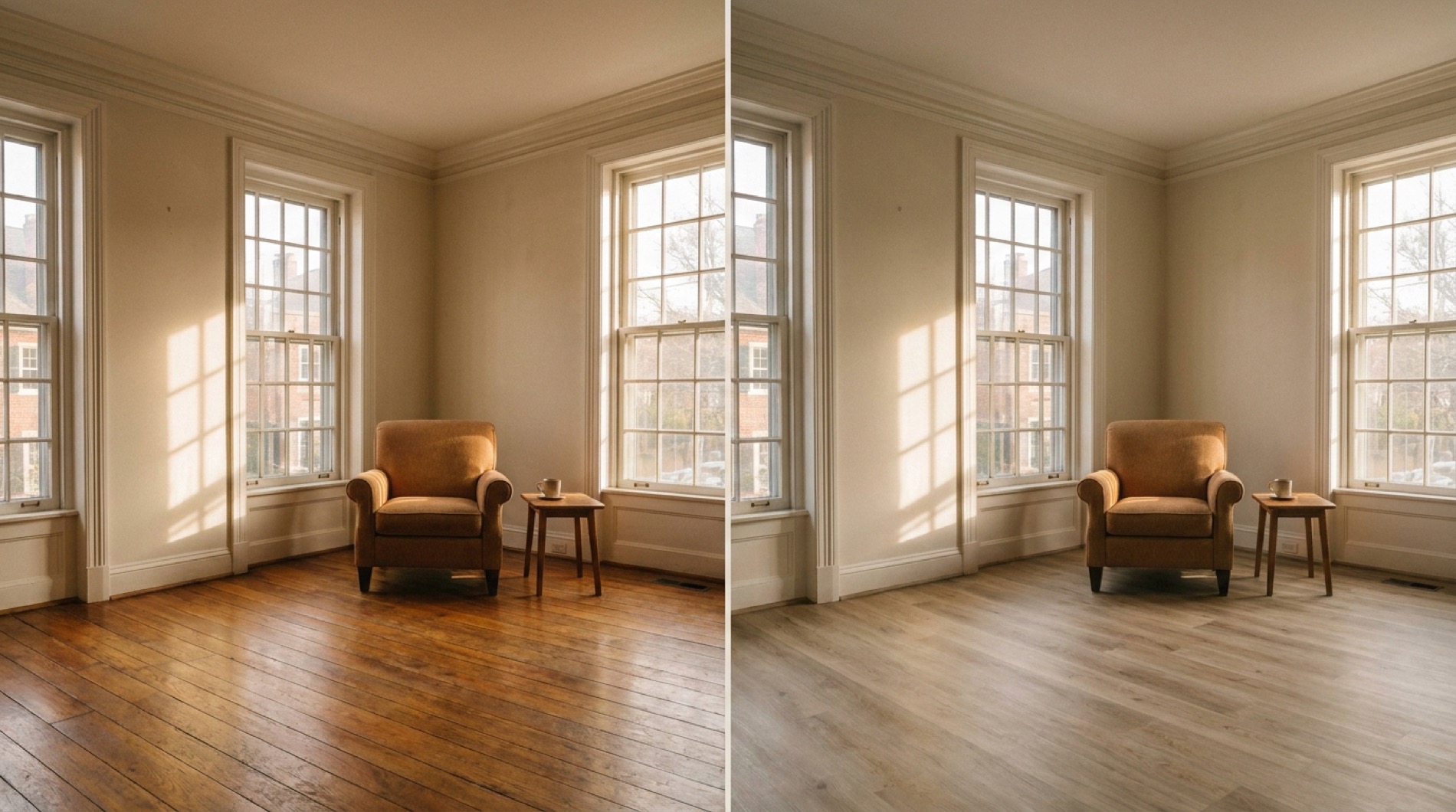
The honest version of this comparison is rarely the version you read on a manufacturer's site. LVP brochures put the lifespan at 25 years. Solid hardwood brochures put it at 100. Neither number matches what we walk into when we tear out floors in Alexandria, Fairfax, Arlington, and Bethesda. The decision between luxury vinyl plank and hardwood is mostly a decision about how long you plan to live with the floor and how much refinishing or replacement budget shows up over the years you own the house.
This is the installer-side breakdown. Real DMV all-in pricing, real lifespan ranges, real refinish and replacement cycles, and the resale-value question reconciled against the actual 2024 NAR Remodeling Impact and Cost vs Value reports rather than realtor folklore. The numbers favor different floors for different homeowners. The number that matters is the one for your house, not the one in a national average.
LVP vs hardwood lifetime cost: the short answer
Quick answer
Over 10 years on a typical 800 sqft DMV install, LVP starts at $5,200 versus $6,800 for engineered hardwood, or $7,200 to $8,800 for solid. Over 20 years, hardwood usually catches up or beats LVP because a single refinish at $4.50 per sqft buys another 8 to 15 years of floor, while LVP plank wear typically forces a full replacement somewhere between year 15 and year 25. Add resale value impact (hardwood adds 2 to 5% to DMV home value per 2024 NAR data, LVP is roughly neutral) and hardwood is the cheaper 20-year answer on most single-family homes. LVP wins on basements, rental units, and condos with HOA noise rules.
The math is not the same for every house. A 1,200 sqft Arlington condo with a strict HOA sound rule and no plans to sell for 25 years tilts toward LVP. A 2,400 sqft Fairfax colonial with a family planning to sell in 8 years tilts toward hardwood. The rest of this article shows you which inputs flip the answer.
How long does each one actually last in a DMV home
Quick answer
Manufacturer claims and field reality: LVP brochure says 20 to 25 years, real DMV residential service life is 12 to 20 years before the wear layer dulls, edges chip, or seams open. Engineered hardwood brochure says 30 to 40 years, real DMV service life is 25 to 50 years with one refinish in the middle. Solid hardwood brochure says 100 years, real DMV service life is 50 to 100+ years with 3 to 6 refinishes across that time.
The brochure number is the lab number. The field number is what we see when we walk into a Northern Virginia kitchen and tell the homeowner whether their existing floor still has another decade in it or whether it is on its way out.
| Floor type | Brochure claim | DMV residential field life | What ends the floor's life |
|---|---|---|---|
| LVP (20-mil wear layer, SPC core) | 20 to 25 years | 15 to 20 years in a low-traffic home, 12 to 15 in a high-traffic home with pets | Wear-layer dulling, edge chipping at high-traffic transitions, seam separation in sunlit rooms, indents from heavy furniture |
| LVP (12-mil wear layer, WPC core) | 15 to 20 years | 10 to 15 years residential, 7 to 10 in rentals | Same failure modes earlier. The wear-layer mil is the single biggest predictor. |
| Engineered hardwood (3mm wear layer) | 30 to 40 years | 25 to 50 years with 1 mid-life refinish | Wear layer used up after one or two refinishes. Plywood core delamination from prolonged moisture. |
| Engineered hardwood (5mm+ wear layer) | 40+ years | 40 to 60 years with 2 to 3 refinishes | Same failures as 3mm but later. Often outlasts the homeowner's tenure. |
| Solid hardwood (3/4-inch oak, maple, hickory) | 100 years | 50 to 100+ years with 3 to 6 refinishes | Cumulative refinishes reach the tongue of the board. Subfloor failure (rare). Insurance event (water damage, fire). |
The wear-layer number on LVP is the single most useful spec on the box. A 20-mil wear layer (often listed as 20 mil or 0.5mm) is the residential grade we install on the $6.50 all-in package. A 12-mil layer is the rental grade and will fail noticeably sooner in a family home. A 6-mil layer is contractor-grade big-box product and we will not install it because we already know we will be back replacing it in 7 years. That wear-layer choice is the biggest lever on how long vinyl plank flooring lasts. For the full LVP spec sheet, see our vinyl plank installation cost guide.
The hardwood number that matters is the wear layer on engineered (3mm vs 5mm vs 6mm) or the total board thickness on solid (3/4-inch is standard, 5/8-inch is a value cut, anything thinner is a refinish liability). For the full breakdown, see our engineered vs solid hardwood comparison.
Key takeaway
The brochure lifespan is the lab life under ideal conditions. The real life is shorter for LVP and longer for solid hardwood because the failure modes are different. LVP wears out (the wear layer is consumable, once it is gone the print starts showing). Solid hardwood gets resurfaced (the wear is sanded off, the wood underneath is still there). Engineered hardwood is in between. That asymmetry is the whole reason the 20-year math comes out different.
10-year all-in cost on a typical 800 sqft DMV install
Quick answer
On 800 sqft (typical DMV single-family first floor or townhouse main level), 10-year all-in cost: LVP $5,200 to $5,600 (one install, possibly one transition strip repair). Engineered hardwood $6,800 to $7,100 (one install, no refinish yet). Solid hardwood $7,200 to $9,100 (one install, no refinish yet). LVP is the lowest initial 10-year cost in this comparison.
800 square feet is the install scope we quote most often: living room, dining room, kitchen, hallway in a typical Alexandria colonial or Fairfax split-level, or the entire main level of a Reston townhouse. Larger jobs (whole-house 1,800+ sqft) scale the numbers but the per-sqft ratios hold.
| Floor type | Install (all-in) | Year 1-10 maintenance | 10-year total |
|---|---|---|---|
| LVP (20-mil) | $6.50/sqft × 800 = $5,200 | $0 to $400 (one transition or threshold repair) | $5,200 to $5,600 |
| Engineered hardwood (3mm wear) | $8.50/sqft × 800 = $6,800 | $0 to $300 (one spot board repair from a chair gouge or pet incident) | $6,800 to $7,100 |
| Solid hardwood (3/4-inch oak) | $9 to $11/sqft × 800 = $7,200 to $8,800 | $0 to $300 (same spot repair window) | $7,200 to $9,100 |
At year 10 the LVP looks the same as it did at year 1 if you bought a 20-mil product and you do not have a high-traffic indoor pet situation. The hardwood looks slightly worn at door thresholds and possibly at the kitchen sink area, but does not need refinishing yet on most homeowners' use level. None of the three has had a major intervention.
If 10 years is the only horizon that matters (you bought a flip, you are a 5-year landlord, you know you will sell before year 12), LVP is the right answer. The math does not favor hardwood inside a 10-year window unless resale value moves the number, which we cover below.
20-year all-in cost: where the math flips
Quick answer
At year 20, hardwood usually catches up and often passes LVP. LVP often needs full replacement around year 15 to 20 ($5,200 to $6,500 again in 2026 dollars, more in nominal future dollars). Hardwood gets refinished once at $4.50/sqft ($3,600 on the same 800 sqft) and is good for another 8 to 15 years. 20-year total: LVP $10,400 to $11,700. Engineered hardwood $10,400 to $11,000. Solid hardwood $10,800 to $12,700. Hardwood is now within a couple thousand dollars of LVP, often less than LVP after a second wear cycle starts.
This is the part of the conversation that does not show up in head-to-head comparison articles. The first install is not the lifetime cost. The lifetime cost is the install plus everything that happens to the floor across the years you live with it.
| Floor type | Year 0 install | Year 10-20 events | 20-year total |
|---|---|---|---|
| LVP (20-mil) | $5,200 | Full replacement at year 15 to 20: $5,200 to $6,500 in 2026 dollars (plus any inflation if it happens in nominal future dollars) | $10,400 to $11,700 in 2026 dollars |
| Engineered hardwood (3mm) | $6,800 | One refinish at year 12 to 15: $4.50/sqft × 800 = $3,600. Floor good through year 25 to 30. | $10,400 |
| Solid hardwood (3/4-inch) | $7,200 to $8,800 | One refinish at year 10 to 15: $3,600. Possibly a second around year 25 to 30. | $10,800 to $12,400 |
LVP at the 20-year mark has been replaced once and the homeowner is now living on a fresh second install. Engineered hardwood has been refinished once and the homeowner is roughly 2/3 of the way through the wear layer with a decade or more of floor left. Solid hardwood has been refinished once, sometimes twice, and is barely halfway through its serviceable life.
The flipping point depends heavily on how the original LVP was installed and what hits it across the years. A 20-mil LVP in a low-traffic bedroom can run 22 to 25 years. The same product in a kitchen-and-entry zone of a family with dogs and a stone driveway often fails at year 12. We see both. The 15 to 20 year window is the planning number; the field number can run earlier or later by a few years.
Watch out
A water event flips the math in either direction. LVP shrugs off most leaks and the install is sometimes salvageable; hardwood often is not (see our water-damaged hardwood and insurance claim flow guide). On the other hand, a fire or a category-3 sewer event takes out both floors and resets the clock; in that case the install cost difference is paid out by insurance and the lifetime-cost math gets reset by the claim, not the homeowner. Account for low-probability events in the back of your head, not in the spreadsheet.
What hardwood vs LVP actually does to your resale value
Quick answer
Per the 2024 NAR Remodeling Impact Report, refinishing hardwood floors recovers 147% of project cost on resale (median nationally) and installing new hardwood recovers 118%. LVP is not tracked separately by NAR but real-estate-agent surveys consistently put it in the neutral-to-mildly-positive bucket: it removes the "needs new floors" objection without adding the perceived premium hardwood adds. In the DMV specifically (Old Town Alexandria, Bethesda, Arlington, McLean), hardwood typically adds 2 to 5% to listing price compared to the same home with LVP. On a $700K DMV home, that is $14,000 to $35,000.
The NAR Remodeling Impact Report is the canonical source for "does this renovation actually return on sale" math. The 147% recovery on hardwood refinishing is the highest of any interior renovation NAR tracks (above kitchen, bath, and attic conversion). New hardwood installation at 118% is also one of the few interior projects that returns more than its cost. LVP is too new to have established its own line item in the NAR data set, but listing-agent feedback in the DMV is consistent: LVP is fine for the home to show, hardwood adds active premium.
The resale number does not apply equally to every home. A 1980s vinyl-floored kitchen replaced with hardwood probably moves the listing price. A new-construction Loudoun house that was already going to list with LVP because that is the developer norm in that price band probably does not get a hardwood premium. The premium attaches to homes where buyers expect hardwood: older DMV stock, mid-and-upper market, custom build, anything inside the Beltway in the 1920s to 1960s stock.
For investment property and rental scenarios the inverse applies. LVP is the right call because it removes the "needs flooring" turnover cost and tenants do not pay rent premium for hardwood. We cover that decision in our best flooring for rental properties piece.
DMV-specific factors that change the math
Quick answer
Five DMV factors shift the answer: (1) basement and below-grade slab moisture (LVP wins), (2) condo HOA sound transmission rules (LVP with proper underlayment wins), (3) old-house subfloor moisture cycles in Alexandria and Arlington (engineered hardwood is more forgiving than solid), (4) summer humidity swings without HVAC (engineered or LVP, never solid in a flip-and-leave scenario), (5) DMV resale market expectation in older neighborhoods (hardwood wins). Each shifts the math by thousands of dollars over 20 years.
Basement and slab floors. Anything below grade or directly on slab is a moisture risk over decades. LVP is waterproof and the SPC core does not delaminate. Engineered hardwood works on slab if a proper vapor barrier is installed and the slab tests dry; solid hardwood does not. For basements specifically, LVP is the default unless the homeowner has dehumidification and is willing to take the warranty risk. See our best flooring for basements in the DMV piece for the full decision tree.
Condo HOA rules. Most DMV condos (Tysons, Crystal City, Rosslyn-Ballston, Bethesda) require an Impact Insulation Class (IIC) rating, typically IIC 50 or higher, for any hard surface above the ground floor. LVP with a 2mm acoustic underlayment meets IIC 50 easily. Hardwood requires a higher-grade underlayment (often cork) to meet the rule and the install becomes more expensive. The HOA letter usually settles the answer.
Old-house subfloor. Alexandria and Arlington homes built between 1900 and 1950 have plank subfloors that move with seasonal humidity. Solid hardwood installed directly on those subfloors cups, gaps, and sometimes squeaks within a few years. Engineered hardwood (cross-laminated core) is more forgiving. LVP is most forgiving but does not match the period look. For diagnostic, see our hardwood buckling and cupping in DMV humidity guide.
HVAC discipline. Solid hardwood needs the indoor humidity kept between 30% and 50% year-round. Homeowners who turn off the HVAC on vacation in July or down to 55 degrees in January are setting up the floor to cup or gap. Engineered hardwood is more forgiving. LVP does not care.
Resale neighborhood expectation. Hardwood premium is highest in Old Town Alexandria, Del Ray, Country Club Hills Arlington, central Bethesda, McLean, Chevy Chase, and historic neighborhoods of DC. Hardwood premium is smallest in newer developments where LVP is the developer-installed norm (Loudoun outer ring, parts of Prince William County, new Loudoun construction). Check the listing photos of 5 recently-sold comps before deciding.
Which one is actually right for your house
Quick answer
Quick decision rule: stay 10+ years in a DMV single-family above the Beltway average, hardwood. Stay 5 to 10 years and resale-focused, hardwood. Basement, rental unit, or condo with strict HOA sound rule, LVP. Empty nester downsizing to a condo, LVP. Family with large dogs and budget pressure, LVP for now and hardwood at the next remodel. Active mid-market family in a colonial planning a 15+ year tenure, engineered or solid hardwood.
| Scenario | Better answer | Why |
|---|---|---|
| 10+ year tenure, mid-to-upper DMV market, above-grade install | Engineered or solid hardwood | 20-year math wins. Resale adds 2 to 5% in DMV mid-market. Hardwood refinish at year 15 is cheaper than LVP replacement. |
| 5 to 10 year tenure, planning to sell | Hardwood (engineered) | 147% NAR resale recovery on hardwood. The premium often more than pays back the install difference. |
| Basement, slab, or below-grade install | LVP | Moisture forgiveness. Hardwood warranties usually exclude below-grade. |
| Condo above first floor with HOA sound rule | LVP with acoustic underlayment | IIC 50 met cheaply. Hardwood install becomes specialist (and often denied by HOA). |
| Rental unit or short-term landlord scenario | LVP | Turnover cost minimized. Tenants do not pay rent premium for hardwood. |
| Active family, big dogs, hard-use kitchen | LVP (20-mil) now, hardwood at next remodel | Honest call. Dogs and grit are hard on hardwood finishes. Refinish frequency goes up. |
| Historic Alexandria, Del Ray, central Bethesda, Old Town DC | Hardwood (usually solid in original homes) | Period appropriate. Resale premium highest. Subfloor often original wide plank that matches. |
The right answer for your house is rarely the cheapest install option and rarely the most expensive. The right answer is the floor that fits how you actually use the house for the next 15 years. The math we ran above gets you most of the way to the answer; the rest is the conversation we have on the walk-through when we look at the kitchen, the kids, the dog, and the basement door.
FAQs about LVP vs hardwood lifetime cost
How long does LVP really last in a DMV home?
A 20-mil wear-layer LVP product installed correctly in a typical Northern Virginia single-family home runs 15 to 20 years before the wear layer dulls enough to notice or before seams open in sunlit rooms. High-traffic homes with dogs and grit can see meaningful wear by year 12. Low-traffic homes (empty nester, bedroom-only LVP) can run 22 to 25 years. The 25-year manufacturer claim is the lab number; field life is consistently shorter.
How long does hardwood really last in a DMV home?
Solid 3/4-inch hardwood properly installed and maintained runs 50 to 100 years with 3 to 6 refinishes across that time. Engineered hardwood with a 3mm wear layer runs 25 to 50 years with 1 mid-life refinish. Engineered with 5mm+ wear layer runs 40 to 60 years with 2 to 3 refinishes. The killers are uncontrolled humidity, prolonged moisture exposure, and a refinish too many that hits the tongue of the board.
Is LVP cheaper than hardwood over 20 years?
Usually not, by year 20. The 10-year table shows LVP's lower initial cost on an 800 sqft install. By year 20 the LVP has often been fully replaced once while the hardwood has been refinished once at roughly half the cost of a replacement. Total 20-year cost in 2026 dollars is usually within a couple thousand dollars between the two, and hardwood often pulls ahead once resale-value impact is added.
Does hardwood actually add resale value in the DMV market?
Yes, in most mid-and-upper DMV neighborhoods. Per the 2024 NAR Remodeling Impact Report, hardwood refinishing recovers 147% of cost on resale (the highest of any interior renovation NAR tracks) and new hardwood installation recovers 118%. In DMV-specific terms, hardwood typically adds 2 to 5% to listing price compared to the same home with LVP in established neighborhoods like Old Town Alexandria, Del Ray, Country Club Hills, central Bethesda, and McLean. On a $700K home that is $14,000 to $35,000. The premium is smallest in newer outer-ring developments where LVP is the developer norm.
Can you put hardwood in a DMV basement?
Engineered hardwood works on a slab if a proper vapor barrier is installed, the slab tests under 4 lb/1000sqft moisture vapor emission rate, and you have dehumidification running year-round. Solid hardwood does not belong below grade. Realistically, even engineered hardwood is a warranty-edge install in DMV basements and most installers will not warranty it. LVP is the standard basement answer and the math works out better over 20 years because of moisture risk insurance.
Can hardwood floors be refinished after water damage?
Sometimes. Mild cupping that releases as the wood dries can be sanded flat and refinished. Severe cupping, crowning, or any delamination of engineered hardwood is past refinish; those boards need replacement. The diagnostic is in our hardwood buckling and cupping guide. Insurance-claim flow if the water was a sudden event is covered in our water-damaged hardwood insurance claim guide.
Does LVP need underlayment in a condo?
Yes, in any DMV condo above the ground floor with an HOA sound rule (which is almost all of them). Most LVP installs above the first floor require an acoustic underlayment rated to IIC 50 or higher. A 2mm IXPE or rubber underlayment meets the rule cheaply. Check the HOA letter before ordering material. Some HOA boards require an installer's IIC certification on the underlayment product before they approve the install.
What about engineered hardwood, where does it fall in the math?
Engineered hardwood at $8.50 per square foot all-in sits between LVP and solid hardwood on install cost and is usually within $1,000 of solid hardwood over 20 years. The plywood core handles DMV humidity better than solid hardwood and is acceptable on slab if vapor barrier is set. The wear layer is the spec to optimize: a 3mm wear layer gets one refinish; a 5mm wear layer gets 2 to 3 and approaches solid-hardwood lifespan. For a full breakdown, see our engineered vs solid hardwood comparison.
Bottom line: pick the one that fits the next 15 years, not the next 15 minutes
The honest 20-year math comes out close. LVP wins on cash out the door by a few thousand dollars. Hardwood wins on resale impact, on refinish-versus-replace economics, and on the floor that looks like it belongs in an Alexandria colonial when the next buyer walks through. Neither is wrong. The wrong move is picking the one with the lowest install number without thinking about year 15 to 20, which is when the difference shows up.
If you want an honest walk-through where we measure the rooms, look at the subfloor, ask about your dog and your timeline, and give you the real all-in number for both options on your specific scope, that is the estimate we write. Same number that's on every other page of this site. See our LVP vs hardwood service comparison for the per-room call, or call us for the in-home walk-through.