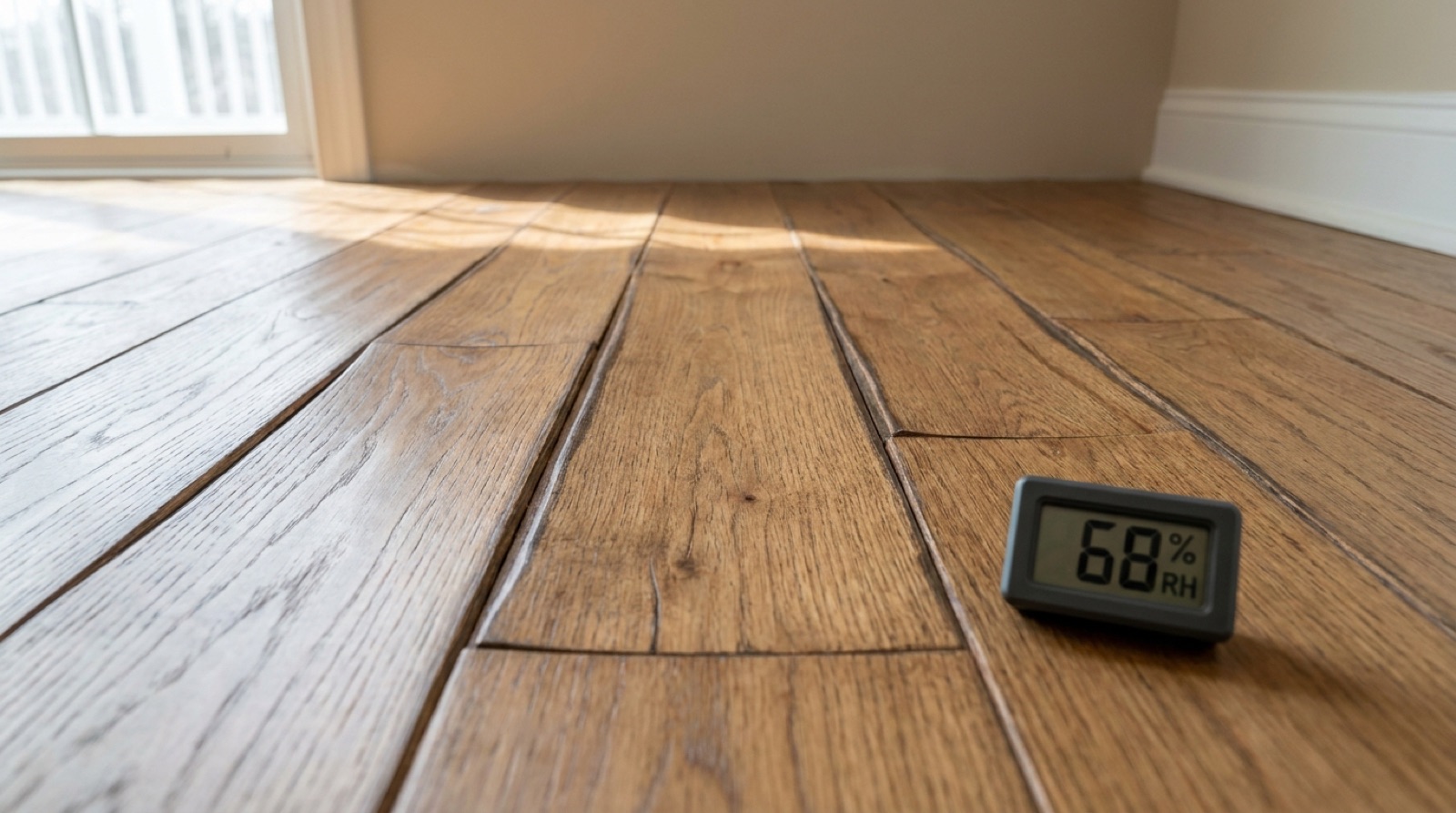
A dishwasher line lets go overnight. A second-floor toilet supply fails on a Tuesday afternoon while you are at work. A hose to the ice maker drips for six weeks behind the fridge before anyone notices. Three different stories, same end state: hardwood floor that is buckling, cupping, or already lifting off the subfloor, and a homeowner with two parallel problems running at once. Save the floor. Save the claim.
Most of the calls we get on water-damaged hardwood arrive with the homeowner already a step or two behind. Standing water sat too long. The adjuster has already been out and lowballed the repair. Someone moved the wet boards into the garage and the adjuster will not write coverage on damage that did not stay where it happened. The good news: the DMV homeowners who get the best outcomes usually did the same 5 things in the first 72 hours. This is the installer-side version of that playbook, with real Northern Virginia and DC pricing for the repairs.
Water-damaged hardwood and insurance: the short answer
Quick answer
Stop the water source first. Photograph everything before you move a single board. Call the insurance carrier within 48 hours and get a claim number. Bring in a remediation company AND an independent flooring installer for separate written estimates. Most "sudden and accidental" leaks (burst pipe, dishwasher failure, appliance hose) are covered; slow long-term leaks, humidity damage, and maintenance issues are not. DMV repair costs in 2026: dry-out only $0 to $1,500, lace-in board replacement $800 to $1,500, full hardwood replacement $8.50 per square foot all-in for engineered or $9 to $11 per square foot for solid.
Insurance carriers in Virginia, DC, and Maryland follow the same standard categories and the same coverage logic. What changes between homeowners is not the policy language; it is whether the floor and the claim were handled in a way that gave the adjuster something to approve. Most of the work happens in the first 3 days.
The first 72 hours: what to do before you call anyone
Quick answer
Five moves in order: (1) stop the water source, (2) photograph and video every angle before anything dries or moves, (3) extract standing water but do not remove any boards yet, (4) call your insurance carrier and get a claim number opened, (5) get two independent estimates (remediation company for dry-out, flooring installer for repair). Do all five in the first 72 hours. The claim quality is set in this window.
The 72-hour window is not arbitrary. Insurance carriers use it as a soft cutoff for "you took reasonable steps to mitigate," which is policy language that gates coverage. Mold typically takes 48 to 72 hours to start growing in wet wood. Adjusters know this and will subtract coverage if the homeowner left a wet floor sitting for a week.
1. Stop the water source. Shut off the main if it is a plumbing line. Pull the appliance and cap the supply line if it is a hose. If it is a roof leak, tarp it. If it is groundwater coming in at the slab, get a sump or pump running. The claim does not move forward until the source is stopped, and damage that grows after you noticed it can be denied.
2. Photograph and video everything before you touch it. Walk the room with a phone, take 30 to 50 photos. Wide shots, close-ups of the damaged boards, the source area, water lines on the baseboards, anything that visibly absorbed water. Date stamps matter. Take a video walkthrough with audio narration ("this is the kitchen, you can see the cupping along this wall, the dishwasher is here"). Adjusters watch these. If a board got moved later, the photo proves where it was.
3. Extract standing water but do not pull boards. Wet-vac or mop up surface water. Set fans. If you have a dehumidifier, run it on the highest setting. Do not pull baseboards, do not pry up wet boards, do not pull cabinets. The adjuster needs to see the damage in place. Pulling a board before they document it can be read as either making the problem worse or hiding what was there. Either reading hurts the claim.
4. Call the carrier within 48 hours. Open the claim by phone. Get a claim number in writing (text, email, or claim portal). Ask explicitly: "Is this a covered loss under my policy?" Their answer in that first conversation is rarely final, but it sets the framing. Ask what category they are filing it as (see the next section) and what documentation they want.
5. Get two independent estimates. One from a water-damage remediation company (for the dry-out, demo of any unsalvageable material, mold testing if needed). One from an independent flooring installer (for the actual hardwood repair or replacement). The carrier will often "recommend" or "prefer" a vendor; you are not required to use them in Virginia or DC. An independent installer estimate gives the adjuster a real DMV repair number, not a national average from a software lookup.
Key takeaway
The single most expensive mistake we see homeowners make is pulling wet boards before the adjuster sees them. We have walked into homes where the floor was already piled in the garage and the adjuster wrote the claim against the empty subfloor only. Half the damaged material was no longer in front of him to count. Leave it where it is until photos and adjuster visit are both done.
How insurance adjusters categorize water damage
Quick answer
Adjusters use three water categories and one timing question. Category 1 is clean water (supply line, ice maker, fridge water line). Category 2 is grey water (dishwasher, washing machine, shower runoff). Category 3 is black water (sewage, toilet backup, flood). For coverage they ask one question: was the loss sudden and accidental, or slow and gradual? Sudden plus accidental usually covered. Slow plus gradual usually not.
The three categories come from the IICRC S500 standard that adjusters and remediation companies both follow. They drive what the carrier will let you put back. A category 1 loss in a single room often gets approval to dry-out and patch. A category 3 loss almost always requires demo of any porous material the water touched, which includes hardwood, subfloor, drywall up the wall, and sometimes cabinets.
| Category | What it means | Typical sources | What gets approved |
|---|---|---|---|
| Category 1 (clean) | Water from a sanitary source, no contamination risk | Burst supply line, ice maker line, refrigerator water line, broken toilet supply (clean side) | Often dry-out plus refinish or partial board replacement. Less demo required. |
| Category 2 (grey) | Water with significant chemical, biological, or physical contamination | Dishwasher discharge, washing machine overflow, shower or tub runoff | More aggressive demo. Hardwood that absorbed greywater for more than 48 hours is often replaced rather than dried. |
| Category 3 (black) | Grossly contaminated water, sewage, or floodwater | Toilet backup, sewer line failure, storm flooding, river or creek overflow | Full demo of all porous material the water touched. Hardwood almost never salvageable. |
The "sudden and accidental" question is where most coverage fights happen. Carrier language varies but the principle is the same across major insurers operating in Virginia, DC, and Maryland: a pipe that bursts on Tuesday is sudden. A pipe that has been dripping behind the fridge for six months and finally got noticed is not. The same wet floor, different cause, different coverage. Adjusters look for evidence of slow damage (long-term staining, established mold, rotted subfloor) versus a sharp recent event (fresh wet line, no mold yet, intact subfloor underneath).
Watch out
If the adjuster floats "this looks like a long-term issue" early in the call, the framing matters. Most policies do not cover gradual damage. If the actual cause is a recent failure but the wood already shows old staining from an unrelated leak years ago, the adjuster can use the staining to deny. Get the plumber's invoice or appliance failure documentation in front of the adjuster fast. That document anchors the loss to a specific date and event.
The documentation pack to hand your adjuster
Quick answer
A clean claim packet has 6 things: (1) 30+ dated photos and a narrated walkthrough video, (2) the plumber or appliance technician invoice that names the cause and date, (3) hygrometer or moisture-meter readings of the affected floor, (4) a written remediation estimate, (5) a written flooring repair or replacement estimate from an independent installer, (6) the original install invoice and any warranty paperwork. Hand the whole pack at once. Half-built packets give adjusters reasons to delay.
Adjusters are processing a queue. The cleaner the packet, the faster it moves and the less they push back on individual line items. Sloppy packets get questioned line by line.
- Photos and video. 30 to 50 photos minimum. Wide shots showing the whole room, close-ups of damaged boards, photos of the source (failed pipe, failed appliance), photos of any visible water lines on baseboards or drywall.
- Cause documentation. The plumber's invoice that says "replaced burst 1/2-inch copper supply line under kitchen sink, water flowed from approximately 2:15am to 7:00am" is worth more than any homeowner statement. Adjusters trust trade invoices. Pay the plumber, get the invoice, file it.
- Moisture readings. If you can get a moisture meter on the wood, do it. Hardwood at 12% or higher moisture content is over saturated. The reading proves the floor was wet, not just that you think it was wet.
- Remediation estimate. Written, on letterhead, itemized. Should cover extraction, drying time, demo of unsalvageable porous material, antimicrobial treatment if applicable.
- Flooring estimate. Written, itemized, with the all-in repair or replacement cost per square foot. We provide a one-page estimate that breaks out demo, subfloor work, material, installation, and finish so the adjuster can match each line to the policy's covered items. See our flooring quote hidden charges guide for what a real quote should include.
- Original install paperwork. The original invoice tells the adjuster the age of the floor, which drives depreciation calculations. A 4-year-old engineered hardwood floor depreciates very differently from a 30-year-old original solid floor. The depreciation math is where insurance "actual cash value" claims often lowball; the original invoice is your counterweight.
The 3 repair tiers and real DMV 2026 pricing
Quick answer
Three tiers cover almost every water-damaged hardwood call in the DMV. Tier 1: dry-out plus refinish, $0 to $1,500 plus a $4.50 per square foot refinish if needed. Tier 2: lace-in partial board replacement, $800 to $1,500 for a localized failure under a fixture. Tier 3: full hardwood replacement, $8.50 per square foot all-in for engineered or $9 to $11 for solid. The tier is set by the category of water and the time it sat on the floor, not by how dramatic the damage looks on day one.
The right tier depends on three questions: how clean was the water, how long did it sit, and what is the floor made of? Engineered hardwood holds up well to brief category 1 exposure but rarely survives prolonged category 2 or 3 because the plywood core delaminates. Solid hardwood is more forgiving on water but takes longer to dry and shows worse cupping if dried unevenly.
| Tier | What's involved | DMV 2026 cost | When it's the right call |
|---|---|---|---|
| Tier 1: Dry-out plus refinish | Industrial dehumidifiers and air movers for 3 to 7 days. Once moisture content reads under 10%, decide whether the floor needs a sand and refinish or just settles back to flat. | $0 to $1,500 for dry-out (often covered by insurance under remediation). $4.50/sqft for a sand and refinish if needed. | Category 1 water, caught within 24 hours, solid hardwood with at least 2mm wear layer remaining. Mild cupping that releases as the wood dries. |
| Tier 2: Lace-in board replacement | Pull the damaged boards, weave in new boards that match species, width, and thickness, sand and refinish the repair area so it blends with the surrounding floor. | $200 to $400 per individual board replacement. $800 to $1,500 for a typical fixture-area repair (under a fridge or dishwasher) including blend refinish. | Localized damage from a contained leak (ice maker, dishwasher, single appliance). Rest of the floor is sound. Matching wood available. |
| Tier 3: Full hardwood replacement | Demo existing flooring, dry and inspect subfloor (repair or replace damaged sections), reinstall vapor barrier if missing, install new hardwood, finish on site or use prefinished. | $8.50/sqft engineered all-in. $9 to $11/sqft solid hardwood all-in. Subfloor repair adds $2 to $6/sqft for the affected zone. | Category 2 or 3 water that sat more than 48 hours. Engineered hardwood that delaminated. Solid hardwood with no wear layer left. Slab without a vapor barrier under the failed install. |
The dry-out alone is often enough on category 1 water caught fast. We have walked into Alexandria and Falls Church kitchens where the homeowner caught a dishwasher leak overnight, ran a dehumidifier on it for 5 days, and the floor came back almost flat with no install work needed. That is the best-case outcome. The opposite case is the slow leak under a fridge that ran for a month: by the time anyone noticed, the subfloor is rotted, the boards are cupped past recovery, and Tier 3 is the only honest answer.
For the diagnostic side of telling cupping from buckling from crowning, see our companion article on hardwood floor buckling and cupping in DMV humidity. The same diagnostic applies whether the moisture came from a leak or from summer humidity.
For the broader pricing context if the claim falls back to full replacement, our hardwood floor installation cost guide breaks the all-in number into its components so you can read the adjuster's estimate against ours line by line.
Key takeaway
The tier the adjuster wants to approve and the tier the floor actually needs are not always the same. A common pattern: adjuster offers a partial replacement plus refinish, the installer walks the floor and sees the moisture wicked beyond the visible damage. Boards 4 to 8 feet away from the visible cupping are also at 14% moisture content. Going back to the adjuster with the moisture-meter readings and an engineering note from the installer is what moves the claim from Tier 2 to Tier 3 in those cases.
Install warranty, insurance, or out of pocket: who pays
Quick answer
Three buckets. Install warranty covers damage from an install error (no acclimation, missing vapor barrier, wrong expansion gap). Homeowner's insurance covers sudden and accidental leaks. Out of pocket covers slow leaks, humidity damage, maintenance issues, and anything past the discovery cutoff. The buckets rarely overlap. Get the source documented fast and the bucket is usually clear.
Install warranty. A reputable installer warranties the install (not the wood itself) for at least one year, often longer for premium work. If a floor buckles within the warranty window and there's no active moisture source we missed, the install is suspect. Our installs include a documented acclimation step and slab vapor barrier where required, so this conversation does not become a guessing game later.
Homeowner's insurance. Most HO-3 policies in Virginia, DC, and Maryland cover sudden and accidental water damage subject to deductible and depreciation. They generally exclude flood (separate flood policy required), groundwater intrusion at the slab, sewer backup unless you carry the sewer-backup rider, and slow long-term leaks. A typical DMV deductible runs $1,000 to $2,500; for a Tier 3 replacement on 800 square feet at $8.50 per square foot, that is $6,800 less deductible, so $4,300 to $5,800 net to the homeowner after carrier payment.
Out of pocket. The unglamorous category covers most of what we see on older homes: HVAC turned off during vacation that let humidity climb, a slab vapor barrier never installed 15 years ago, a humidifier never installed, accumulated seasonal swings that finally caught up. Nothing to claim, nothing to fight, just the cost of the fix.
Condo HOA and master-policy reality in DMV buildings
Quick answer
In a DMV condo or townhome, the building's master policy and your unit policy run in parallel. The master policy typically covers the building structure and original finishes; your HO-6 unit policy covers upgrades you installed. A leak from above (your upstairs neighbor's bathroom) usually goes through their carrier first, then potentially the master, then yours as a last resort. The HOA management company holds the master policy contact. Get that number on day one.
This is the part homeowners in Crystal City, Rosslyn-Ballston, Tysons, and Bethesda condos get tangled in. Every building has a slightly different master policy structure, but a few patterns hold across the DMV.
Damage that originates above your unit (upstairs neighbor's plumbing, common-area leak) usually triggers the upstairs neighbor's HO-6 policy first. If they have a leak that damages your hardwood, their liability coverage pays your repair, subject to their deductible. Their carrier and your carrier negotiate. Your only real cost is your time and the documentation pack.
Damage from a building system (the common stack riser, a main water line, an HVAC condensate failure routed through ceiling cavities) often falls to the master policy. The HOA's property management company is the one to call. Master policies have higher deductibles ($10,000 to $25,000 is typical in DMV high-rises) but cover the structure and original-grade finishes.
Damage from inside your own unit (your own dishwasher, your own toilet, your own washer) is on your HO-6 policy. The master policy will almost never cover this.
Original-grade finishes versus upgrades is the second tangle. If the building was delivered with builder-grade carpet and you installed engineered hardwood as an upgrade, the master policy usually pays the carpet allowance and your HO-6 picks up the difference for the upgrade. Document the upgrade with the original install invoice; that paper is what protects the upgrade value in the claim.
FAQs about water-damaged hardwood and insurance claims
Does homeowner's insurance cover water-damaged hardwood floors?
Most HO-3 policies in Virginia, DC, and Maryland cover sudden and accidental water damage, which includes burst pipes, failed appliance lines, and similar events. They generally do not cover slow leaks left to drip for months, humidity damage, or maintenance issues. Flood (groundwater, storm surge, river overflow) is excluded from standard policies and requires a separate flood insurance policy through the NFIP or a private carrier.
How long do I have to file an insurance claim for water damage?
Most policies require prompt notification, which is usually interpreted as within a few days of discovery. In practice, calling the carrier within 48 to 72 hours of finding the damage is the right move. Policies typically allow up to 1 year to file the formal claim documentation, but the conversation starts in the first 3 days. Waiting weeks gives the adjuster reason to argue you did not mitigate.
Should I tear out the wet hardwood before the adjuster sees it?
No. Leave the damaged material in place for the adjuster's inspection. Pulling boards before the adjuster sees them means they cannot count the damaged square footage and may write the claim short. The only exception is if leaving the boards is creating a safety hazard or active mold growth, in which case document the pre-removal state with extensive photos and video before any demo, and notify the carrier in writing that emergency mitigation is happening.
Will insurance cover the dry-out and the floor repair?
Usually yes if the loss is covered. Dry-out is billed under remediation and is typically covered separately from the repair, often without depreciation since it is mitigation. Floor repair or replacement is billed under building or dwelling coverage and is subject to depreciation if your policy is "actual cash value" rather than "replacement cost value." Replacement cost policies pay the full repair, then the carrier holds back depreciation until you complete the work and submit the receipts.
Can I choose my own flooring contractor or do I have to use the insurance company's vendor?
In Virginia, DC, and Maryland you can choose your own contractor. The carrier may recommend a "preferred" vendor (sometimes called managed repair or direct repair), but you are not required to use them. An independent installer's estimate often comes in higher than the carrier's vendor estimate because the carrier vendor agrees to discounted rates in exchange for volume. The carrier will negotiate based on your estimate; you can usually get them to match a reasonable independent number.
What is the deductible on water-damaged hardwood claims?
Standard DMV homeowner's deductibles run $1,000 to $2,500. Some policies carry a separate water-damage deductible (often $2,500 to $5,000) layered on top of or instead of the standard deductible. Check the declarations page before you assume. The deductible comes out of your payout regardless of the repair cost.
How long does a water-damage insurance claim take in the DMV?
From first call to adjuster visit: usually 3 to 10 days. From adjuster visit to written settlement offer: another 2 to 4 weeks for clean claims, longer if there are disputes. From settlement to repair: depends on contractor scheduling, but most repairs run 1 to 4 weeks of physical work. End to end, expect 6 to 12 weeks from leak to finished floor for a typical claim. Complex claims with disputes can run 6 months.
What if the floor cups but I can't tell where the water came from?
Most insurance carriers require a known cause of loss before they will write a claim. A floor that cupped without a known source is most likely humidity damage (not covered) or a slow long-term leak (not covered). Run a moisture meter across the room, look for higher readings clustered near a specific fixture (refrigerator, dishwasher, toilet, ice maker line in the wall), and check the ceiling below if there's plumbing above. If no source surfaces, the floor diagnosis is probably in our hardwood buckling and cupping guide rather than the insurance side.
Bottom line: how to protect the floor and the claim at the same time
Five things determine how a water-damaged hardwood claim ends. Stopping the water source fast. Photographing before anything moves. Calling the carrier within 48 hours. Bringing in independent estimates that give the adjuster real DMV numbers. Handing over a clean documentation pack instead of a half-built one. Homeowners who do all five usually get the claim approved at the tier the floor actually needs. Homeowners who skip steps usually get a Tier 1 offer on a Tier 3 floor and end up paying the gap.
If you have water on your hardwood right now, the order of operations is: stop the source, take 30 photos, call the carrier, then call us. We will write you a real independent estimate that breaks down the repair the same way the adjuster's software does, so the two numbers can be compared line by line. Same number that's on every other page of this site.