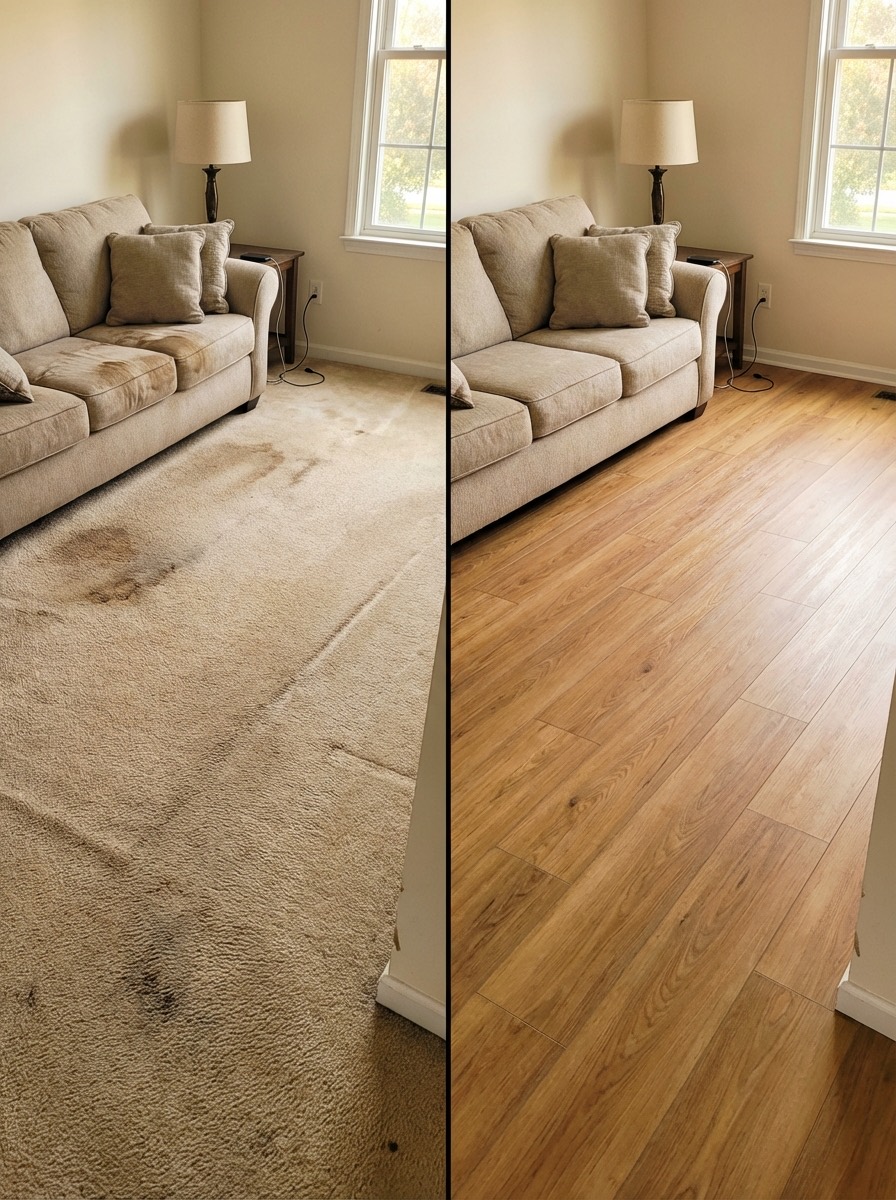
The short answer
Quick answer
Start with the room conditions. For a three-season sunroom, porcelain tile is usually the first material to evaluate; a rigid vinyl plank can also fit when the exact product is approved for the room's temperature range and installed over the right base. For a four-season room that stays conditioned, LVP, engineered hardwood, laminate, and tile may all be options. Direct light, water exposure, subfloor type, and the written product limits decide the final choice.
Classify the sunroom first. If the room stays within the product's written temperature range and a wood-look floor fits the conditions, compare the details on our LVP installation service. Tile and hardwood remain separate choices when the room conditions support them.
Almost every "best flooring for a sunroom" article gives you a material list and skips the fact that decides whether the list applies. A sunroom is not automatically the same as a living room. Depending on how it is built and used, temperature, direct light, tracked-in water, and the base below the floor can narrow the options. Get the room type right first, then compare the material and its written installation limits.
First question: is it heated year-round?
Quick answer
A three-season sunroom is not tied into your home's heating and cooling, so its temperature and humidity can follow the weather outside. A four-season sunroom is insulated and conditioned like the rest of the house. Unconditioned rooms need products whose written temperature, moisture, and installation limits match the room. Conditioned rooms generally allow more choices.
Before you look at a sample, identify how the room is conditioned. A three-season room usually has large windows or screens, limited insulation, and no dedicated HVAC. A four-season room is insulated and conditioned with the house. In an unheated room the floor sees a wider seasonal range, so the product documentation and installation details become stricter. In a conditioned room the options widen. Confirm that difference before choosing a material.
What a sunroom does to a floor
Quick answer
Three forces hit a sunroom floor that a normal room never sees: direct sun that fades color, big temperature swings that make floors expand and contract, and moisture from condensation, plants, and doors to the outside. Solid wood and laminate handle these poorly. Tile and rigid vinyl handle them well. The more the room swings, the fewer floors survive it.
Three things make a sunroom harder on a floor. Direct light can change color over time, and the product's light-resistance guidance matters. Temperature changes make flooring expand and contract, which is why acclimation and perimeter clearance must follow the selected product. Moisture can come from condensation, plants, or an exterior door. Put those together and a floor approved for a conditioned bedroom may not be approved for the sunroom.
💡 Key takeaway
The colder and hotter your sunroom gets, the shorter your list of safe floors. A fully heated four-season room can take almost any floor. A truly unheated three-season room realistically comes down to porcelain tile or a good rigid vinyl. Match the floor to how much the room actually swings, not to what looks nice in the showroom.
Every material, ranked for a sunroom
Quick answer
Porcelain tile is the top all-around sunroom floor. Rigid SPC vinyl plank is the best-value pick and fine for most rooms. Engineered hardwood and laminate work only in a heated four-season room. Indoor/outdoor carpet suits a low-traffic lounge. Solid hardwood is a no in any sunroom. Below is the quick verdict on each.
| Material | Three-season (unheated) | Four-season (heated) | Watch out for |
|---|---|---|---|
| Porcelain tile | Best choice | Great | Cold underfoot, hard; use a slip-rated finish |
| Rigid SPC vinyl (LVP) | Good, if rated for the temp range | Great | Needs full acclimation + a real expansion gap |
| Engineered hardwood | Risky, not recommended | Good | Sun fade; keep humidity stable |
| Laminate | No | OK | Swells at the seams if it ever gets wet |
| Indoor/outdoor carpet | OK for a light-use lounge | OK | Traps grit and moisture in a busy room |
| Solid hardwood | No | No | Cups, gaps, and fades; the wrong room for it |
The pattern is clear once you see it. The floors that win in a sunroom are the ones that do not care about moisture and move very little with temperature: porcelain tile, which is basically stone, and rigid SPC vinyl, whose stone-composite core barely expands. The floors that struggle are the ones made of wood or paper that swell, shrink, and fade: solid hardwood, laminate, and to a lesser degree engineered wood. Carpet sits off to the side as a comfort choice for a quiet, lightly used room. We break down the vinyl-versus-tile call in detail in our LVP vs tile guide, and the SPC-versus-WPC vinyl difference in our WPC vs SPC guide.
Best for a three-season (unheated) sunroom
Quick answer
Evaluate porcelain tile first for a truly unconditioned room because it handles water and temperature change differently from wood-based products. Rigid SPC vinyl can be the next option when the exact product is rated for the room and installed with the required expansion space. Confirm the product and substrate instead of relying on the category name alone.
For an unheated sunroom, keep the list short. Porcelain tile is often the first material to assess, but the substrate, movement joints, finish, and installation system still matter. We compare porcelain and ceramic in our porcelain vs ceramic guide. Rigid SPC vinyl plank can be warmer underfoot, but it must be a product whose documented temperature range permits the room. Acclimation and perimeter clearance follow that product's instructions. Skip those details and a floating floor can buckle. Our acclimation guide explains the underlying decision.
Best for a four-season (heated) sunroom
Quick answer
A fully heated and cooled sunroom behaves like any other room, so you can use engineered hardwood, quality LVP, laminate, or tile. Match the floor to the rest of the house so it flows straight through. The only sunroom-specific issue left is sun fade, so lean toward lighter colors or add a UV-blocking shade or film on big south-facing windows.
If your sunroom is insulated and on the HVAC, the hard part is over. It holds normal indoor conditions, so the same floors that work in your living room work here. Engineered hardwood is now a fine option and lets you carry the same wood look straight through from the adjoining room, which is often the goal. Quality LVP and laminate both work too. Tile is still great if you want it. At that point the choice is about matching the rest of your home, and we can run the new floor right up to the threshold with a clean transition, covered in our room transitions guide. The one issue that does not go away is sun. Even a conditioned sunroom gets far more direct light than a normal room, so fading is still in play. Lighter floors hide fade better than dark ones, and a solar shade or a UV-blocking window film protects any floor. The wear layer on your vinyl matters here too; our wear layer guide explains what to look for.
The warranty trap nobody warns you about
Quick answer
Some LVP, laminate, and engineered hardwood warranties limit use to stated temperature, humidity, substrate, and acclimation conditions. An unheated sunroom can fall outside those terms. Check the exact product warranty and installation instructions before choosing it for the room.
Read the warranty and installation instructions for the exact product. Many vinyl, laminate, and engineered wood products specify indoor temperature, humidity, substrate, and acclimation conditions. If an unheated sunroom falls outside those written conditions, the product may not be covered for that use. That is why a category claim such as "waterproof" cannot answer the sunroom question by itself. The quote should name the product and confirm that its documented limits fit the room.
⚠ Watch out
"Waterproof" on the box is not the same as "rated for a sunroom." Waterproof means the plank survives a spill. It says nothing about surviving freeze-to-bake temperature swings or keeping its warranty in an unconditioned room. Those are separate ratings. If a salesperson says a floor is fine for your unheated sunroom, ask them to show you that in the written warranty before you buy.
What it costs installed in the DMV
Quick answer
At Potomac, luxury vinyl plank and laminate run $6.50 per square foot all-in, and carpet is $3.25, each including material, install, and old-floor removal. Tile is quoted per project because the tile, layout, substrate, prep, and room conditions change the scope.
Sunroom pricing follows the same all-in model we use everywhere: one number that covers the material, the professional install, and hauling away the old floor, with no surprise line items at the end. Rigid luxury vinyl plank is $6.50 per square foot all-in and is one material to evaluate when the selected product fits the room conditions. Laminate is also $6.50 and carpet is $3.25, though each needs more caution in an unheated room. Tile is quoted per project because the tile, layout, substrate, prep, and room conditions change the scope. The written estimate gives the real number after we inspect the room. We spell out how we avoid hidden charges in a separate guide.
DMV sunrooms: slabs, crawlspaces, and sun
Quick answer
A DMV sunroom may sit on a concrete slab or a framed floor over a crawlspace, and the actual base changes the prep. A slab may need moisture evaluation and the right tile substrate. A framed floor needs its structure, moisture control, and product movement requirements checked. That is why the heated-versus-unheated question and an on-site inspection come first.
The base changes the plan. A concrete slab may need moisture testing and the installation system must fit the measured conditions; we cover that decision in our engineered wood over concrete guide. A framed floor over a crawlspace needs its structure, moisture control, and product movement requirements checked. An unheated room can also see wider seasonal temperature and humidity changes than the conditioned house. Those conditions can contribute to cupping, gaps, or buckling when the product or installation system does not fit; see our buckling and cupping guide and winter gaps guide. If the sunroom also serves as a mudroom, include tracked water and grit in the material decision, as you would for a basement.
FAQs about sunroom flooring
What is the best flooring for a sunroom?
Porcelain tile is often the first material to assess for an unconditioned sunroom. Rigid SPC vinyl plank can be a warmer alternative when the selected product is approved for the room's conditions. In a fully conditioned four-season room, engineered hardwood, LVP, laminate, and tile may all be options.
Can you put hardwood floors in a sunroom?
Solid hardwood is a poor choice for any sunroom. The temperature and humidity swings make it cup and gap, and direct sun fades it. In a fully heated, insulated four-season sunroom, engineered hardwood is a reasonable option because it is more stable. In an unheated three-season room, skip real wood entirely and use tile or rigid vinyl.
Will sun fade my sunroom floor?
Direct light can change flooring color over time. The amount depends on the product, exposure, glass, and room orientation. Compare the manufacturer's light-resistance guidance and use shades or suitable window treatments when exposure is high.
Is vinyl plank good for a sunroom?
Rigid SPC vinyl plank is a good sunroom floor when it is the right product. Its solid stone-composite core barely expands with temperature, so it handles swings better than flexible vinyl or laminate. It must be rated for the temperature range, acclimated in the room, and installed with an expansion gap at every wall. Check the warranty for unheated-room terms.
Do flooring warranties cover sunrooms?
It depends on the exact product. Some vinyl, laminate, and engineered hardwood warranties require stated temperature, humidity, substrate, and acclimation conditions. An unheated three-season sunroom can fall outside those terms. Read the product warranty and installation instructions before buying flooring for the room.
What flooring is best for an unheated three-season sunroom?
Porcelain tile is often the first material to assess for an unheated sunroom. Rigid SPC vinyl can be the next option when the exact product is rated for the room, acclimated as required, and installed with the specified expansion space. Wood-based products and standard carpet need more caution where the room tracks outdoor conditions.
Bottom line
The best sunroom floor starts with the room conditions: HVAC, direct light, water exposure, substrate, and how the room is used. A conditioned four-season room allows more choices. An unconditioned room narrows the list to products whose written limits match the space. Start with luxury vinyl plank when you want a wood-look floor, compare tile for the more exposed room, and use hardwood only where the actual product and conditioned room support it. Request a free in-home estimate so the room and subfloor can be checked before the material is locked in.