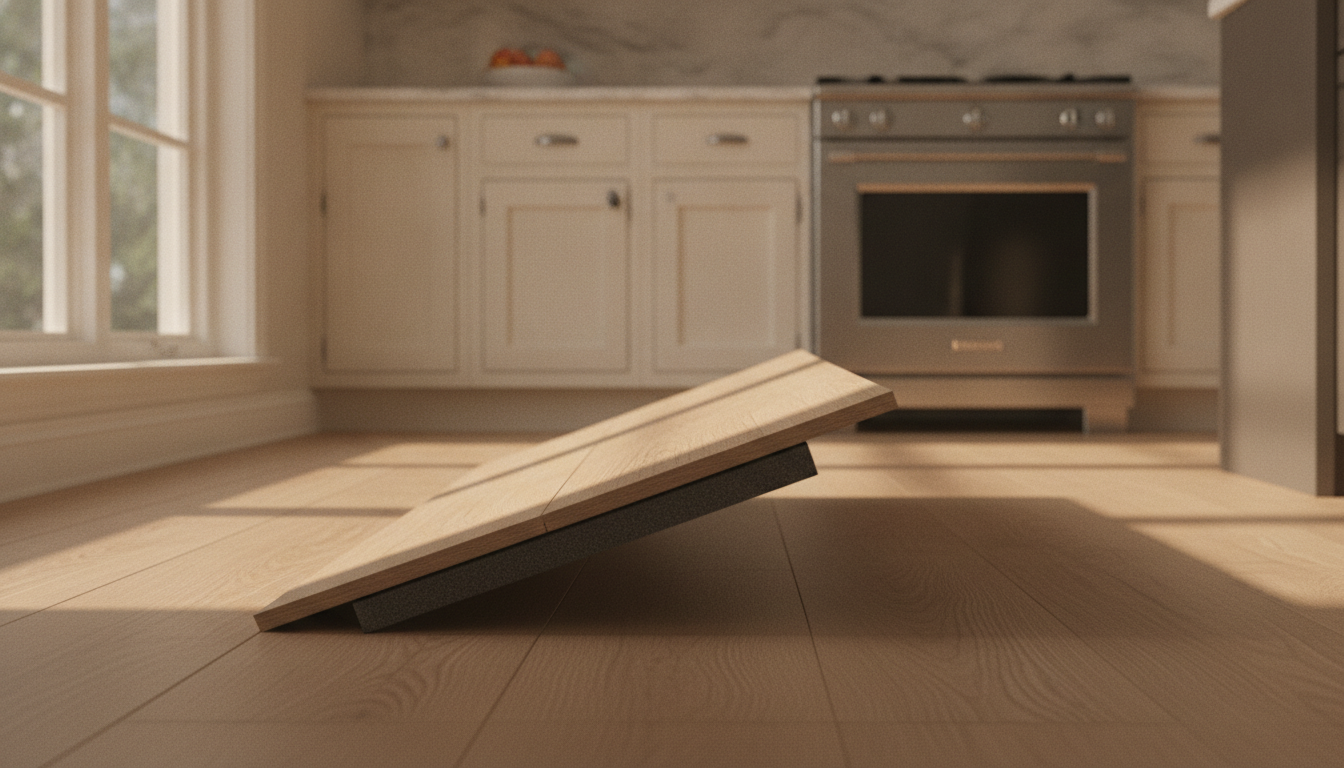
The wear layer is the single most over-marketed spec in luxury vinyl plank flooring, and it is also the spec that most determines how the floor looks at year 10. Both things are true. Walk into Floor and Decor and the 28-mil products are positioned as the only serious choice. Open a builder's spec sheet and you find a 6-mil wear layer on the same brand. Somewhere between those two extremes is the right answer for your room, and that answer is rarely the most expensive option.
This is the working guide Potomac Floors gives DMV homeowners during the consultation. We install LVP in Alexandria, Arlington, Fairfax, Tysons, Reston, and across the broader DMV every week. Below is what each tier of wear layer actually does, where we install which one, where the marketing oversells, and the per-room spec we put on most of our quotes.
The short answer by room
Quick answer
For a typical DMV home in 2026: 20-mil wear layer in kitchens, entryways, mudrooms, hallways, and main living areas. 12-mil is honest and enough in bedrooms, dens, closets, and any low-traffic upstairs room with no dogs. 28+ mil belongs in light commercial (small offices, retail) and high-end rentals with documented heavy turnover, not the average DMV house. The 6-mil products you see at the bottom of the big-box shelf are builder-grade and we do not install them in occupied homes. The right wear layer matters more than the brand on the box.
If you take nothing else from this piece: pick the wear layer by the room, not by the marketing tier. A 12-mil LVP in a guest bedroom outperforms a 28-mil LVP in a kitchen, because the room decides how the floor lives. The most expensive wear layer in your master bedroom is wasted; the cheapest in your kitchen fails inside five years.
What the wear layer actually is (and how it fails)
Quick answer
The wear layer is a clear, transparent PVC film fused to the top of the plank, between you and the printed wood-look design layer underneath. Its only job is to take scratches, scuffs, and abrasion so the design layer below stays untouched. It is measured in mils (one mil equals one thousandth of an inch, 20 mil is half a millimeter). When the wear layer fails, you do not see a scratch in the wear layer itself; you see the printed pattern start to lose color, dull out, or show through to the lighter PVC below. At that point the floor is cosmetically done and no refinishing recovers it.
The LVP stack from top to bottom: a clear PVC wear layer (the spec everyone talks about), a printed film with the wood or stone pattern, a rigid core (SPC stone-polymer or WPC wood-polymer), and usually an attached pad on the bottom. The wear layer is the only piece that touches your shoes, your chair legs, your dog's nails, and the dirt you track in. Everything else is design or structure.
The failure mode is gradual and looks like the floor is "fading." That is not really what is happening. The wear layer is thinning from abrasion (millions of footsteps over years), and at some point it is too thin to refract light correctly, so the design layer reads dull. By the time you notice, the wear layer is mostly gone in the traffic path. The fix is replacement, not repair. Unlike hardwood, you cannot sand and refinish LVP, which is a big part of how long a vinyl plank floor actually lasts. The full LVP-vs-hardwood lifetime calculation is in our LVP vs hardwood lifetime cost piece.
The mils number is the only honest comparison metric across brands. Marketing terms like "extra-tough" or "diamond-coated" or "advanced wear" are noise. Two products at the same mil rating perform within a small margin of each other regardless of brand, assuming both are reputable manufacturers. A premium-brand 12-mil and a value-brand 12-mil last roughly the same number of years in the same room. Brand matters for the core, the pattern realism, and the warranty enforcement, not the wear layer itself.
The four tiers: 6, 12, 20, and 28+ mil
| Wear layer | Realistic lifespan | Right use | Per-sqft material premium |
|---|---|---|---|
| 6 mil (0.15 mm) | 3-5 years in a home, 1-2 years in a rental | Builder spec only. Flips, ultra-low-budget rentals | Cheapest, $0.50-$1.00/sqft material |
| 12 mil (0.3 mm) | 8-12 years in low-traffic, 5-7 in moderate | Bedrooms, dens, closets, low-traffic upstairs | $1.50-$2.50/sqft material |
| 20 mil (0.5 mm) | 15-20 years in residential, 10-12 in rental | Kitchens, entries, hallways, main living, pet households | $2.50-$3.50/sqft material |
| 28 mil and above (0.7 mm+) | 20-25 years residential, 15+ in commercial | Light commercial, high-end rentals, dog kennels, mudrooms with three large dogs | $3.50-$5.50/sqft material |
The 6-mil tier is what shows up under "$2.99/sqft installed" big-box financing promotions. It exists, it gets installed in flips and new-construction builds where the buyer never sees the spec sheet, and it shows wear inside 3 years in a normally-occupied DMV home. We do not install it in homes people are living in. The math does not work and the call-back is guaranteed.
The 12-mil tier is honest mid-range LVP and the unsung default for most of a typical home. It is what most reputable mid-tier brands ship as their core residential product. In a bedroom where the only foot traffic is a sock-foot walk from the bed to the door, a 12-mil wear layer outlasts the homeowner's interest in the color. We install 12-mil happily and a 12-mil install with a good SPC core in the right room is not a compromise.
The 20-mil tier is the genuine workhorse and where most of our DMV LVP installs land. It survives kitchen drops (a cast-iron pan corner hitting the floor leaves a dent in any LVP, but the wear layer keeps the dent from also being a tear). It survives entry-way grit (the abrasive winter sand and salt that comes in on shoes is the single biggest wear-layer killer in the DMV climate). It survives dogs that are not actively destructive. It is the right choice in any room where life happens.
The 28-mil-and-above tier is where the marketing gets aggressive and the actual need gets thin. It is genuinely useful in a handful of cases. A small dental office reception area, a vacation rental with a 50+ percent annual turnover rate, a mudroom that serves as a primary entry for a household with three large active dogs. In a typical DMV single-family home it is overspecified. You pay $1 to $2 per square foot more, and in residential use the wear layer outlasts the design layer's appeal. You replace the floor because the color no longer fits the redecorated room, not because the wear layer wore through.
Key takeaway
If you are quoted 28-mil throughout a 2,000-sqft house, that is roughly $2,000 to $4,000 of extra material cost over the 20-mil version of the same product. In a typical DMV home, that money is better spent on a thicker core (going from a 4 mm to a 5.5 mm SPC) or a better acoustic underlayment than on extra wear-layer thickness you will never use.
What we install by room across the DMV
| Room | Wear layer we spec | Why |
|---|---|---|
| Kitchen | 20 mil | Grit, drops, water spills, sliding chairs at the island stool |
| Entry / foyer / mudroom | 20 mil (28 mil if 3+ large dogs) | Outside grit is the single biggest abrasive load in any DMV home |
| Main hallway | 20 mil | Traffic concentration. The path from front door to kitchen wears 3-5x the rest of the floor |
| Living room / family room | 20 mil | Furniture moves, kids play, sometimes shoes stay on |
| Dining room | 12 mil | Chair-leg sliders solve the wear problem cheaper than a thicker top coat |
| Bedrooms (master + secondary) | 12 mil | Sock-foot traffic only; 20 mil is wasted spend |
| Closet / walk-in | 12 mil or matched to bedroom | Visual continuity matters more than spec |
| Home office / den | 20 mil if rolling chair, 12 mil if not | The chair caster is the wear-layer killer, not the foot traffic |
| Basement living area | 20 mil | Subfloor often less than ideal. See the basement piece |
| Bathroom (LVP not the first pick. See notes) | 20 mil minimum if you go LVP | Water-edge intrusion is the real failure mode, not wear |
| Laundry / utility | 20 mil | Appliance vibration, occasional water |
| Stairs | 20 mil minimum, glued tread treatment | Edge wear on stair noses is the highest-stress point in any LVP install. See the stairs piece |
The mixed-tier approach is what professional installers actually do and is rarely what gets quoted by a sales-led showroom. Quoting "20 mil throughout" is easier to write up and pads the ticket. Quoting "20 mil in the kitchen, hallway, entry, and living room; 12 mil in the bedrooms and dining" saves the homeowner $800-$1,500 on a typical 1,800-sqft install with no functional downside. We do this on every LVP quote where the homeowner asks for honesty over upsell. The full LVP install pricing context across DMV unit sizes is in our vinyl plank installation cost piece.
The two exceptions to the table. First, basements with documented moisture history (the older Annandale, Falls Church, and Arlington split-levels where the perimeter drain has worked overtime) get the highest-rated SPC core regardless of wear layer. The failure mode is the core swelling, not the surface wearing. Second, rentals override the entire table. See our rental flooring piece for the 20-mil minimum we install everywhere in a rental.
What a thick wear layer doesn't protect against
Quick answer
The wear layer only protects against abrasion (footsteps, sliding objects, dragging). It does not protect against: dents from hard impact (a dropped wrench or cast-iron pan leaves an impression in any LVP), gouges from sharp dragging (a screw stuck in a chair leg cuts through 28 mil same as 12), water intrusion at the seams (the core's job, not the wear layer's), UV fading of the printed layer (which is mil-independent), and any subfloor imperfection telegraphing through (which is a core and underlayment problem). A thicker wear layer fixes none of these. People expect more from the wear-layer spec than it can deliver.
The dent issue is the one that surprises homeowners most often. LVP across every tier is a relatively soft floor. The SPC core is denser than WPC but neither one resists point-impact the way ceramic tile or solid hardwood does. A 28-mil top layer over a 4-mm SPC core dents the same as a 12-mil top layer over the same core, because the dent is the core compressing under the impact, not the wear layer giving way. If you drop a heavy item on LVP, you get a small permanent depression regardless of which wear layer you bought.
The gouge issue is the second surprise. The wear layer is clear PVC, not armor. A sharp point under load (a screw, a small nail, a hard piece of debris stuck in a chair caster) cuts through any wear layer in residential use. The 28-mil takes maybe slightly longer to fail and the visual is the same once it fails: a thin white-edged line in the floor where the design layer is exposed.
Water intrusion is core-territory, not wear-layer territory. The LVP's waterproof claim is the click-lock joint plus the SPC or WPC core, neither of which is the wear layer. If your seams are not tight (most often from an install that did not account for subfloor flatness within manufacturer tolerance, or did not respect perimeter expansion), water finds the joint and the wear layer thickness above it does not matter. The laminate buckling piece covers the parallel failure mode in laminate, which behaves similarly at the joint level.
UV fading of the printed design is a separate spec that gets confused with wear-layer thickness. Quality LVP includes UV inhibitors in the wear layer specifically (some brands tier the inhibitor with the wear layer, others bake it in at the same concentration across tiers. Read the spec sheet). If your kitchen has a south-facing sliding door and your LVP fades there over 8 years, that is UV, not wear. A 28-mil wear layer with poor UV protection fades faster than a 12-mil with good UV protection.
Warranty math: what manufacturers actually cover
Quick answer
LVP residential warranties typically read "25 years" or "lifetime" on premium tiers, but the covered failure is narrow: wear-through of the wear layer (the printed pattern visibly worn down to the core) under documented normal use. They do not cover dents, scratches from sharp objects, fading from UV, water damage from improper install, or labor to remove and replace. The realistic warranty payout on a covered claim is the material cost of the failed planks (usually 5 to 15 percent of the original purchase), prorated against years of use. In practice, almost nobody collects on these.
The 25-year-residential warranty on a 20-mil product looks like meaningful insurance and is mostly marketing. The conditions to collect typically include: original purchase receipt, original install by a "qualified installer" with proof, documented normal residential use, the failure being wear-through (not damage), and a manufacturer's inspection that often concludes the issue is install-related (perimeter expansion, subfloor variance, or moisture) and therefore excluded.
The exclusions list runs long and excludes most real-world failures. Pet damage: generally excluded. Furniture impressions: excluded. Subfloor variance causing seam separation: excluded. Improper acclimation: excluded. Water damage from any source other than direct manufacturer defect: excluded. The honest read on most LVP warranties is that they cover the rare case where the wear layer manufactures defectively and shows premature wear in a low-traffic room, which is also the case that almost never happens.
The practical implication: pick the wear layer based on expected real-world performance, not on the years-of-warranty number on the box. A 20-mil with a "25-year warranty" and a 28-mil with a "lifetime warranty" perform within a percentage of each other in the same room. The warranty tier difference is mostly the marketing tier difference. We have never seen a residential LVP warranty claim get paid out at meaningful value in our shop. Plan to buy the floor that lasts in your room, not the warranty.
Marketing traps: when 28 mil is overkill and 12 mil is being upsold
Quick answer
The big-box and showroom playbook is to anchor on 28 mil as "premium" and 12 mil as "starter," skipping the honest middle (20 mil). The downward trap is the opposite. A builder or flipper quotes a single low number (often 6 or 8 mil) and frames it as "luxury vinyl" without distinguishing tiers. Both traps work because most homeowners are not given the comparison table above. The honest middle answer (20 mil in wet/high-traffic, 12 mil in bedrooms) is what gets quoted last because it ends in a smaller ticket.
The "all-28-mil" upsell is the most common trap in dedicated flooring showrooms. The math: a sales associate working on commission ships a 2,000-sqft house at $4.50 sqft material instead of $3 sqft material, $3,000 more in the ticket. The performance argument ("28 mil lasts longer") is technically true and practically irrelevant in 60 percent of the home (the bedrooms, the dining, the closet, the den), where a 12 or 20 mil wear layer outlasts the homeowner's color preference anyway. Push back: ask the showroom to quote a mixed-tier spec by room. Reputable installers will. Sales-led showrooms often will not.
The "6-mil under luxury vinyl labeling" trap is the builder-flipper side of the market. A new-construction home or a flip is quoted "luxury vinyl plank flooring" with no wear-layer spec listed. The wear layer is 6 or 8 mil and the floor starts showing wear inside 18 months in the kitchen and entry. The buyer assumes LVP failed; the actual failure is the spec, not the category. Before buying a flipped or new-construction home, ask for the LVP wear-layer spec in writing.
The "thicker is always better" framing ignores the more important spec under the wear layer. The core thickness. A 28-mil wear layer over a 4-mm SPC core is a worse floor than a 20-mil wear layer over a 5.5-mm SPC core, because the core determines how the floor feels underfoot, how it bridges subfloor imperfections, and how it transmits sound to the unit below. The WPC vs SPC piece covers the core decision; the wear layer rides on top of whatever core you pick.
The attached-pad question (different from the wear layer)
Quick answer
The attached pad (the 1 to 2 mm IXPE foam stuck to the bottom of most LVP planks) is a separate spec from the wear layer and people conflate them. The attached pad does a small amount of acoustic dampening (3 to 6 IIC points), a small amount of underfoot comfort, and a small amount of subfloor-imperfection forgiveness. It is not an acoustic underlayment. On a slab in a single-family home it is fine. On an upstairs apartment unit you need a real acoustic underlayment on top. See the apartment flooring piece. On a basement install you usually need a moisture barrier separately. The attached pad solves none of these problems on its own.
This is the spec confusion we see most often during consultations. A homeowner reads "20-mil wear layer, attached pad" on the box and assumes one or both will handle sound, moisture, and feel. The wear layer handles abrasion only. The attached pad handles a small slice of comfort and acoustics. Everything else is a separate decision about underlayment, moisture barrier, and subfloor prep. The cork vs foam vs rubber underlayment piece covers when you need a real acoustic underlayment on top of the attached pad.
One useful corollary: pad-attached LVP is not strictly better than non-pad-attached. The attached pad means you cannot easily change the underlayment, which can be a problem on a basement install where a 6-mil poly moisture barrier is required by the manufacturer and the attached pad conflicts with it. We sometimes specify non-pad-attached LVP for basement projects specifically so we can lay down the moisture barrier directly.
FAQs about LVP wear layers in DMV homes
Is 12-mil LVP really fine in bedrooms, or am I cheaping out?
Genuinely fine. A bedroom in a normal DMV home sees sock-foot traffic from one or two people per night. The abrasive load is roughly one percent of what the kitchen sees. A 12-mil wear layer in that environment outlasts the bed frame. We install 12-mil in bedrooms on quotes where the homeowner asks us to spec by room, and we have not had a wear-layer callback on a bedroom 12-mil install yet.
What wear layer do I need if I have a large dog?
20 mil is fine for one or two large dogs in a normally-occupied home. The 28-mil bump is justified when you have three or more large active dogs that spend most of their day on the floor (working dogs, kennels, breeders). Dog claws scratch the wear layer over time but do not gouge it under normal nail-trim conditions. The bigger issue is the dirt the dogs track in, which is solved by a mudroom mat and a quarterly broom of the entry path. Pet-friendly flooring specifics are in our pet-friendly flooring piece.
Can I refinish or restore a worn wear layer?
No. LVP cannot be sanded, refinished, or recoated. Once the wear layer is worn through to the design film, the only fix is plank replacement. This is the most important durability difference between LVP and hardwood. Hardwood can be refinished 3 to 5 times across a 50-year span. LVP gets one life, however long the wear layer lasts. The full lifetime comparison is in our LVP vs hardwood lifetime cost piece.
Does a higher wear layer mean more scratch resistance from chair legs?
Marginally. Chair-leg scratches happen because there is dirt or a sharp particle under the leg, not because the chair itself is sharp. Adding felt sliders to every chair leg eliminates 90 percent of chair-leg scratches regardless of which wear layer you bought. Spending an extra $1,200 on 28-mil wear layer instead of buying $40 of felt sliders is the wrong investment.
What's the difference between "wear layer" and "AC rating"?
AC rating (AC1 through AC5) is a laminate spec, not an LVP spec. Laminate uses a different surface technology (an aluminum oxide coating over a melamine-impregnated paper layer) and rates abrasion resistance on a different scale. LVP uses mil thickness on a clear PVC layer. They are not directly comparable. If a salesperson uses AC ratings to describe an LVP product, they are conflating two different categories.
How do I check the wear layer spec on LVP I already own?
The original purchase paperwork (invoice or contract) should list it explicitly. Failing that, the manufacturer's website usually publishes the spec by SKU. Find the brand and product name on the back of a leftover plank (most installs leave a few planks in the basement or garage) and look it up. If nothing is documented, you can sometimes infer from the plank thickness: a 5-mm or thicker plank is usually 20 mil; a 4-mm or thinner plank is usually 12 mil or below. Not a perfect rule but a useful first guess.
Should I match the wear layer across the whole house for resale?
Real-estate impact of wear-layer spec is small. Buyers respond to the visual (color, plank width, finish realism) and the brand name on the disclosure form. Wear-layer spec by room rarely surfaces in a typical home inspection. The bigger resale move is consistent color and plank style across the open floor plan; mixed tiers in hidden rooms (bedrooms, closet) do not register.
Bottom line: the wear layer we spec on most DMV jobs
The default Potomac Floors LVP spec for a typical DMV single-family home in 2026: 20-mil wear layer in the kitchen, entry, hallway, main living areas, mudroom, and any room with a rolling chair; 12-mil wear layer in bedrooms, dining, closets, and low-traffic upstairs rooms. SPC core at 5 to 5.5 mm for slab installs, 5 to 6 mm for wood-joist installs. Attached 1-mm IXPE pad for the small acoustic and comfort lift. Float installed with proper perimeter expansion. All-in pricing $6.50 per square foot across the mix, no separate charges for the 20-mil rooms versus the 12-mil rooms (we average the spec into the quote).
The mixed-tier approach is rarely offered because it requires the installer to think about your house rather than ship a single SKU. The savings are real on most installs, typically $800 to $1,500 versus the "20-mil throughout" upsell, and $2,000 to $4,000 versus the "28-mil throughout" premium quote. Performance in every room matches or beats the higher-cost single-tier alternative because the wear layer is matched to actual traffic, not to a salesperson's commission structure.
If you are getting LVP quoted in the DMV and want a spec-by-room quote rather than a single-tier upsell, call us and ask for the mixed quote. We will walk every room with you, identify the traffic and the use, and write the spec on the invoice. Same all-in pricing model. Material, install, demo and removal of the existing floor, and the quote you sign is what you pay.
Related reading: the vinyl plank installation cost piece covers all-in LVP pricing across DMV home sizes. The WPC vs SPC vinyl plank piece covers the core-construction decision that sits under the wear layer. The LVP vs hardwood lifetime cost piece covers when LVP is the right answer versus going hardwood. The flooring-quote hidden charges piece covers the other lines on a quote where margin gets hidden. And the rental flooring piece covers the 20-mil rental override.