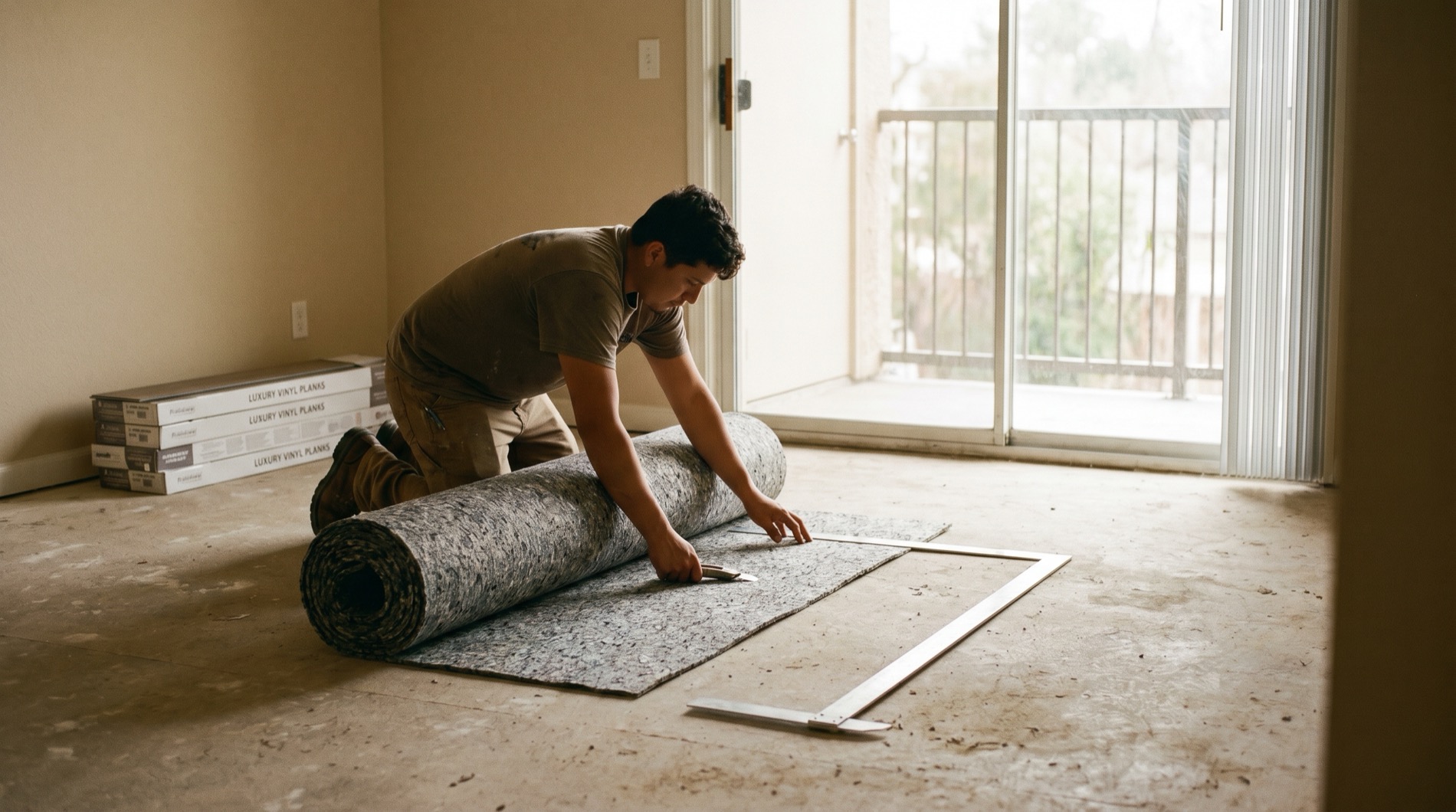
If a tenant in your upstairs unit is filing noise complaints about the unit below them, the math has already turned against you. Most Northern Virginia leases and most HOA governing documents put the responsibility for impact-noise mitigation on the landlord, not the tenant. The longer the complaint sits unresolved, the more leverage the downstairs neighbor accumulates, and in the worst case you end up paying to replace flooring you already installed once.
This is the working answer we give DMV landlords who call us after a complaint has surfaced or when they are planning a unit refresh between leases and want to fix the noise problem before it starts. Potomac Floors installs in apartment buildings, stacked townhomes, and rental condos across Alexandria, Arlington, Fairfax, Tysons, and the broader DMV every week. The spec below is what we install on rental upstairs units, what it costs per unit, and why it holds up through tenant turnover.
The short answer for DMV landlords
Quick answer
For a DMV rental upstairs unit, the spec that resolves a noise complaint and survives tenant turnover is SPC luxury vinyl plank floating over a rated acoustic underlayment (cork or rubber, IIC delta of 20+), installed with proper perimeter expansion and a continuous transition seal. All-in cost runs $6.50 to $7.50 per square foot at Potomac Floors, or roughly $4,500 to $7,500 for a typical 1BR or 2BR unit. Carpet is quieter at day one but loses on lifetime cost by the second tenant. Avoid: glued or nailed-down installs, generic foam underlayment, and any LVP product without a documented IIC test report.
The cheap mistake landlords make is treating the floor as a single decision. The floor that passes a tenant noise complaint is not one material. It is a layered assembly. The plank on top, the acoustic underlayment underneath, the perimeter detailing at walls and transitions, and the install method itself all matter. Get the layer right and you pass an IIC 50 review with mid-grade LVP. Get it wrong and you can install premium hardwood and still fail the inspection.
When a tenant noise complaint becomes the landlord's problem
Quick answer
Most DMV leases (and most condo/HOA documents that cover rentals) put the responsibility for the unit's flooring assembly and its impact-noise performance on the owner, not the tenant. The tenant did not choose the floor, so they cannot be asked to fix it. Once a complaint is documented, the typical path is: HOA or property manager issues a notice, owner has 30 to 60 days to bring the floor up to the building's flooring rule, and the owner pays for the upgrade. Ignoring a documented complaint is how landlords end up tearing out a perfectly good hardwood install and replacing it at full cost.
This is the part landlords get wrong most often. The lease covers tenant behavior (no parties past 11pm, no removing carpet, no installing personal flooring). The lease does not cover the building's flooring assembly. That belongs to the owner. When a downstairs neighbor in a condo or stacked townhome submits a written impact-noise complaint, the HOA or property manager almost always routes it to the unit owner, because the building's governing documents name the owner as responsible for compliance.
The escalation path is consistent across DMV buildings we work in. First complaint goes informal. Second complaint goes in writing. By the third documented incident, the HOA's flooring rule is invoked, which typically requires hard-surface floors to meet a minimum IIC rating (almost always 50 or 55) measured at the field assembly, not just the manufacturer's lab number. The owner has 30 to 60 days to either prove the existing floor meets the rule or replace it with one that does. If you can't produce documentation showing your floor meets the rating, the only practical option is to install one that does and keep the paperwork.
Key takeaway
If you bought a DMV rental condo with hardwood already installed and no documentation of the underlayment beneath it, you are one tenant complaint away from a forced replacement. Get the paperwork or budget for the upgrade. This is the single most common scenario that drives a rental flooring call to our shop.
The IIC 50 spec: what it means and why it's the practical floor
Quick answer
IIC stands for Impact Insulation Class. It measures how much footstep, dropped-object, and dog-claw noise the floor assembly blocks from passing through to the unit below. Higher numbers are better. The widely-used DMV minimum for hard-surface flooring over an occupied unit is IIC 50, with many newer buildings (Tysons, Reston town-center high-rises, downtown DC conversions) requiring IIC 55 or 60. Achieving IIC 50 on a wood-joist floor without acoustic underlayment is nearly impossible; with a rated cork or rubber underlayment, mid-grade SPC LVP gets you there at reasonable cost.
The Impact Insulation Class number is the rating that decides whether a rental upstairs unit's floor is compliant. The full breakdown of IIC versus the separate STC (airborne sound) rating is in our soundproof flooring for condos and townhomes piece, which is the owner-occupant companion to this article. The short version for landlords: IIC is the one that matters, because footsteps and dropped objects are what drive tenant complaints. STC matters for voices and TV but is mostly a function of the building's wall and ceiling construction, which you cannot change.
The IIC scale runs from roughly 25 (untreated wood subfloor. Every footstep audible below) to 70+ (concrete slab with multiple isolation layers. Essentially silent). IIC 50 is the practical threshold most DMV buildings settle on because it correlates to the point where a normal-volume footstep stops being clearly audible in the unit below. IIC 55 is noticeably quieter. IIC 60 starts to feel like a single-family home.
The honest part most product brochures gloss over: the IIC number printed on a flooring product's spec sheet is a lab rating measured over a concrete slab in ideal conditions. The field rating (what the floor actually performs at when installed in a wood-joist apartment building) is typically 5 to 10 points lower. So if the HOA rule says IIC 50 minimum field rating, you need a lab-rated assembly closer to IIC 55 to 60 to comfortably pass. This is where the acoustic underlayment carries most of the work.
The landlord stack that passes review: LVP plus rated underlayment
Quick answer
The assembly we install on DMV rental upstairs units, in order from subfloor up: existing structural subfloor (do not modify), a 3 to 5 mm cork or recycled-rubber acoustic underlayment with a documented IIC delta of 20 points or higher, a 5 mm SPC luxury vinyl plank with a 20-mil wear layer and an attached 1 mm IXPE pad, floated with proper expansion gaps at every perimeter and a continuous silicone seal at the wall transition. Lab-rated IIC of this stack ranges from 65 to 72; field-rated comes in at 55 to 62, which clears the typical 50-rating HOA minimum with margin.
The reason this specific stack works on rentals (and not, say, glued hardwood with a foam pad) is that every layer is doing a specific job and none of them can be skipped. The acoustic underlayment dissipates impact energy before it reaches the subfloor. The floating LVP install means there is no rigid bridge between the plank and the structure, so footstep vibration cannot transmit through a fastener. The perimeter expansion gap and the silicone seal at the wall prevent flanking noise (sound leaking around the floor edge instead of through it). Remove any one of those and the field-rated IIC drops by 5 to 10 points.
The acoustic underlayment is where landlords often try to save money and where the math breaks. A standard 2 mm IXPE foam pad (the kind that ships attached to most LVP) provides an IIC delta of about 8 to 12 points. A 3 mm cork underlayment provides 18 to 22. A 5 mm recycled-rubber underlayment provides 22 to 26. The cost difference between the foam and the cork over a 900 square foot unit is roughly $400 to $700 in material. The performance difference is the gap between failing and passing an IIC 50 review. The cork vs foam vs rubber underlayment piece walks through the comparison in detail.
SPC is the right LVP core for rental upstairs units for two reasons. First, it is dimensionally stable across the DMV humidity swing (70 percent in July, 25 percent in February without active control). A rental sitting empty between leases for two months in the summer is not a hospitable environment for WPC's wood-flour-filled core. Second, SPC's density bridges minor subfloor imperfections that telegraph through the softer WPC. The full WPC vs SPC argument is in our WPC vs SPC vinyl plank piece. The short version for landlords: pick SPC every time.
Watch out
The wear layer matters more on rentals than on owner-occupied units. Tenants move furniture without sliders, drag rolling office chairs across the floor, and rarely catch a chair leg before it leaves a scratch. We install nothing under a 20-mil wear layer in a rental. A 12-mil builder-grade LVP will show wear at year 3 and need replacement at year 6 to 8. A 20-mil SPC takes you 12 to 15 years across multiple tenants.
Carpet vs hard surface in a rental: the honest math
Quick answer
Carpet is the quietest floor at IIC 65 to 75 lab-rated, needs no acoustic underlayment, and costs $3.25 per square foot all-in at Potomac Floors. It also gets replaced every 2 to 4 tenants in the DMV at full cost because pet stains, smoke, and traffic wear do not come out. A rated SPC + cork stack at $6.50 to $7.50 per square foot costs more upfront but lasts 12 to 15 years across the same span of turnover. By tenant 2, hard surface is ahead on lifetime cost. By tenant 3, it is not close.
This is the calculation landlords run wrong by defaulting to "carpet is cheaper, easier to replace, and quieter." All three are true at day one. None of them survive across a 10-year hold.
Carpet replacement triggers in DMV rentals: pet stains (most leases now allow pets with deposit; the deposit rarely covers the damage), cigarette smoke (older buildings, harder to detect at lease-out, embedded in fibers), traffic wear lines from the entry door to the couch, and general matting in the main walking path. The honest DMV turnover frequency is one full carpet replacement every 2 to 4 tenants, which on a 12 to 18 month average lease is one carpet job every 3 to 5 years. At $3.25 per square foot all-in for a 900 sqft unit, that is roughly $2,925 every 3 to 5 years.
The SPC + cork stack at $6.50 to $7.50 per square foot for the same 900 sqft is roughly $5,850 to $6,750 once. It survives mop-down between tenants, does not absorb pet urine, does not hold cigarette smoke, and does not show traffic wear lines. The break-even is at the second carpet replacement, which arrives at year 6 to 10 in most DMV rentals. After that, hard surface gets cheaper every year. The full rental flooring math is laid out in our best flooring for DMV rental properties piece.
The one case where carpet still wins for landlords: a unit you intend to hold for less than 5 years before selling, where the downstairs neighbor is not a concern (top-floor unit, single-family rental, or building with no documented IIC rule). In that case the lower upfront cost matters more than lifetime math. Everything else points to hard surface.
Real per-unit cost: 1BR and 2BR all-in installs
| Unit type | Typical sqft | SPC + cork all-in | Carpet all-in | Hardwood + cork all-in |
|---|---|---|---|---|
| Studio (Tysons / Crystal City high-rise) | 450-650 | $2,925-$4,225 | $1,460-$2,115 | $5,400-$7,800 |
| 1BR (Arlington / Alexandria mid-rise) | 650-850 | $4,225-$5,525 | $2,115-$2,765 | $7,800-$10,200 |
| 2BR (Reston / Ashburn garden-style) | 900-1,200 | $5,850-$7,800 | $2,925-$3,900 | $10,800-$14,400 |
| 3BR (Falls Church / Vienna stacked townhome) | 1,200-1,600 | $7,800-$10,400 | $3,900-$5,200 | $14,400-$19,200 |
The numbers above are Potomac Floors all-in pricing. Material, professional installation, demo and removal of the existing flooring, all included. The hard-surface options include the 3 mm cork acoustic underlayment that brings the assembly to a passing IIC field rating; without that layer, the same install would not clear a DMV HOA review. The carpet number includes a standard 8-pound rebond pad and old-carpet haul-away.
The reason hardwood costs nearly double the SPC + cork stack is the labor. Solid hardwood on a wood-joist apartment floor needs to be installed over a sound-rated plywood subfloor or a rated underlayment with a built-up cleat or glue-assist system to maintain IIC compliance. The full hardwood install method breakdown is in our hardwood installation methods piece. For most landlords, the question is whether the rental commands a rent premium that justifies hardwood over SPC. In the DMV in 2026, the answer in apartment units is almost always no. SPC reads as premium flooring to tenants and the per-square-foot rent does not move enough to recoup the difference.
What doesn't work on a rental upstairs unit
Quick answer
Avoid on a rental upstairs unit: any nailed-down or glued-down hard-surface install (rigid bridge to the structure, fails IIC), generic foam underlayment under LVP (IIC delta of 8 to 12, will not clear an HOA 50 rating), laminate flooring (failure mode at any humidity exposure. See the laminate buckling piece), engineered hardwood thinner than 1/2 inch (wear layer too thin for refinishing across multiple tenants), and any flooring product without a documented IIC test report from the manufacturer (HOA will not accept it as proof of compliance).
The five mistakes above account for nearly every rental flooring call we get from a landlord who already paid once and is now paying again. Each one is a place where short-term cost savings or general homeowner advice fails in the rental context.
Nailed or glued hard-surface installs sound counterintuitive. Surely a fastened floor is more secure? They fail because the fastener creates a rigid bridge from the plank through the subfloor to the joist, and impact energy travels straight through it. Even with a perfect acoustic underlayment, a nailed install drops the field IIC by 8 to 15 points compared to the same material floated. For a rental upstairs unit, float every hard-surface install.
Generic foam underlayment is the cheap path that does not pass review. The 2 mm IXPE foam attached to most LVP at the factory is fine on a slab in a basement, fine on a main floor in a single-family home, and not adequate for an upstairs apartment unit where IIC 50 field is required. You need a rated cork or rubber underlayment in addition to whatever the LVP comes with attached.
Laminate is rare in DMV rentals because its failure modes match the rental environment perfectly: tenants spill, tenants leave windows open, tenants do not run dehumidifiers. Every laminate failure in our shop traces to water exposure or humidity swings. The why your laminate is buckling piece covers the mechanism. For a rental, install LVP instead. Same look, waterproof core, no failure mode you cannot recover from.
Thin engineered hardwood (3/8 inch or less) cannot be refinished, which means once it shows wear at year 5 to 7 of rental use, the only option is full replacement. A 1/2 inch or 5/8 inch engineered with a 4 mm wear layer can be screened and recoated once or twice across a 15-year rental hold, recovering most of the install cost over time.
Undocumented LVP is the one that catches landlords by surprise. The HOA flooring rule requires you to produce an IIC test report showing your assembly meets the building's minimum. If you bought a no-name LVP from a wholesale lot or an internet warehouse and the manufacturer cannot produce an IIC report on letterhead, the HOA can refuse to approve the install regardless of the actual acoustic performance. Stick to brands that publish IIC ratings. Coretec, Shaw, Mohawk, COREtec Pro, Mannington, and our preferred mid-tier SPC brands all do.
DMV building types: what changes between mid-rise, garden-style, and stacked townhome
| Building type | Substructure | Acoustic challenge | Spec adjustment |
|---|---|---|---|
| High-rise condo (Tysons, Crystal City, Rosslyn, downtown DC) | Concrete slab | Slab transmits less impact noise naturally; STC of walls is the limit | Standard 3 mm cork + SPC clears IIC 50 easily |
| Mid-rise apartment (Alexandria, Arlington, Bethesda) | Concrete slab or wood-joist with concrete topping | Variable. Verify before specifying | 3 mm cork on slab; 5 mm rubber on wood-joist |
| Garden-style apartment (Reston, Ashburn, Springfield) | Wood-joist with plywood subfloor | Hardest to soundproof; full assembly matters | 5 mm rubber underlayment, SPC with attached pad, silicone perimeter seal |
| Stacked townhome (Falls Church, Vienna, Annandale) | Wood-joist with plywood subfloor | Same as garden-style | 5 mm rubber underlayment, SPC, careful perimeter detailing |
| Older garden-style (1960s-70s. Annandale, Falls Church) | Wood-joist, original subfloor may flex | Subfloor irregularity + acoustic both | Self-leveling compound if needed, then 5 mm rubber + SPC |
The substructure under your unit changes both the acoustic challenge and the right answer. Concrete-slab high-rises are the easy case. Concrete is already an excellent acoustic barrier, and the upgrade to passing IIC 50 with margin is straightforward. Wood-joist garden-style apartments are the hardest case because every joist bay is a flanking path for impact noise and the existing subfloor often has some flex from age.
Verifying your substructure before specifying matters. We pull the existing flooring back at a sample location during the consultation and look. Concrete slab is obvious. Plywood-over-joists is the wood-joist case. Plywood-with-concrete-topping (some 1990s-2000s mid-rise conversions did this for fire-rating reasons) gets the slab treatment but at the joist field-rating, which is usually intermediate. For older DMV garden-style buildings with original subfloors, we sometimes pour a self-leveling compound to bring the substrate up before installing the acoustic underlayment, which adds $1 to $2 per square foot but is necessary on units where the subfloor has visible variation across a 6-foot span. The subfloor repair piece covers what we typically find.
What survives turnover: pick floors you can mop, not steam-clean
Quick answer
The floor that survives tenant turnover best is one that can be cleaned with a damp mop in 15 minutes between leases, does not absorb anything, and shows no permanent damage from pet accidents, spills, or normal wear. SPC LVP fits all three. Carpet needs a $250-$400 professional steam clean between every tenant and still does not recover from cigarette smoke or repeated urine accidents. Hardwood needs a screen-and-recoat at year 7 to 10 to recover from tenant wear. SPC needs neither.
Turnover economics drive most landlord flooring decisions even when landlords do not frame it that way. Every tenant change in a DMV rental triggers a flooring touchpoint: at minimum a deep clean, often a spot repair, and on the 1-in-3 or 1-in-4 lease that ends badly, a full replacement. The right floor minimizes the cost and time of every touchpoint.
SPC LVP between tenants: damp mop, dry, move new furniture in. Total time on the flooring step: 20 minutes. Cost: zero. No carpet pad off-gassing, no refinishing dust, no waiting for sealer to cure.
Carpet between tenants: professional steam clean ($250-$400 for a typical unit), 24 to 48 hours dry time, and the carpet still smells like the previous tenant's pet or cooking. Half of DMV property managers we work with budget a full carpet replacement every other tenant just to avoid the complaint pipeline.
Hardwood between tenants: damp mop in the same 20 minutes as LVP, until year 7 to 10 when surface wear forces a screen-and-recoat (typically $4.50 per square foot at Potomac Floors. The full math is in our hardwood floor refinishing cost piece). For a 900 sqft unit that is roughly $4,000 every 7 to 10 years, on top of the higher initial install cost. SPC stays maintenance-free for the same span.
FAQs about soundproof apartment flooring for DMV landlords
My HOA rule says IIC 50 minimum. Does my current floor meet that?
If your existing floor is hardwood or LVP installed without a documented acoustic underlayment, almost certainly not. Field IIC on a wood-joist apartment with hard-surface flooring and no acoustic layer typically ranges from 32 to 42. Well below 50. The only way to know for sure is to either pull up a sample to inspect the substrate, or get a field IIC test (a few DMV acoustic consultants will do this for $400-$700 per unit). For most landlords the practical answer is: assume it does not meet the rule, plan for the upgrade if a complaint surfaces.
Can I require my tenant to install rugs to reduce noise?
You can include a clause requiring 60-80 percent floor coverage with rugs and pads, and many DMV landlord-friendly leases do. Whether that actually resolves a noise complaint is a separate question. Rugs do help with IIC by a few points, but they do not bring a non-compliant assembly into compliance, and an HOA citation is typically against the unit owner regardless of what the tenant did. Treat the rug clause as a useful supplement, not a substitute for an upgraded floor assembly.
What's the cheapest spec that passes IIC 50 field rating?
3 mm cork acoustic underlayment ($0.85-$1.25 per sqft material) under a mid-grade SPC LVP with attached IXPE pad ($2.50-$3.00 per sqft material), floated with proper expansion gaps. All-in at Potomac Floors: $6.50 per sqft. For a 900 sqft 2BR that lands at $5,850 total. This is the minimum-spec rental stack we install. You can go higher (5 mm recycled rubber underlayment, premium SPC with 20-mil wear layer) for an extra $1 to $1.50 per square foot if the building requires IIC 55 or 60.
Does my landlord insurance cover a noise-complaint flooring replacement?
Almost never. Standard landlord policies cover sudden damage (water, fire, vandalism), not compliance upgrades or remediation of a pre-existing flooring assembly that no longer meets the building's evolving rules. Some umbrella policies offer broader coverage; check the specific language. The honest answer most landlords hear from their insurer is that the upgrade is a property improvement, not an insured loss.
Can I install LVP over the existing hardwood to save the demo cost?
Not on an upstairs apartment unit. Installing a new floor over an existing one adds an extra layer of rigid bridge and almost always reduces IIC field rating compared to a clean install of the same materials on the bare subfloor. The acoustic underlayment needs to be in direct contact with the subfloor to perform. That is what dissipates the impact energy. Removing the existing floor first costs $1.25 to $1.75 per square foot in our quotes and is included in the all-in pricing above.
What's the timeline from quote to compliant install?
For a typical 1BR or 2BR DMV apartment unit: in-home consultation within 5 business days of the call, written quote within 48 hours of the consultation, materials ordered with a 5 to 10 business day lead time, and installation completed in 1 to 2 working days for the unit. From signed quote to tenant-ready floor is usually 2 to 3 weeks. If you have an active HOA notice with a 30-day clock, call us first and we will move the schedule to fit.
Should I do the upgrade between tenants or while the unit is occupied?
Between tenants if you have any flexibility. A flooring install in an occupied unit means moving tenant furniture, working around their schedule, and accepting that the tenant will not be living in the unit during installation. The all-in price is the same either way; the friction is higher in an occupied install. The one case where occupied installs make sense: an active HOA notice with a hard deadline and no upcoming lease end. In that case we coordinate with the tenant for a one-day move-out and same-day move-back.
Bottom line: the rental spec we install across the DMV
The default Potomac Floors spec for a DMV rental upstairs unit in 2026: 3 mm cork acoustic underlayment over the existing subfloor, mid-grade SPC luxury vinyl plank with a 20-mil wear layer and attached 1 mm IXPE pad, floated with 1/4 to 5/16 inch perimeter expansion gap, silicone seal at every wall transition, and quarter-round trim covering the gap. All-in at $6.50 to $7.50 per square foot. Lab-rated IIC of the assembly: 65 to 72. Field-rated IIC: 55 to 62. Passes every DMV HOA flooring rule we have encountered, including the IIC 55 and 60 high-rise rules at the newer Tysons and Reston town-center buildings.
The cases where we deviate from that default: high-rise concrete-slab buildings where 3 mm cork is overkill and 2 mm cork saves $400 per unit; older garden-style apartments with subfloor flex where we add self-leveling compound before the underlayment; tenant complaints already documented and the HOA requiring IIC 60 field, where we go to 5 mm recycled rubber underlayment and a premium SPC. Every variant of the spec stays within the all-in pricing model. There are no hidden charges, no change orders mid-job, and the quote you sign at the consultation is what you pay.
If you are a DMV landlord with a pending tenant complaint or a planned unit refresh and want a straight quote, call the shop or book a consultation through the site. We will pull a corner of the existing floor at the consultation, identify the substructure, and write a spec sheet you can hand to the HOA before any work starts. The documentation alone often resolves the complaint without further escalation.
Related reading: the owner-occupant soundproof flooring piece covers the same IIC/STC framework from the homeowner side. The best flooring for DMV rental properties piece covers the broader rental flooring decision (carpet vs LVP vs engineered hardwood) for both upstairs and ground-floor units. The cork vs foam vs rubber underlayment piece breaks down the underlayment options. The WPC vs SPC vinyl plank piece covers which LVP core to pick. And the vinyl plank installation cost piece covers all-in LVP pricing across DMV unit types.