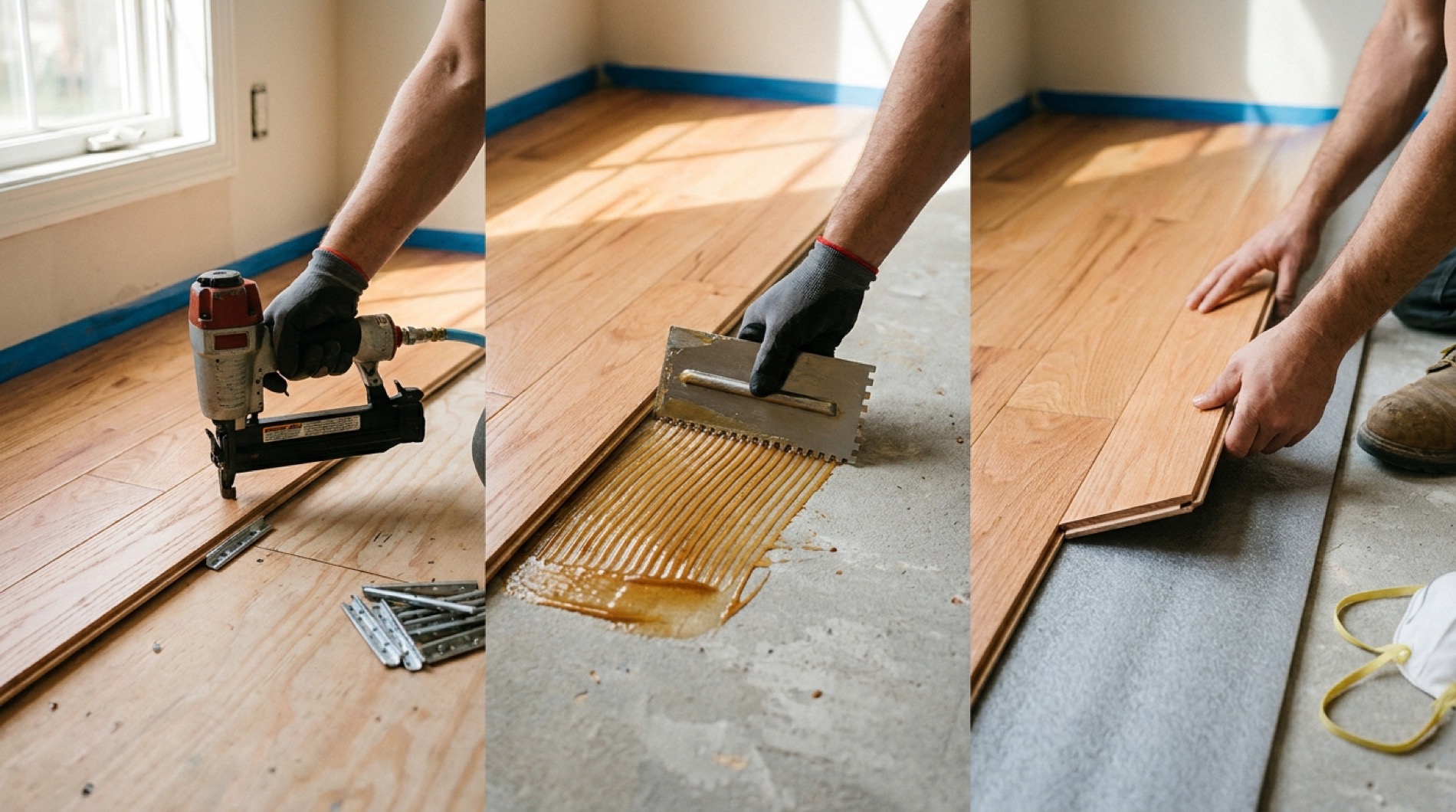
"Should my hardwood floors be nailed down, glued down, or floating?" is one of the first questions every DMV homeowner asks, and the answer most installers give back is "depends on the subfloor," which is true and not useful on its own. The full answer is that one of these three methods is almost always the right one for your house, and the wrong one creates problems that show up six to eighteen months in: gaps, hollow sounds, cupping, squeaks, or a floor that simply will not stay flat. The decision is rarely a preference call. The subfloor, the house type, the material you picked, and where in the house the floor is going usually pick the method for you.
This is how Potomac Floors picks between nail down, glue down, and floating on a DMV hardwood job. What each method does, what subfloor each requires, what each one adds or saves on the all-in $8.50/sqft hardwood install price, which house types in Northern Virginia, DC, and suburban Maryland get which method, and the gotchas that show up when the wrong choice gets made.
Nail, glue, or float: the short answer
Quick answer
Nail down works on a plywood subfloor with the right joist span, costs the least to install, and gives you the most refinishable floor over 30 to 50 years. Glue down is the default for concrete slabs (most DMV condos, basement-on-slab additions) and any engineered hardwood that cannot be nailed, runs $0.50 to $1.00 more per square foot than nail down, and gives you a quiet, stable floor. Floating is the click-lock fast track that needs no fasteners or glue, costs the least in labor, works on almost any subfloor, but feels and sounds different underfoot and limits which products you can install. We install nail down on most single-family colonials in NoVA, glue down on most condos and high-rises in Arlington/DC/Bethesda, and floating on basement engineered jobs and most rental-property quick turns.
If you remember nothing else from this article: the method is downstream of your subfloor and your product. Solid 3/4-inch hardwood on a plywood subfloor in a single-family home almost always nails down. Engineered hardwood on a concrete slab almost always glues down. Engineered click-lock in a basement or over an unknown subfloor almost always floats. Anything else is the exception.
What each method actually is
Quick answer
Nail down fastens each board through its tongue into a wood subfloor with a flooring nailer or cleat gun, every 6 to 10 inches along the length. Glue down spreads a polyurethane or modified-silane adhesive on the subfloor with a notched trowel, then the boards are pressed into the wet bed. Floating boards click into each other but never touch the subfloor. They sit on a thin foam or cork underlayment and move as one floating mat. Each method handles seasonal wood movement, sound transmission, and refinish-ability differently.
Here is what each method physically does to your floor and why the difference matters once the house is lived in.
| Method | How it attaches | What holds it down | How it moves with humidity |
|---|---|---|---|
| Nail down | Cleats or staples driven through the board tongue at a 45-degree angle into the wood subfloor | Hundreds of mechanical fasteners per room | Each board can move independently a tiny amount; gaps and tight seams happen seasonally but evenly |
| Glue down | Adhesive trowelled onto the subfloor, board pressed into the wet glue, then weighted or rolled | Continuous adhesive bond across the board's bottom | The whole floor moves as a glued sheet; the adhesive flexes to absorb seasonal expansion |
| Floating | Boards click-lock into each other along all four edges; nothing attaches to the subfloor | The boards' own weight and the locked joint pattern | The entire floor expands and contracts as one mat; needs a 1/2-inch expansion gap around the perimeter |
That last column is the one homeowners do not think about until year two. A nail-down floor in a NoVA colonial breathes evenly through the four-season swing because each board is fastened. A floating floor in the same house can shift as a sheet under furniture, and if the perimeter expansion gap was undersized at install, the whole mat pushes against the baseboard and starts to buckle. A glue-down floor on a slab has the adhesive flexing for it, which is why it is the right answer for concrete (more on that in the slab section).
Your subfloor decides most of this for you
Quick answer
Plywood or OSB subfloor over wood joists supports all three methods, with nail down preferred for solid hardwood. Concrete slab supports only glue down or floating (you cannot nail into concrete without specialty fasteners that are not standard residential practice). Existing tile, vinyl, or old hardwood usually requires floating over an underlayment or full demo first. Radiant-heat slabs require glue down with a heat-rated adhesive or floating with an approved engineered product, never nail down.
The first thing we do on any DMV hardwood job is figure out the subfloor. The subfloor narrows the methods before the homeowner has expressed any preference. Here is what we find in real DMV homes and what each subfloor permits.
| Subfloor | Common in | Methods that work | Methods that don't |
|---|---|---|---|
| Plywood over wood joists | Most colonials, Cape Cods, and split-levels in Alexandria, Fairfax, Vienna, Arlington, McLean, Bethesda, Annandale | Nail down (preferred), glue down, floating | None. All three are options |
| OSB over wood joists | Most 1990s-and-newer single-family in Reston, Ashburn, Loudoun, Stafford, Fredericksburg | Nail down, glue down (with primer), floating | Glue-direct without primer (OSB is too porous) |
| Concrete slab on grade | Condos and high-rises in Arlington, Crystal City, Old Town Alexandria, DC NW, Tysons, Bethesda, Rockville | Glue down (preferred), floating | Nail down (concrete will not hold standard cleats) |
| Concrete slab in basement | Most DMV basements (finished or unfinished) | Floating engineered (preferred), glue down with moisture barrier | Nail down (concrete), solid hardwood (basement humidity) |
| Radiant-heat slab | Custom new builds in McLean, Great Falls, Potomac MD, occasional Bethesda renovations | Glue down with heat-rated adhesive, floating with manufacturer-approved engineered | Nail down (would puncture heating lines), most solid hardwood |
| Existing hardwood or tile | Renovations where prior floor is staying | Floating over underlayment (sometimes), full demo and start over | Nail or glue directly on top. Voids most warranties |
The single biggest install-method mistake we see homeowners make when getting bids is not understanding that their subfloor has already cast a vote. A concrete slab in a Crystal City condo cannot take a nailed floor; insisting on nail down means tearing out the slab or building a plywood overlay, which adds $3 to $5 per square foot and 3/4-inch of floor height that the door jambs were never cut for. A basement on slab cannot take solid hardwood with any method because the seasonal humidity below grade is wrong for the product, not just wrong for the install.
Watch out
If a contractor tells you they can nail solid hardwood into a concrete slab using a powder-actuated nail gun, get a second bid. It can be done in commercial settings with specialty fasteners and a sleeper system, but it is not standard residential practice in the DMV, the cleats split the wood at unpredictable rates, and most manufacturer warranties are voided. Glue down or floating is the correct call on a slab.
Nail down: when it's the right call
Quick answer
Nail down is the right call for solid 3/4-inch hardwood on a plywood or OSB subfloor in a single-family home or townhouse with a proper crawlspace or basement underneath. It is the longest-lived install method (40 to 80 years), the most refinishable (4 to 8 full sand-and-refinishes over its life), and the cheapest in labor of the three. The cleat fastener pattern (every 6 to 10 inches) is what gives a nailed floor its solid feel underfoot.
Nail down is the install method most people picture when they imagine "real hardwood floors." Solid 3/4-inch oak, walnut, or maple, planks running across the joists, a flooring nailer driving a cleat every 8 inches at the tongue, the room filling in board by board. It is also the install method that most rewards a properly prepped subfloor: flat to within 3/16 inch over 10 feet, screwed down to silence squeaks, swept clean and acclimated to the room's humidity for at least 72 hours before the first board goes down.
Where nail down wins on a DMV home:
- Plywood subfloor in a single-family colonial with a vented crawlspace or full basement underneath that allows the wood to acclimate. This is the most common scenario across Alexandria, Falls Church, Annandale, Springfield, Burke, Fairfax, Vienna, McLean, Arlington, and most of inside-the-Beltway Bethesda.
- Long-term ownership intent. A nail-down solid hardwood floor sanded and refinished every 10 to 15 years can last 60 to 80 years. The math beats every other floor type at the 30-year mark.
- Whole-house hardwood that needs to flow seamlessly from room to room with no transition strips. Nail down lets us run 80-foot continuous runs through doorways without expansion gaps in awkward visible spots.
- Stain-grade or hand-scraped floors where the homeowner wants the floor to be sandable and re-stainable later. Glue-down jobs can be refinished but the adhesive bond limits the number of sands.
Where nail down is the wrong call:
- Concrete slabs (no wood to nail into).
- Engineered hardwood under 3/8 inch. The tongue is too thin for cleats to hold.
- Radiant-heat slabs. Cleats puncture the heating lines.
- Basements. Humidity below grade is wrong for solid hardwood regardless of method.
Glue down: the concrete-slab default
Quick answer
Glue down is the default for engineered hardwood on a concrete slab, which covers most DMV condos and high-rises. A urethane or modified-silane adhesive (Bostik Best, Mapei Ultrabond ECO 995, Sika AcouBond) trowelled at the spec rate (40 to 60 sqft per gallon) gives a continuous bond that handles seasonal movement, kills 90% of impact sound, and lasts the life of the floor. Adds $0.50 to $1.00 per square foot over nail down because of adhesive cost (a 4-gallon pail runs $130 to $160 and covers about 240 sqft) and slower install pace.
Glue down is what we install on the great majority of condo and high-rise jobs in Arlington, Crystal City, Pentagon City, Old Town Alexandria, DC's NW quadrant, Tysons, Reston Town Center, downtown Bethesda, and Rockville. The slab dictates the method, and engineered hardwood with glue-down installation is the cleanest answer.
Why glue down is the right call on a slab and the wrong call on a wood subfloor:
- Slab + engineered hardwood: The adhesive bridges the slab's micro-imperfections, kills sound transmission downward (critical for condo HOA STC compliance. See our condo soundproofing guide), and handles the slab's near-zero seasonal movement against the wood's normal expansion. The floor feels solid, quiet, and stays flat.
- Wood subfloor + glue down: Adds labor and material cost without much benefit over nail down on the same subfloor. The fasteners would have done the job with less mess. Glue-down on plywood makes sense when nailing is impractical (radiant-heat plywood with embedded lines, or a finished basement where you cannot access the subfloor screws).
The adhesive choice on a slab matters more than most homeowners realize. The right urethane adhesives bond to concrete, flex with seasonal wood movement, and double as a moisture barrier (most premium adhesives are rated for up to 12 to 15 lbs/1000 sqft of moisture vapor emission). Cheaper adhesives lock the floor down but allow moisture migration that cups the boards from below within 18 to 36 months. On any glue-down slab job in the DMV, we use Bostik Best or Mapei Ultrabond at the manufacturer-spec trowel notch. Bottom-of-bid jobs that use generic construction adhesive are why some DMV condos start cupping in year two.
Key takeaway
A slab moisture test (calcium chloride or in-situ relative humidity probe) is non-negotiable before a glue-down install. DMV slabs that read above 75% RH need a topical moisture mitigation coat ($1 to $2/sqft add) before the adhesive goes down. Skipping the test is the single most common reason a glue-down condo floor fails in year two or three.
Engineered hardwood specifically built for glue-down on slab is documented in our engineered hardwood over concrete slab guide. The wear layer, core construction, and adhesive rating questions a homeowner should be asking on any condo bid live there in detail.
Floating: the click-lock fast track
Quick answer
Floating installs are the fastest of the three. A 500 sqft room can be done in a day by a two-person crew, and work over almost any flat subfloor. Boards click into each other along all four edges, sit on a 2mm to 5mm foam or cork underlayment, and need a 1/2-inch expansion gap at every wall. Cost is roughly the same as nail down or slightly less in labor, but the product cost is higher because click-lock engineered hardwood runs $5 to $9/sqft material vs $3 to $6 for nail-down solid. Best for basements, rental quick-turns, condos where adhesive smell is an issue, and renovations over existing floors.
Floating is the install method that has changed the most in the last 10 years. Click-lock joinery has gotten precise enough that a properly installed floating floor feels stable underfoot and lasts as long as a glued or nailed floor in residential use. The compromises are real but specific: floating floors sound slightly more hollow than glued floors (the air gap between board and subfloor), need careful underlayment selection for sound and moisture, and limit you to engineered click-lock products (you cannot float a traditional solid 3/4-inch tongue-and-groove board).
Where floating is the right call:
- Basements. A floating engineered floor with a 6-mil poly underlayment doubles as a moisture barrier and lets the floor move independently of the slab. Our most-installed basement floor in the DMV.
- Rental quick-turns. Speed of install matters when a unit is sitting vacant. A 600 sqft rental can be ripped and refloored in two days with floating engineered.
- Condo jobs where adhesive smell would be a neighbor complaint. Urethane adhesives smell strongly for 24 to 48 hours. In a stacked-unit building, that smell travels through the HVAC. Floating skips it entirely.
- Renovations over a tile or vinyl floor that is staying. Floating over an existing flat hard surface saves the demo cost.
- DIY-friendly installs. If a homeowner wants to do the work themselves, floating is the only method realistically attemptable without flooring-specific tools.
Where floating is the wrong call:
- Open-concept whole-house hardwood over 1,200 sqft in one mat. The expansion potential of a single connected sheet that large can exceed the 1/2-inch perimeter gap and push against walls. Better to use transitions or split into nail-down or glue-down zones.
- Heavy furniture on casters or rolling office chairs on a thin underlayment. The floor flexes under the load and the click joints can separate over time.
- Long-term ownership intent on a forever home where the floor needs to be refinished multiple times. Most floating engineered products have a 1 to 3mm wear layer that supports 1 to 2 sandings, not the 4 to 8 of solid nail-down.
By DMV house type: what we install where
Quick answer
Single-family colonial with plywood subfloor: nail-down solid hardwood. Townhouse with plywood subfloor: nail-down solid or glue-down engineered if HOA requires sound limits. High-rise condo on slab: glue-down engineered. Garden-level condo or basement-on-slab: floating engineered with moisture barrier. Custom new build with radiant-heat slab: glue-down engineered with heat-rated adhesive. Rental property anywhere: floating engineered click-lock for speed and replaceability.
The DMV housing stock spans 1700s federal-style homes in Old Town Alexandria, 1940s Cape Cods in Arlington, 1960s split-levels in Vienna, 1980s colonials across Fairfax County, 1990s townhomes in Reston and Ashburn, 2000s condo towers across Arlington and DC, and new construction across Loudoun, Stafford, and Charles County. Each has subfloor and humidity characteristics that point to a specific install method.
| House type | Typical subfloor | Default method | Common product |
|---|---|---|---|
| Federal-style colonial (Old Town Alexandria, Georgetown) | Original 100+ year plank subfloor over hand-hewn joists | Nail down, often over a new 3/4-inch plywood overlay | 3/4-inch solid white or red oak, site-finished |
| 1940s-50s Cape Cod (Arlington, Falls Church) | 1-inch plank or early plywood over 2x10 joists | Nail down | 3/4-inch solid red oak natural or stained |
| 1960s split-level (Vienna, Annandale, Springfield) | Plywood over 2x8 joists; basement-level on slab | Nail down upper levels, floating engineered in basement | Solid oak upstairs, engineered click-lock down |
| 1980s-90s colonial (Fairfax, Centreville, Loudoun) | Plywood or OSB over engineered I-joists | Nail down | 3/4-inch solid oak or 1/2-inch engineered nail-down |
| Townhouse (Reston, Ashburn, Alexandria West End) | Plywood over wood joists, party walls on either side | Nail down or glue-down engineered if HOA STC rules | 3/4-inch solid or glue-down engineered with acoustic underlayment |
| Mid-rise condo (Arlington, Tysons, Bethesda) | Concrete slab | Glue down with adhesive that doubles as sound barrier | 1/2-inch or 5/8-inch glue-down engineered, premium wear layer |
| High-rise condo (Crystal City, Old Town, DC NW) | Concrete slab, HOA-mandated underlayment requirements | Glue down with HOA-approved adhesive and sound spec | HOA-approved engineered with documented STC/IIC ratings |
| Finished basement (any DMV) | Concrete slab below grade | Floating engineered with moisture barrier | Waterproof engineered click-lock or LVP if hardwood look not required |
| New construction with radiant heat (McLean, Great Falls, Potomac MD) | Radiant-heat slab | Glue down with heat-rated adhesive, manufacturer-approved engineered only | 5/8-inch or 3/4-inch engineered rated for radiant; quartersawn or rift-sawn for stability |
The reason for the basement rule (no solid hardwood, floating engineered preferred) is below-grade humidity. DMV basements run 55 to 70% RH in summer regardless of HVAC, and solid hardwood expands and contracts too much in that range. The reason for the high-rise rule (glue down with HOA-approved spec) is liability. Most DMV condo HOAs require a documented IIC sound rating on any new floor, and only certain adhesive + underlayment + product combinations have the third-party tested numbers in writing.
What each method does to the price
Quick answer
All three methods land in roughly the same $7.50 to $10/sqft all-in range on a typical DMV residential install. Nail down is the lowest-labor method but tied to solid hardwood product cost. Glue down adds $0.50 to $1.00/sqft in adhesive material but the engineered products are usually a touch cheaper than solid. Floating is the lowest labor cost but click-lock engineered products carry a $1 to $2/sqft premium for the precision-milled joints. Potomac Floors charges $8.50/sqft all-in for hardwood install (material + labor + demo + haul-away) across all three methods on standard residential jobs.
One of the most common bidding tactics that confuses homeowners is line-item pricing that makes one method look much cheaper than another. The truth is that material, labor, and adhesive trade off against each other across the three methods, and the all-in cost lands close. Here is the honest breakdown.
| Method | Material cost (typical) | Labor cost | Add-on cost | All-in /sqft |
|---|---|---|---|---|
| Nail down (solid 3/4-inch oak) | $3 to $6/sqft material | $2.50 to $3.50/sqft labor | Subfloor screw-down $0.25/sqft if needed | $7 to $9 |
| Glue down (engineered, slab) | $4 to $7/sqft material | $2.50 to $3.50/sqft labor | Adhesive $0.50 to $1/sqft; moisture mitigation coat $1 to $2/sqft if slab tests high | $7.50 to $10 |
| Floating (click-lock engineered) | $5 to $9/sqft material | $1.50 to $2.50/sqft labor | Underlayment $0.25 to $0.75/sqft (acoustic upgrade adds $0.50) | $7.25 to $11 |
The Potomac Floors all-in price of $8.50/sqft (full breakdown in our hardwood install cost guide) is the same across all three methods because we absorb the material/labor tradeoff in the bid. The reason: most homeowners are picking a floor that fits their house, not picking a method as a cost lever. If a slab job needs moisture mitigation or an HOA-rated adhesive, that gets called out as a separate line.
Watch out
Beware bids that quote "$5/sqft hardwood install" without specifying the method, the product, or the subfloor prep. That number usually means cheapest material (likely big-box stock engineered), floating install, no demo, and no haul-away of the old floor. By the time the change orders land, the homeowner pays $9 to $11/sqft for a thinner floor with shorter wear life. See our hidden flooring quote charges guide for what to watch for.
Can it be refinished later? Method matters.
Quick answer
Nail-down solid hardwood can be refinished 4 to 8 times over its life (every 10 to 15 years), giving 40 to 80 years of service. Glue-down engineered with a 4mm to 6mm wear layer can be refinished 2 to 4 times for 30 to 50 years. Floating engineered with a 1mm to 3mm wear layer can be refinished 1 to 2 times before the wear layer is gone. Method does not directly cause this, but the products typical to each method have very different refinish budgets.
One of the longest-tail decisions a homeowner makes when picking an install method is the refinish path. A floor that lives 50 years on the same boards is a different financial proposition than one that gets pulled and replaced at year 25. Here is how the methods stack up.
- Nail-down solid hardwood: 3/4-inch board with about 1/4-inch above the tongue available for sanding. Each refinish removes about 1/32 inch. That allows 4 to 8 full sand-and-refinishes over the floor's life. Real-world: refinished at year 12, 25, and 40 is typical, with replacement at year 60 to 80 if at all.
- Glue-down engineered hardwood: Depends entirely on wear-layer thickness. Premium engineered products carry a 4mm to 6mm wear layer (real hardwood veneer above the plywood core), which sands 2 to 4 times. The remaining engineered core is structural; it does not get sanded.
- Floating engineered hardwood: Most click-lock floating products carry a thin 1mm to 3mm wear layer that supports 1 to 2 light sands. Some budget click-lock products have a print-and-paper layer rather than real wood, which cannot be refinished at all.
The honest read on this: if the house is the long-term forever home, nail-down solid is the right financial call even if the upfront cost is similar to engineered. If the house is a 5 to 10 year property, the refinish runway is mostly academic and the method should be picked on subfloor and feel-underfoot instead. The full refinish economics live in our hardwood refinishing cost guide and refinishing vs replacement walkthrough.
Noise, feel underfoot, and HOA rules
Quick answer
Glue-down feels the most solid underfoot and is the quietest. Nail-down feels solid but slightly more resonant than glue-down, especially over plywood that has not been screwed down at the joists. Floating feels slightly hollow and can sound a touch louder when walked on, especially with thin underlayment. For condo and stacked-unit installs where downstairs neighbor noise complaints are real, glue-down with an acoustic adhesive (Sika AcouBond) or floating with a 5mm cork underlayment gives the best IIC sound rating numbers. Both can hit IIC 55 to 65, which is what most DMV HOAs require.
The "hollow sound" problem with floating floors is real but often overstated. A correctly installed floating floor over a 5mm cork or rubber underlayment, with proper expansion gaps and tight click joints, feels and sounds almost identical to nail down in a residential setting. The hollow sound mostly happens when the underlayment is too thin (the 2mm foam packaged with budget floors), when the subfloor is uneven (the boards drum against high spots), or when the perimeter expansion gap is too tight and the floor cannot settle.
For condo and high-rise installs in Arlington, Crystal City, DC NW, Tysons, and Bethesda, the sound issue is HOA-regulated, not just a comfort question. Most condo HOAs require any new hardwood floor to meet a minimum IIC (Impact Insulation Class) rating, typically IIC 50 to 60 depending on the building. Both glue-down with an acoustic adhesive and floating with a quality cork underlayment can hit that spec. Nail-down generally cannot, which is one of the reasons nail-down is rarely the answer in a DMV high-rise. The full condo soundproofing breakdown is in our condo and townhome soundproofing guide.
FAQs about hardwood install methods
Can I install solid hardwood on a concrete slab?
Not as a standard residential install. Solid 3/4-inch hardwood requires a wood subfloor to nail into, and concrete will not hold standard flooring cleats. The workarounds (building a plywood sleeper system over the slab, or using powder-actuated fasteners on a thin solid board) add $3 to $5 per square foot and 3/4 inch or more of floor height, which usually breaks door clearance. The right product for a slab is engineered hardwood glued down or floated. The result looks identical to solid hardwood from above.
Does nail down or glue down make any difference in how the floor sounds?
Glue down is quieter. A continuous adhesive bond absorbs impact sound and prevents the slight drumming that happens between a nailed board and the plywood beneath it. Nail-down on a properly screwed-down subfloor sounds solid and warm but is slightly more resonant than glue-down. Floating sounds the most distinct. A faint hollow note when walked on, especially in stocking feet. In a single-family home this is rarely a complaint; in a stacked-unit condo it can be the deciding factor.
How much does the install method affect the total price?
Less than most homeowners assume. The all-in $8.50/sqft Potomac Floors hardwood install price holds across nail down, glue down, and floating on standard residential jobs. What moves the price is the product cost (solid vs engineered, premium vs builder-grade), the subfloor prep (whether moisture mitigation or a plywood overlay is needed), and the add-ons (stairs at $75 to $125/tread, custom borders, transitions). The method itself rarely moves the all-in number by more than $0.50/sqft once the product is locked in.
Is floating hardwood the same as laminate or LVP?
No. Floating hardwood is real engineered hardwood (a hardwood veneer over a plywood or HDF core) with a click-lock joint, installed without fasteners. Laminate is a print of a wood pattern over a fiberboard core; LVP is luxury vinyl plank, a print over a vinyl core. All three install with similar methods (click-lock, floating, no fasteners), but the materials are different. Engineered hardwood can be sanded and refinished; laminate and LVP cannot. The comparison lives in our hardwood vs engineered vs LVP guide.
Will a floating floor squeak or shift over time?
A properly installed floating floor should not. Common causes when it does: the expansion gap at the perimeter was undersized, an uneven subfloor was not flattened before install (high spots cause the boards to flex and click joints separate), or a poor-quality click-lock product was used. We have pulled up enough other contractors' floating jobs to know that the install quality on a floating floor matters more than on a nailed or glued floor. There is no fastener or adhesive correcting subfloor mistakes.
Can I refinish a glue-down engineered floor?
Yes, if the wear layer is thick enough. A glue-down engineered product with a 4mm to 6mm wear layer can be sanded and refinished 2 to 4 times over its life. The board cannot be removed without destroying the adhesive bond, so the refinish has to happen in place. Same process as solid hardwood, just with less wear layer to spare. Thin-wear-layer engineered (1mm to 2mm) is essentially a one-refinish product, and many budget engineered floats cannot be refinished at all.
What about radiant-heat floors?
Radiant heat narrows the choices to glue down with a heat-rated adhesive or floating with a manufacturer-approved engineered product. Nail down is off the table. The cleats would puncture the heating lines. Solid hardwood is also generally off the table. The heat cycles cause too much movement in a solid board. Engineered hardwood specifically rated for radiant heat (usually 5/8-inch with a quartersawn or rift-sawn cut for stability) glued down with Bostik Best or Mapei Ultrabond is the standard answer in DMV custom builds with radiant systems.
How long does each method take to install?
Nail down: a two-person crew installs roughly 400 to 600 sqft per day. Glue down: 350 to 500 sqft per day (the adhesive working time slows pace). Floating: 500 to 800 sqft per day (no glue, no nailer setup). A typical 1,000 sqft DMV install is 2 days for floating, 2 to 3 days for nail down, and 2 to 3 days for glue down, plus a 24 to 48 hour adhesive cure window before furniture goes back on a glue-down floor.
Can I switch methods mid-house?
Yes, with a transition strip at the change point. Nail-down upstairs and floating engineered in a basement is one of the most common DMV combinations. The transition can be a flush T-molding or a stepped reducer depending on the height match. The two floors do not need to be the same product or method to look continuous, but the transition needs to be planned at install, not added on after.
Bottom line: what we'd install in your house
If your house is a single-family colonial, Cape Cod, or split-level anywhere in NoVA or suburban Maryland with a plywood subfloor and a basement or crawlspace, the right install method is almost always nail-down solid hardwood. It is the longest-lived, most refinishable, and most cost-effective method when you account for the 30 to 80 year horizon. It is also what builds the most home resale value in this market.
If your house is a condo or high-rise on a concrete slab in Arlington, Crystal City, Old Town, DC NW, Tysons, Bethesda, or Rockville, the right method is almost always glue-down engineered hardwood with an HOA-approved adhesive and a slab moisture test done before install. The floor will be quiet, stable, and pass the IIC sound rating most DMV HOAs require.
If you are doing a basement renovation, a rental quick-turn, or a condo job where adhesive smell is a problem for neighbors, the right method is floating engineered click-lock over the appropriate underlayment. Modern click-lock products feel and sound nearly identical to glued floors in residential use, and the install pace lets us pull and refloor a unit in days instead of a week.
The decision is rarely the homeowner's preference. The subfloor, the house type, and the product picked have already cast the vote. Our job is to read those signals and install the right method the right way. When we walk a DMV house for a hardwood bid, the install method gets specified in the quote alongside the all-in $8.50/sqft number, the subfloor prep notes, and the timeline. No "we'll figure it out on day one" mystery. If you want the same walk-through for your floor, that is what the free estimate gets you. The cost breakdown is in our hardwood install pricing guide, the engineered-on-slab specifics are in our engineered over concrete slab guide, the finish decision is in our oil-based vs water-based polyurethane walkthrough, and the lifetime math is in our LVP vs hardwood lifetime cost comparison.