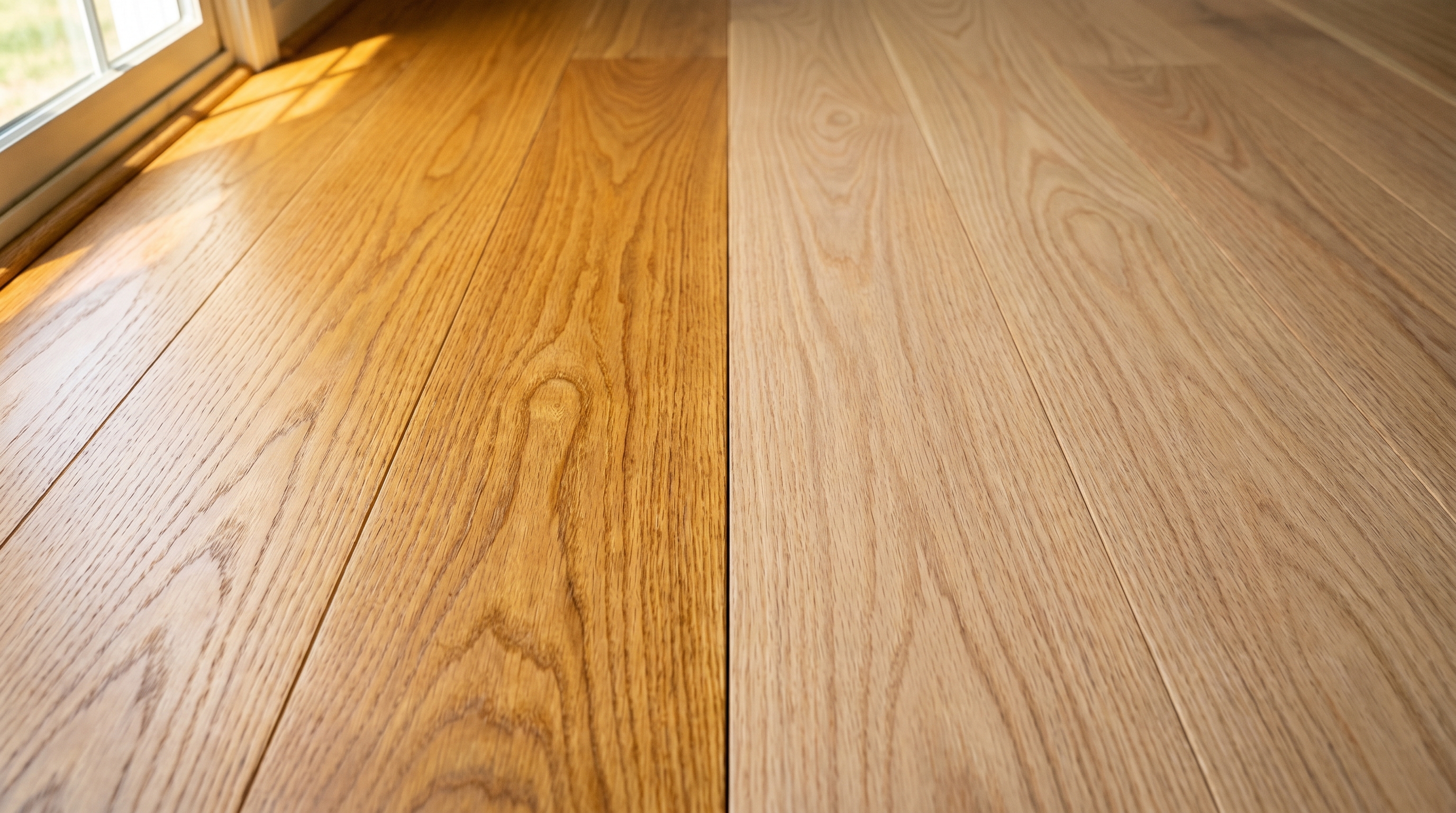
"Oil-based or water-based polyurethane" is the single biggest finish decision on a hardwood refinish, and the answer most blogs give is "it depends," which is true and useless. The honest answer is that both products work, both products last, and the right pick depends on five things specific to your house: how much you mind a one-week smell, whether you want amber warmth or clear honest wood color, whether you have a stair runner or pets to time around, whether your condo HOA has a VOC rule, and how soon you need to be living on the floor again. This is the breakdown we walk DMV homeowners through before we put a sander on the wood.
What follows is what oil-based and water-based polyurethane actually do, how they age in Northern Virginia, DC, and suburban Maryland homes, what each adds to a Potomac Floors refinish bid, and the decision tree we use to pick one over the other on any given job.
Oil-based vs water-based polyurethane: the short answer
Quick answer
Water-based polyurethane dries in 4 to 6 hours per coat, smells noticeably for 24 to 48 hours, stays clear over the life of the floor, and lets you live in the house during the job. Oil-based polyurethane dries in 8 to 24 hours per coat, smells strongly for 4 to 7 days, ambers into a warmer honey tone over time, and costs roughly $0.25 to $0.50 less per square foot. Modern water-based finishes (Bona Traffic HD, Loba 2K) match oil-based in real-world durability. We install water-based on most DMV refinishes for occupied homes and oil-based when the homeowner specifically wants the amber look on red oak.
The short version of why most installers in this region have shifted toward water-based since around 2018: dry time and smell. The wait time between coats on oil-based is one full day; on water-based it is a few hours. The smell on oil-based lingers for a week; on water-based it is mostly gone by day three. For a family that lives in the house during the refinish, water-based is the practical default. The reason to still pick oil-based is purely aesthetic: red oak under oil-based amber polyurethane has a warm, traditional, slightly golden look that water-based does not match.
Color: amber warmth vs clear honest tone
Quick answer
Oil-based polyurethane goes on with a slight amber tint, deepens to a honey-gold tone in the first 6 months, and continues to darken faintly over years. Water-based polyurethane is clear in the can and dries clear, showing the wood and stain at their actual color forever. On red oak and white oak with no stain, oil-based makes the floor look warmer and more traditional. Under any gray, white-washed, or modern light stain, water-based is the only correct choice because oil-based will yellow the stain into something it was never meant to be.
This is the difference homeowners can see most clearly in a side-by-side sample. Oil-based starts amber and continues to amberize for the life of the floor. It is the look of a 1950s Cape Cod red oak floor at 30 years old. Water-based stays the color it dried, which is to say it stays the color of the wood and the stain you applied. It is the look of a modern white oak floor with a natural matte finish.
| Effect | Oil-based | Water-based |
|---|---|---|
| Color on day 1 | Slight amber tint, warmer than the wood | Clear, shows the wood as-is |
| Color after 6 months | Honey-gold, noticeably warmer | Same as day 1 |
| Color after 10 years | Continues amberizing slightly each year | Same as day 1, may dull from wear but does not change hue |
| Effect on natural red oak (no stain) | Warm traditional look. The "classic hardwood" appearance | Honest red-oak pink-tan, more modern |
| Effect on natural white oak (no stain) | Pulls white oak warmer, slightly yellow | Keeps white oak's cool tone. The modern look |
| Effect on dark walnut or espresso stain | Slightly richer, slightly warmer | True to the stain color |
| Effect on gray, whitewash, or light modern stain | Yellows the stain. Wrong choice. Will look dirty within months. | Stays clean. The only correct choice. |
Key takeaway
If you are doing a gray, whitewashed, or light-Scandinavian floor, the choice is already made for you: water-based. Oil-based polyurethane will yellow any cool-toned stain into a muddy color within the first year. This is the single most common refinish-gone-wrong call we get from homeowners who picked a contractor that defaulted to oil-based on a modern stain.
Dry time and when you can walk on the floor
Quick answer
Water-based polyurethane lets us apply two coats in a single day, with socks-only foot traffic 4 to 6 hours after the final coat and furniture back in 3 days. Oil-based polyurethane is one coat per day, socks-only foot traffic 24 hours after the final coat, furniture back in 5 to 7 days. Full cure (when area rugs and heavy furniture can go anywhere) is 14 days for water-based and 30 days for oil-based. A 3-coat oil-based finish takes 3 days of waiting between coats; a 3-coat water-based finish can be done in 2 days total.
This is where the real lifestyle difference lives. On a typical 800 sqft main-level refinish, water-based shortens the on-site phase by about 2 to 3 days and the "can my kids run on the floor" wait by another 3 to 4 days. For most DMV families that is the difference between vacating for a long weekend versus vacating for a full week.
| Milestone | Water-based (3 coats) | Oil-based (3 coats) |
|---|---|---|
| Dry between coats | 2 to 3 hours | 8 to 24 hours |
| Coats per day | 2 (sometimes 3 in summer) | 1 |
| Total finish days on site | 1 to 2 days for finish (after sanding) | 3 days for finish (after sanding) |
| Walkable in socks after final coat | 4 to 6 hours | 24 hours |
| Light foot traffic with shoes | 24 to 48 hours | 72 to 96 hours |
| Furniture back (with felt pads) | 72 hours (3 days) | 5 to 7 days |
| Area rugs OK | 14 days | 30 days |
| Full cure | 14 days | 30 days |
The 14-day-versus-30-day full cure window matters more than people expect. A homeowner who lays an area rug over an oil-based finish on day 10 traps the still-curing solvents underneath, which can lift the finish or create a permanent rectangle of slightly different sheen where the rug sat. We have rescued floors where the homeowner did exactly that. With water-based, the same mistake at day 7 is also a problem, but the cure window is half as long so the risk window closes faster.
Northern Virginia summer humidity adds time to both. On a 90-degree day at 70 percent humidity in July, an oil-based coat that should dry in 12 hours can take 18 to 24. Water-based handles humidity better but still slows by an hour or two per coat. The full refinishing cost guide goes into the day-by-day timeline.
Smell, VOCs, and whether you can stay in the house
Quick answer
Oil-based polyurethane has roughly 450 to 550 grams of VOCs per liter and smells strongly for 4 to 7 days. Water-based polyurethane has 150 to 275 grams per liter (sometimes less) and smells noticeably for 24 to 48 hours. With oil-based, we recommend vacating the entire house during application and for at least 48 hours after the last coat. With water-based, the family can usually stay in the bedrooms during the finish phase as long as those rooms are not the work area. Anyone with respiratory sensitivity, kids under 5, or pets that breathe heavily (bulldogs, pugs, parrots) should still leave for the active finish days regardless of which product.
"How long does it smell" is the question that decides the product for most DMV households with kids or pets. Oil-based polyurethane is what older flooring guys grew up on, but it is also what gives the entire house a strong solvent smell for a week. Water-based polyurethane smells too, but the smell is much milder and dissipates within 48 hours.
| Smell stage | Water-based | Oil-based |
|---|---|---|
| Day of application (during) | Mild solvent smell in the work area | Strong solvent smell throughout the house |
| 24 hours after final coat | Faint, mostly in the work area | Strong, throughout the house |
| 48 hours after final coat | Mostly gone | Strong but diminishing |
| 4 to 7 days after final coat | No detectable smell | Noticeable, especially in still air |
| 2 to 4 weeks after final coat | No detectable smell | Faint amber smell during full cure |
Watch out
Cats and small dogs are more sensitive to VOC off-gassing than humans because their lungs are smaller and they spend more time near the floor. We have had two DMV homeowners with parrots cancel oil-based jobs after their vet flagged the off-gassing risk; both went water-based instead. If you have pets, this is a real factor. The full pet-friendly flooring notes on materials and finishes are worth a read.
Durability: scratch resistance vs dent resistance
Quick answer
A correctly applied 3-coat water-based finish (Bona Traffic HD, Loba 2K, Pallmann Pall-X) matches a correctly applied 2-coat oil-based finish in real-world wear over 10 to 15 years. The technical difference: oil-based is thicker and softer (more dent-resistant, scratches blend into the amber tone), water-based is thinner and harder (more scratch-resistant, scratches are slightly more visible because they show against the clear finish). Most installers who claim oil-based "lasts longer" are comparing modern oil-based to cheap single-component water-based, which is a real gap. Two-component water-based ("2K") closes that gap completely.
The durability debate is mostly an artifact of bad water-based products from 10 to 15 years ago. The early water-based finishes were genuinely thinner and softer and wore out faster than oil-based. That gap has closed. Bona Traffic HD, Loba 2K Easy Finish, and Pallmann Pall-X Gold are two-component water-based finishes with a hardener that catalyzes the cure, and they test at or above oil-based polyurethane on the Taber abrasion test (the industry standard for scratch wear).
| Wear factor | Oil-based | Water-based (2K, modern) |
|---|---|---|
| Thickness per coat | Thicker (45 to 50% solids) | Thinner (30 to 35% solids) |
| Number of coats for full protection | 2 coats minimum, 3 standard | 3 coats minimum, 4 for high-traffic |
| Hardness | Softer. Dents resist, scratches blend | Harder. Scratches resist, but visible when they happen |
| Penetration into wood grain | Soaks in deeper | Sits more on surface |
| 10-year wear (residential) | Typically holds full coverage | Typically holds full coverage |
| 15-year wear (residential) | Edges and high-traffic show wear | Edges and high-traffic show wear |
| Re-coat (screen and recoat) compatibility | Re-coatable with oil or modified water | Re-coatable with water-based |
| UV yellowing over time | Yes, ambers steadily | Almost none |
The practical takeaway: with a quality 3-coat water-based job from a real installer, durability is not a reason to pick oil-based anymore. The reasons to pick oil-based are color preference, lower per-square-foot material cost, and slightly better dent recovery on a high-traffic species like pine or hickory. If a contractor still insists "oil-based is more durable" without naming a specific water-based product, they are either using a cheap single-component water-based or they have not updated their materials in a decade.
What each one actually costs on a DMV refinish
Quick answer
At Potomac Floors, water-based is the default on our $4.50 per square foot all-in refinish price. Oil-based is $0.25 to $0.50 per square foot less because the material itself is cheaper ($55 to $75 per gallon for oil-based, $110 to $150 per gallon for a quality two-component water-based). On an 800 sqft refinish, choosing oil-based saves $200 to $400. We do not push either direction. If a homeowner specifically wants oil-based, we save them the difference. If they want water-based or do not have a preference, we install water-based.
The cost gap between the two finishes is mostly material, with a tiny labor difference. Water-based dries faster, which means the finish phase takes one less day on site for our crew, which partially offsets the higher material cost. The full breakdown is in our refinishing cost guide.
| Cost factor | Oil-based | Water-based (2K) |
|---|---|---|
| Material cost per gallon (installer trade pricing) | $55 to $75 | $110 to $150 |
| Coverage per gallon | 400 to 500 sqft | 400 to 500 sqft |
| Material cost on 800 sqft, 3 coats | $330 to $450 | $660 to $900 |
| Labor delta (extra days on site) | +1 to 2 days | Standard |
| Potomac all-in price (DMV) | $4.00 to $4.25/sqft | $4.50/sqft (standard) |
| 800 sqft total all-in | $3,200 to $3,400 | $3,600 |
| 1,500 sqft total all-in | $6,000 to $6,375 | $6,750 |
| Whole-house 2,000 sqft total all-in | $8,000 to $8,500 | $9,000 |
The Patch.com piece from a New York installer argues that oil-based costs less over the life of the floor because it lasts longer and you redo it less often. That argument made sense in 2014, when the comparison was three coats of oil-based against three coats of a cheap single-component water-based. Against modern two-component water-based, the lifetime cost is essentially identical. The 10-year and 20-year cost-of-ownership math is in our LVP vs hardwood lifetime cost walkthrough.
DMV humidity, summer cure windows, and basement jobs
Quick answer
DMV summers run 75 to 90 percent relative humidity for weeks at a time. Oil-based polyurethane fights humidity harder than water-based: a coat that normally dries in 12 hours can take 24 to 30 hours during a July humid stretch. Water-based handles humidity better but slows by 1 to 2 hours per coat. Run the air conditioning during the job (target 60 to 70 percent indoor RH and 65 to 75°F). For basement refinishes, water-based is the safer pick because basements in DMV homes often run 60 to 75 percent RH even with conditioning, and oil-based cure problems compound in damp air.
The DMV climate creates real finish problems that practitioners in dry regions never see. Northern Virginia averages 70 to 75 percent relative humidity from May through September, and DC basements can stay above 65 percent year-round without dehumidification. Polyurethane cures by solvent evaporation (oil-based) or coalescence (water-based), and both processes slow when the air is already saturated with moisture.
| DMV condition | Oil-based behavior | Water-based behavior |
|---|---|---|
| Spring 60-65°F, 50-60% RH | Normal 12-hour dry, good cure | Normal 4-hour dry, good cure |
| Summer 80-90°F, 70-80% RH (July) | 18 to 30 hour dry, soft tacky coat possible | 5 to 7 hour dry, normal cure |
| Fall 55-65°F, 55-70% RH | 14 to 18 hour dry, good cure | 4 to 6 hour dry, good cure |
| Winter 55-65°F, 25-40% RH with heat on | 10 to 14 hour dry, good cure | 3 to 5 hour dry, slightly faster than spec |
| Basement, 60-75% RH year-round | Risky, can fail to fully cure | Slow but reliable cure with dehumidifier |
On July and August refinishes we run a portable AC or window units even in unconditioned spaces to bring the room to spec. The same hardwood humidity dynamics that cause buckling and cupping also slow finish cure. If you are quoted a 3-day finish window in mid-July with no mention of climate control, ask about it.
Condo HOA rules and water-based as a requirement
Quick answer
Many DMV condos and co-ops now require water-based polyurethane for any in-unit hardwood refinish. The reasoning is VOC migration to neighboring units through shared HVAC and hallways. Buildings with this rule include several Crystal City, Old Town Alexandria, and DC NW high-rises. Check your condo association rules before scheduling a refinish. If your building has a VOC limit (often expressed as "low-VOC finish only" or "under 250 g/L VOC"), oil-based polyurethane at 450 to 550 g/L is not compliant. Two-component water-based at 150 to 275 g/L is.
Condo refinishing has compliance layers that single-family refinishes do not. The hallway-shared HVAC in a typical DMV high-rise means that solvent fumes from one unit's refinish reach neighbors through the corridor and through return vents. Buildings have learned this the hard way and many now write the VOC rule into the standard work-authorization form. Some also require water-based simply because the smell complaints from oil-based jobs are constant.
| Building type | Common rule | What this means for you |
|---|---|---|
| Pre-2000 garden condo (Arlington, Falls Church) | No VOC rule typically | Either finish works; smell will reach neighbors briefly |
| Post-2010 mid-rise (Reston Town Center, Tysons) | Often "low-VOC only" in work auth | Water-based required, verify with management |
| DC NW or downtown high-rise | Frequently water-based-only by rule | Water-based required, oil-based often refused at door |
| Co-op (rare in DMV but exists in DC) | Board-approved contractor list, often water-based required | Get written approval before scheduling |
| Single-family detached house | No HOA rule typically | Either works, no compliance step |
If the floors are in a condo, get the work-authorization form before you book the refinish. The same paperwork-first logic applies to sound transmission rules for condo flooring, which are often in the same document.
Which one to pick: the installer's decision tree
Quick answer
Pick water-based if: you are doing any gray, whitewash, or light modern stain; you have kids under 10, pets, or anyone with respiratory sensitivity; you need the floor back in service within a week; you are refinishing a condo with a VOC rule; you have a basement refinish; or you do not have a strong preference. Pick oil-based if: you want the traditional amber tone on red oak natural finish; the house will be empty for at least 10 days; you are doing pine or hickory where dent recovery matters; or you are matching an existing oil-based floor in another room.
This is the actual decision flow we use when a homeowner asks us "which one." Most cases land on water-based within two or three questions. The cases that land on oil-based usually do so for a specific aesthetic reason.
| If your situation is... | Pick | Why |
|---|---|---|
| Gray, whitewash, or light Scandinavian stain | Water-based | Oil-based yellows the stain. Non-negotiable. |
| Kids under 10 or anyone with asthma in the house | Water-based | VOC exposure and 7-day smell are real factors |
| Pets (especially birds, cats, small dogs) | Water-based | Sensitive lungs, lower-to-floor breathing zone |
| Condo with any VOC rule or low-VOC requirement | Water-based | Oil-based is often not compliant |
| Basement refinish | Water-based | Humidity tolerance, faster cure in damp conditions |
| Need furniture back within 5 days | Water-based | 3-day furniture window vs 5-7 day for oil-based |
| House will be empty for 10+ days, you want classic amber red oak look | Oil-based | Traditional aesthetic on red oak natural is hard to match otherwise |
| Pine, hickory, Brazilian cherry where you want maximum dent forgiveness | Oil-based | Softer film recovers from dents better |
| Matching one room to an existing oil-based floor in the next room | Oil-based | Avoid sheen and color mismatch at thresholds |
| No strong preference, single-family detached house, no kids or pets | Water-based | Faster turnaround, cleaner color over time, equal durability |
The decision is almost never close once we walk through it. Most DMV homeowners pick water-based after the third question because the practical advantages (live in the house, faster turnaround, no smell) outweigh the aesthetic gain of amber tone. The homeowners who land on oil-based are usually doing a natural-red-oak refinish in a traditional house and specifically want the warm look. Both are right answers; neither is a wrong answer.
FAQs about oil-based vs water-based polyurethane
Is water-based polyurethane as durable as oil-based on hardwood floors?
Yes, when both are applied at full spec by a real installer. A 3-coat two-component water-based finish (Bona Traffic HD, Loba 2K, Pallmann Pall-X) tests at or above oil-based on the Taber abrasion test, which is the industry standard for scratch wear. The "water-based is less durable" reputation comes from older single-component water-based products that have largely been replaced. Most DMV installers, including Potomac Floors, default to water-based on residential refinishes specifically because the modern 2K products match oil-based in real-world wear.
How long does water-based polyurethane take to dry?
2 to 3 hours between coats and 4 to 6 hours after the final coat before socks-only foot traffic. Two coats can usually be applied in a single day, so a 3-coat finish job takes 2 days total. Full cure (when area rugs and heavy furniture can return to their normal placement) is 14 days.
How long does oil-based polyurethane take to dry?
8 to 24 hours between coats, depending on temperature and humidity. Only one coat can be applied per day, so a 3-coat finish job takes 3 days. Socks-only foot traffic is OK 24 hours after the final coat. Furniture goes back at 5 to 7 days. Full cure is 30 days, during which area rugs should not be placed over the new finish.
Which polyurethane is better for hardwood floors with pets?
Water-based, for two reasons. First, the VOC exposure during application and cure is roughly one-third of oil-based, which matters for any pet that breathes heavily or stays near the floor. Second, the faster cure window (14 days versus 30) means pet nails and active play resume sooner with less risk of indenting still-curing finish. The broader pet-floor decisions are in our pet-friendly flooring notes.
Does oil-based polyurethane smell longer than water-based?
Yes, significantly. Oil-based smells strongly for 4 to 7 days and faintly for 2 to 4 weeks during full cure. Water-based smells noticeably for 24 to 48 hours and is mostly undetectable by day 4. For a family staying in the house during the refinish, this is usually the deciding factor.
Can I put oil-based polyurethane over an existing water-based finish?
Yes, but only after a full sand-and-refinish. You cannot apply oil-based directly over a water-based finish without first sanding back to bare wood. A screen-and-recoat (light buff plus new finish) needs the same product family as what is already on the floor; mixing oil over water-based without sanding causes adhesion failure within a year.
Can I put water-based polyurethane over an existing oil-based finish?
Yes, with a screen-and-recoat using a water-based product specifically designed for over-oil application (Bona Mega Clear, Loba WS 2K Invisible). A full refinish makes this easier because you sand back to bare wood, but a screen-and-recoat is possible if the existing oil-based finish is intact and you use the right product. We confirm compatibility before booking.
Does water-based polyurethane work with gray-stained or white-washed floors?
Yes, this is one of the cases where water-based is the only correct choice. Oil-based polyurethane has an amber tint that yellows any cool-toned stain (gray, white, modern light wash) and pushes it into a muddy, slightly green color within months. Every modern Scandinavian-style or gray hardwood floor in the DMV that still looks clean was finished with water-based.
What about VOCs and indoor air quality?
Oil-based polyurethane runs 450 to 550 grams of VOCs per liter. Water-based two-component finishes run 150 to 275 grams per liter, sometimes less. Both are below OSHA exposure limits for residential use after the active dry window, but for anyone with respiratory sensitivity, kids under 5, or pets, the difference matters during application and the first week of cure. Open windows, run HVAC on circulate, and stay out of the work area until the dry windows pass.
How much does it cost to switch from oil-based to water-based mid-refinish?
You cannot switch mid-refinish without sanding back to bare wood. If the first coat is already down, switching products means a full re-sand at $4.50/sqft. The product choice gets locked in before the stain coat. If a homeowner is genuinely unsure, we apply a small sample patch with each product in a closet or under the kitchen island so they can see both finishes before committing.
Bottom line: what we install and why
Potomac Floors defaults to two-component water-based polyurethane (Bona Traffic HD or Loba 2K Easy Finish) on most DMV refinishes. The reasoning is practical, not ideological: water-based gets families back into their house faster, matches oil-based in durability when applied at full 3-coat spec, has no smell complaints from neighbors in shared-wall buildings, and stays clear under any stain color we install. The $0.25 to $0.50 per square foot extra in material cost is more than worth the live-in-your-house experience for most homeowners.
We install oil-based when a homeowner specifically wants the amber warmth on red oak natural, when an entire house is being refinished while empty, or when matching an existing oil-based floor in an adjacent room. We have no preference between the two products; we have a preference between the right product and the wrong product for each house.
If you want a real recommendation on your specific floor, we walk it, ask the five questions in the decision tree above, and put the answer in the quote alongside the all-in $4.50/sqft refinish price. No mid-job change orders, no surprise smell complaints from upstairs neighbors, no finish-yellowed stain at month six. The full cost breakdown is in our refinishing cost guide, the refinish-versus-replace decision is in our refinishing vs replacement walkthrough, and the install-side context is in our hardwood install pricing guide.