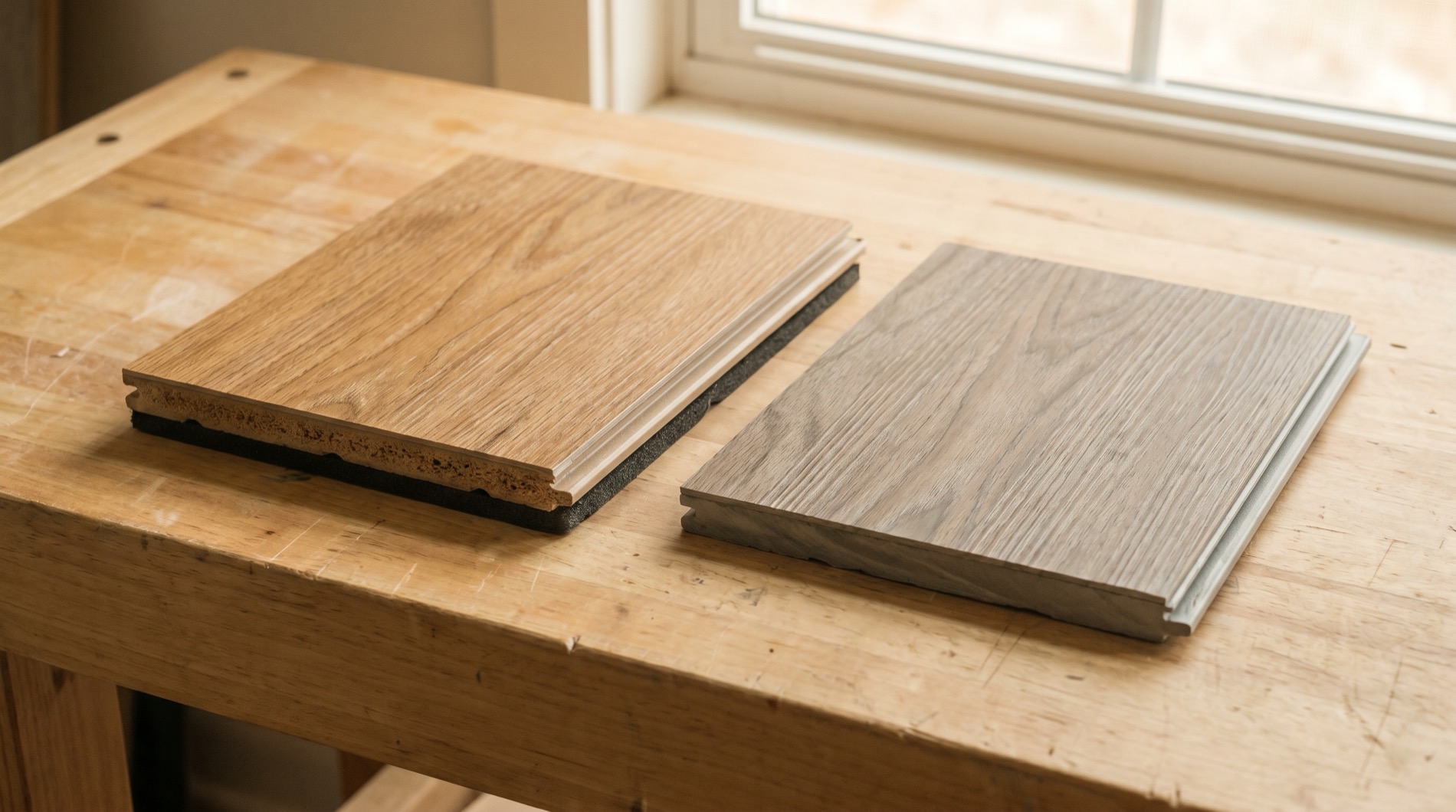
"WPC or SPC" is the second question almost every homeowner asks once they've decided LVP is the floor they want, and almost every homeowner gets the wrong answer from a big-box salesperson who is selling whichever product is on the rack that month. The two cores look identical in the showroom. They behave very differently across 15 years on a DMV subfloor, and one of them is quietly disappearing from the market for reasons most consumers haven't been told.
What follows is the working answer we give at every Potomac Floors LVP consultation: what WPC and SPC actually are at the material level, which one performs better in DMV basements and bathrooms versus main-floor installs, the honest cost delta, and why the answer in 2026 is different from the answer in 2022. Roughly 90 percent of new LVP installs we do today are SPC, and that's not because WPC is bad. It's because the math shifted.
The short answer on WPC vs SPC
Quick answer
SPC (Stone Plastic Composite) is the right pick for roughly 90 percent of DMV homes in 2026. It's denser, more dimensionally stable in our humidity swings, more forgiving of imperfect subfloors, and now costs the same or less than WPC. WPC (Wood Plastic Composite) is softer underfoot and warmer-feeling, but expands and contracts more, dents under heavy furniture, and is being phased out by major manufacturers. Pick SPC for basements, bathrooms, rentals, main floors, and any room with heavy traffic. Pick WPC only if you specifically want the softer feel in a bedroom and your subfloor is already flat.
If you want the shortest possible decision: SPC in almost every case. The market has moved decisively in the last three years. Coretec, Shaw, Mohawk, and most major manufacturers either dropped their WPC lines entirely or rebranded them as "hybrid" or "rigid core" while quietly switching the formula to SPC. The reason is straightforward: SPC outperforms WPC in the conditions LVP customers actually install in, and a denser product ships at lower freight cost. The detail below is what makes the difference between an LVP install that still looks new at year 10 and one that's already shifting at the seams.
What WPC and SPC actually mean
Quick answer
WPC stands for Wood Plastic Composite. The core is a blend of PVC, wood flour (sawdust), and foaming agents that produce a softer, slightly cushioned plank. SPC stands for Stone Plastic Composite. The core is PVC blended with limestone powder (calcium carbonate), producing a denser, more rigid plank. Both are "rigid core" LVP. Both are 100 percent waterproof at the core. The difference is what's mixed into the PVC binder.
The confusion starts in the showroom because both products are marketed as "rigid core LVP" or "waterproof vinyl plank" without any clear labeling of which core type you're buying. WPC and SPC are not different categories of flooring. They're different recipes for the inner layer of the same five-layer plank. Every modern LVP product has the same basic structure: a UV-cured urethane wear layer on top, a printed decorative film, a clear PVC vinyl layer, the core (WPC or SPC), and on most products an attached underlayment pad on the bottom.
The core is roughly 75 to 90 percent of the plank's mass and 100 percent of its mechanical behavior. The decorative film determines what the floor looks like. The wear layer determines how long it lasts under traffic (covered in detail in the section on wear layer thickness in the vinyl plank installation cost piece). But the core determines how the floor feels underfoot, how it handles subfloor imperfections, how much it expands and contracts with temperature and humidity, and how it sounds when you walk on it. That's why the WPC versus SPC question matters and why the answer is mostly about the core, not the surface.
Key takeaway
If a salesperson can't tell you whether a specific product is WPC or SPC, the answer is almost always SPC in 2026, but ask, because it changes how the floor will install and how it will perform in your specific room. The spec sheet under the product, or the manufacturer's website, names the core directly. "Rigid core" and "waterproof LVP" are marketing terms that cover both.
Core construction: the only difference that matters
Quick answer
SPC cores are made dense with limestone powder, giving a typical density of around 1.9 to 2.0 grams per cubic centimeter. WPC cores are made lighter with wood flour and foaming agents, giving a typical density closer to 1.3 to 1.5 g/cc. That density difference is responsible for every downstream behavior. SPC is harder, stronger under point loads, more dimensionally stable, and thinner for the same load rating. WPC is lighter, softer, warmer, and more forgiving on bare feet at the cost of every other performance metric.
| Property | WPC (Wood Plastic Composite) | SPC (Stone Plastic Composite) |
|---|---|---|
| Core filler | Wood flour + foaming agents | Limestone powder (calcium carbonate) |
| Density | ~1.3-1.5 g/cc | ~1.9-2.0 g/cc |
| Typical thickness | 6.5-8 mm | 4-6 mm |
| Weight | Lighter | Heavier (about 40-50% more per box) |
| Feel underfoot | Slightly softer, more cushioned | Firmer, harder |
| Dent resistance | Lower. Heavy furniture can leave divots | Higher. Resists point loads better |
| Dimensional stability | Moderate. Expands with heat | Excellent. Very low expansion |
| Sound | Quieter, warmer | Slightly louder, more "tile-like" |
| Cost in 2026 (typical retail) | $3.50-5.50/sqft material | $2.50-5.00/sqft material |
The density gap is the engineering story. Limestone is roughly twice as dense as wood flour and doesn't expand or contract with temperature. When you take an SPC plank from a 65-degree warehouse into a 95-degree DMV attic, the plank changes dimension by a tiny fraction of a percent. A WPC plank in the same conditions can change dimension by enough to push seams open or buckle against a wall if installed too tight. That's why nearly every LVP install in a sunroom, a south-facing room with large windows, or above a radiant heat system in the DMV is now SPC. The heat tolerance gap is real.
Water resistance: both are waterproof, with one catch
Quick answer
Both WPC and SPC are 100 percent waterproof at the core. Neither one absorbs water or swells like laminate or engineered hardwood. The catch is at the seams. Water can sit on top of either floor indefinitely without damaging the planks themselves, but standing water at the seams can seep through to the subfloor over time. For bathrooms, basements, and laundry rooms, both work, but SPC is the stronger pick because its tighter machining produces tighter seams.
One of the bigger marketing claims that gets thrown around is that one core is "more waterproof" than the other. They're not. PVC, limestone, and wood flour are all non-absorbent materials. A WPC or SPC plank dropped in a bucket of water will float and come out unchanged. The honest answer about water resistance is that both are excellent for the LVP, and the failure mode in either is at the seam where the planks join.
SPC tends to produce tighter seams in two ways. First, the harder core lets the click-lock joint machine to a more precise tolerance. There's less material flex during install, so the seam stays sealed. Second, SPC's lower expansion means the seam doesn't open up seasonally the way a WPC seam can in a basement that swings from 60 percent humidity in July to 30 percent in February. For a basement install with any history of moisture, or a bathroom near a tub or shower, SPC is the lower-risk pick. The full DMV basement flooring decision is laid out in the best flooring for DMV basements piece.
Watch out
"Waterproof" does not mean "water can sit indefinitely with no consequences." Standing water under any floating LVP for days will eventually find a path to the subfloor through the seams, even on SPC. If you have a leak, mop it up. The waterproof rating means the planks themselves survive water. It doesn't mean you can ignore a leak.
Feel underfoot: WPC is softer, SPC is firmer
Quick answer
WPC feels noticeably softer underfoot than SPC. If comfort on bare feet matters. Primary bedroom, nursery, kitchen where you stand and cook for hours. WPC is the more forgiving floor. SPC feels much closer to tile or laminate underfoot. Most homeowners can't tell the difference once shoes are on, and a good underlayment under SPC closes most of the gap. But for bare-feet rooms, the difference is real.
This is the one performance metric where WPC actually wins. The softer foam-filled core absorbs more energy when you walk on it, so it reads as warmer and less fatiguing than SPC. Homeowners who replaced carpet with WPC tend to be satisfied with the feel. Homeowners who replaced carpet with SPC sometimes say the new floor feels "harder" than they expected, even when the surface look is identical.
The fix for SPC's harder feel is underlayment. Most SPC products ship with a thin (1-1.5 mm) IXPE foam pad already attached to the back, which helps. Adding a separate 1.5 to 2 mm cork or rubber underlayment under that adds noticeable comfort and significantly cuts sound transmission to the room below. The full underlayment comparison is in the cork vs foam vs rubber underlayment piece. For condos and townhomes with downstairs neighbors, this is non-negotiable regardless of which core you pick. For single-family homes, it's a comfort upgrade worth the $0.50 to $0.75 per square foot.
Subfloor tolerance: SPC hides more, WPC hides less
Quick answer
SPC's rigidity means it bridges small subfloor imperfections that would telegraph through WPC. A 1/8-inch dip in the subfloor over a 6-foot span shows up as a soft spot or visible dip in WPC. SPC spans the same dip without flexing. For older DMV homes (anything pre-1990) with imperfect plywood or original-construction subfloor variation, SPC is the safer pick. WPC requires a closer-to-flat subfloor, often meaning self-leveling compound work that adds $1 to $2 per square foot to the install.
This is the gap that catches a lot of homeowners. Big-box LVP comes with installation guides that assume a perfectly flat subfloor. Most modern construction in places like Reston, Ashburn, and new-build townhomes meets that bar without prep. Older DMV homes don't. Federal-era colonials in Old Town Alexandria, Cape Cods in Arlington, 1970s split-levels in Vienna, and 1960s ranches across Falls Church and Annandale all have subfloors that have settled and shifted across decades. Some have plywood layers that have softened or delaminated near plumbing. Some have original 1x6 board subfloors that flex under load.
SPC's stone-filled rigidity lets it span small dips and bridge mild variation without showing it on the surface. WPC's softer foam-filled core flexes into the same variations, which over time produces visible low spots and accelerates wear at the high spots. The full breakdown of what subfloor problems we typically find in DMV homes (and what fixes them adds to a quote) is in the subfloor repair piece. The short version: if your house was built before 1990, SPC is the smarter pick.
DMV humidity, basements, and dimensional stability
Quick answer
DMV indoor humidity swings from 70 percent in July to 25 percent in February without active control. Both WPC and SPC handle this better than hardwood or laminate, but SPC handles it dramatically better than WPC. SPC's limestone core barely changes dimension across the year. WPC's wood-flour core expands with humidity and heat enough that an install with too-tight expansion gaps can buckle in August. For basements, sunrooms, and any room without consistent HVAC, SPC is the right pick.
The DMV climate is one of the more punishing in the country for any wood-based or wood-blended floor. The 40-point indoor humidity swing across the year is why we cover hardwood dimensional behavior so carefully in the hardwood buckling and cupping piece. LVP is more tolerant than hardwood, but among LVP cores, the difference matters.
SPC's coefficient of thermal expansion is roughly 30 to 40 percent lower than WPC. In practical terms: a 30-foot run of SPC planks across a basement gains or loses about 1/4 inch across a full year. The same run of WPC can gain or lose 3/8 to 1/2 inch. Both require expansion gaps at the walls (usually 1/4 to 5/16 inch), but WPC's larger swing means a tighter install will eventually push against a wall and either buckle in the middle or open up at a seam. We've replaced more WPC than SPC for this exact failure mode in DMV basements and sunrooms.
Real DMV cost: WPC vs SPC
Quick answer
At Potomac Floors, LVP installation is $6.50 per square foot all-in regardless of whether the core is WPC or SPC. We don't surcharge by core type. The cost difference shows up in the material itself: in 2026, SPC has become slightly cheaper than equivalent WPC at the manufacturer level, which is part of why the market is shifting. Premium SPC ($4 to $5/sqft material) and premium WPC ($4.50 to $5.50/sqft material) sit close on retail price. Mid-grade SPC ($2.50 to $3/sqft material) is the value sweet spot for rental properties and basements.
| Tier | WPC material cost | SPC material cost | All-in install (Potomac) |
|---|---|---|---|
| Builder-grade / rental | $2.50-3.50/sqft (becoming hard to find) | $2.00-2.50/sqft | $6.50/sqft |
| Mid-grade residential | $3.50-4.50/sqft | $2.75-3.50/sqft | $6.50/sqft |
| Premium | $4.50-5.50/sqft | $3.75-5.00/sqft | $6.50/sqft |
The pricing inversion in 2026 is real. Five years ago, SPC was the premium pick at a 10 to 15 percent material price premium over WPC. Today, the same brands sell SPC at a slight discount to WPC because limestone is cheaper than wood flour, the manufacturing process is more efficient, and consumer demand has shifted decisively toward SPC. For room-by-room math on what an LVP install actually costs at different square footages, see the vinyl plank installation cost piece. For the broader comparison against hardwood across a 20-year lifetime, see the LVP vs hardwood lifetime cost piece.
Install method and transition heights
Quick answer
Both WPC and SPC install as floating click-lock floors over the same range of subfloors. SPC's thinner profile (typically 4 to 6 mm versus WPC's 6.5 to 8 mm) means lower transitions at doorways to existing hardwood or tile, which often eliminates the need for a transition strip. WPC's thicker profile sometimes requires shaving an interior door bottom or building up to match an adjacent floor. For renovations where matching the existing floor height matters, SPC has the install advantage.
The click-lock systems on modern WPC and SPC are nearly identical in design, and any installer comfortable with one is comfortable with the other. The differences show up in transitions. A standard 5/8-inch site-finished hardwood floor sits at a finished height of about 3/4 inch. A 5 mm SPC plank with attached pad lands at about 6 mm or 1/4 inch. A clean step down that's easy to bridge with a low T-molding or a flush threshold. A 7 mm WPC plank with attached pad lands at about 8 mm or 5/16 inch. Usable but requires a thicker transition strip and sometimes a built-up filler under the WPC at the threshold.
For DMV renovations where LVP goes in a basement or laundry room adjacent to existing hardwood on the main level, SPC's lower profile is the easier install. For a whole-house LVP replacement where no transitions matter, either works. The choice mostly comes down to subfloor flatness and the room's humidity exposure, with thickness as a tiebreaker.
Which one to pick by room and house type
| Room or condition | Recommended core | Reason |
|---|---|---|
| Basement (finished, DMV) | SPC | Humidity stability, seam integrity, subfloor tolerance |
| Bathroom | SPC | Tighter seams under moisture exposure |
| Kitchen | SPC | Dent resistance under appliances and chairs |
| Family room / living room (main floor) | SPC | Higher dent and traffic tolerance |
| Primary bedroom (carpet replacement) | WPC if budget allows | Softer underfoot for bare-feet comfort |
| Kids' bedrooms | SPC | Toys and furniture wear, easier to clean |
| Sunroom / south-facing room with large windows | SPC | Heat-driven expansion is much lower |
| Rental property (single-family or condo) | SPC | Tenant traffic, lower replacement risk between leases |
| Pre-1990 home with original subfloors | SPC | Bridges subfloor variation that WPC telegraphs |
| New construction with perfect subfloor | Either, but SPC trending | Cost slightly favors SPC in 2026 |
| Condo/townhome with downstairs neighbor | SPC with cork or rubber underlayment | Sound transmission control matters more than core type |
The single situation where WPC still wins outright is a primary bedroom or nursery where the homeowner specifically wants a softer floor than tile or hardwood, is replacing carpet, and has a flat modern subfloor. In that one case the comfort difference matters and SPC's other advantages don't. Everywhere else, including the rooms most homeowners think they want WPC for, SPC is the right call. The decision matrix for rentals specifically is broken out in the best flooring for DMV rental properties piece.
Why WPC is disappearing from store shelves
Quick answer
Coretec, Shaw, Mohawk, and several other major manufacturers have either dropped their WPC lines or quietly reformulated existing product names as SPC. The market has shifted toward SPC because it's cheaper to produce, easier to ship (heavier per box but thinner so more fits per pallet), more dimensionally stable in real-world humidity, and produces fewer warranty claims. Most products marketed as "rigid core" or "EVP" (Enhanced Vinyl Plank) on big-box shelves in 2026 are SPC even when the box doesn't say so directly.
This shift caught a lot of installers by surprise around 2023 and 2024. A homeowner would specifically request a particular brand of WPC they'd seen in a friend's house two years earlier, only to discover the product was now SPC under the same name. The performance is usually better, but the underfoot feel is different enough that the homeowner notices on day one. We started asking every LVP customer at the consultation: "Do you specifically want the softer WPC feel, or are you comfortable with the firmer SPC feel?" The answer often surprises homeowners who didn't know the question existed.
The honest market reality: in 2026, walking into a Home Depot, Lowe's, or Floor & Decor and finding genuine WPC requires reading spec sheets carefully, and the available WPC SKUs are thinning out year over year. By 2027 to 2028, WPC will likely be a niche category sold only by a few specialty manufacturers for the bare-feet-bedroom use case. SPC is what the market wants.
Key takeaway
If a contractor or salesperson is still pushing WPC hard in 2026, ask them why. The legitimate answers are "you specifically want a softer feel in a bedroom" or "we have a specific product matched to your existing decor that happens to be WPC." Any other answer (warmth, water resistance, longevity) suggests they're moving older inventory rather than recommending what's actually best for your install.
FAQs about WPC and SPC vinyl plank
Is SPC really better than WPC, or is this just marketing?
SPC is genuinely better for roughly 90 percent of DMV installs. The market shift isn't marketing. It's driven by lower warranty claims, better humidity tolerance, and lower manufacturing cost. WPC still wins on bare-feet comfort but loses on every other metric that matters in a DMV home.
Will WPC buckle in my basement?
If installed with too-tight expansion gaps at the walls, yes. WPC's higher thermal expansion makes seasonal buckling more likely than SPC. Even with proper expansion gaps, WPC seams can open or shift in a basement that swings from 70 percent humidity in July to 30 percent in February. SPC is the lower-risk pick for any DMV basement.
Can I install SPC over my existing tile?
Yes, if the tile is flat, level, and well-bonded to the substrate. SPC's rigid core bridges small grout lines without telegraphing them, and the floating install doesn't bond to the tile. Confirm the height clearance at doorways before committing. The LVP plus underlayment plus existing tile may stack above adjacent floors.
Does SPC need underlayment?
Most SPC products ship with a 1 to 1.5 mm IXPE foam pad attached to the back. That's enough for a typical install. For condos and townhomes with downstairs neighbors, add a separate 1.5 to 2 mm cork or rubber underlayment on top of the attached pad for sound transmission control. The underlayment comparison piece covers the tradeoffs.
Is SPC waterproof in a bathroom?
Yes. SPC's core is 100 percent waterproof, and its tighter seams reduce the risk of water reaching the subfloor at the joints. For a full bathroom (where the tub or shower is the main water source), SPC is a strong pick, especially with silicone caulk at the wall transition. For wet rooms with floor drains or no shower curb, tile is still the safer choice. The best flooring for DMV bathrooms piece walks through the decision.
How long will SPC last in a DMV home?
15 to 25 years for a quality SPC product (20-mil wear layer or higher) in normal residential conditions. Cheaper builder-grade SPC with a 6-mil or 12-mil wear layer will show wear in high-traffic areas in 5 to 8 years. The wear layer matters more for longevity than the core type. The full breakdown of wear layer math is in the vinyl plank installation cost piece.
Will SPC feel cold in winter?
Slightly colder than WPC but warmer than tile. SPC's density transmits floor temperature more readily than WPC's foam-filled core. In a DMV winter, a basement SPC floor sits around 60 to 65 degrees when the room is at 68. Adding a separate cork or rubber underlayment cuts the perceived cold meaningfully. Radiant floor heat under SPC works well. SPC's heat tolerance is high enough that 80-degree floor temperatures are safe.
Bottom line: what we install in DMV homes today
In 2026 we install SPC in roughly 90 percent of Potomac Floors LVP jobs. Basements, kitchens, bathrooms, family rooms, rentals, condo conversions, and most main-floor installs across Alexandria, Arlington, Fairfax, McLean, Bethesda, and the broader DMV. We install WPC only when a homeowner specifically asks for it for a primary bedroom or nursery and we've confirmed their subfloor is flat enough to support it without showing through. Both cores install at the same all-in price ($6.50 per square foot, material plus installation plus demo and removal of existing flooring), so there's no financial reason to pick the wrong one.
The single most useful question to ask any LVP salesperson or contractor in 2026 is: "Is this WPC or SPC, and why are you recommending this one for my room?" A salesperson who can't answer that clearly is selling whatever is in stock. A contractor who recommends WPC for a basement is either working from outdated information or moving inventory. The right answer in almost every DMV install is SPC, and the operator's job is to match the wear layer, surface look, and underlayment to the specific room, not to push one core type as universally better.
Comparing to other flooring options? See the LVP vs hardwood lifetime cost piece for the 20-year math against hardwood. For room-specific decisions, see the best flooring for DMV basements, best flooring for DMV bathrooms, and best flooring for DMV rental properties guides. For the install method comparison across rigid-core LVP, laminate, and engineered hardwood, see the hardwood installation methods piece. And if you've already got laminate buckling and you're researching what to replace it with, the why your laminate is buckling piece walks through the failure mode and why SPC is the right replacement.