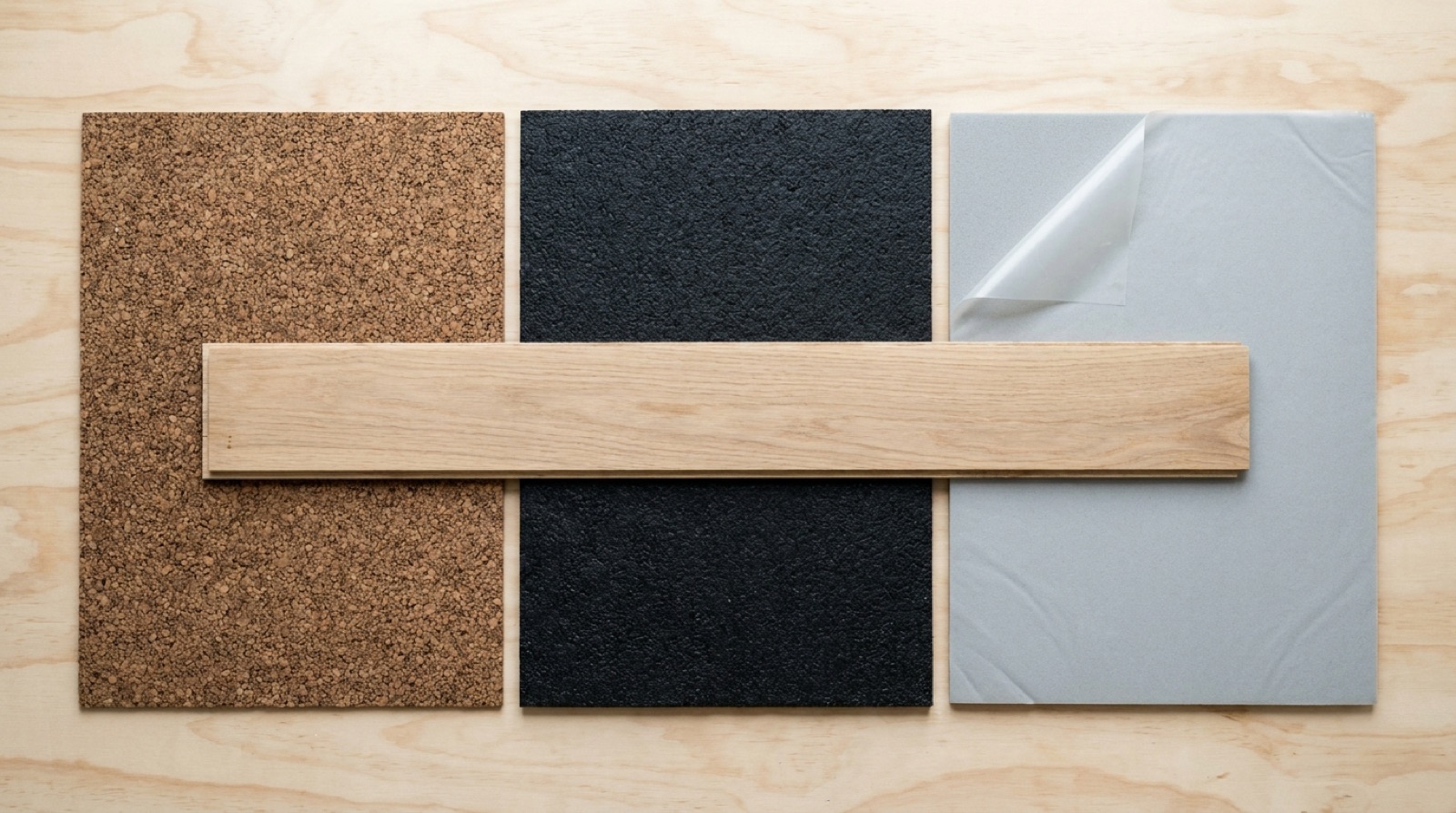

Homeowners shopping flooring almost never think about underlayment. The store points at the floor, you pick the floor, the underlayment is whatever they roll out with it. That works in a single-family house. In a DMV condo, a stacked townhome, or any install where impact noise or moisture matters, it's how floors fail HOA review and how cheap quotes get cheaper.
Cork, rubber, and foam composite are the three real choices for a quality acoustic underlayment. They are not interchangeable. Each one is the right answer for a specific job. Here is the honest installer comparison and exactly when each one wins.
Cork vs foam vs rubber underlayment: the short answer
Quick answer
Cork is the best all-round underlayment for hardwood, engineered wood, and laminate over a concrete slab in a DMV condo: quiet, dimensionally stable, breathes, and lasts the life of the floor. Rubber is the strongest acoustic performer, the right call for gyms, multi-story rentals, and any install where heavy impact noise is the priority. Foam composites are the budget choice under floating LVP and laminate in a single-family home: cheap, easy to install, fine when sound and longevity aren't critical. Cork wins most condo jobs, rubber wins the heaviest acoustic loads, foam wins the budget jobs.
Nothing is universally best. The right call depends on whether you're on a concrete slab or wood joists, what flooring is going on top, how strict your HOA is about impact noise, and how long you expect the floor to last. The rest of this guide unpacks each one.
What cork, foam, and rubber underlayment actually are
Quick answer
Cork underlayment is sheets or rolls of compressed natural cork granules. Rubber underlayment is recycled or virgin rubber in dense mats. Foam composite is closed-cell polyethylene foam, often with a film vapor barrier and sometimes a thin cork or rubber layer laminated in. They all sit between the subfloor and the flooring, but they perform very differently.
Cork is made from the bark of the cork oak. Manufacturers grind it, press it with a binder, and roll or sheet it at thicknesses from 3mm to 12mm. Cork is dense, dimensionally stable, slightly elastic, and one of nature's better acoustic absorbers. It is the traditional acoustic underlayment under hardwood and the default product spec for most condo flooring rules.
Rubber underlayment is either virgin or recycled rubber in dense mats, typically 5mm to 10mm thick. It is heavy, dense, and the strongest acoustic absorber per millimeter of any common underlayment. It costs more, but it punches above its weight on impact noise. Rubber is the spec for commercial gyms, multi-story rentals where impact loads are heavy, and the toughest HOA acoustic ratings.
Foam composite is the broad category sold as the "underlayment that comes with the floor" or as a stand-alone roll at the big box. It is closed-cell polyethylene, sometimes laminated to a thin cork or rubber layer, often with a built-in moisture barrier. It is cheap, light, and easy to install. Performance varies wildly. A good foam composite with a real acoustic core can pass IIC 50; a basic 2mm foam pad cannot.
Cork vs foam vs rubber, side by side
| Factor | Cork | Rubber | Foam composite |
|---|---|---|---|
| Acoustic performance | Strong (IIC 50 to 60 typical) | Strongest (IIC 55 to 70 typical) | Variable (IIC 45 to 55 for quality composites; basic foam fails IIC 50) |
| Thickness common | 3mm, 6mm, 12mm | 5mm, 8mm, 10mm | 2mm to 3mm |
| Dimensional stability | Excellent: barely moves with humidity | Excellent: heavy, stays put | Moderate: can compress over time |
| Lifespan | 30+ years; outlives most floors | 30+ years; commercial-grade | 10 to 15 years; compresses under heavy traffic |
| Moisture behavior | Breathes; tolerates humidity but needs a separate vapor barrier over concrete | Largely impervious; some products integrate a vapor barrier | Closed-cell; many products include a built-in vapor barrier |
| Installation | Float, glue-down, or self-adhesive sheets | Float or glue-down; heavy to handle | Float only; quickest to roll out |
| Cost installed (DMV 2026) | $0.80 to $1.50/sqft | $1.20 to $2.00/sqft | $0.30 to $0.75/sqft |
| Best for | Hardwood, engineered wood, and laminate over a slab in a DMV condo | Heavy impact loads, gyms, top-floor rentals, IIC 60+ HOAs | Floating LVP and laminate in a single-family home where sound isn't critical |
Key takeaway
A 6mm cork at $1/sqft will outperform a 2mm builder-grade foam at $0.40/sqft on every metric except price. If you're in a condo or anywhere impact noise matters, the cheaper underlayment is the false economy. The IIC rating on the foam roll is tested on a perfect lab assembly; your actual floor will be a step or two lower.
When cork underlayment is the right call
Quick answer
Pick cork when you're installing hardwood, engineered hardwood, or laminate over a concrete slab in a DMV condo, when your HOA requires IIC 50 to 55, and when you want a 30-year underlayment under a 30-year floor. Cork is the default acoustic spec for condos for a reason: it works, it lasts, and it doesn't fight humidity.
Cork is the workhorse acoustic underlayment for residential condo work in the DMV. There are three reasons it ends up under most of the floors we install in Rosslyn, Ballston, Tysons, Crystal City, and Old Town.
It performs. A 6mm cork sheet under engineered hardwood routinely tests in the IIC 50 to 55 range over a concrete slab, which is exactly the band most condo HOAs require. Step up to 12mm and you reach IIC 55 to 60 territory. That covers all but the strictest buildings.
It lasts. Cork doesn't compress, doesn't crumble, doesn't break down. The underlayment outlives the floor, which matters because the typical condo floor is on a 25 to 30 year life. A foam pad will compress and lose performance well before then.
It behaves around DMV humidity. Northern Virginia summers run 70 to 90% relative humidity, winters drop to 20 to 30%. Cork is dimensionally stable through the swing. It also breathes, which lets a hardwood or engineered floor acclimate normally and prevents the moisture trap that can cup or crown a floor over a slab. For more on that interaction, see our engineered hardwood over a concrete slab guide.
For a typical concrete-slab condo where the spec calls for IIC 50 and the homeowner wants hardwood, cork is the right answer almost every time.
When rubber underlayment is worth the extra weight and cost
Quick answer
Pick rubber when you need the highest acoustic performance per millimeter, when impact loads are heavy (a home gym, a top-floor rental, a kid's room above a sleeping unit), or when your HOA spec is IIC 60 or higher. Rubber is also the right answer when the floor can't add much height and you need the acoustic rating in a thinner package.
Rubber is the heavy hitter. Per millimeter it absorbs more impact energy than any other common underlayment, which is why commercial gyms and exercise studios use rubber and nothing else. In residential work it shows up in a few specific spots:
- Home gyms inside a condo or townhome. Dropped weights, rowing machines, treadmills. The downstairs neighbor will hear them through any underlayment but rubber, and even rubber needs to be thick.
- HOAs that spec IIC 60 or higher. Some newer luxury buildings in Arlington, Tysons, and Old Town are written this strict. Cork at 12mm sometimes hits it; a quality 8mm rubber underlayment hits it more reliably.
- Top-floor units with sensitive neighbors below. Especially in older buildings without modern sound assemblies, rubber is the insurance policy.
- Height-limited installs. When the floor has to slip under a door without trimming, an 8mm rubber outperforms 12mm cork on IIC.
The trade is real: rubber is heavier (a roll is hard to carry up to the unit), more expensive per square foot installed, and harder to cut clean. In a typical condo with a standard IIC 50 spec, rubber is overkill and cork is the better value. In the specific cases above, rubber is the only material that gets the job done.
When a foam composite underlayment is the better fit
Quick answer
Pick a foam composite under floating LVP or laminate in a single-family home where impact noise isn't a constraint, when the budget is tight, and when you accept the underlayment will need replacing at the next floor cycle rather than the one after. A quality foam composite with a real acoustic core is a different product than the 2mm pad that comes attached to budget vinyl plank.
Foam gets a bad reputation because most of what gets sold as foam underlayment is the 2mm pad pre-attached to cheap floating floors. That is not an acoustic product. A real foam composite underlayment, the kind you buy as a separate spec, is closed-cell polyethylene typically 2 to 3mm thick, often laminated to a thin cork or rubber acoustic layer, almost always with a built-in moisture barrier. Done right, it is a genuine acoustic product and the right pick in some scenarios:
- Floating LVP in a single-family home. No HOA, no neighbor below, and the budget is the constraint. A quality 3mm foam composite is the right tool.
- Basement LVP over a slab. The moisture barrier built into most foam composites is the feature you actually need. The acoustic performance is a secondary benefit. See our best flooring for DMV basements guide for the broader picture.
- Rental property turnover floors. Where the underlayment doesn't need to outlive the floor and the cost per unit matters.
Watch out
The thin foam pre-attached to a budget floating floor is not the same product as a 3mm foam composite underlayment with a published IIC rating. The pre-attached pad is dust suppression and a small thermal break. It will not pass an HOA acoustic spec. If you're in a condo and you bought a budget LVP "with underlayment built in," you still need a separate rated underlayment underneath it.
Cork, water, and what really happens when it gets wet
Quick answer
Cork tolerates moisture better than most flooring materials but it is not waterproof and it does not stop water. It absorbs slowly, dries out without rotting, and resists mold. Used as underlayment over a concrete slab in the DMV, cork must still be paired with a separate poly vapor barrier between the slab and the cork. The barrier stops slab vapor; the cork handles sound and small humidity swings.
This is the most common question on cork and the one the SERP gets wrong. Cork has a natural waxy substance called suberin that makes it water-resistant in the short term: it won't dissolve, swell catastrophically, or grow mold the way drywall would. But sustained moisture exposure does compress and degrade cork over time, and a concrete slab in the DMV will move enough water vapor up through it that cork alone is not enough of a barrier.
The right install over a slab is layered: poly vapor barrier directly on the slab (6 mil minimum, taped at the seams), cork underlayment over the barrier, then the flooring. The vapor barrier stops the slow drip of moisture that would otherwise sit against the cork for decades. The cork handles acoustic and small humidity work above the barrier.
In a wet incident, like a dishwasher leak or a burst pipe, cork is more forgiving than foam. It dries out and recovers. Foam doesn't degrade but it also doesn't absorb, so water sits on top and rides into the flooring. That's another reason cork is the spec under hardwood in a kitchen or near plumbing.
What each underlayment actually costs in the DMV in 2026
Quick answer
In the DMV in 2026, cork underlayment runs roughly $0.80 to $1.50/sqft installed, rubber runs $1.20 to $2.00/sqft installed, and foam composite runs $0.30 to $0.75/sqft installed. The total adder for going from a basic foam to a rated cork or rubber is typically $400 to $1,200 on a typical 800 sqft condo.
Here is real Potomac Floors pricing for a typical 800 sqft DMV condo with a hard-surface floor on top. All-in means we deliver the underlayment, install it, and dispose of any waste; the flooring on top is priced separately on our standard hardwood, vinyl plank, and laminate rates.
| Underlayment | Spec we'd install for a typical condo | Per sqft installed | 800 sqft condo |
|---|---|---|---|
| Cork 6mm | Most condos, IIC 50 spec, under hardwood or engineered | $1.00 to $1.20/sqft | $800 to $960 |
| Cork 12mm | Stricter IIC 55 to 60 spec, top-floor units | $1.30 to $1.50/sqft | $1,040 to $1,200 |
| Rubber 8mm | Home gyms, IIC 60+ HOAs, height-limited installs | $1.50 to $2.00/sqft | $1,200 to $1,600 |
| Foam composite 3mm | Floating LVP/laminate in single-family, no HOA | $0.50 to $0.75/sqft | $400 to $600 |
| Builder-grade 2mm pad | What comes attached to budget flooring; not a real acoustic product | ~$0.30/sqft | ~$240 |
The underlayment line is also the line item that quietly disappears from cheap quotes. If a quote looks low and the floor is going in a condo, check whether a rated acoustic underlayment with a published IIC is actually in the spec. Our breakdown of the charges that get hidden in flooring quotes covers this trap.
How to read an underlayment spec sheet without getting fooled
Quick answer
Look for three numbers on the spec sheet: a published IIC rating, the floor assembly the rating was tested on, and the density (cork) or thickness (rubber, foam). An IIC number without an assembly description is marketing. A density under 200 kg/m³ on cork means a cheap mix that won't last.
Manufacturers publish IIC numbers, and the numbers vary wildly because IIC depends on the entire floor-ceiling assembly, not the underlayment alone. A 6mm cork underlayment might test at IIC 53 over a concrete slab with a 6-inch concrete deck and no ceiling treatment, and IIC 68 over the same slab with a suspended drywall ceiling underneath. Same underlayment, two different floors.
What to look for on the spec sheet:
- The IIC rating, with the test assembly described. "IIC 52 tested per ASTM E492 on a 6-inch concrete slab with no ceiling treatment" is honest. "IIC 70" with no assembly description is marketing.
- For cork, density. Quality acoustic cork runs 200 to 220 kg/m³. Anything lower is a cheaper, less dense mix that won't acoustically perform or last.
- For rubber, thickness and weight. 8mm rubber should weigh several pounds per square foot. Light rubber is a cheaper foam-filled mix.
- For foam composite, the acoustic layer. A real composite has a cork or rubber core, not just foam. Read what's in it.
- Whether a vapor barrier is integrated. Foam composites often have a built-in 6 mil poly barrier; cork and rubber usually don't, so a separate barrier is on the install spec.
Key takeaway
When your HOA spec says "IIC 50," that's the rating for your specific floor assembly, not the underlayment in isolation. Bring the spec sheet, the test assembly description, and a description of your building's floor-ceiling construction to the management company when you submit for approval. The pre-approval is the safest place to settle whether the underlayment qualifies.
FAQs about cork, foam, and rubber underlayment
What are the disadvantages of cork underlayment?
Cork costs more per square foot than foam (roughly two to three times more), is harder to install over uneven subfloors than a flexible foam sheet, and absorbs moisture slowly over time without a vapor barrier underneath. Used correctly it pays for itself in lifespan and acoustic performance, but it's not the cheapest option and it does need proper install.
Is cork good for underlayment under hardwood?
Yes, it is the traditional spec under engineered and solid hardwood, especially over a concrete slab. Cork's dimensional stability through DMV humidity swings, acoustic performance, and 30+ year lifespan match what hardwood needs. Most condo HOAs recognize cork specifically by name in their flooring rules.
What happens to cork underlayment when it gets wet?
Cork tolerates short wet exposure better than most underlayments: it absorbs slowly, dries out without rotting, and resists mold thanks to natural suberin in the cell walls. It is not waterproof, though. Sustained moisture over years will degrade it. Used over a concrete slab, cork should always sit on top of a separate poly vapor barrier.
Can you lay cork underlayment directly on concrete?
You can install it directly, but you shouldn't. A concrete slab releases water vapor for decades, even after it looks dry. Best install is a 6 mil poly vapor barrier on the slab, then the cork underlayment on top of that, then the flooring. The barrier protects the cork; the cork handles the acoustics and small humidity work above the barrier.
How thick should cork underlayment be?
6mm is the practical minimum for an IIC 50 condo spec under hardwood or engineered. 3mm works under floating laminate or LVP in a single-family home but doesn't reliably hit IIC 50. Step up to 12mm for stricter HOA ratings (IIC 55 to 60) or for the strongest acoustic performance under a fixed floor.
Is rubber underlayment worth it over cork?
Worth it when impact loads are heavy (a home gym, dropped weights, a treadmill room) or when the HOA spec is IIC 60 or higher and you'd otherwise be stacking 12mm cork. For a standard condo install with a standard IIC 50 spec under hardwood, rubber is overkill and cork is the better value.
Can underlayment go over an old subfloor?
It can if the subfloor is sound, level, and clean. If it flexes, has soft spots, or has dips greater than 3/16" over 10 feet, the underlayment can't compensate and you'll feel and hear it in the finished floor. We commonly find subfloor work needed on older DMV homes; our notes on subfloor repair walk through what we find and what it costs to fix.
Do I need underlayment under engineered hardwood that's glued down to a slab?
For acoustic reasons, yes if you're in a condo. A glued-down engineered floor without an acoustic layer will transmit impact noise straight into the slab. The right install is a cork acoustic membrane glued to the slab, then engineered hardwood glued to the cork. This is the standard condo spec for engineered hardwood over concrete.
Bottom line: how to pick the right underlayment for your floor
Three quick rules cover most of the calls we make on DMV jobs. If you're installing hardwood, engineered hardwood, or laminate over a concrete slab in a condo and your HOA spec is IIC 50, pick a 6mm acoustic cork over a 6 mil poly vapor barrier; that's the workhorse condo install. If your HOA spec is IIC 60, you have a home gym, or you have heavy impact loads upstairs, step up to 8mm rubber. If you're in a single-family home with no HOA, no neighbor below, and you're installing floating LVP or laminate, a 3mm foam composite with a built-in vapor barrier is fine.
The cheapest underlayment is almost never the right one. The line is small relative to the floor on top, and the lifespan and acoustic performance compound. If you want a real recommendation for your specific building, slab, and floor, we'll walk it and tell you the right spec. Same number that's on every other page of this site.