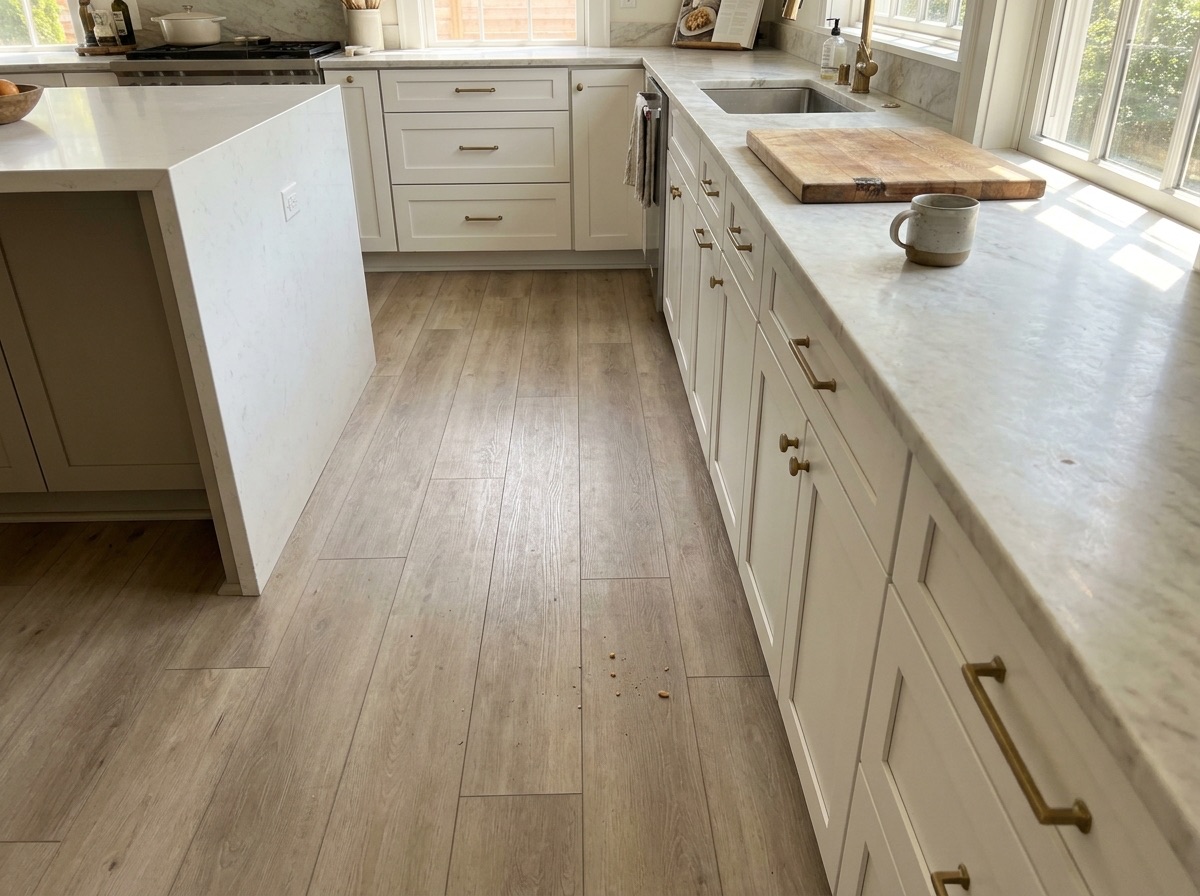
The short answer
Quick answer
Luxury vinyl plank (LVP) is cheaper, faster to install, warmer and quieter underfoot, and fully waterproof. Ceramic or porcelain tile is harder, more heat-tolerant, lasts longer, and still carries a resale edge in higher-end kitchens and baths. For most DMV homeowners doing living areas, bedrooms, basements, and hallways, LVP is the practical pick, and our all-in price is $6.50 per square foot including demo and removal. For a bathroom, an entry, a mudroom, or a high-end kitchen where you want the real-stone feel and the longest life, tile is worth the extra cost and the extra install days. The honest headline: they are not the same product doing the same job, so the right answer depends on the room, not on which one is "better."
People usually come into this comparison expecting one clear winner. There isn't one. LVP and tile are built from completely different materials to solve slightly different problems, and after 20-plus years installing both across Alexandria, Arlington, Fairfax, and the rest of the DMV, the pattern is consistent: the choice comes down to the room, the budget, and how long you plan to stay. Here is the real breakdown, with our actual pricing, not a national retailer's $2-to-$20 guessing range.
Why there's no universal winner
Quick answer
LVP is a layered vinyl product with a printed wood or stone look, a clear wear layer, and a rigid core. Tile is fired clay (ceramic) or denser fired clay (porcelain) set in mortar with grout lines. Vinyl bends, tile doesn't. Vinyl is warm and quiet, tile is hard and cold. Vinyl installs in a day or two, tile takes several days. Neither wins every category, so you match the material to the room's job.
Every blog that declares a flat winner is skipping the part that actually decides it. If you asked us "which is more durable," the honest answer is tile. If you asked "which is more comfortable to stand on in a kitchen," the honest answer is LVP. If you asked "which is cheaper and faster," LVP again. If you asked "which lasts 30-plus years without looking dated," tile. Both are true at the same time. That is why we quote by the room, not by a slogan. For the closely related question of plank-shaped versus tile-shaped vinyl (a different comparison entirely), see our LVT vs LVP guide.
LVP vs tile at a glance
Quick answer
LVP wins on cost, install speed, comfort, and noise. Tile wins on hardness, heat tolerance, lifespan, and resale signal. Both are waterproof when installed right. The tiebreaker is almost always the room and how long you plan to own the home.
| Luxury vinyl plank (LVP) | Ceramic / porcelain tile | |
|---|---|---|
| All-in installed cost (DMV) | $6.50/sqft (our price) | ~$12-20/sqft (DMV estimate) |
| Install time (typical room) | 1-2 days | 3-5 days |
| Feel underfoot | Warm, soft, quiet | Hard, cold, echoes |
| Waterproof | Yes | Yes (sealed grout) |
| Scratch / dent | Can dent under heavy furniture | Very hard, resists both |
| Cracking | Won't crack | Can crack if dropped on / slab moves |
| Lifespan | 15-25 years | 30-50 years |
| Radiant heat | Most LVP not compatible | Ideal |
| Resale signal | Neutral, widely accepted | Premium in kitchens/baths |
What each costs installed in the DMV
Quick answer
Our all-in LVP price is $6.50 per square foot, and that includes the material, professional installation, and demo and removal of your old floor. A professionally installed tile floor in the DMV usually lands somewhere around $12 to $20 per square foot once you add material, labor, substrate prep, and grout. So tile typically runs two to three times the installed cost of LVP for the same room.
That gap is real, and it is mostly labor, not material. Tile itself can be cheap (a basic ceramic runs a few dollars a square foot) or expensive (porcelain and stone climb fast), but the install is what drives the total. Tile has to be set in mortar, spaced, cut on a wet saw, grouted, and sealed. LVP clicks together and floats, or glues down, in a fraction of the time. Our $6.50 all-in number already covers tearing out and hauling away your old floor, which is a line item big-box quotes usually add separately (along with underlayment, disposal, and trim) to turn a "$3 a foot" floor into $9 or $10 on the ground. Our hidden charges guide shows exactly where those add-ons hide.
For the full per-square-foot picture on either material, our vinyl plank installation cost guide and our tile installation cost guide break down what pushes the numbers up and down. We price tile per project instead of posting a flat rate, because a small powder room in a plain layout and a large kitchen in a diagonal pattern are two very different jobs.
💡 Key takeaway
If budget is the deciding factor, LVP wins clearly: same waterproof performance for roughly a third to a half of tile's installed cost. Spend the tile premium where it earns its keep (a bathroom, an entry, a high-end kitchen), and use LVP for the rooms where the extra hardness of tile buys you nothing you'll feel.
Install time and mess
Quick answer
LVP goes down fast. Most rooms are finished and walkable the same day or the next. Tile is a multi-day job: set the tile, let the mortar cure, grout the next day, then seal. Plan on 3 to 5 days for a typical tile room, and you can't walk on it during the cure. If you need a room back in service quickly, LVP is the easy call.
This matters more than people expect, especially in a kitchen or a primary bath you actually use every day. With LVP, our own in-house crew can demo the old floor and lay a whole room in a day, and you are back on it right away. With tile, the mortar and grout need time to cure, so the room is out of commission for several days, and you often can't use the space at all mid-job. For a rental turn or a house you're prepping to list, that timeline difference is a genuine cost.
Tile is also the messier install: mortar, wet-saw slurry, and grout haze. It is manageable, and our crew contains it, but it is not the clean, dry, click-together process LVP is. If a fast, low-disruption install is a priority, that is another point in LVP's column.
Durability, water, and cracking
Quick answer
Tile is the harder, longer-lived surface. Porcelain shrugs off dropped pans, pet claws, and heavy traffic, and a good tile floor lasts 30 to 50 years. LVP is durable too, with a 15-to-25-year life, but it can dent under heavy furniture legs and can't be refinished, so worn LVP gets replaced. Both are waterproof. Tile's weak point is cracking (a dropped object or a moving slab) and grout upkeep; LVP's weak point is dents and a shorter lifespan.
If you want the toughest floor money can buy for a busy kitchen or entry, tile is it. It resists scratches, heat, and impact better than any vinyl, and it does not fade in a sunny room the way LVP can over years of direct light. The trade-offs are that tile is brittle (drop a cast-iron pan and you can crack a tile, and repair means replacing that piece) and that grout needs occasional sealing and can stain or crack if it is a rigid cement product. Our tile grout guide covers keeping it right.
LVP holds up well for normal household life, and its wear layer is what actually decides how long it lasts, not the plank itself. A thin builder-grade wear layer wears through in a few years; a 20-mil layer handles a busy family for decades. The catch is that once vinyl wears through, you replace it, you don't refinish it. For the full story on what drives LVP's lifespan, read our WPC vs SPC guide.
⚠ Watch out
Both floors are only as good as the subfloor under them. Tile cracks when it's set over a substrate that flexes or a slab that moves, which is a real risk in older DMV homes and finished basements. LVP telegraphs and clicks apart over a floor that isn't flat. Whichever you pick, the prep (leveling, a proper membrane under tile, a flat clean base under LVP) is what actually determines whether it lasts. That prep is included in the way we quote both.
Comfort, warmth, and noise
Quick answer
LVP wins comfort easily. It is warmer, softer, and quieter underfoot than tile. Tile is hard and cold, and it echoes in an open room. If you stand and cook a lot, have kids on the floor, or hate a cold floor on a January morning, LVP is the more livable surface. Tile only feels warm if you add radiant heat under it.
This is the category people underrate until they live with the floor. Standing on ceramic tile in an Old Town kitchen or an Arlington bath in the winter is genuinely cold, and it is hard on your feet and joints over a long cooking session. LVP has a slight give and a warmer surface temperature, so it feels better to stand on and stays quieter, less of the click and echo you get from tile in an open floor plan. For a household with young kids who spend time on the floor, that softness is a real plus.
The one way to fix tile's cold is radiant floor heating, which tile is perfectly built for. That is a whole decision on its own, and it changes the math, which is why we cover it separately below.
The DMV-specific stuff: condos, radiant heat, basements
Quick answer
In a DMV condo or townhome, check your HOA's sound rule before you choose: LVP with the right underlayment usually passes the required sound rating easily, while tile needs a full acoustic membrane under it to pass and is a bigger, costlier job. If you want radiant heat, choose tile, because most LVP is not rated for it. In a below-grade basement, both work over a slab, but LVP is the warmer, more forgiving pick.
Three DMV realities decide a lot of these jobs. First, condos and many townhomes in Arlington, Tysons, Reston, and DC carry HOA rules requiring a minimum sound rating (IIC) for hard flooring over a neighbor below. LVP with a rated underlayment typically clears that bar without drama; tile requires a proper acoustic membrane under the mortar to pass, which adds cost and complexity. Our condo and townhome soundproofing guide walks through exactly what passes.
Second, radiant heat. If you're putting warm floors in a bathroom or kitchen, tile is the material for it, because most LVP will warp or void its warranty over sustained radiant heat. We cover which floors work with heat in our radiant heat compatibility guide. Third, basements: DMV below-grade rooms deal with slab moisture and humidity swings, and while both materials can go down over a properly prepped slab, most homeowners want the warmer, softer wood look of an SPC-core LVP down there rather than cold stone. Our best flooring for basements guide covers that call.
Which one for each room
Quick answer
Use LVP for living areas, bedrooms, hallways, and basements, where comfort, cost, and a warm wood look matter most. Use tile for bathrooms, entries, mudrooms, and laundry rooms, where hardness and a true stone look earn their cost. Kitchens can go either way, and in many DMV homes we run LVP through the main living space and tile in the wet rooms.
| Room | Our usual pick | Why |
|---|---|---|
| Living room, bedrooms, hallways | LVP | Warm, quiet, cost-effective, flows through open plans |
| Basement over slab | LVP (SPC core) | Warm waterproof wood look for below-grade moisture |
| Kitchen | Either | LVP for comfort and cost; tile for the highest-end look and durability |
| Full and powder baths | Tile | True stone look, maximum water and heat tolerance, radiant-ready |
| Entry / foyer | Tile | Hardness for grit and traffic, high-end first impression |
| Mudroom / laundry | Tile | Handles water, grit, and heavy use, easy to hose down |
Kitchens are the honest coin-flip. If you cook a lot and want a warm, comfortable floor for a fair price, LVP is a great kitchen floor. If you want the top-end stone or porcelain look and the longest possible life and you don't mind the cold, tile is the upgrade. Our best flooring for kitchens guide and best flooring for bathrooms guide go deeper on each room.
What each does for resale
Quick answer
Tile still carries a resale premium in kitchens and bathrooms, where DMV buyers read real tile as a quality, permanent finish. LVP is widely accepted and won't hurt a sale, especially in living areas and basements, but it doesn't add the same perceived value that genuine tile does in a wet room. If resale in the next few years is a priority, tile in the baths and a nice LVP or hardwood elsewhere is the safe combination.
In the DMV market, buyers and agents still respond to real tile in the rooms where they expect it. A tiled bathroom or a stone entry reads as a finished, high-quality home in a way that vinyl, however good, doesn't quite match at the top of the market. That said, LVP has become mainstream enough that it is a non-issue in bedrooms, living rooms, and basements, and it beats worn carpet or dated flooring every time. If you're weighing the resale angle across your whole house, our flooring and resale value guide lays out where each material helps and where it's neutral. And if you specifically want to compare tile against real ceramic-versus-porcelain choices, see our porcelain vs ceramic guide.
FAQs about LVP vs tile
Is luxury vinyl plank or tile better?
Neither is better overall. LVP is cheaper, faster to install, warmer, and quieter, so it wins for living areas, bedrooms, and basements. Tile is harder, more heat-tolerant, longer-lived, and carries more resale value, so it wins for bathrooms, entries, and high-end kitchens. The right pick depends on the room, not on one being superior.
Is vinyl plank cheaper than tile?
Yes, usually by a lot. Our all-in LVP price is $6.50 per square foot, including demo and removal. A professionally installed tile floor in the DMV typically runs $12 to $20 per square foot, so tile costs roughly two to three times as much. Most of that gap is labor: tile takes far longer to set and grout.
Is tile or LVP better for a bathroom?
Tile is the stronger bathroom floor. It handles standing water and heat best, works with radiant heating, and gives you a true stone or ceramic look. LVP is fully waterproof and works fine in a bath too, especially if you want warmth and a lower cost, but for maximum durability and resale in a bathroom, tile has the edge.
Does LVP or tile add more home value?
Tile adds more perceived value in kitchens and bathrooms, where DMV buyers expect a permanent, high-quality finish. LVP is widely accepted and won't hurt a sale, but it doesn't add the same premium as real tile in wet rooms. A common resale-smart setup is tile in the baths and LVP or hardwood through the rest of the house.
Can you put tile and LVP in the same house?
Yes, and it's the most common setup we install. Running LVP through the living areas, bedrooms, and basement, with tile in the bathrooms, entry, and mudroom, gets you comfort and cost savings where they matter and hardness and resale value where they matter. The key is planning the transitions and color families so it reads as intentional.
How long does each one last?
A quality tile floor lasts 30 to 50 years and can outlive the room around it. LVP typically lasts 15 to 25 years depending on the wear-layer thickness and traffic. Tile can be spot-repaired but cracks if something heavy drops on it; LVP resists cracking but dents and can't be refinished, so worn LVP gets replaced rather than restored.
Bottom line
Luxury vinyl plank and tile aren't really rivals fighting for one spot in your house. They're two tools for two jobs. LVP gives you a warm, quiet, waterproof floor for a great price, put down in a day or two, and it's the right call for most living areas, bedrooms, and basements at our all-in $6.50 per square foot including demo and removal. Tile gives you the hardest, longest-lived, most heat-tolerant surface with a real resale edge, and it's worth its higher cost and its extra install days in bathrooms, entries, mudrooms, and top-end kitchens. In a lot of DMV homes the smart answer is both, matched and transitioned so it looks planned. If you're in Alexandria, Arlington, Fairfax, or anywhere in the DMV and want a straight recommendation for your rooms and a real number on each, get a free in-home quote and we'll tell you exactly what fits where.