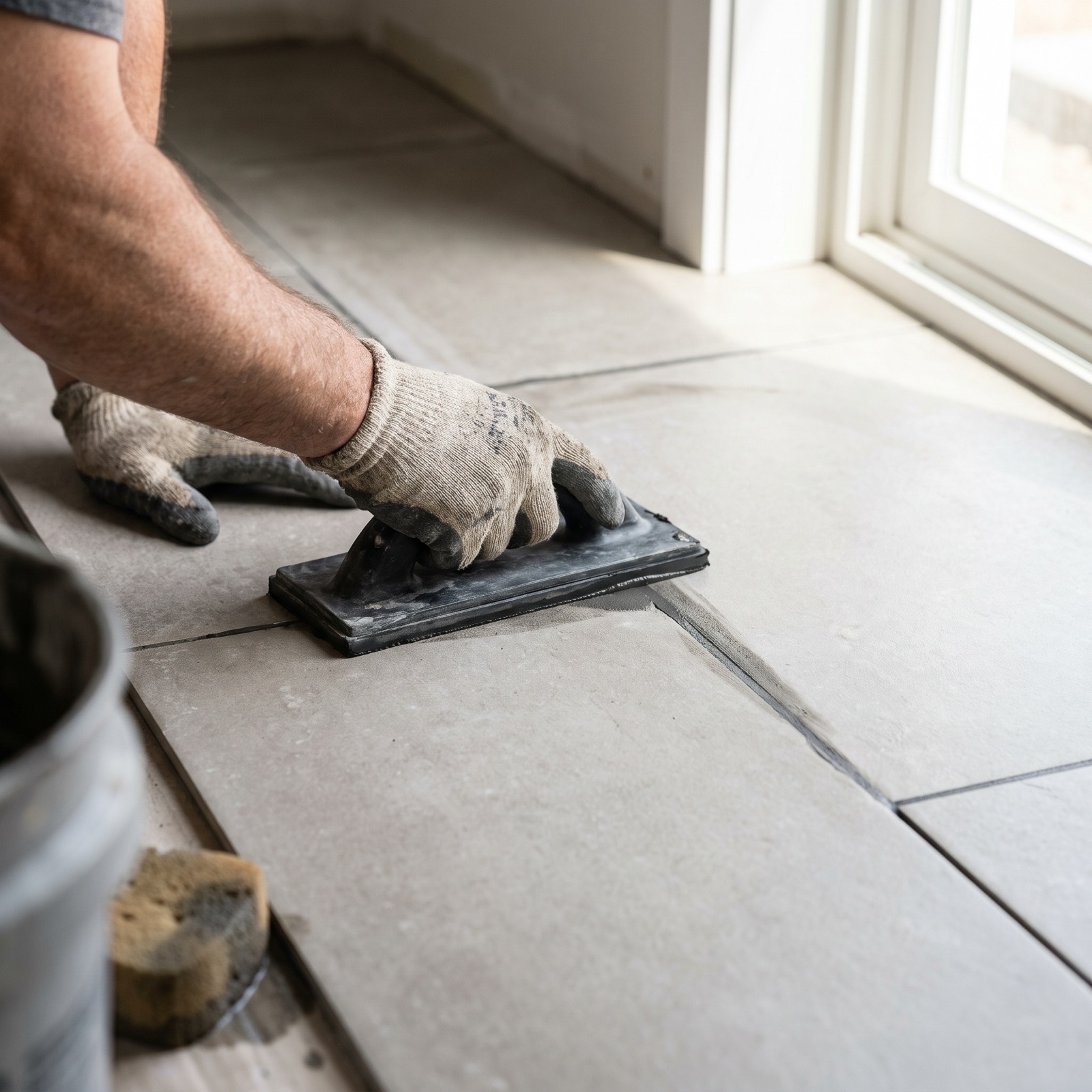
On almost every tile job we scope in the DMV, the grout gets about ten seconds of thought and the tile gets an hour. That is backwards. The tile body is nearly waterproof and lasts for decades. The grout is the porous part, the part that stains, the part that grows mildew in a humid Northern Virginia summer, and the single most common reason we get called back to a bathroom or a kitchen. So the grout decision deserves real attention. After 20+ years setting tile across this metro, here is the honest guide: the grout types and what each is for, the sanded-vs-unsanded rule, epoxy vs cement and where each belongs, how to seal grout and how often in our climate, the special rules for a shower floor, grout color and the dirt problem, when failing grout means you can regrout versus when the whole floor has to come out, real DMV pricing, and the grout mistakes we get called to fix.
The short answer on grout
Quick answer
For most DMV floors, use sanded cementitious grout in joints 1/8 inch or wider and seal it after it cures. In showers and heavy wet areas, use epoxy grout, which needs no sealing and resists stains and mildew. Match the grout color to how the room gets used, not just the look. The body of the tile barely absorbs water; the grout lines are where water and mildew get in. So the grout type and whether it is sealed decide how the floor ages far more than the tile itself does.
The rest of this guide explains each call: the four grout types, the joint-width rule that picks sanded or unsanded, the epoxy-vs-cement tradeoff, the right way to seal and reseal in DMV humidity, the shower-floor exception, grout color, the regrout-or-replace diagnostic, real pricing, and the failures we get called back to fix.
Tile grout types explained
Quick answer
There are four grout types you will run into: sanded cementitious, unsanded cementitious, epoxy, and single-component (pre-mixed urethane). Sanded cement is the workhorse for floors, unsanded is for narrow joints and polished tile, epoxy is the no-seal premium choice for wet zones, and single-component is an easier pre-mixed option mostly for walls and low-traffic. Almost every residential floor in the DMV uses sanded cement or epoxy.
| Grout type | Best for | Sealing | Notes |
|---|---|---|---|
| Sanded cementitious | Most floors, joints 1/8" and wider | Must be sealed after cure, reseal every 1-2 years | Budget-friendly, strong, the floor workhorse |
| Unsanded cementitious | Narrow joints under 1/8", polished and soft tile, walls | Must be sealed | Sand would scratch polished tile; do not use in wide joints |
| Epoxy | Showers, family baths, kitchens, anyone who hates resealing | None needed; stain and water resistant | Costs more, harder to install, sets fast |
| Single-component (pre-mixed urethane) | Walls, backsplashes, low-traffic, easier DIY | Varies by product, check the label | Convenient, not as durable as epoxy on a busy floor |
For a typical DMV floor, the real choice is between sanded cement (seal it, reseal it, lowest cost) and epoxy (no sealing ever, costs more, and we install it because the working time is short and unforgiving). The two cementitious options, sanded and unsanded, are not interchangeable, and which one is correct comes down to one number: the width of your grout joint.
Sanded vs unsanded: the joint-width rule
Quick answer
Use sanded grout in joints 1/8 inch and wider, and unsanded grout in joints narrower than 1/8 inch. The sand keeps a wide joint from cracking and shrinking; in a tight joint the sand will not fit and unsanded is correct. There is one extra rule: never run sanded grout against a polished or soft tile, because the sand scratches the surface. Get this backwards and the joint either cracks (unsanded in a wide gap) or scratches your tile (sanded against polished marble).
This is one of the few hard rules in tile, and it is simple. Floors almost always run a 1/8 inch joint or wider, so floors almost always take sanded grout, which has fine sand mixed in to give it body and keep a wider joint from cracking as it cures. A tight joint under 1/8 inch, common with rectified large-format tile set close, takes unsanded grout because the sand grains literally will not pack into the gap. The exception that catches people: a polished porcelain, a glass tile, or a soft natural stone like marble can be scratched by the sand in sanded grout, so even in a wider joint we either use unsanded or switch to epoxy. We pick the grout after we know the tile and the joint width, never before.
⚠ Watch out
A DIY tile job that cracks at the joints within months is usually unsanded grout used in a wide floor joint. Unsanded grout shrinks and cracks when it is asked to fill more than about 1/8 inch. If your new grout is hairline-cracking along the lines, the grout type was wrong for the joint, and the fix is raking it out and regrouting with sanded.
Epoxy vs cement grout: which to use where
Quick answer
Use epoxy grout in showers, family bathrooms, and busy kitchens, where its no-seal, stain-proof, waterproof joint pays for itself. Use cementitious grout on lower-moisture floors where the upfront savings matter and you do not mind resealing every year or two. Epoxy costs more in both material and labor, but it never needs sealing and it does not stain. The deciding factor is moisture and traffic, not budget alone.
| Factor | Cementitious grout | Epoxy grout |
|---|---|---|
| Upfront cost | Lower | Higher (material and labor) |
| Sealing | Required, reseal every 1-2 years | None, ever |
| Stain and mildew resistance | Moderate, depends on sealing | High, the joint is non-porous |
| Color consistency | Can blotch or shade if cured unevenly | Very consistent, holds color |
| Install difficulty | Forgiving, long working time | Short working time, must be cleaned fast |
| Best DMV use | Mudrooms, low-moisture floors, budget jobs | Showers, baths, kitchens, anything wet |
Here is the honest installer note on epoxy: it is a better joint, and it is genuinely harder to install. Epoxy sets fast and hazes if it is not cleaned off the tile face quickly and correctly, which is why a DIY epoxy job often ends up with a permanent film across the tile. On a wet floor or a shower, we still recommend it most of the time, because the lifetime payoff (no sealing, no mildew, no resealing on a schedule) is worth the upcharge, and we have the working speed to install it clean. On a low-moisture floor like a mudroom or a basement rec room where you want to save money, a sealed cementitious grout is perfectly fine as long as you actually keep up with resealing. We talk through this on the quote, because it is a real money-vs-maintenance tradeoff, the same kind we lay out in our best tile for a bathroom floor guide.
How to seal grout and how often (DMV humidity)
Quick answer
Seal cementitious grout after it cures (usually 48 to 72 hours), using a penetrating sealer run down each joint, and reseal every one to two years in a DMV bathroom or kitchen. Epoxy grout never needs sealing. Test whether it is time to reseal by dripping water on a joint: if it soaks in instead of beading, reseal. Our humid summers push mildew into any unsealed joint fast, so sealing is not optional on cement grout here.
Sealing is a short job that homeowners skip, and then they call us about stained, dark, mildewed joints a year later. The steps are simple: wait for the grout to cure fully, clean the joints so there is no dust or haze, run a penetrating (impregnating) sealer down each grout line with a small applicator, wipe the sealer off the tile face before it dries, give it a second coat, and keep the floor dry while it cures per the bottle. Then reseal every one to two years. The DMV climate is the reason the cadence matters: from roughly June through September we run high humidity, and an unsealed cement joint in a bathroom or near a kitchen sink is a perfect home for mildew. The water-drip test is the easy check, if water beads on the joint the seal is holding, if it darkens and soaks in it is time. If you never want to think about any of this, that is the case for epoxy grout, which skips the whole sealing cycle.
The best grout for a shower floor
Quick answer
The best grout for a shower floor is epoxy. A shower pan is wet every day, the joints are small (a 2-by-2 mosaic to follow the slope), and epoxy's waterproof, no-seal, mildew-resistant joint is exactly what that environment needs. Cementitious grout in a shower means resealing on a tight schedule and watching for mildew. The shower is the one place we almost never compromise on grout.
A shower floor is the harshest spot for grout in the whole house: constant water, soap, heat, and a small-mosaic tile that means lots of grout lines packed into a small wet area. Cementitious grout can be made to work there, but it has to be sealed and resealed religiously, and our summers will find any lapse. Epoxy removes the maintenance problem entirely because the joint itself is non-porous, so water and mildew have nothing to grab. This is also why the shower floor is its own product from the rest of the bathroom: it takes a small 2-by-2 mosaic to pitch to the drain and give your feet grip, and it takes the better grout. The full shower-floor logic, including the waterproofing under the tile, is in our DMV bathroom flooring guide.
Grout color and the dirt-show problem
Quick answer
Pick grout color by how the room gets used, not just the look. A grout that matches the tile gives a clean continuous-looking floor but shows dirt and stains in a high-traffic spot. A slightly darker grout, or epoxy that holds color, hides traffic and ages better in DMV entries, mudrooms, and kitchens. Bright white grout on a floor is the highest-maintenance choice there is. Color is not just a design call, it decides how often the floor looks dirty.
Two homeowners pick the same white floor tile, one chooses white grout for the continuous look and one chooses a soft greige, and a year later the white-grout floor looks perpetually dirty in the traffic lanes while the greige floor still looks clean. In a low-traffic powder room or a primary bath, light matched grout is fine and looks great. In a busy entry, a mudroom off a DMV driveway, or a kitchen, a slightly deeper grout color, or epoxy (which holds its color and does not absorb stains), keeps the floor looking clean far longer. We walk clients through this on the floors that take real traffic, because the prettiest grout in the showroom is often the one that looks worst after a Virginia winter of salt and mud tracks through the door.
Regrout or replace? The diagnostic
Quick answer
If the tile is sound and the waterproofing underneath is intact, failing grout is a regrout job: rake out the old joints and re-grout, often with epoxy. If water has gotten behind the tile, the tile is loose or hollow-sounding, or the membrane has failed, the floor has to come out. The test is whether the problem is just the joint or whether water already got past it. Stained or cracked grout over solid tile is cheap to fix; water behind the tile is not.
This is the question that decides whether you are spending a few hundred dollars or a few thousand. Surface grout problems, stained joints, hairline cracks in the grout lines, mildew that will not scrub out, are almost always a regrout: we rake out the failed grout to a consistent depth and re-grout the joints, usually upgrading to epoxy in a wet area so it does not happen again. The line that changes everything is whether water has already gotten past the grout. If tiles are loose, sound hollow when you tap them, or there are signs of water in the room below, the waterproofing membrane has likely failed and re-grouting the surface will not fix it, because the leak is behind the tile. In a DMV basement, white crusty haze on the grout (efflorescence) is a separate sign worth flagging, it means moisture is moving up through a slab and depositing minerals, and that is a moisture-source problem, not just a grout problem. We diagnose which case you are in before quoting, because regrout and full replacement are very different jobs. The basement-moisture side of this is in our DMV basement flooring guide.
What grout and regrouting cost in the DMV
Quick answer
On a new tile install, grout is a small line inside the all-in price, with epoxy adding a few dollars per square foot over cement for material and labor. A standalone regrout job in the DMV typically runs about $3-8 per square foot depending on how hard the old grout is to remove and whether you upgrade to epoxy. Resealing existing grout is the cheapest option of all. Grout is a small share of a new floor and a fair-value repair on an old one.
| Job | Typical DMV range | Notes |
|---|---|---|
| Grout on a new tile install | Part of all-in price | Epoxy adds roughly $2-5/sqft over cement (material + labor) |
| Regrout (rake out + re-grout) | $3-8/sqft | Higher if old grout is hard to remove or you upgrade to epoxy |
| Reseal existing cement grout | Lowest cost | Cheapest way to extend a floor that is otherwise fine |
| Full tile replacement | By the job | Needed only when water got behind the tile or the membrane failed |
On a new floor, grout is not the place to pinch pennies, because choosing epoxy in a wet area for a few dollars more per square foot saves you the entire resealing cycle for the life of the floor. On an existing floor, the smartest spend depends on the diagnosis above: if it is just tired grout over sound tile, a regrout (often upgrading to epoxy) at $3-8 per square foot buys you a floor that looks and performs new again. If the tile and waterproofing are sound and the grout is only thirsty, a reseal is the cheapest fix there is. Either way, our pricing is all-in: the quote includes material, professional installation by our in-house crew with no subcontractors, demo and removal of any old grout or tile, and any prep we flag up front, with no surprise line items. The quote traps we built our pricing to avoid are in our DMV hidden-charges guide, and the broader tile picture is in our tile installation cost guide.
Grout mistakes we get called to fix
Quick answer
The grout redos we get called for are almost always one of five things: unsealed cement grout growing mildew, unsanded grout cracking in a wide joint, sanded grout scratching a polished tile, a hazy film left by a botched epoxy install, and white grout on a high-traffic floor that always looks dirty. Every one of them is a grout-selection or installation decision, not a tile defect.
The five we see most across DMV homes:
- Unsealed cement grout. Stains, darkens, and grows mildew in our humid summers, and lets water work into the joint. The fix is regrouting, often with epoxy, or at minimum a thorough clean and reseal.
- Unsanded grout in a wide joint. Hairline cracks along the grout lines within months because the grout shrank. The joint needed sanded grout; the fix is rake out and re-grout correctly.
- Sanded grout on polished tile. Fine scratches across the tile face from the sand. The tile needed unsanded grout or epoxy; the scratching does not undo.
- Hazy film from a DIY epoxy job. Epoxy not cleaned off the tile fast enough leaves a permanent dull film. This is the most common reason a DIY epoxy job goes wrong.
- White grout on a busy floor. Looks perpetually dirty in the traffic lanes. The color was the problem; a deeper grout or epoxy holds up far better.
The thread through all five: grout is a selection-and-install decision made before the float ever touches the joint. Match the type to the joint width, the material to the moisture, and the color to the traffic, install it clean, and seal it if it is cement. Get those right and the grout outlasts most of the things people worry about instead.
FAQs about tile grout
What is the best grout for tile?
For most DMV floors, sanded cementitious grout (sealed) in joints 1/8 inch and wider. For showers, family baths, and busy kitchens, epoxy grout, because it needs no sealing and resists stains and mildew. The right grout depends on the joint width and how wet and busy the room is, not on one universal pick.
What is the difference between epoxy and cement grout?
Cement grout is cheaper and forgiving to install but is porous, so it has to be sealed and resealed every one to two years. Epoxy grout costs more and sets fast (harder to install), but the joint is non-porous, so it never needs sealing and does not stain or grow mildew. Epoxy is the better joint for any wet area; cement is fine on lower-moisture floors if you keep up the sealing.
Do I really need to seal grout?
Yes, if it is cementitious grout. It must be sealed after it cures and resealed every one to two years, or in our humid DMV summers the joints stain and grow mildew. Epoxy grout is the exception and needs no sealing at all, which is why we often recommend it in wet areas.
How often should I reseal grout?
Every one to two years for cement grout in a DMV bathroom, kitchen, or other wet area. The easy test is to drip water on a grout line: if it beads, the seal is holding; if it soaks in and darkens, it is time to reseal. Drier, low-traffic floors can go longer between coats.
Should I use sanded or unsanded grout?
Use sanded grout in joints 1/8 inch and wider, which covers most floors, and unsanded grout in joints narrower than 1/8 inch. Also use unsanded (or epoxy) against polished or soft tile like marble or glass, because the sand in sanded grout can scratch the surface. The joint width and the tile decide it.
Can you regrout tile without replacing it?
Yes, if the tile is sound and the waterproofing underneath is intact. We rake out the failed grout and re-grout the joints, often upgrading to epoxy in a wet area. Regrouting only fails as a fix when water has already gotten behind the tile or the membrane has failed, in which case the floor has to come out instead.
How much does it cost to regrout a floor in the DMV?
A standalone regrout job typically runs about $3-8 per square foot, depending on how hard the old grout is to remove and whether you upgrade to epoxy. Resealing grout that is otherwise fine is cheaper still. Full tile replacement is only needed when water got behind the tile, which is a different and larger job.
Bottom line: how to pick grout
Grout is the part of a tile floor that fails first, so it is worth more than ten seconds of thought. The rules are short: sanded cement in floor joints 1/8 inch and wider, unsanded in tight joints and against polished tile, epoxy in showers and busy wet rooms, and seal any cement grout after it cures and reseal it every year or two in our humid climate. Match the color to the traffic, not just the look. And when grout fails on an existing floor, the first question is whether water got behind the tile, because that decides between a cheap regrout and a full replacement.
We tile and regrout across the DMV, and every quote is all-in: material, professional installation by our in-house crew with no subcontractors, demo and removal of the old grout or tile, and any prep flagged up front with no surprise line items. If you want a straight answer on the right grout for your floor, or whether a tired floor needs a regrout or a reset, request a free estimate or call us at 571-341-7247 and we will walk the space with you. The full service is on our tile and ceramic page.