The short answer
Quick answer
Sometimes. Engineered hardwood is real wood on top, so it can be sanded and refinished, but only if the top wood layer (the veneer, sometimes called the wear layer) is thick enough to survive a sanding. A 3mm or thicker veneer refinishes once or twice like a thin solid floor. A 2mm veneer takes one light pass. A thin 0.6mm to 1mm veneer cannot be sanded at all, because a full sanding removes about a millimeter and you would cut straight through the wood into the plywood core. So the real question is not "is it engineered," it is "how thick is the veneer." Once you know that number, the answer is simple.
This is the question we get most on engineered floors, and the honest answer annoys people because it is not a clean yes or no. It depends on one spec that most homeowners never wrote down when the floor went in. After 20-plus years sanding and installing floors across Alexandria, Arlington, Fairfax, and the rest of the DMV, here is the version that actually helps: engineered hardwood is a wear layer of solid wood glued over a plywood core, and refinishing means sanding that wear layer down and putting a new finish on. Whether you can do that comes down to how much wood is up top to work with. Let me show you how to find that number and what to do at each thickness.
The one number that decides it: veneer thickness
Quick answer
The veneer is the layer of real wood on the surface, above the plywood core, and it is the only part you can sand. A full sand-and-refinish takes off roughly a millimeter of wood. So a 4mm veneer has room for several refinishes, a 3mm has one or two, a 2mm has one careful pass, and anything under 2mm has almost no room before the sander hits the core and ruins the floor. Total plank thickness does not matter here. The veneer number is the whole story.
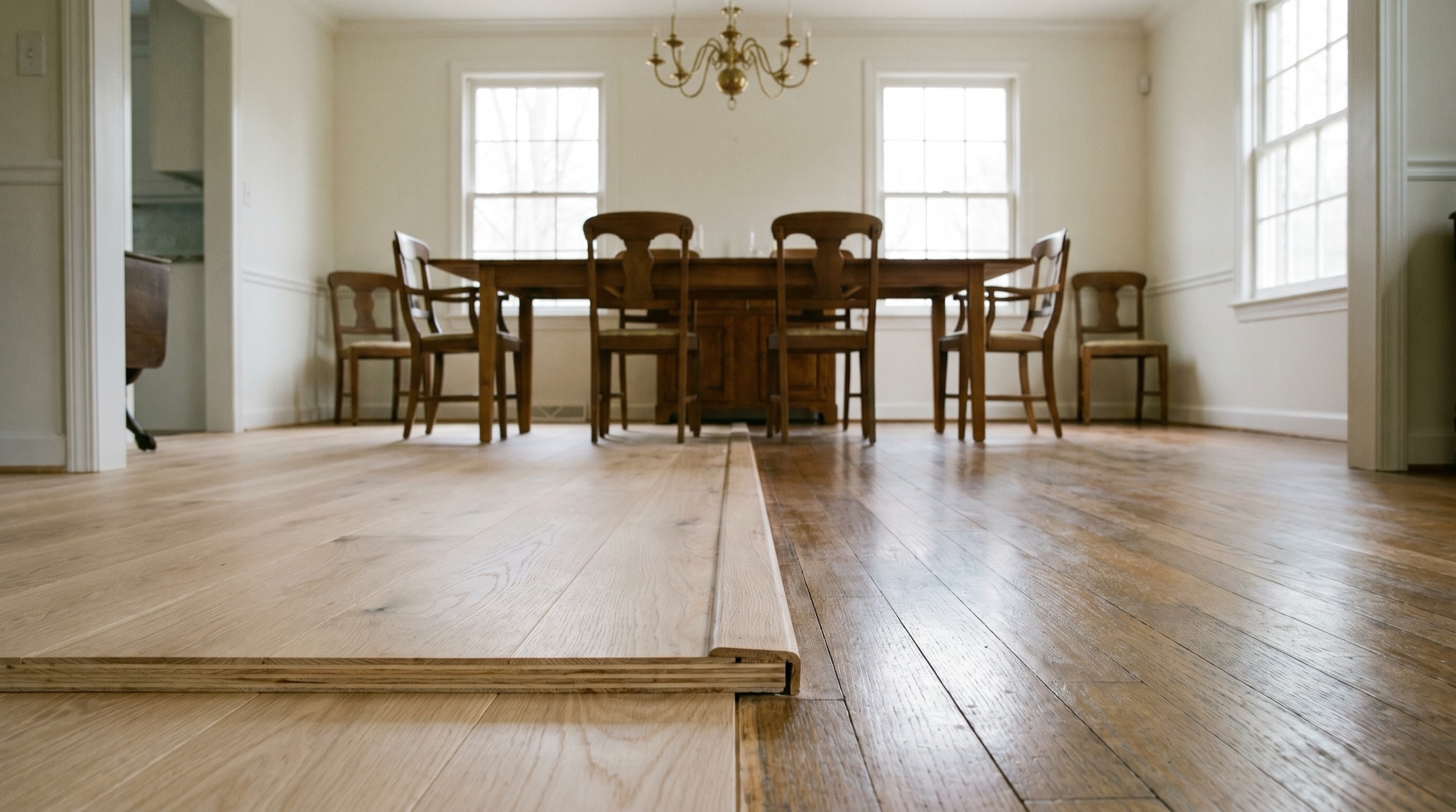
Do not confuse veneer thickness with the overall thickness of the plank. A 1/2-inch engineered board can have a fat 3mm veneer or a paper-thin 0.6mm one, and the two refinish completely differently even though they measure the same at the edge. The veneer is just the real-wood cap on top. When a floor guy sands, he is removing wood from that cap and nothing else, and every full refinish costs you about a millimeter of it, sometimes a little less with a careful grit sequence. Leave too little and the next foot traffic wears through to the seam where the veneer meets the plywood, which shows as a gray or blond line and cannot be fixed. That is why the veneer number, not the word "engineered," decides everything. Our engineered hardwood thickness guide breaks down how veneer and total thickness show up on a spec sheet if you are still shopping.
How to tell if your engineered floor can be refinished
Quick answer
Four ways, easiest first: find the product name and look up the veneer thickness in the spec sheet, pull up a floor vent or register and measure the veneer at the cut edge, look at an exposed edge under a threshold or transition strip, or count how many times it has already been refinished. If you can see the real-wood layer on top is 2mm or more, you can refinish. If it is a thin sliver, you recoat instead. Ignore the coin and thumbnail "tests," they tell you nothing.
You do not need a lab. You need to see the edge of the veneer. The cleanest way is to pull the leftover box or the spec sheet from when it was installed and look up the veneer or wear-layer number, which is listed in millimeters. No paperwork? Lift a floor register or a heat vent cover, because the floor is cut through there and you can see the layers stacked at the opening: the wood cap on top, then the plywood plies underneath. Measure the top wood layer. A threshold, a stair nose, or the transition strip at a doorway is another spot where the edge is exposed. If none of that works, count the refinishes: a floor that has already been sanded twice has little left no matter what it started at. What does not work is the internet advice to "flick a coin" or "press your thumbnail" to judge hardness. That tells you nothing about veneer thickness, which is the only thing that matters here.
⚠️ Watch out
If you cannot confirm the veneer is at least 2mm, treat the floor as not sandable until a pro checks it. Sanding a thin-veneer floor on a guess is the one refinishing mistake with no undo. Once the sander cuts through the wood into the plywood, that section is done and the only fix is replacing the boards.
Veneer thickness to refinish potential
Quick answer
Here is the working rule installers use. A 0.6mm to 1mm veneer is recoat-only, no sanding. A 2mm veneer allows one light refinish in its lifetime. A 3mm veneer allows one to two. A 4mm to 6mm veneer behaves almost like a thin solid floor and can take two to five over the decades. Match your floor to the row and you know your options before anyone turns on a sander.
| Veneer thickness | Grade | Full sand-and-refinishes | Your real option |
|---|---|---|---|
| 0.6mm to 1mm | Builder / budget | 0 | Screen and recoat only, never sand |
| 2mm | Standard residential | 1 (light) | Refinish once, then recoat after |
| 3mm | Better residential | 1 to 2 | Refinish, plenty of years of use |
| 4mm to 6mm | Premium | 2 to 5 | Acts like a thin solid floor |
The refinish counts are lifetime totals, not per-decade. A floor that came with a 3mm veneer and has already been sanded once has one refinish left, not two. If you want the deeper version of this math on solid and engineered floors, our guide on how many times you can refinish hardwood walks through it board by board.
💡 Key takeaway
If your engineered floor is 2mm veneer or thicker, you can refinish it. If it is under 2mm, you cannot sand it, but you are not stuck: a screen and recoat brings back most of the look without touching the veneer. Knowing which camp you are in saves you from either wasting a refinish or ruining the floor.
When you can't sand: screen and recoat
Quick answer
A screen and recoat lightly scuffs the old finish with a fine abrasive and rolls a fresh coat of polyurethane over the top, without sanding into the wood. It fixes a dull, lightly scratched, worn-looking finish and makes the floor look close to new. It does not remove deep gouges, dents, or worn-through spots, and it cannot change the stain color. But it works on almost any engineered floor, including thin-veneer ones that can never be sanded.
This is the move most homeowners with engineered floors actually need, and most have never heard of it. The damage on a floor that looks tired is usually in the finish, not the wood: fine scratches, cloudiness, dull traffic lanes. A recoat addresses exactly that. We scuff the existing polyurethane so a new coat bonds, clean it, and lay down fresh finish. The wood underneath is never touched, so it works on a 0.6mm veneer just as well as a 4mm one, and you can do it every handful of years to keep a floor looking sharp. What it will not do is erase a deep dog gouge, pull out a dent, or fix a spot already worn to bare wood, and it cannot take a floor from dark to light. For those you need a real sanding, which brings you back to the veneer question. If your problem is a few isolated marks rather than the whole floor, our hardwood scratch repair guide covers the spot fixes first. Whether we use an oil-based or water-based finish for the recoat depends on the floor and your timeline, which we break down in the polyurethane comparison.
Refinish or replace? The honest math
Quick answer
Refinishing is almost always cheaper than replacing when the veneer allows it, because you keep the existing floor and only redo the surface. Replace instead when the veneer is worn through in spots, the boards are delaminating or cupped, or water got underneath and left soft or discolored planks. In those cases there is nothing sound left to sand, so a recoat or refinish just puts fresh finish over a failing floor. The tell is whether the wood itself is still good.
Homeowners ask which is cheaper, and refinishing wins that on price nearly every time, since you are paying to redo a surface instead of buying and installing a whole new floor. But cheaper is only the right call if there is a floor worth saving. Refinish when the veneer is thick enough and the boards are flat, tight, and dry, just tired on top. Replace when the wood has actually failed: worn through to the plywood in the traffic paths, planks separating in layers, boards cupped or crowned from moisture, or soft and stained spots that mean water got under them. No finish fixes failed wood. If you are genuinely on the fence, our refinishing vs replacement breakdown lays out the decision in detail, and if water is the cause, the water-damaged hardwood insurance guide covers how to handle a claim before you spend a dollar.
What it costs in the DMV
Quick answer
We refinish hardwood, solid or engineered, at $4.50 a square foot, which covers sanding, staining, and sealing. A screen and recoat costs less than a full refinish because it skips the sanding and the stain. Replacing with new engineered hardwood runs $8.50 a square foot all-in, which includes the material, professional installation, and tearing out and hauling off the old floor. One honest number for whichever path your floor actually needs.
Here is where the veneer question turns into dollars. If your floor can be sanded, a full refinish with us is $4.50 a square foot and covers the whole job: sanding down to fresh wood, staining to the color you want, and sealing with polyurethane. If your floor is thin-veneer and can only be recoated, that costs less because there is no sanding stage and no stain, just the scuff and the fresh finish coat. If the wood has failed and refinishing is off the table, new engineered hardwood is $8.50 a square foot all-in, with the material, the install, and demo and removal of the old floor included, one price before we start with no add-ons after. For a fuller picture of what drives a refinishing quote, see our hardwood refinishing cost guide, and for the timeline of a job, our refinishing timeline guide.
What ends the chance to refinish for good
Quick answer
Four things end an engineered floor's refinishing life: sanding through the veneer into the plywood (no undo), delamination where the veneer peels off the core, deep water damage that cups or rots the boards, and simply running out of veneer after too many prior refinishes. The first is a mistake, the rest are wear. Once any of them hits a section, that wood is done and only replacement fixes it.
Engineered hardwood dies in a few specific ways, and it is worth knowing them so you catch a floor before it crosses the line. Sanding through the veneer is the avoidable one: cut past the wood cap into the plywood and you expose the plies, which cannot be stained or saved. Delamination is when the veneer lifts away from the core, usually from moisture or a bad glue job, and a peeling surface has nothing solid to refinish. Deep water damage, the kind that cups the boards or leaves them soft and discolored, has gone past the finish into the wood itself. And plain age: a floor sanded to the end of its veneer has no wood left to remove. The through-veneer risk is exactly why we measure before we sand and why sanding a thin engineered floor is not a DIY job. If your boards are cupping from humidity rather than standing water, our guide on buckling and cupping in DMV homes shows what is fixable and what is not.
Engineered hardwood in DMV homes
Quick answer
Around the DMV we see engineered hardwood most in basements, additions, and condos on concrete slab, and solid hardwood upstairs in older Alexandria and Arlington homes. Engineered is used there because it handles the slab moisture and humidity swings better than solid. That same setting is why a lot of local engineered floors are thin-veneer builder grade that can only be recoated, so checking the veneer before planning a refinish matters even more here.
The DMV housing stock shapes what we find under people's feet. Older colonials and Cape Cods in Alexandria, Arlington, and Fairfax often have solid oak on the main levels, which sands and refinishes many times. But basements, additions, and the condos and townhomes around Tysons, Reston, and DC are usually engineered, because engineered wood rides out the moisture off a concrete slab and our big summer-to-winter humidity swing far better than solid would. The catch is that a lot of that engineered floor, especially in builder-grade and rental installs, came with a thin veneer chosen to hit a price, not to be refinished. So in this market it is common to find a good-looking engineered floor that simply cannot be sanded, and a recoat is the right and only move. If your engineered floor sits on a slab, our guide on engineered hardwood over concrete covers the moisture side, and the engineered vs solid comparison explains why each ends up where it does.
FAQs about refinishing engineered hardwood
Can all engineered hardwood be refinished?
No. Only engineered hardwood with a veneer, the real-wood top layer, of about 2mm or thicker can be sanded and refinished. Thin-veneer floors, roughly 0.6mm to 1mm, cannot be sanded at all, because a full refinish removes about a millimeter of wood and would cut into the plywood core. Those floors can still be screened and recoated instead.
How do I tell if my engineered hardwood can be refinished?
Find the veneer thickness. Check the spec sheet or leftover box, or pull up a floor register and look at the cut edge, where you can see the wood cap over the plywood. If the top wood layer is 2mm or more, it can be refinished. Ignore coin and thumbnail tests, they tell you nothing.
Is it cheaper to refinish or replace engineered hardwood?
Refinishing is cheaper when the veneer allows it, because you keep the existing floor and only redo the surface. But if the boards are worn through, delaminating, cupped, or water damaged, there is nothing sound to refinish, so you replace. The wood's condition decides it, not just the price.
How do you make engineered hardwood look new again without sanding?
A screen and recoat. We lightly scuff the old finish, then roll on a fresh coat of polyurethane without sanding into the wood. It clears dullness, fine scratches, and worn traffic lanes, and works on any engineered floor, including thin-veneer ones. It will not remove deep gouges or dents or change the stain color.
How many times can engineered hardwood be refinished?
It depends on the veneer thickness. A 2mm veneer takes one light refinish, a 3mm one to two, and a 4mm to 6mm premium veneer two to five over its life. Each full sanding removes about a millimeter. These are lifetime totals, so a floor already sanded once has that many fewer refinishes left.
Can you change the color of engineered hardwood when refinishing?
Yes, but only with a full sanding, which needs a 2mm-plus veneer. Sanding to bare wood lets us apply a new stain, so you can go darker or lighter. A screen and recoat cannot change color, because it never reaches the wood. If your floor is thin-veneer and you want a different color, replacement is usually the honest answer.
Bottom line
Can you refinish engineered hardwood floors? Yes, if the veneer, the real-wood layer on top, is about 2mm or thicker, because that is what a sander has to work with, and each full refinish costs roughly a millimeter of it. Thinner than that and you cannot sand, but a screen and recoat still brings the look back without touching the wood. So before anyone fires up a sander, find your veneer number, from the spec sheet or the edge at a floor vent or threshold. We refinish solid and engineered hardwood at $4.50 a square foot, recoat for less, and replace with new engineered hardwood at $8.50 a square foot all-in when the floor is past saving. Not sure which camp your floor is in? We will come measure the veneer and tell you straight. Getting your floors looked at in Alexandria, Arlington, Fairfax, or anywhere in the DMV? Get a free in-home quote and we will tell you honestly whether to refinish, recoat, or replace.