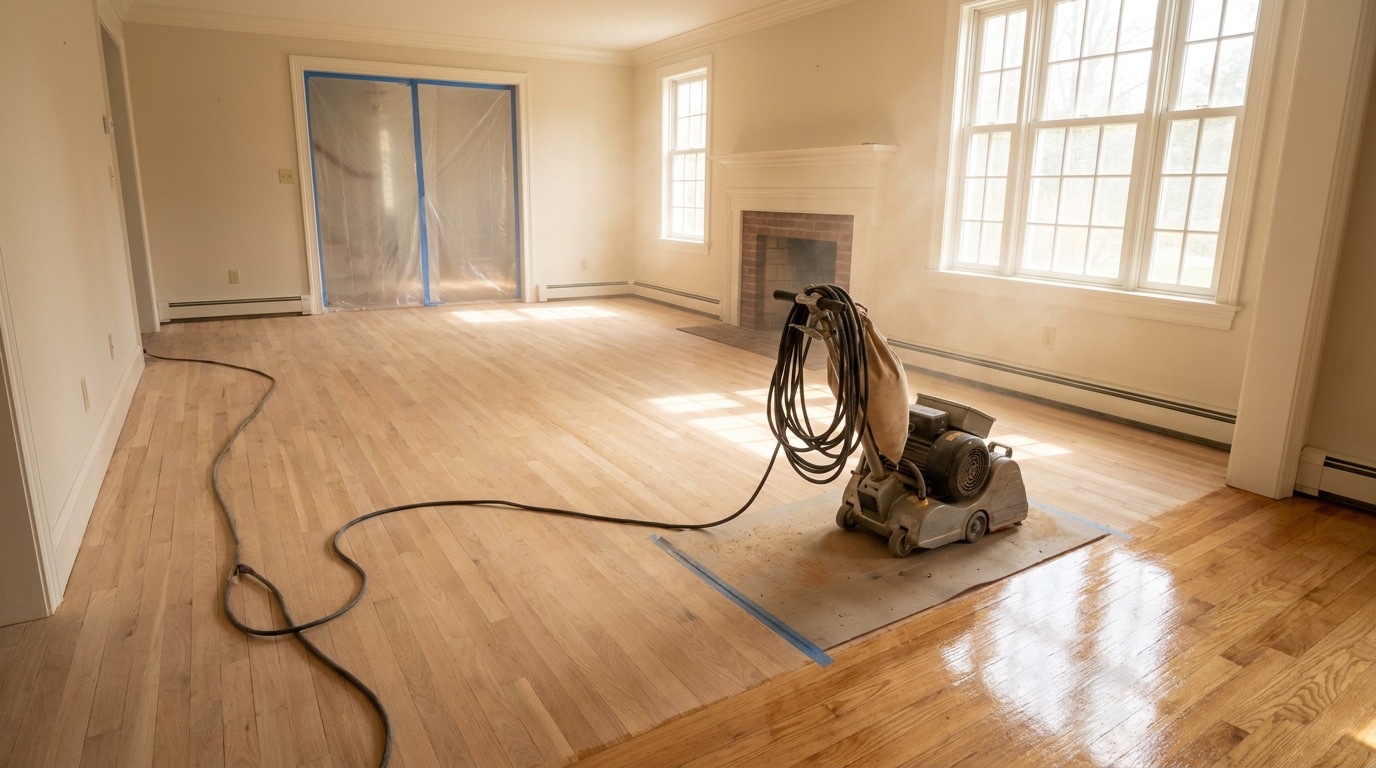
The first question a homeowner asks when we walk a refinishing job in Alexandria, Arlington, Fairfax, Falls Church, Vienna, Bethesda, Reston, Old Town, Tysons, or anywhere else in the DMV metro: "How long will my house be unusable?" The second question, after the price: "Are you sure it only takes that long?" Both are fair. After 20+ years refinishing hardwood across this market, here is the honest day-by-day timeline. What happens each day, when you can walk on the floor, when furniture goes back, what shifts the schedule, what we need from you to keep it on track, and the three timeline mistakes we hear on almost every job that runs long.
The short answer for DMV homeowners
Quick answer
Plan on 5-7 days off the floor for a standard 800-1,500 sqft refinish, plus 7-14 more days of cure before furniture and rugs go back. A typical DMV refinish runs Day 1 prep and rough sand, Day 2 fine sand, Day 3 stain (skip if natural), Days 4-6 three coats of polyurethane, then 7-14 days of cure. You can walk on the floor in socks 24 hours after the last poly coat. Furniture goes back on felt pads at Day 10. Area rugs at Day 14. Full cure to factory spec is 30 days for water-based and 60 days for oil-based polyurethane. The whole-house timeline depends on square footage, staining, and weather. A small unstained 600 sqft refinish can wrap in 3 working days, and a 2,000 sqft whole-floor stained refinish in DMV July humidity can push 7-8 working days. Potomac all-in refinish pricing is $4.50/sqft (sanding, staining, sealing) regardless of which species or sheen. See our DMV refinishing cost guide.
That is the head answer. The body walks through the structural reason refinishing takes longer than people expect, each day in real hours and what is happening on the floor, the cure-and-return rules people get wrong, the timeline-shifters that turn a 4-day job into a 7-day job, what we need from you before Day 1, the three mistakes we hear constantly, and the FAQs.
Why refinishing takes longer than people expect
Quick answer
Sanding is fast. Drying is slow. The actual labor on a 1,200 sqft refinish is roughly 18-24 crew-hours. That's a crew of two working two full days. The reason the calendar runs 5-7 days is that every poly coat needs 6-12 hours of dry time before the next one goes on, and you cannot rush it. Water-based polyurethane in DMV July humidity (65-75 percent RH) dries closer to 12 hours per coat than 6. Oil-based polyurethane runs even longer at 12-24 hours per coat. Multiply by three coats and the dry windows alone consume 36-72 hours of the calendar. That is why "I thought you said two days" is the most common homeowner confusion: two days of WORK, five to seven days of CALENDAR.
The structural mechanic underneath: polyurethane cures by chemical reaction, not by air drying. A poly coat goes through three stages: dry-to-touch (a few hours), dry-to-walk (12-24 hours), and fully cured (30-60 days). You can lay a second coat once the first is dry-to-walk, but you cannot do it faster than that. Putting a coat on wet poly traps solvent below the surface, gives you a milky finish, and either peels in six months or never fully hardens. We have refinished over plenty of botched DIY jobs where exactly this happened. The dry windows are non-negotiable.
DMV climate adds a real timing factor. The metro sits in the humid-subtropical zone. May through September commonly runs 65-85 percent indoor relative humidity if windows are open or AC is undersized. High humidity slows polyurethane cure roughly 30-50 percent. Winter (December-February) at 25-35 percent indoor RH is the fast season. Coats can dry in 4-6 hours and a refinish wraps in 4 days. Same crew, same floor, same product, different calendar.
Day 1: Prep, furniture out, demo (if needed), first sand
Quick answer
Day 1 is the heaviest physical day. The crew arrives at 8am with the trailer. First two hours: move remaining furniture out, lay plastic dust barriers across every adjoining doorway, tape baseboards and HVAC returns, pull floor vents and stair nosing, vacuum the floor of grit. Next four to six hours: drum sander cuts the field with 36-grit (or 24-grit if there is heavy finish or pet damage), edger handles the perimeter and closets, palm sander cleans the corners. End-of-day floor is raw wood, dust-vacuumed, sealed behind plastic. The room is unusable, dusty, and smells like fresh wood.
| Time | What is happening | What you should not do |
|---|---|---|
| 8:00-8:30am | Crew arrives, walk-through, confirm scope and stain sample | Be home for first 15 min only; then leave |
| 8:30-10:30am | Furniture move-out, dust barriers up, baseboards taped, floor prep | Walk through the work area |
| 10:30am-3:00pm | Drum sand field at 36-grit (or 24-grit on rough), edge work begins | Bring pets or kids into the work zone |
| 3:00-5:00pm | Edge work continues, palm-sand corners, HEPA vacuum field | Open windows wide on a hot humid day (raises moisture) |
| 5:00-6:00pm | Floor sealed off behind plastic; crew packs up | Inspect by walking on raw wood with shoes |
A few Day-1 specifics that matter in DMV homes. We never sand a floor that still has carpet tack strip nails sticking up. The drum sander will rip a $400 cloth-and-paper belt in one pass and stop work cold. Our walk-through catches this before the truck unloads. We also catch unexpected water-stain rings (toilet leaks, fish tank spills, pet accidents that soaked into the wood), which sometimes require board replacement before sanding can continue. This is one of the most common timeline-shifters and we cover it in the water-damaged hardwood guide. If you have a 1955-1985 Northern Virginia colonial or split-level with the original 3/4-inch oak strip, expect 24-grit on the first pass to cut through 60 years of layered finish; if you have a 2010s engineered floor, expect 60-grit because there is less wear layer to spend.
Day 2: Fine sanding to 120 grit
Quick answer
Day 2 is the dust day. The crew runs the drum sander through three progressively finer grits (60, 80, then 100 or 120) to cut out the 36-grit scratches and bring the surface to a uniform smoothness. A buffer with 120-grit screen finishes the edge work and corners. The room produces the most fine dust on this day. Our HEPA vacuum runs continuously and the dust barrier doors stay sealed. By 4-5pm the floor is sanded to final smoothness, vacuumed twice, wiped with a tack cloth, and ready for stain (Day 3) or the first poly coat if you are doing a natural finish.
| Pass | Grit | What it does |
|---|---|---|
| First (Day 1) | 24-36 grit | Cuts old finish off, levels cupped boards, removes pet stains and gouges |
| Second (Day 2) | 60 grit | Removes the deep 36-grit scratches |
| Third (Day 2) | 80 grit | Refines the surface, removes 60-grit scratches |
| Fourth (Day 2) | 100 or 120 grit | Final smoothness; sets stain-acceptance grain |
| Edge work (both days) | Matched grits | Edger and palm sander match the drum-sander grit at each pass |
The most common Day-2 surprise is finding that the floor is not flat. Original 1950s strip oak in a Falls Church or Vienna home can develop seasonal cupping or crowning that the original installer never sanded out. When we hit it with the drum sander, the high spots cut faster than the lows. We can sand it flat, but that eats wear layer and changes how many future refinishes the floor can take. We cover that count in the DMV refinish-count guide. The choice (sand it flat now and lose a future cycle, or leave the cup and live with the read) is one we walk you through on Day 2 if it comes up.
Day 3: Stain application (or skip if natural)
Quick answer
Stain is wiped on, allowed to set 5-10 minutes per the manufacturer spec, then wiped back to remove the excess. The crew works in 200-300 sqft sections so the stain does not over-penetrate before the wipe-back. A typical 1,200 sqft stained floor takes one crew of two roughly 4-5 hours, finishing by 1-2pm. The floor then sits overnight to dry. No traffic at all. If you are doing a natural or clear refinish (no stain), this day is skipped. The first poly coat goes on the morning of Day 3 instead, and the whole timeline compresses by one day. We pick stain on Day 0 from sample boards we leave with you, or fast-track samples on Day 2 morning if you are deciding mid-job.
A few stain-specific timing notes. Water-based stain dries faster than oil-based. Water-based goes from wipe to poly-ready in 4-6 hours in DMV winter, 8-12 in DMV summer. Oil-based needs 12-24 hours minimum. The current 2026 DMV mix on our refinishing book is roughly 70 percent water-based stain, 30 percent oil. The water-based shift is driven by faster cure, lower VOC (important for occupied homes and condos with HOA VOC rules), and the modern light/gray stain palette that water-based hits better. Full stain choice rationale is in our DMV stain color guide and the oil-vs-water question is unpacked in the poly comparison.
Days 4-6: Three coats of polyurethane
Quick answer
Three coats of polyurethane go down over three calendar days, one coat per day. Each coat is rolled or applicator-pulled across the field in 100-150 sqft sections, dries 6-12 hours (water-based) or 12-24 hours (oil-based), and the next coat goes on top the following morning. A light buff or 120-grit screen between coats is standard on the second and third. It knocks down any raised grain and gives the next coat better adhesion. Sheen choice (matte, satin, semi-gloss, or gloss) is set in the topcoat. Our 2026 mix is heavily satin and matte (see the DMV sheen guide). After the third coat dries to touch (a few hours), the floor is walkable in socks 24 hours later, typically the morning of Day 7.
| Day | Morning | Afternoon | Overnight |
|---|---|---|---|
| Day 4 | Tack-cloth surface, first poly coat applied | Coat dries to touch (2-4 hrs) | Full overnight dry |
| Day 5 | Light buff/screen, vacuum, second poly coat | Coat dries | Full overnight dry |
| Day 6 | Light buff/screen, vacuum, third (final) poly coat | Coat dries to touch | 24-hour dry-to-walk window starts |
The mid-coat buff is one of those installer details that separates a long-lasting refinish from a callback. A poly coat that dried overnight has a slick surface; the next coat needs a slightly toothed surface to bond. The buff takes 15-20 minutes per 1,000 sqft and meaningfully extends the floor's lifespan. We do it on every refinish. We have walked DIY refinishes where the homeowner skipped the buff to save time and the topcoat peeled in eight months. Worth the 20 minutes.
⚠ Watch out
Some DMV homeowners want to live in the house during Days 4-6, thinking the dust is over. The fumes are not. Water-based poly has a real but mild ammonia-like smell for 24-48 hours per coat. Oil-based poly has a much stronger solvent smell that can linger 4-7 days. If anyone in the house has asthma, respiratory sensitivity, or is pregnant, plan to stay elsewhere through Day 7. Pets (especially birds and small dogs) should not be in the home during oil-based poly cure at all.
Days 7-14: Cure, walk rules, furniture return
Quick answer
The cure window after the last poly coat is where most floor damage happens, and it is also where most homeowners get the rules wrong. Walk in clean socks after 24 hours. Walk with bare feet after 48 hours. Furniture moves back on felt pads after 10 days. Area rugs go down after 14 days. Full cure (so the finish is at maximum hardness and scratch resistance) is 30 days for water-based polyurethane and 60 days for oil-based. Putting a heavy couch on a 3-day-cured finish leaves a permanent indent. Putting an area rug on a 5-day-cured finish can trap solvent, leave a haze ring, and ruin the finish in that footprint. The 10-day furniture / 14-day rug rule is the conservative version that prevents all the common return-day mistakes.
| Time after last coat | What you can do | What to still avoid |
|---|---|---|
| 0-24 hours | Nothing. Stay off the floor | Walking, pets, anything |
| 24-48 hours | Walk in clean socks only | Bare feet, shoes, pets, dragged items |
| 48-72 hours | Bare feet OK; pets in only briefly | Furniture, rugs, heavy traffic |
| 3-7 days | Normal foot traffic; light shoes OK | Furniture, area rugs, heavy items |
| Day 10 | Furniture back, on felt pads only | Area rugs still off |
| Day 14 | Area rugs go down | None |
| Day 30 (water-based) | Floor is at factory-spec hardness | None |
| Day 60 (oil-based) | Floor is at factory-spec hardness | None |
One DMV-specific note on the furniture-return day. Roughly 60 percent of summer refinish jobs come with a "we have a party / family in town / out-of-state guests in two weeks" pressure to push furniture back early. We hold the line on the 10-day rule because we have seen the indent damage too many times. A heavy sectional or a piano dropped on a 6-day-cured floor leaves footprint-shaped craters that only a full re-sand and refinish will remove. Same job, same money, six months later. If the calendar is tight, the right move is to schedule the refinish earlier, not to compress the cure. See our DMV pre-listing flooring guide for the two-week buffer logic on real estate timelines.
What can change the timeline (and by how much)
Quick answer
Six things shift a refinish timeline up or down. Square footage (small jobs compress, large jobs stretch). Stain vs natural (natural saves one day). Water-based vs oil-based poly (water saves 2-4 days). DMV season (winter is faster than July humidity). Board replacement or sub-floor repair (adds 1-2 days). Stair refinishing (stairs add 1-2 days on top of the field). Most of these get scoped on the walk-through; the unpredictable one is what we find under old carpet or sub-floor on Day 1 demo.
| Factor | Timeline impact | How we plan |
|---|---|---|
| Square footage 600 sqft or under | -1 to -2 days | Can wrap in 3-4 working days |
| Square footage 1,500-2,000 sqft | +1 to +2 days | Bigger crew or split sanding days |
| Square footage 2,000+ sqft (whole house) | +2 to +4 days | Two-zone sequencing |
| Skipping stain (natural finish) | -1 day | Poly coat 1 lands on Day 3 |
| Oil-based poly instead of water-based | +2 to +4 days | Each coat needs longer dry; family stays out longer |
| DMV May-September humidity | +1 to +2 days | Dehumidifier on-site, longer dry windows |
| DMV December-February dry season | -0 to -1 day | Fast cure; ideal refinish window |
| Board replacement (water/pet damage) | +1 to +2 days | Match wood, acclimate, blend the sand |
| Stair refinish on top of field | +1 to +2 days | Stairs sanded by hand; longer dry window per coat |
| Screen-and-recoat instead of full refinish | -3 to -5 days | 1-day job, walkable in 24 hours, see "Bottom line" |
The screen-and-recoat option deserves a callout because plenty of DMV homeowners assume they need a full refinish when they don't. If your floor has only Level 1 wear (the topcoat is scratched but the wood and stain underneath are fine), a screen-and-recoat takes one working day, costs $3.00-4.50/sqft all-in, and the floor is walkable in 24 hours. No sanding to bare wood. No stain. No board replacement. Same crew, same equipment, one day. We assess for this on the walk-through and the decision logic is in the refinishing-vs-replacement guide.
What we need from you before Day 1
Quick answer
Five things ready by 8am on Day 1 keep the schedule on track. Furniture out of the work zone (or coordinated with us to move on Day 1 morning, which adds 2 hours). Wall art and curtains down (the sanding vibration knocks loose anything not secured). Pets relocated. Stain color decision made and signed off. A working power outlet within 50 feet of the work zone (our drum sander pulls a 20-amp dedicated circuit; we sometimes need to plug into a garage or basement outlet for older homes). Anything not done by 8am on Day 1 stretches the schedule by the time it takes to fix.
- Furniture move-out. Empty the work zone yourself, or pay us to do it (typically $200-400 per room for our crew on Day 1 morning, adds 2-4 crew-hours). The most common timeline-blower we see is a homeowner who says "I'll move it morning of" and is still moving things at 10am while our drum sander is parked in the truck waiting.
- Wall art, curtains, blinds. Take them down or expect dust on everything. Sander vibration also knocks loose anything not pinned, including framed art and shelving brackets.
- Pets. Dogs and cats should be out of the home through Day 7 (last poly coat plus 24 hours). Birds and small caged animals should be out through Day 14 (oil-based) or Day 10 (water-based). Fumes affect respiratory systems disproportionately.
- Stain decision. We bring sample boards on the walk-through and leave them with you. Pick by the time the crew arrives on Day 1. If you are deciding mid-job, we can run a fast-track sample on Day 2 morning but it shifts the stain day from Day 3 to Day 3.5.
- Power. Our drum sander needs a 20-amp dedicated outlet within reach. We bring 50-foot cords. In older Alexandria and Arlington homes pre-1955, sometimes we need to coordinate access to a basement panel or garage outlet because the living-room circuits will trip under load. We check this on the walk-through; you don't have to figure it out.
Three timeline mistakes we hear constantly
Quick answer
"Two days, right?" "I'll have the furniture back by the weekend." "We're hosting Saturday. Can you finish Friday?" The three timeline mistakes we hear on almost every DMV refinish are confusing work-days with calendar-days, compressing the cure window, and trying to schedule a refinish around a hard social event. All three end the same way: a callback, a damaged floor, or a stressed homeowner. The fix is up-front honesty about the real schedule. That's why we walk through this guide on the quote call.
| Mistake | What goes wrong | The real number |
|---|---|---|
| "It's only 2 days of work" | True for crew-hours, false for calendar; cure windows are non-negotiable | 2 days of work, 5-7 days of calendar, 14 days to full furniture return |
| "Furniture back by the weekend after Day 6" | Heavy couches dent the soft-cured finish permanently | Felt-pad furniture Day 10; heavy items Day 14 |
| "Can you finish Friday for Saturday's party?" | You will be hosting on day-of-last-coat. Wet, smelly, and unwalkable in shoes | Schedule the refinish to END 14 days before the event, not the day before |
| "I'll just keep the rugs rolled up in the corner" | OK if the corner is outside the work zone; not OK if rugs touch the floor before Day 14 | Rugs stay rolled and out of the work zone until Day 14 |
| "We'll just put felt pads on heavy stuff right away" | Felt pads concentrate weight; soft finish indents even faster | Wait the full 10 days even with pads; heavy items wait 14 |
💡 Key takeaway
If you have a hard social or real-estate date (party, listing photos, family arrival), schedule the refinish to FINISH 14 days before, not 2-3 days before. Build the cure window into the calendar, not around it. The two-week buffer is non-negotiable for water-based; it's three weeks for oil-based. We will tell you the right calendar window on the quote call and hold to it.
FAQs about the refinishing timeline
How long does a typical DMV hardwood refinish actually take?
Plan on 5-7 working days from start to last coat for a typical 800-1,500 sqft refinish, then 7-14 calendar days of cure before furniture and rugs return. A small 600 sqft natural refinish in DMV winter can wrap in 3 working days. A 2,000 sqft stained refinish in July humidity can stretch to 7-8 working days. The first 24 hours after the final coat is the only true no-walk window. After that you are in socks-only, then bare-feet, then increasingly normal traffic.
When can I walk on a refinished hardwood floor?
Walk in clean socks 24 hours after the last polyurethane coat. Walk with bare feet at 48 hours. Wear soft-soled shoes at 72 hours. Normal walking traffic resumes after Day 4-5. Pets are OK in the house at Day 7 (water-based poly) or Day 10 (oil-based). The finish is not at maximum hardness until Day 30 (water-based) or Day 60 (oil-based). That is the difference between "can I walk on this" and "is this scratch-resistant yet."
When can I move furniture back on a refinished floor?
Day 10 with felt pads under every leg. Day 14 if the furniture is heavy (pianos, dressers full of clothes, large sectionals). Lighter items like end tables and lamps can come back on Day 7-8 with felt pads. The reason for the wait: the polyurethane is dry to the touch in hours but still soft for two to four weeks. A heavy load on a soft finish leaves a permanent indent that no buffing will fix.
When can I put area rugs back down?
Day 14 minimum for water-based polyurethane, Day 21 for oil-based. The reason is that the rug traps off-gassing solvent under it, which can leave a permanent yellow or hazy ring in the footprint of the rug. We have seen this happen on DIY refinishes where the homeowner rolled the rug back out at Day 5. The damage is permanent and only a full re-sand fixes it.
Can the refinish go faster with more crew?
Sometimes. A bigger crew can compress Day 1 prep and Day 1-2 sanding from 18 crew-hours to 12, which can shave half a day off the front of the job. What more crew cannot do is shrink the dry windows. Two coats per day is not possible no matter how many people are there. The fastest a 1,200 sqft natural refinish can wrap is 4 working days; the fastest a stained one is 5 working days.
What if I need the kitchen but the rest of the floor is being refinished?
Common DMV ask. Main floor hardwood that opens to a kitchen island, where the kitchen needs to stay accessible. The fix is sequencing: we refinish the kitchen field after the living/dining is sealed off, or we split the job into two phases with a week between. Either way, plan to be either eating out, using an outdoor grill, or accepting limited kitchen access for the 5-7 day window. We will walk you through the options on the quote call.
Is screen-and-recoat actually faster than refinishing?
Yes, dramatically. A screen-and-recoat is a 1-day job. The crew lightly abrades the existing finish with a 120-grit screen, vacuums, and applies one fresh coat of polyurethane. Floor is walkable in 24 hours, fully cured in 7 days. Cost is $3-4.50/sqft all-in DMV. The catch is that screen-and-recoat only works if your existing finish is intact (only the top layer is worn, the wood and stain underneath are fine) and the existing finish is compatible with new poly. We check this on the walk-through. If a homeowner waxed the floor or used a non-compatible product, we cannot just recoat.
What if it's the middle of DMV summer? Should I wait until fall?
You don't have to, but expect a 1-2 day timeline stretch. Summer high-humidity months (June-September) slow polyurethane cure 30-50 percent. We compensate with on-site dehumidifiers and HVAC management, and water-based poly handles summer better than oil-based. If you have a hard deadline and humidity is high, we'll use water-based and plan for an extra day. If the deadline is flexible, October-April is the fastest cure window in the DMV.
Bottom line: the real DMV refinishing schedule
A standard DMV hardwood floor refinish (800-1,500 sqft, stained, water-based polyurethane, three coats) runs five to seven working days from the morning the crew arrives to the morning of the last poly coat. You walk in socks 24 hours after the last coat. Furniture goes back on felt pads at Day 10. Area rugs at Day 14. Full cure to factory-spec hardness at Day 30 (water-based) or Day 60 (oil-based). Cost is $4.50 per square foot all-in (sanding, staining, sealing) regardless of species or sheen. If you need to be in the house for any of it, plan to be on the second floor and out the door by 8am every day; full out-of-the-house from Day 1 through Day 7 is the calmest version. We give you the real schedule on the quote call and hold to it. The only honest way to refinish a floor is to give the cure windows their time.
Related reading: DMV refinishing cost guide, oil vs water polyurethane, sheen guide, DMV stain colors, how many times can a floor be refinished, refinish vs replace, maintenance guide.
Thinking about refinishing this season?
Free in-home walk-through. We measure the floor, check the wear layer, identify any board replacement, and quote the real all-in price + the real calendar before you sign anything. $4.50/sqft all-in for a full refinish across the DMV metro.