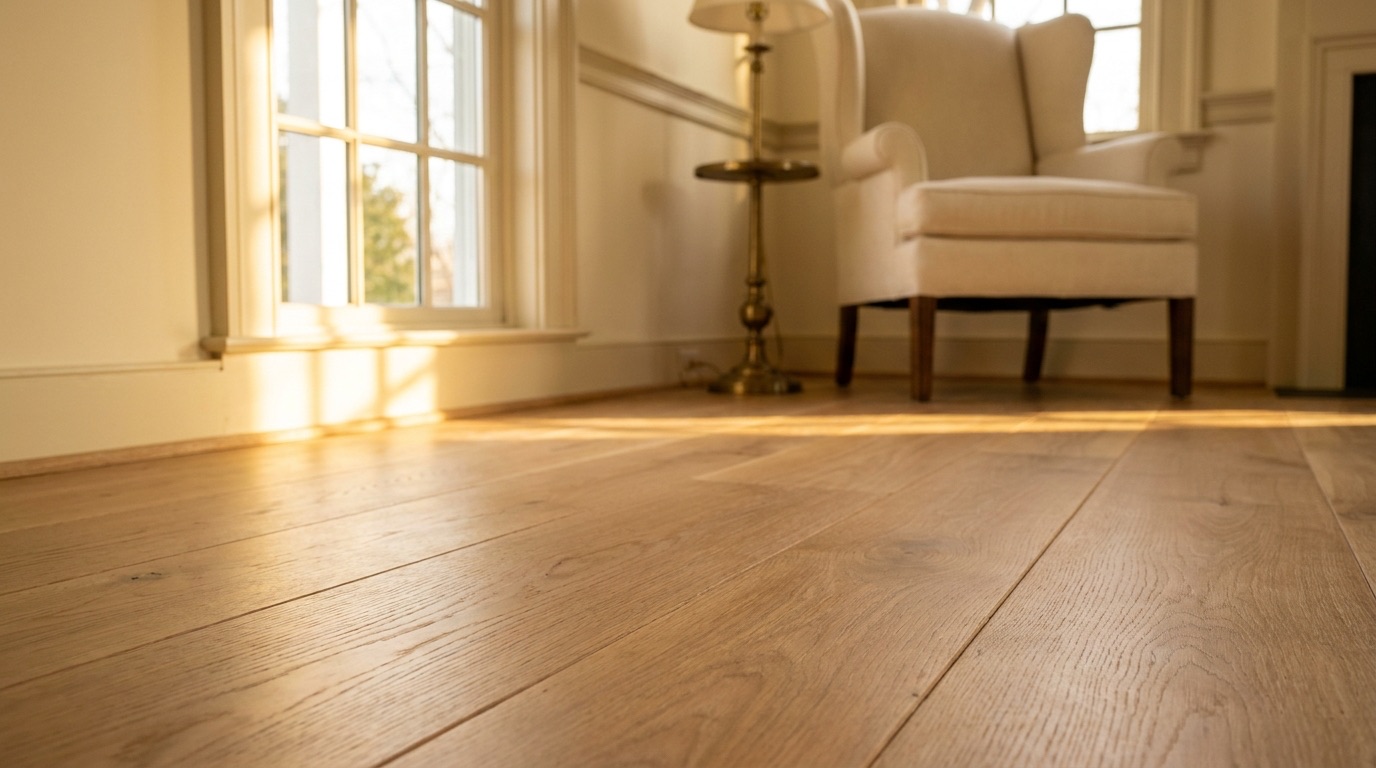
The last choice every refinish customer makes before our crew rolls the topcoat is sheen. The stain is already cured. The sander is already loaded back on the truck. The applicator is about to come out of the can, and we ask the homeowner one question: matte, satin, semi-gloss, or gloss. Half of them stare at the four sample boards on the floor and pick the wrong one for their room. After 20+ years refinishing hardwood across Alexandria, Arlington, Fairfax, Falls Church, Vienna, Bethesda, Reston, Old Town, Tysons, and the rest of the DMV metro, here is the honest sheen guide. What each one actually looks like, which hides scratches and which shows every footprint, which sheen works in north-facing Old Town colonials versus south-facing Reston rambler bay windows, what we install most often by room, and the three sheen mistakes we get called back to fix.
The short answer for DMV homeowners
Quick answer
Most DMV homeowners should pick matte or satin. Matte (around 10-25 gloss units) is the most forgiving. It hides scratches, dust, and pet hair, no glare, looks like raw wood. Satin (around 30-40 gloss units) is the most popular sheen we install in 2026. Slight warm reflection, hides most wear, easy to live with. Semi-gloss (around 55-70 gloss units) shows wood grain depth but also shows every footprint, scratch, and dust speck, usually wrong for high-traffic family homes. High-gloss (75+ gloss units) is a specialty look for formal dining rooms, foyers, or restored historic homes. Gorgeous on day one, brutal to maintain. Sheen choice does not change Potomac refinish pricing. Same $4.50/sqft all-in (sanding, staining, sealing) regardless of which sheen you pick. The default we recommend in 2026 DMV homes is satin for living areas and matte for bedrooms, kid spaces, and pet-heavy rooms.
That is the head answer. The body walks through the gloss-unit scale, the four sheens side by side, the scratch and dust-hiding test, how DMV light hits each sheen differently, what we install by room, the design shift away from gloss since 2015, whether sheen changes refinish cost or timeline, maintenance differences, the three mistakes we get called back to fix, and the FAQs.
What sheen actually means (and the gloss-unit scale)
Quick answer
Sheen is a measurement of how much light bounces straight back off the floor when a beam hits it at 60 degrees. The unit is gloss units (GU). 0 GU is a perfectly matte chalkboard. 100 GU is a wet-looking mirror. Hardwood floor polyurethane is generally rated on a scale: matte runs 10-25 GU, satin 30-40 GU, semi-gloss 55-70 GU, and high-gloss 75+ GU. Brands use slightly different numbers (Bona, Loba, Pallmann, Duraseal each have their own house definitions) but the four-step ladder is consistent. The higher the GU, the more the finish reflects like glass and the more every small surface defect shows up as a visible difference in reflection.
The reason gloss units matter is the structural mechanic underneath the design choice. Wood is never perfectly flat at the micro level. Every plank has small grain rises, sanding-pad swirls, edge bevels, and pinprick imperfections invisible to the eye on raw wood. A matte topcoat scatters light diffusely off all of them, so the eye reads the floor as uniform. A glossy topcoat acts like a mirror. Every micro-imperfection becomes a visible glint or shadow. The same floor, same wood, same stain reads very different at 15 GU vs 70 GU.
| Sheen | Gloss units (60° angle) | How it reads in a room |
|---|---|---|
| Matte / Extra matte | 5-25 GU | Looks like raw oiled wood; no reflection; reads "honest" and natural |
| Satin | 30-45 GU | Soft warm reflection; the most common 2026 choice; subtle depth without glare |
| Semi-gloss | 55-70 GU | Bright reflection; shows wood depth; also shows every footprint and scratch |
| High-gloss / Gloss | 75-90 GU | Mirror-like; formal, polished, traditional; very hard to live with daily |
Quick reference for thinking about it without going to a showroom: matte reads like raw wood with sealer on it, satin reads like a soft warm wood-tone, semi-gloss reads like a polished bowling lane, high-gloss reads like a piano top. The first two look casual; the second two look formal.
Matte, satin, semi-gloss, gloss: side by side
Quick answer
Each sheen has a specific best-fit profile. Matte: pet-heavy homes, kid spaces, low-grain species like maple or birch where you do not want glare from grain shadows. Satin: living rooms, dining rooms, kitchens, hallways, stairs. The default sheen in 2026 DMV refinishes. Semi-gloss: formal dining rooms in traditional homes, foyers in colonial-revival builds, churches and commercial spaces. High-gloss: restored historic floors, ballrooms, music rooms, period-appropriate Federal-style colonials. The vast majority of modern DMV homes land on matte or satin.
| Matte | Satin | Semi-gloss | Gloss | |
|---|---|---|---|---|
| Gloss units | 10-25 GU | 30-40 GU | 55-70 GU | 75-90 GU |
| Shows scratches | Almost never | Rarely | Frequently | Constantly |
| Shows dust | Almost never | Lightly | Visible across the room | Visible from across the room |
| Shows footprints | No | Slightly when sun hits | Yes | Yes, every step |
| Wood grain depth | Subtle | Warm and clear | Strong contrast | Maximum depth, very saturated |
| Best for species | Maple, birch, hickory (low contrast) | White oak, red oak, walnut | Red oak, mahogany (formal) | Brazilian cherry, mahogany, restored historic |
| Best for rooms | Bedrooms, kid playrooms, pet areas | Living, dining, kitchen, hall, stair | Formal foyer, formal dining | Restored historic, ballrooms, music rooms |
| Maintenance burden | Lowest | Low | High | Highest |
| Looks dated in 10 years | No, timeless | No, timeless | Sometimes (mid-2000s look) | Yes (1980s-90s formal look) |
The 2026 DMV install mix in our refinishing book is roughly 55% satin, 35% matte, 8% semi-gloss, and 2% high-gloss. Ten years ago that mix was 50% semi-gloss, 30% satin, 15% gloss, 5% matte. The shift toward matte and satin is real and durable. It tracks the broader interior design move away from formality and high-shine surfaces. See our DMV stain color guide for how sheen interacts with stain. A dark stain at high gloss reads very different from the same stain at matte.
Which sheen hides scratches, dust, and pet damage
Quick answer
Lower sheen hides everyday wear; higher sheen highlights it. A dog-nail scratch on a matte finish is almost invisible from standing height. The same scratch on a semi-gloss reads as a bright white line because the scratch breaks the reflective layer. Dust does the same thing: matte scatters light evenly, so dust blends in; gloss reflects light cleanly, so dust shows up as fuzzy specks. Footprints (the oil and dead skin left by bare feet and socks) read as dull patches on high-gloss within a week and are barely visible on matte even after a year. The rule of thumb: if you have a dog, kids, or hate dusting, go matte or satin.
| What you have | What sheen to install | Why |
|---|---|---|
| Large dog (any breed over 40 lbs) | Matte or satin | Nail scratches are inevitable; matte hides them so refinish cycle stretches from 7-10 years to 12-15 years |
| Small dog (under 40 lbs) | Satin | Lighter nails; satin is the sweet spot of warmth and durability |
| Cats only | Satin or semi-gloss | Cat claws rarely score the finish; sheen is more of a design choice |
| Toddler or kid playroom | Matte | Crayon, marker, dropped toys, food spills. Matte forgives everything visually |
| High-traffic main hall | Satin | Constant footwear traffic shows on gloss within a year; satin handles it |
| You hate dusting | Matte | Dust is roughly 4-5x more visible at 70 GU than at 15 GU |
| Formal dining room (used 6x a year) | Semi-gloss or gloss | Low traffic means scratches stay minimal; gloss showcases stain depth |
| Restored 1930s formal foyer | Gloss | Period-appropriate; gloss matches the original 1920s-30s look |
⚠ Watch out
The most common DMV refinish disappointment is the homeowner who picks semi-gloss because they "want the floor to pop" in the showroom, then comes home to a sun-flooded south-facing living room and sees every speck of dust, every footprint, every dog nail scratch within two weeks. By month three they hate it. The fix is a full screen-and-recoat at lower sheen, which is roughly $2-2.50/sqft on top of the original refinish. Pick the right sheen the first time. If you are unsure, default to satin.
DMV light: which sheen works in which room
Quick answer
The amount and angle of natural light hitting your floor changes how each sheen reads. A sun-flooded south-facing Reston or Tysons living room with full bay windows amplifies glare on semi-gloss and gloss. The floor looks washed out at midday and shows every footprint by 4pm. A north-facing Old Town colonial parlor with low ambient daylight makes matte read flat and lifeless. Satin or a low semi-gloss adds the warmth the room is missing. East-facing kitchens get harsh morning glare that turns gloss into a mirror at 7am. West-facing rooms get the same problem in evening. The rule: more light favors lower sheen; less light favors slightly higher sheen.
| Room light condition | Common DMV examples | Best sheen |
|---|---|---|
| South-facing, large windows | Reston rambler living rooms, Tysons new-build great rooms, Fairfax colonial sun rooms | Matte or low satin (control glare) |
| North-facing, smaller windows | Old Town colonial parlors, Alexandria pre-war side rooms, Arlington Cape Cod studies | Satin (add warmth without showing wear) |
| East-facing, morning sun | Kitchen breakfast areas, Vienna split-level dining | Matte or low satin (avoid 7am mirror effect) |
| West-facing, afternoon sun | Bethesda great rooms, Falls Church sun porches | Matte (the late-day glare on gloss is brutal) |
| Interior hallways, no windows | Townhouse stair halls, condo entries | Satin (low light needs slight reflection to read warm) |
| Mixed light, average room | Most DMV main living rooms | Satin (the all-purpose default) |
One DMV-specific gotcha: many 1955-1985 Northern Virginia split-levels have lower ceilings (7'6" to 8'0") than newer builds. Low ceilings + glossy floor amplifies reflected glare in the seated eye line. You see the ceiling fixture twice (once on the ceiling, once on the floor). Matte or satin solves this; gloss makes the room feel smaller and brighter than it needs to. See our DMV basement flooring guide for the low-ceiling logic in basements.
By room and use case: what we install most
Quick answer
Our standard 2026 DMV recommendations by room. Living and dining: satin (or matte if the room gets heavy south sun). Kitchen and breakfast nook: satin (matte if pets or kids; semi-gloss only in low-traffic formal kitchens). Hallways and stairs: satin (durability + warmth). Bedrooms: matte (lowest sheen, lowest wear, calmest read). Kid playrooms and family rooms: matte. Foyer in a formal colonial: satin standard, semi-gloss if the rest of the home is traditional. Home office, library, study: satin (warm, professional read). Whole-house consistency: pick one sheen and run it everywhere except bedrooms. Mixing sheens across open-concept layouts looks inconsistent.
| Room or use case | Default sheen | Alternate if |
|---|---|---|
| Living room | Satin | Matte if south-facing with bay windows |
| Dining room (used weekly) | Satin | Semi-gloss if formal-only use |
| Open-concept great room | Satin | Matte if pets or large sun exposure |
| Kitchen / breakfast nook | Satin | Matte if pets, kids, or heavy cooking traffic |
| Hallways and stairs | Satin | None |
| Master bedroom | Matte | Satin if matching adjacent hall |
| Kid bedroom / playroom | Matte | None |
| Home office, library | Satin | Semi-gloss for traditional libraries |
| Formal foyer in a colonial | Satin | Semi-gloss for full traditional look |
| Restored 1920s-30s historic floor | Semi-gloss or gloss | Period-appropriate |
| Basement family room with hardwood | Matte | Low-ceiling reflection control |
| Commercial / retail with hardwood | Satin or semi-gloss | Use case-dependent |
💡 Key takeaway
For an open-concept main floor where the living room flows into the dining room and kitchen, pick one sheen and run it across all three spaces. Mixing matte in the kitchen with satin in the living room reads as inconsistent and cheap, even if both look fine alone. The exception is bedrooms. Drop down one step (satin elsewhere becomes matte in bedrooms) and it reads as intentional.
Why almost everyone picks matte or satin now
Quick answer
The shift from glossy to matte/satin started around 2015 and is now near-total in new installs and refinishes. Four reasons drive it. European-style matte oiled floors became visible in DMV high-end builds and trickled down to mid-market. Wide-plank engineered hardwood (the dominant 2020s install) comes prefinished in matte or low satin from almost every manufacturer. Site-finished refinishes followed the same look. The "modern farmhouse" and "transitional" design vocabularies that dominated 2015-2025 reward low-sheen, natural-wood-look surfaces. And the rise of large-dog and kid-friendly residential design pushed homeowners toward the most forgiving sheen that did not look cheap.
A few specifics on the design shift that matter for your decision:
- Prefinished engineered hardwood set the floor. Most engineered hardwood that ships from Mirage, Hallmark, Mercier, Lauzon, Anderson Tuftex, and DuChateau is matte or low-satin out of the box. When a DMV homeowner installs prefinished and three years later refinishes a different room or hallway in site-finished poly, they want it to match, so the refinisher hits the same sheen. The aftermarket has now fully shifted to match.
- Wide plank looks better at lower sheen. A 6-7 inch plank at matte reads as natural and grounded. The same plank at semi-gloss looks plastic and showroom-staged. Since wide plank is the dominant 2020s install, the sheen choice followed. For more on wide plank tradeoffs see our DMV wide plank guide.
- Open-concept layouts dominate DMV new builds. When the living, dining, and kitchen all flow into one big space, the floor becomes 800-1,400 sqft of continuous surface. At that scale, semi-gloss reads as overwhelming glare. Matte or satin lets the eye relax across the space.
- Pet ownership is up. National AVMA data shows pet ownership rose steadily from 2015-2025; DMV builds out the same. Anecdotal but consistent on our refinish book: 70%+ of homes we refinish now have at least one dog. Low sheen handles dog life; high sheen does not.
The practical implication: if you are unsure, satin is the safe modern default. Matte is the calm, no-maintenance default. Both will look current in 10 years. Semi-gloss and high-gloss can look dated faster. The 1990s-2000s formal-suburban look. The only reason to pick gloss in 2026 is a deliberate period-appropriate or formal-historic statement.
Does sheen change refinish cost or timeline?
Quick answer
No. Sheen choice is free in a Potomac refinish. Our refinishing all-in price stays $4.50 per square foot regardless of whether you pick matte, satin, semi-gloss, or gloss. Same sanding, same staining, same sealing, same coat count. Different sheens have slightly different curing characteristics but the timeline is identical: 3-5 days for the full process on a typical 800-1,500 sqft floor, including drying time. The only cost lever that moves with sheen is in DIY territory. Gloss polyurethane is sometimes 5-10% more expensive per gallon at the retail level than satin or matte from the same brand. At professional volume the difference disappears.
| Item | Matte | Satin | Semi-gloss | Gloss |
|---|---|---|---|---|
| Potomac all-in refinish price | $4.50/sqft | $4.50/sqft | $4.50/sqft | $4.50/sqft |
| Typical timeline (800-1,500 sqft) | 3-5 days | 3-5 days | 3-5 days | 4-6 days (an extra dry-time buffer is wise) |
| Coat count (water-based poly) | 3 coats | 3 coats | 3 coats | 3 coats + a buff between |
| Walk-on time after final coat | 24 hours (socks); 72 hours (shoes) | Same | Same | Slightly longer to fully cure-test |
| Furniture back time | 5-7 days | 5-7 days | 5-7 days | 7-10 days |
For the full refinish cost framework see our DMV hardwood refinishing cost guide and our oil vs water-based polyurethane guide. Which polyurethane formula you pick matters more for amber-tone, dry-time, and durability than sheen does for the bill.
Maintenance differences by sheen
Quick answer
Lower sheen needs less cleaning to look good; higher sheen needs more. Matte hides dust between weekly vacuums. Satin needs a dust mop every 4-7 days to stay looking clean. Semi-gloss shows dust within 48 hours of a clean. Gloss shows dust the next morning. None of the sheens require a different cleaner. A pH-neutral hardwood cleaner (Bona, Loba Cleanstar, or equivalent) works for all four. The cleaning frequency is what changes. Plan for a screen-and-recoat every 7-10 years regardless of sheen; this resets the topcoat without a full sand and is roughly $1.50-2.50/sqft.
- Daily and weekly: Dry dust mop or microfiber sweep, more often the higher the sheen. Matte once a week is enough in most homes; gloss often needs 2-3x per week to stay looking right.
- Monthly: Wet mop with pH-neutral hardwood cleaner. Avoid vinegar, soap, ammonia, and anything labeled "wax." They all leave residue that builds up on every sheen but reads worst on gloss.
- Annual: Inspect for high-traffic dull patches (these show first on matte but read as scratched on gloss). A spot recoat to a worn area is possible but is usually deferred until a full screen-and-recoat is due.
- Every 7-10 years: Screen-and-recoat (or "buff and coat"). The crew lightly abrades the existing topcoat, vacuums, and applies one fresh coat at the same sheen. Costs ~$1.50-2.50/sqft and resets the surface without removing wood. For details see our DIY vs pro maintenance guide.
- Every 15-25 years (or sooner if heavily worn): Full sand and refinish. Removes the old finish entirely. Same $4.50/sqft. For the refinish-vs-replacement decision see our refinish vs replacement guide.
Common DMV sheen mistakes we fix
Quick answer
Three mistakes we see most often on DMV refinish callbacks. Picking semi-gloss for a high-traffic family room because it looked good on a showroom sample board (every footprint shows by month two). Mixing sheens across an open-concept layout (matte kitchen flowing into satin living room reads as inconsistent and cheap). Choosing gloss because a 1980s memory of a fancy formal floor felt right, in a 2026 transitional-style home where it now looks dated. All three are fixable with a screen-and-recoat at the right sheen, but it is a roughly $1.50-2.50/sqft do-over you avoid by picking right the first time.
| Mistake | What goes wrong | Fix |
|---|---|---|
| Semi-gloss in a south-facing family room | Every footprint, scratch, and dust speck shows; homeowner unhappy by month two | Screen-and-recoat at satin or matte; ~$1.50-2.50/sqft |
| Gloss in a low-ceiling split-level | Glare amplifies ceiling fixtures; room feels smaller and brighter than intended | Screen-and-recoat at satin |
| Mixed sheens across open-concept main floor | Reads inconsistent; eye catches the transition; looks unintentional | Sand and recoat the lower-sheen rooms up to match (or all to satin) |
| Matte in a north-facing parlor with no other warm finishes | Floor reads flat and lifeless without ambient warm reflections | Screen-and-recoat at low satin (adds warmth without showing wear) |
| Picked sheen from a 3-inch sample board only | Sample reads differently than a 200 sqft floor; almost always pick too glossy | Always check the sheen sample on a 4-foot square test patch in the actual room before committing |
The pattern across all five mistakes is the same: the homeowner picked a sheen from a small sample under showroom light without considering how 800-1,500 sqft of it will read under their actual home light and daily use. The single fix that prevents all of them: ask your refinisher to apply a 4-foot test patch in the actual room, with the actual stain, and live with it for 24 hours under your real morning, midday, and evening light before committing the whole floor. Every reputable DMV refinisher will do this on request.
FAQs about hardwood floor sheen
What is the most popular hardwood floor sheen in 2026?
Satin is the most popular sheen we install in the DMV in 2026, roughly 55% of our refinishes. Matte is second at about 35% and rising fast, especially in pet households, kid spaces, and large open-concept homes. Semi-gloss runs around 8% of installs (mostly formal dining rooms and traditional foyers) and high-gloss is under 2% (mostly restored historic floors). Ten years ago the mix was inverted. Semi-gloss and gloss together were more than half of all installs.
What is the difference between matte and satin polyurethane?
Matte polyurethane reflects 10-25 gloss units; satin reflects 30-40 gloss units. The practical difference: matte looks like raw wood with sealer on it (no perceptible reflection), satin has a soft warm glow that you can feel in the room without seeing actual reflections. Matte hides scratches and dust slightly better than satin. Satin reads as slightly warmer and more inviting in low-light rooms. For most DMV homes, satin is the safe default; matte is the right call for pet-heavy homes, kid spaces, and bedrooms.
Does sheen affect how durable the finish is?
No. Sheen does not affect the underlying polyurethane durability. All four sheens use the same base resin; the difference is in the flatting agents (fine silica particles) added to scatter light. A 3-coat water-based satin and a 3-coat water-based gloss are equally scratch-resistant and equally water-resistant. The reason matte appears more durable in real life is purely visual. The same scratch shows less, so the floor looks "fresher" longer. Plan the same 7-10 year screen-and-recoat cycle regardless of sheen.
Which sheen is best for pets and large dogs?
Matte is best for pets and large dogs. Dog nail scratches are inevitable on any sheen, but matte's diffuse reflection hides them almost completely. The same scratch that reads as a bright line on semi-gloss disappears on matte. Households with one large dog or two medium dogs typically extend their refinish cycle from 7-10 years on semi-gloss to 12-15 years on matte before the floor looks worn enough to justify a screen-and-recoat. The wear is the same; only the visibility changes.
Can I mix sheens in different rooms?
Yes, with one rule: keep the same sheen across any rooms that share a continuous sightline (open-concept living/dining/kitchen). Drop down one step (satin → matte) for bedrooms, since the doorway and threshold break the sightline. Mixing matte and semi-gloss across a continuous main floor reads as inconsistent. The professional-looking move is one sheen everywhere on the main level, matte in bedrooms only. Mixing more than that requires real design intent (a formal foyer in semi-gloss against a satin main floor can work in a traditional colonial, but it has to be deliberate).
Is high-gloss hardwood out of style?
For modern, transitional, and farmhouse design vocabularies, yes. High-gloss reads as 1980s-90s formal. For period-appropriate historic restoration (1920s-30s federal-style colonials, Georgian foyers, restored ballrooms) gloss is correct and looks intentional. The risk with picking high-gloss in a 2026 build is that it locks the room into a formal-traditional read that does not match the rest of modern DMV interiors. If you want a polished, formal look without going dated, semi-gloss in a formal-only room is the safer call.
Does sheen change the stain color?
The stain itself does not change, but how the eye reads it does. Higher sheen makes a stain look slightly darker and more saturated because the glossy surface reflects more light, increasing perceived contrast. Lower sheen makes the same stain look slightly lighter and softer. A dark walnut stain at high gloss reads almost black; the same stain at matte reads as a warm dark brown. If you are unsure about your stain choice, see our DMV stain color guide. Always evaluate stain samples at the same sheen you plan to apply on the final floor.
Can a refinisher change just the sheen without sanding?
Yes. A screen-and-recoat (also called a buff-and-coat) lightly abrades the existing finish, then applies a fresh coat at whatever sheen you pick. Cost is roughly $1.50-2.50 per square foot in the DMV, takes 1-2 days, and works as long as the existing finish is sound and there are no deep scratches into bare wood. It is the right fix for a sheen-regret refinish. You get a new sheen without removing any wood. A full sand and refinish ($4.50/sqft) is only needed if there are deeper issues or you want to also change the stain color.
Bottom line: the 60-second sheen decision
If you have pets, kids, big windows, or you hate dusting, pick matte. If you want the warm modern default that handles real DMV family life, pick satin. If you have a formal-only dining room or foyer in a traditional colonial that you use a few times a year, semi-gloss is fine. If you are restoring a 1920s-30s historic floor where period-appropriate gloss is the right call, pick high-gloss with eyes open about the maintenance burden. The most common mistake is picking semi-gloss because it "pops" on a 3-inch sample board, then living with it daily under DMV light. Default to satin if you are unsure. Drop to matte if you have any concern about scratches, dust, or kids.
The cost reality at Potomac: sheen choice is free. All four sheens come in at the same all-in $4.50 per square foot for a full sand and refinish (sanding + staining + sealing), and a screen-and-recoat to change sheens later runs about $1.50-2.50 per square foot. The decision is design and lifestyle, not budget.
Want to see all four sheens side by side on your own floor? Alvaro and the in-house Potomac crew will bring sample boards out for free, apply a 4-foot test patch in your actual room with your actual stain, and walk you through how each will look under your morning, midday, and evening light before any sander leaves the truck. No subcontractors, no upsell pressure, no hidden fees. Call 571-341-7247 or book a free estimate and we will get you the right sheen the first time.