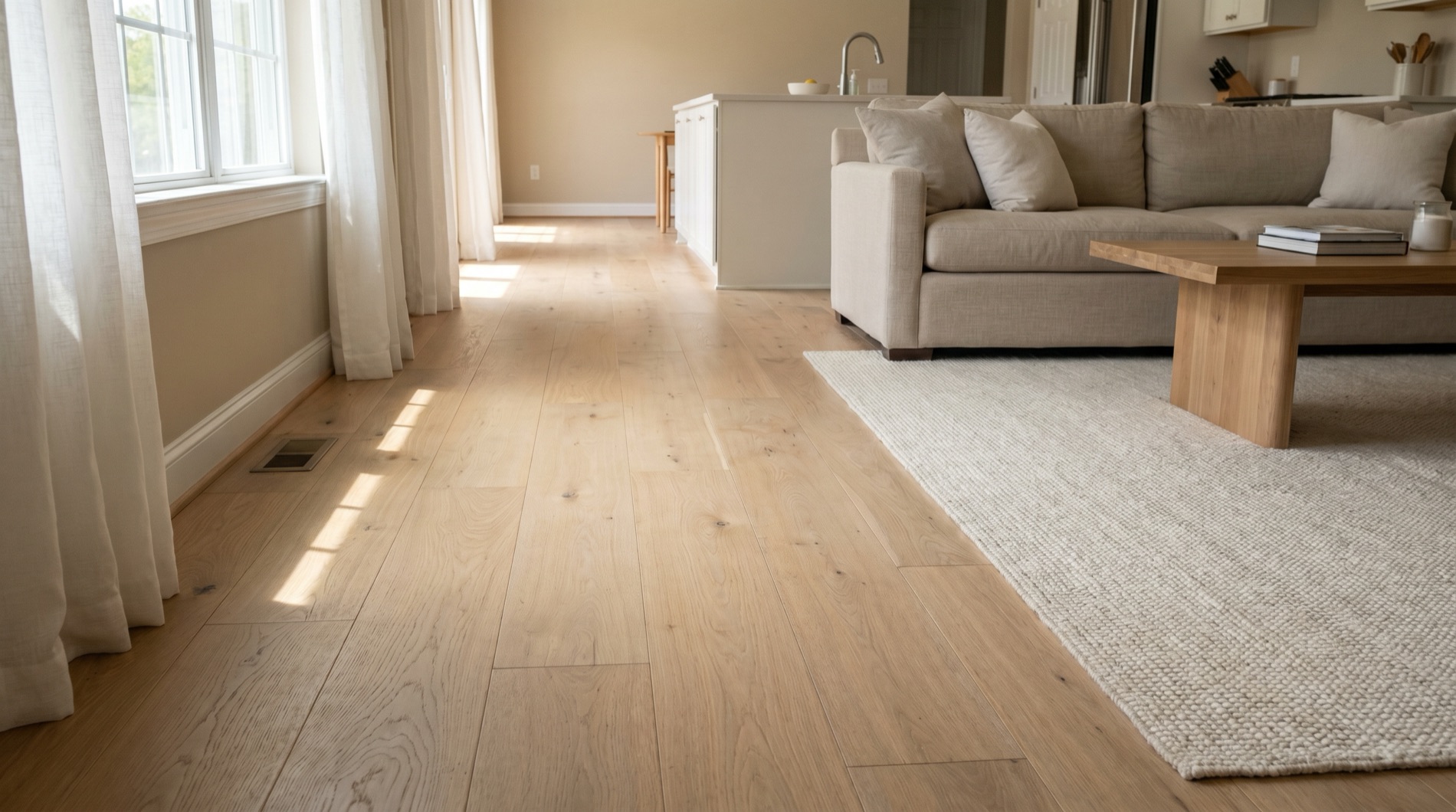
The homeowner texts us a photo of a magazine spread: 8-inch white oak planks running through an open-concept kitchen and living room. "Can we do this in our Vienna split-level?" The answer is yes, but the texting back-and-forth that follows is always the same set of questions. Will it move more than narrow plank in DMV humidity. Will it cost more. Will the subfloor need extra prep. Will it look right in a 1970s split-level or only in modern open-concept. Will it help the resale. After 20+ years installing solid and engineered hardwood across Alexandria, Arlington, Fairfax, Falls Church, Vienna, Reston, Bethesda, McLean, and the rest of the DMV metro, here's the honest plank-width breakdown. Width categories, DMV humidity behavior, install cost, subfloor reality, resale impact, and the decision rule for when wide plank is right and when narrow strip is the smarter call.
The short answer for DMV homeowners
Quick answer
For most DMV homes, the practical hardwood plank width is 4 to 7 inches. Wider than 7 inches looks great in photos but moves more per board with DMV humidity swings (30 percent RH in February to 65 percent in August), shows more seasonal gapping, and demands a flatter subfloor. Narrower than 3 inches reads as traditional or builder-grade in homes built after 1995. The 5-inch plank is the sweet spot for most Northern Virginia colonials, split-levels, townhouses, and condos. Wide plank (7 to 12 inches) is the right call only when the home is modern or transitional, the subfloor is flat enough, the species is dimensionally stable (white oak or quarter-sawn), and the install includes a humidity-control strategy. Wide plank in a 1970s ranch over a wavy plywood subfloor without humidity control is the most common DMV hardwood failure we get called to repair.
That's the head answer. The rest of this article is the width breakdown, the humidity math that drives it, the install differences, the subfloor reality, the resale impact at DMV price bands, and the decision rule.
Plank width categories: strip, standard, wide, extra-wide
Quick answer
Hardwood plank width falls in four real categories. Strip (1.5 to 2.25 inches): the traditional standard, builder-grade through 1995. Standard (3 to 4.25 inches): the most common modern install. Wide (5 to 7 inches): the trending preference in DMV homes since ~2015. Extra-wide (8 to 12+ inches): the premium spec, mostly $1M+ homes and architect-led renovations. Within each category, the install cost, the humidity behavior, the visual read, and the resale impact all shift in predictable ways.
| Category | Width | What it reads as | DMV home fit |
|---|---|---|---|
| Strip | 1.5" to 2.25" | Traditional, builder-grade, period-correct in pre-1985 homes | Old Town Alexandria pre-war, Arlington Cape Cods, original 1955-1985 splits |
| Standard | 3" to 4.25" | Mid-2000s suburban builder default, neutral aesthetic | Fairfax/Vienna 1990s-2000s colonials, Reston townhouses |
| Wide | 5" to 7" | Modern, transitional, current 2020-2026 preference | Most DMV remodels, McLean rebuilds, open-concept renovations |
| Extra-wide | 8" to 12"+ | Premium, architectural, magazine-spread aesthetic | $1M+ Old Town, McLean custom, Bethesda contemporaries |
The current default in DMV remodels is 5-inch wide oak (red or white). It reads as modern without the install premium of true wide plank, fits both colonial and contemporary architecture, and matches buyer expectation at the $600k-$1.5M band where most DMV remodels live.
Why wide plank moves more in DMV humidity
Quick answer
Hardwood expands and contracts across its width with humidity, not its length. The expansion is proportional to the board width: a 2.25-inch strip moves ~0.02 inches between February (30% RH) and August (65% RH) in a typical DMV home. A 7-inch wide plank moves ~0.06 inches over the same humidity swing. Across a 12-foot run of flooring, that's the difference between ~0.10 inches of aggregate seasonal gapping with narrow strip and ~0.10 inches per board (1.0 inches of aggregate) with wide plank. Wide plank doesn't move more per inch of board; it just has more inches per board, which is why the seasonal gapping shows more.
The DMV is one of the harder hardwood markets in the country for plank movement. Indoor RH typically swings from 25-35 percent in deep winter (forced-air heat dries the house) to 55-70 percent in summer (humid outside air plus AC condensation). That's a 25-40 point RH swing across the year. Hardwood reaches equilibrium moisture content (EMC) of roughly 6 percent at 30 percent RH and roughly 12 percent at 65 percent RH. The wood physically shrinks and grows with that moisture cycle.
Wider planks make the shrink/grow more visible because:
- Seasonal gaps concentrate. A 2.25-inch strip floor distributes the shrinkage across many small joints, each one too narrow to notice. A 7-inch wide plank floor concentrates the same total shrinkage into fewer, larger joints. The eye reads each gap as a defect.
- Cupping and crowning amplify. When a board absorbs moisture unevenly (top vs bottom, like over a slab basement or a damp crawl), it bows. The bow scales with width. A narrow strip cups slightly; a wide plank cups visibly.
- Crack and check risk rises. Wide plank under aggressive winter drying (below 25% RH) can split across the face. Strip flooring almost never does.
The DMV humidity reality is why wide plank in this region needs a humidity-control strategy. Whole-house humidifier on the HVAC (target 30-50% RH year-round), proper acclimation before install (5-10 days on-site at job-site humidity), and the right species selection (white oak is more dimensionally stable than red oak; quarter-sawn is more stable than plain-sawn). See our acclimation guide for the install-week humidity protocol and our DMV humidity failure guide for what happens when the strategy is skipped.
⚠ Watch out
If a contractor quotes 7-inch or wider plank for a DMV home without asking about your humidifier setup or proposing one as part of the job, that's a flag. Wide plank installed in a DMV home without humidity control will show 1/8 to 3/16-inch seasonal gaps within the first 12 months, often more. The fix after the fact (whole-house humidifier retrofit plus partial board replacement) costs more than building it into the original install.
Visual difference: what each width reads as
Quick answer
Plank width sets the room's visual tone more than species or stain does. Strip (2.25") reads as traditional or period-correct. Standard (3-4") reads as neutral or builder-default. Wide (5-7") reads as modern, transitional, or upscale. Extra-wide (8"+) reads as architectural or designer. The width also interacts with room scale: wide plank in a small room reads as out-of-proportion; narrow strip in a large open-concept room reads as fussy. Match the width to the room, not just the aesthetic.
| Width | Best room scale | Style read | Best species pairing |
|---|---|---|---|
| 2.25" strip | Smaller rooms, period homes | Traditional, colonial, vintage | Red oak (matches era), heart pine |
| 3-4" standard | Most modern rooms | Neutral, builder-default, safe resale | Red oak, white oak, maple |
| 5-7" wide | Open-concept, larger rooms, main floors | Modern, transitional, upscale | White oak (most stable), engineered oak |
| 8-12" extra-wide | Open-concept great rooms, custom architecture | Architectural, designer, premium | White oak quarter-sawn, walnut (engineered), reclaimed |
The room-scale rule is what most plank-width mistakes break. Wide plank in a 10x12 bedroom looks like the room is wearing oversized shoes. Narrow strip in a 28-foot open-concept great room looks like a museum gallery. Match the scale. For full species-to-room pairing, see our DMV hardwood species guide.
Installation differences by width
Quick answer
Wider plank changes the install method, the fastener spacing, and the subfloor prep requirements. Strip and standard widths (under 5") install as straight nail-down with cleats every 6-8 inches. Wide plank (5-7") often requires nail-and-glue assist (cleats every 6 inches plus a bead of adhesive between board and subfloor) to control movement. Extra-wide plank (8"+) almost always requires full glue-down on a flat substrate, or full glue-down plus nail assist. The labor on wide and extra-wide adds 15-30 percent to install time vs strip flooring.
| Width | Install method (solid) | Install method (engineered) | Fastener spacing |
|---|---|---|---|
| 2.25" strip | Nail-down, plywood subfloor | Nail-down or floating | Cleats every 6-8" along board |
| 3-4" standard | Nail-down, plywood subfloor | Nail-down or floating | Cleats every 6" along board |
| 5-7" wide | Nail-and-glue assist recommended | Glue-down or nail-and-glue | Cleats every 6" plus continuous adhesive bead |
| 8-12" extra-wide | Full glue-down on flat substrate, often nail assist | Full glue-down | Continuous adhesive plus nail/screw assist at intervals |
The install-method shift is why wide plank costs more to install, not just more to buy. Nail-and-glue assist on a 1,200 sqft job adds roughly 4-6 hours of crew time and ~$200-350 in adhesive cost vs straight nail-down. Full glue-down on extra-wide plank can add 12-20 hours of crew time vs nail-down strip. The flatter the substrate, the cleaner the result. See our install method guide for the full nail vs glue vs float decision matrix.
Cost comparison: wide vs narrow at DMV pricing
Quick answer
At Potomac DMV pricing ($8.50/sqft all-in for hardwood including material, install, and demo), the upcharge for wider plank breaks down as material premium plus install-method premium. Strip 2.25" red oak: baseline. Standard 3-4" red or white oak: roughly $0 to +$0.50/sqft over strip. Wide 5" white oak: +$1.50 to +$2.50/sqft. Wide 7" white oak: +$2.50 to +$6.50/sqft. Extra-wide 8-12" white oak or engineered: +$4 to +$8/sqft. The premium is driven about 60 percent by material cost (wider milling costs more per board foot, less yield per log) and 40 percent by install labor (nail-and-glue or full glue-down).
| Plank width | Species typical | All-in DMV cost (Potomac) | Premium vs strip baseline |
|---|---|---|---|
| 2.25" strip (red oak solid) | Red oak | $8.50/sqft | Baseline |
| 3.25" standard (red oak solid) | Red oak | $8.50 to $9/sqft | $0 to +$0.50/sqft |
| 4" standard (white oak solid) | White oak | $9 to $9.50/sqft | +$0.50 to +$1/sqft |
| 5" wide (white oak solid or engineered) | White oak | $10 to $11/sqft | +$1.50 to +$2.50/sqft |
| 6" wide (white oak engineered, common spec) | White oak engineered | $10.50 to $12/sqft | +$2 to +$3.50/sqft |
| 7" wide (white oak engineered) | White oak engineered | $11 to $13/sqft | +$2.50 to +$4.50/sqft |
| 8-10" extra-wide (engineered white oak) | Engineered white oak | $13 to $16/sqft | +$4.50 to +$7.50/sqft |
| 10-12" extra-wide (premium engineered or reclaimed) | Engineered or reclaimed | $15 to $22/sqft | +$6.50 to +$13/sqft |
The numbers above are all-in (material plus install plus demo/removal) for residential installs in the DMV metro under typical conditions. Subfloor leveling, custom borders, intricate cut work, premium species (walnut, hickory, exotic), and stair treads add to the per-sqft number. For the full hardwood cost breakdown see our hardwood cost per square foot guide and the installation cost breakdown.
Subfloor flatness: the wide plank trap
Quick answer
Wide plank is unforgiving of subfloor unevenness in a way that strip flooring is not. NWFA spec is 1/4-inch deviation over 10 feet for any hardwood install. For wide plank 5" and up, most manufacturers tighten that to 3/16-inch over 10 feet. For extra-wide 8"+, the spec drops to 1/8-inch over 6 feet. Older DMV homes (1955-1985 builds) routinely have plywood subfloors with 1/2-inch deviation across 10 feet from joist settling and original installation tolerances. Subfloor prep (self-leveling compound, plywood shims, or sand-down) on those homes adds $1 to $3.50 per sqft to the wide-plank install, and skipping it causes the failures.
The subfloor reality is the most common DMV-specific cost surprise on wide plank installs. We've seen three patterns repeatedly:
- 1970s split-level over a slab basement. Plywood subfloor on sleepers has typically settled 1/4 to 1/2 inch in spots over 50 years. Wide plank install requires self-leveling compound, adding $1.50-2.50/sqft.
- 1990s townhouse with engineered I-joists. Generally flatter than older joists but often have 1/4-inch deviation at joist mid-spans. Wide plank install needs targeted plywood shims, $0.50-1/sqft.
- Old Town pre-war over wood-framed crawl. The original plank subfloor is wavy and creaky. Wide plank install needs a full 3/4-inch plywood overlay plus self-leveling at low spots, $2.50-4/sqft.
The subfloor decision is part of the wide-plank decision. If the budget is tight and the substrate is wavy, the smart move is staying with standard width (3-4 inches), which forgives 1/4-inch deviation over 10 feet without prep work. See our floor leveling cost guide for the full subfloor prep breakdown.
Resale value: which width DMV buyers expect
Quick answer
DMV buyer preference on plank width is price-band-driven and has shifted toward wider plank since ~2015. Under $600k: standard width (3-4 inch) is buyer-neutral; wide plank doesn't get rewarded at the offer table. $600k-$1.2M: wide 5-inch plank is now the expected default, narrower reads as builder-grade. $1.2M+: wide 6-7 inch white oak or extra-wide reads as the premium spec; standard width discount-flags the listing as "missed the upgrade." Strip 2.25-inch flooring is buyer-positive only in period-correct homes (pre-1985 originals in Old Town Alexandria, Arlington, Bethesda where it reads as authentic).
| Home price band | Buyer-expected width | Width upgrade ROI | Anti-pattern |
|---|---|---|---|
| Under $500k | Standard 3-4" or LVP-equivalent | Negligible (under 50% recovery) | Extra-wide upgrade (overspend) |
| $500k-$700k | Standard 3-4" | Small premium for 5" white oak (~70-80% recovery) | Builder-grade 2.25" strip in remodel context |
| $700k-$1.2M | Wide 5" white oak (current default) | Solid premium for 5" white oak vs strip (~100-115% recovery) | Strip flooring reads as missed upgrade |
| $1.2M-$2M | Wide 6-7" or extra-wide white oak | Solid premium for wide plank (~95-110% recovery) | Standard 3-4" reads as cost-cut at this band |
| $2M+ | Extra-wide 8-12" or premium engineered/reclaimed | Architectural baseline (~85-100% recovery) | Anything narrower flags as wrong spec |
| Period-correct pre-1985 home (any band) | Strip 2.25" red oak refinished | Strong premium for period-correct preservation | Wide plank in colonial context (jarring) |
The wide-plank preference shift has been the biggest visible change in DMV hardwood specs since 2015. In 2010, 3-4 inch was the default at all price bands; today, 5-inch is the floor (no pun) at $700k+ and 6-7 inch is the default at $1M+. Building this into a 2026 install means planning ahead for resale even if you're not selling soon. For the broader pre-listing flooring math see our DMV resale value guide.
When to pick wide, when to pick narrow
Quick answer
Pick wide plank (5-7") when the home is $700k+, the subfloor is flat or budgeted for prep, you have whole-house humidity control, and the room scale supports it. Pick standard width (3-4") when the subfloor is wavy and prep budget is tight, when the home is sub-$700k where the upgrade doesn't recover, or when matching existing narrower hardwood in adjoining rooms. Pick extra-wide (8"+) only when the home is $1.2M+, the architecture is modern or transitional, and engineered construction is acceptable. Pick strip (2.25") when the home is pre-1985 and the goal is period-correct preservation or restoration.
The decision rule, simplified:
- Pick 5" wide white oak if you're a $700k-$1.2M DMV home, building a 5-10 year hold, modern/transitional aesthetic, and have or plan a whole-house humidifier. This is the safe default and what we install most often.
- Pick 6-7" wide engineered white oak if you're $1M+, the architecture is open-concept, the subfloor is solid (typically newer construction), and you want a more premium read. Engineered handles the width-movement better than solid at this size.
- Pick 3-4" standard width if you're under $700k, the subfloor is wavy and prep budget is tight, or you're matching existing flooring in an adjoining room. Safe, neutral, and forgives subfloor imperfections.
- Pick 2.25" strip refinish or new only in period-correct pre-1985 homes (Old Town pre-war colonials, Arlington Cape Cods, Bethesda Tudors) where the original spec was strip and authenticity drives resale.
- Pick extra-wide 8-12" engineered white oak only in $1.2M+ modern or transitional renovations with flat subfloors and humidity control. The visual is worth it; the cost and complexity are not at lower price bands.
💡 Key takeaway
If you're staring at flooring samples and stuck on width, here's the unsexy advice: 5-inch wide white oak is the right answer for ~70 percent of DMV remodels we estimate. It hits the modern read, the resale expectation, the dimensional stability (white oak moves less than red oak), and stays within the subfloor tolerances most DMV homes can meet without major prep work. Don't talk yourself into 8-inch plank because of a magazine photo. The maintenance burden of wide plank in DMV humidity is real, and the offer-table premium past 7 inches doesn't compound at most price bands. For the species-and-width pairing logic see our hardwood species guide.
FAQs about hardwood plank width
What is the most popular hardwood plank width in 2026?
5-inch wide plank in white oak is the current default for DMV mid-to-high-end remodels (2026). It's wide enough to read as modern and current, narrow enough to forgive moderate subfloor imperfections and DMV humidity swings, and pairs well with both colonial and contemporary architectural styles. For homes priced over $1.2M, the default shifts to 6-7 inch wide white oak engineered. For period-correct pre-1985 homes, 2.25-inch red oak strip remains the right call.
Does wide plank hardwood cost more than narrow plank?
Yes, both in material and install labor. At Potomac DMV pricing, 5-inch wide white oak runs ~$10-11/sqft all-in vs $8.50/sqft for 2.25-inch red oak strip (a $1.50-2.50/sqft premium). 7-inch wide runs $11-13/sqft. Extra-wide 8-10" runs $13-16/sqft. The material premium accounts for ~60 percent of the upcharge (wider boards mean less yield per log and more selective milling); the install premium is ~40 percent (nail-and-glue assist or full glue-down replaces straight nail-down).
Will wide plank hardwood gap more in DMV humidity?
Yes, visibly. Wide plank shows the same percentage shrinkage as narrow plank, but the absolute gap per board is larger because the board is wider. A 7-inch wide plank in DMV winter humidity shows roughly 3x the visible seasonal gap of a 2.25-inch strip. The fix is whole-house humidity control (target 30-50% RH year-round via humidifier on the HVAC), proper acclimation before install, and using dimensionally stable species (white oak or quarter-sawn rather than plain-sawn red oak). Without humidity control, wide plank in the DMV will show gaps within 12 months of install.
Can I install wide plank hardwood in a basement?
Only as engineered, never as solid, and only with moisture testing first. Solid hardwood (any width) fails over a slab basement because the slab releases moisture year-round. Engineered wide plank with a stable core (multi-ply or HDF) can handle slab conditions when installed with a full vapor barrier and full glue-down on a flat substrate. Even then, wide plank in a basement gives up some dimensional stability. The wider the board, the more visible any seasonal movement. For most DMV basements, we recommend LVP for waterproof certainty; engineered hardwood (preferably 5" or narrower) only in dry, conditioned finished basements with a tested-dry slab. See our basement flooring guide.
Is engineered hardwood better for wide plank?
Yes, for plank widths 6 inches and above. Engineered hardwood has a cross-ply or stable-core construction that physically resists the width-direction movement that solid hardwood expresses freely. For 8 inch and wider plank, engineered is the only safe install in the DMV humidity climate. For 5-inch wide, both solid and engineered work; engineered is slightly more forgiving over wavy subfloors. For 3-4 inch standard width, solid hardwood is fine for most DMV installs above grade with humidity control.
What's the difference between wide plank and extra-wide plank?
Industry shorthand: wide plank is 5-7 inches, extra-wide is 8 inches and up. The 8-inch threshold matters because manufacturer warranties and install method change at that point. Below 8 inches, nail-and-glue assist is usually acceptable; at 8 inches and above, most manufacturers require full glue-down on a flat substrate (1/8-inch over 6 feet or better). The cost premium also jumps at 8 inches: wide 7" runs $11-13/sqft at Potomac, extra-wide 8-10" runs $13-16/sqft.
Does plank width affect resale value in DMV homes?
Yes, and the impact is price-band-driven. Under $600k, plank width is buyer-neutral. $600k-$1.2M, 5" wide plank reads as current and earns a small premium over strip flooring. Above $1.2M, 6-7" wide is the expected default; standard widths discount-flag the listing as "missed upgrade." Strip flooring (2.25") is buyer-positive in period-correct pre-1985 homes where it reads as authentic. For the full resale framing see our DMV resale value guide.
Bottom line: the 60-second width decision
Wide plank hardwood is the right call in most DMV remodels at the $700k+ price band, provided three conditions hold: the home has whole-house humidity control, the subfloor is flat enough (or budgeted for prep), and the room scale supports it. 5-inch wide white oak is the safe default for ~70 percent of DMV jobs. 6-7 inch wide white oak engineered is the move for $1M+ homes with open-concept layouts. Extra-wide 8-12 inch is for $1.2M+ architectural renovations only. Standard 3-4 inch width remains the right call when budget is tight, subfloor prep is impractical, or you're matching adjoining narrower flooring. Strip 2.25 inch is reserved for period-correct pre-1985 homes where authenticity drives resale.
The mistake to avoid: picking wide plank for the magazine look without considering the DMV humidity reality. A 7-inch wide plank floor in a DMV split-level without a whole-house humidifier is the most common hardwood failure call we get. Build humidity control and subfloor prep into the original install or step the width down. Both options give a better finished result than chasing wide plank and skipping the prerequisites.
Want a free in-person hardwood estimate? Alvaro and the in-house Potomac crew will check your subfloor, your humidity setup, your existing flooring, and give you an all-in number that includes material, install, and demo. No subcontractors, no hidden fees, no quote games. Call 571-341-7247 or book a free estimate and we'll walk through the right plank-width call for your home and budget.
More Guides
Which Direction to Lay Vinyl Plank Flooring in DMV Homes
Plank direction is settled by the install method first, then the hallway, then the light. A DMV crew on joists, transition strips, and wasted material.
Material ComparisonBamboo Flooring Pros and Cons for DMV Homes
Bamboo is a grass, not a wood, and only one of the four types is hard. A DMV flooring crew on humidity, scratches, refinishing, and what we install instead.
Process & PrepHow to Measure Square Footage for Flooring, Waste Included
Length times width is the easy part. A DMV flooring crew on measuring closets and doorways, old walls that aren't square, and how much waste to add.
Need an honest estimate on your floors?
In-home estimate. We measure, check subfloor, give you a real all-in number. No sales pitch.