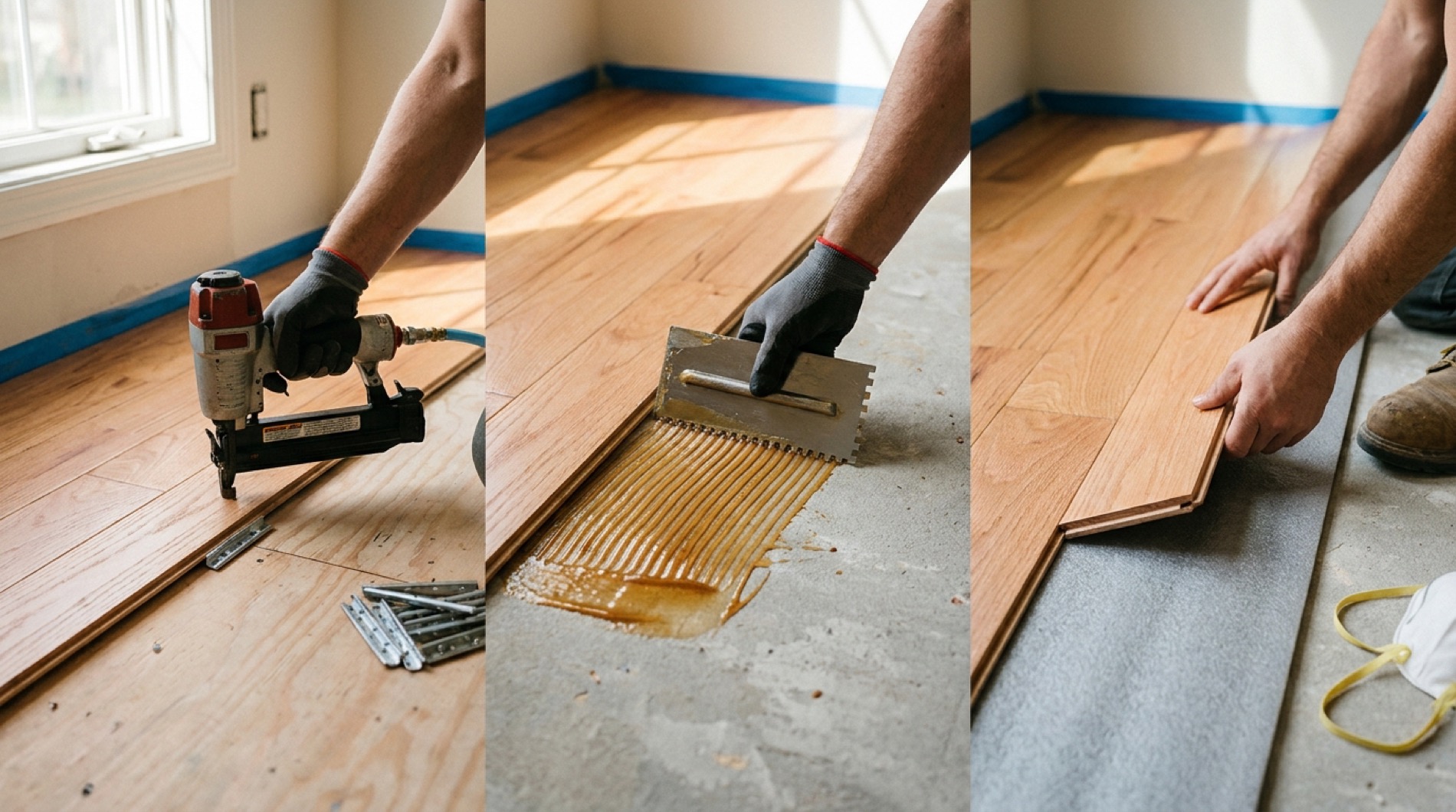
Every hardwood floor quote in the DMV runs into the same question. The homeowner asks "when can you install?" The right answer is almost never the date the boxes arrive on the porch. It is the date the wood has equalized to the inside of the house. In Northern Virginia, DC, and Maryland, that gap between delivery and ready-to-install is anywhere from 4 days to 4 weeks depending on the species, the season, the subfloor, and whether the HVAC has been running long enough to dry the building out.
The "let it sit 72 hours" line printed on every flooring box is a continental US default. It assumes a finished, conditioned, occupied home with indoor relative humidity in the 35-55% range and a subfloor that is already inside the wood's target moisture window. Take any of those assumptions away and the 72-hour rule is the reason your hardwood floor cups across the third board from the wall in August or opens a 1/8 inch gap line through every seam in February. Potomac Floors installs and refinishes hardwood across Alexandria, Arlington, Fairfax, Falls Church, Tysons, Reston, Ashburn, Springfield, Bethesda, Rockville, DC, and the broader DMV. This is the real acclimation playbook we walk every customer through before the truck rolls.
The short answer
Quick answer
Solid hardwood: typically 7-14 days on site in a conditioned DMV home, longer in winter (low indoor RH) and longer for wide planks over 5 inches. Engineered hardwood: typically 3-5 days, sometimes skipped if the slab and ambient RH are already inside spec. Prefinished factory-coated: less critical than unfinished, but still 3-7 days because the wear layer does not stop moisture exchange through the edges and back. The rule that matters: install only when the flooring moisture content reads within 2% of the subfloor for strip flooring (under 3 inches wide) and within 4% for plank (3 inches and wider), measured with a calibrated pin or pinless meter. Time is a proxy; moisture content is the actual gate.
The reason the time-based answer keeps changing on a quote is that time is the rough proxy. The real metric is equilibrium moisture content (EMC). EMC is the moisture percentage a piece of wood will eventually reach when held at a given temperature and relative humidity. When the flooring and the subfloor are both at the same EMC inside the home's normal yearly indoor RH range, the install is safe. When they are not, the install fails, sometimes within weeks, more often in the next seasonal swing.
What acclimation actually is
Quick answer
Acclimation is the period before installation when the flooring sits inside the home, in the room where it will be installed, so its moisture content equalizes with the conditioned indoor air. Wood is hygroscopic: it gains and loses moisture from the air until it reaches equilibrium with the room. The boards leave the mill at one moisture level (usually 6-9%), travel through a warehouse and a truck and a porch (anywhere from 5% to 14% depending on season and storage), and need to settle to the home's actual EMC before the click joints get locked, the nails get driven, or the adhesive gets spread.
The hygroscopic part is the structural fact most homeowner content glosses. Wood does not "dry out" once and stay dry. Every cell wall in every plank is continuously exchanging water vapor with the surrounding air. A board sitting at 7% moisture content in a 30% RH room will pull moisture out of the air across the summer until it reaches roughly 9% MC at 50% RH, and the board's width physically grows by about 0.6% in the process. Across a 5 inch plank that is about 1/32 of an inch of width change per board. Across a 20-foot wide great room with 48 boards laid side by side, that is 1.5 inches of total width change between February dry and August humid. The expansion gap at the perimeter absorbs that movement only if the install moisture content was inside the right window to begin with.
Acclimation is not "letting the wood get used to the room." It is letting the wood reach the moisture content the room will hold most of the year. If the install moisture content is 5% (kiln-dry shipping MC, never been near a normal home) and the room's mid-year EMC is 8.5%, the boards will absorb water aggressively across the first 60 days, expand into each other, and either cup at every seam or push the perimeter expansion gap closed and crown across the field. If the install moisture content is 13% (wet from a humid warehouse) and the room's mid-year EMC is 8.5%, the boards will give up water through the first winter, contract, and open visible gap lines at every seam. The install is racing the wood's natural moisture exchange, and the wood wins.
DMV indoor humidity by season
Quick answer
In a typical DMV home with the HVAC running, indoor relative humidity runs roughly 25-30% in February (winter dry, central heat pulls moisture out), 35-45% in April and October (shoulder seasons), and 55-65% in July and August (humid outside, AC pulls some moisture but not all). That seasonal swing translates to a wood EMC of about 5.5% in February and 11% in August. A 5.5 percentage point swing across the year. The manufacturer's "8% target install moisture content" only works if the install was done within roughly 1% of the room's annual mean EMC, which in the DMV is about 8.5%. Install too dry, the wood swells. Install too wet, the wood shrinks.
The DMV sits on the mid-Atlantic coast with the full continental humidity swing: hot wet summers, cold dry winters, and two brief shoulder windows where the indoor air sits naturally inside the install-safe range. The numbers are not abstract. In an Alexandria colonial with the furnace running through January, the indoor RH at the floor level reads 27-32% on a meter. Sahara dry for hardwood. By late July with the AC running and the kids opening the back door every 20 minutes, the same floor reads 58-64% RH. The EMC the wood is chasing across that swing covers everything from 5.5% (February) to 11% (August).
| DMV month | Typical indoor RH | Wood EMC equivalent | Install verdict |
|---|---|---|---|
| January-February | 25-32% | 5.0-6.0% | Too dry. Install moisture content target should be 6-7%, hard to hit without a humidifier |
| March | 30-38% | 5.8-7.0% | Marginal. Okay if home is humidified to mid-range |
| Mid-April to early-June | 38-50% | 7.0-9.0% | Ideal window. Install moisture content matches annual mean EMC |
| July-August | 55-65% | 10.0-11.5% | Too wet. Install moisture content target should be 9-10%, only safe if AC has dehumidified the home below 55% RH for 7+ days |
| Mid-September to early-November | 38-48% | 7.0-8.8% | Ideal window. Second shoulder season, what most installers prefer |
| December | 28-35% | 5.5-6.5% | Marginal. Only if home has been humidified to 40%+ for two weeks |
The takeaway is not that we refuse to install in February or August. We install year-round across the DMV; the truck rolls every week. The takeaway is that the install moisture content target shifts with the season, the acclimation period stretches, and in the dry-cold months the home needs to be humidified for at least two weeks before delivery to give the boards a target to settle to. None of that lives on a manufacturer's flooring box.
The moisture-meter delta rule
Quick answer
The NWFA installation rule that actually matters: the flooring moisture content must be within 2% of the subfloor moisture content for strip flooring (boards under 3 inches wide) and within 4% for plank flooring (3 inches and wider). Measured with a calibrated pin or pinless meter on at least 20 boards across the load and at least 20 subfloor points across the install area. Get those two numbers within the delta and the install is safe at any time of year. Skip the meter readings and you are gambling on the box's 72-hour rule.
The delta rule is the closest thing the National Wood Flooring Association has to a hard install gate. The reason for the 2% strip / 4% plank split is geometric: a 2 1/4 inch strip plank moves about half as much in width per percentage point of moisture change as a 5 inch plank does. The narrower board can tolerate a larger relative MC swing without producing a visible cup or gap. The wider the plank, the tighter the delta has to be at install time, because there is more wood per board exchanging water with the environment, and any mismatch shows up as a bigger physical movement.
The meter we use on every job is a pinless Wagner Orion 950 (dielectric reading, no holes in the boards) cross-checked against a pin-type Lignomat for any board that reads anomalously. We take readings on 20 boards picked randomly from across the entire load (not just the top of the stack. The bottom boards always read higher because they pulled moisture from the floor). We take 20 subfloor readings at the install location (different rooms, near exterior walls, near interior walls, near the bathroom plumbing wall, near any HVAC vent). We apply the species correction factor for the flooring species being installed (oak reads close to nominal; maple reads about 1% low; hickory reads about 1% high. The meter's manual has the full chart). We log all 40 readings with timestamps in the project file.
The single biggest meter mistake homeowners and DIY installers make: reading the moisture content once when the flooring shows up, recording it, and never testing again. Acclimation by definition means the moisture content is changing. The reading on Day 1 is the starting point. The reading we care about is when two consecutive daily readings come back within 0.5% of each other. That is the signal the boards have equalized to the room. Anything before that is a moving target.
How long it actually takes
Quick answer
In a typical DMV home with the HVAC dialed in to the install-target RH, the time-to-equalize math runs: 3-5 days in shoulder seasons (April-June, September-October), 7-10 days in summer with AC running, 10-14 days in winter with central heat running, and up to 21 days in winter without a humidifier. Wider boards (5 inches and up) take 30-50% longer than strip. Solid hardwood takes 30-50% longer than engineered. Prefinished factory-coated takes 20-30% less than unfinished. The 72-hour box rule applies in roughly 15% of the year. The two brief shoulder windows. The other 85% of the year it is too aggressive.
The timing math comes out of two physical realities. First, water vapor moves into and out of wood through the cell wall surface area exposed to air. A 3/4 inch thick solid plank has surface area on the top, the bottom, and four edges, and the box stacking pattern controls how much of that surface is exposed. Bottom-of-the-box boards see almost no airflow until they are unboxed and laid out. Second, the room's vapor-pressure differential drives the rate. A high-vapor-pressure room (humid, warm) pulls dry boards toward equilibrium fast. A low-vapor-pressure room (dry, cold) gives up moisture to dry boards slowly. In a 28% RH January Alexandria living room with the heater running, a stack of boards that arrived at 12% MC needs about 14 days to settle to 6% MC and stop changing.
The other piece of the timing puzzle is the species. Oak (red and white) is the workhorse of DMV hardwood floors and the species the install timelines are calibrated to. Hickory and maple have tighter cell structures and equalize 20-30% slower than oak. Walnut is in the middle. Brazilian cherry, jatoba, and other dense tropical species are dramatically slower (sometimes 25+ days to equalize) and have wider seasonal movement coefficients. We install these only in shoulder seasons and warn homeowners that the perimeter expansion gap has to be larger than for oak. Engineered hardwood, regardless of species, equalizes faster because the cross-grain plywood substrate dramatically reduces the moisture-driven movement of the assembly.
Solid vs engineered vs prefinished
Quick answer
Solid hardwood: full acclimation required, 7-14 days typical, longer in extreme seasons. The whole plank is solid wood; moisture moves through the whole cross-section. Engineered hardwood: shorter acclimation, 3-5 days, sometimes skipped if the slab and ambient RH are pre-tested inside spec. The plywood core resists movement; only the top wear layer exchanges meaningful moisture. Prefinished factory-coated (solid or engineered): 20-30% less time than unfinished. The factory-applied UV-cured aluminum-oxide coating slows top-surface moisture exchange, but the edges and back are still raw. The boards still need to equalize, just slightly faster.
The structural reason engineered hardwood acclimates faster is the cross-ply core. A typical 5/8 inch engineered plank has a 3-4mm sawn-veneer wear layer of the named species (oak, walnut, hickory) bonded over a 10-12mm cross-grain plywood substrate. The plywood's alternating grain directions cancel out the directional moisture movement that drives solid hardwood's seasonal expansion. The engineered plank's overall dimensional change between February and August is about one-third of a solid plank's change for the same species. The plank still moves, just less, and the install moisture content window is correspondingly wider.
That wider install window is the reason engineered hardwood is the default recommendation for DMV basements, condo upper units over slab, and any room with radiant heat. The shorter acclimation is a side benefit; the structural moisture stability is the main one. Full slab-install detail is in our engineered hardwood over concrete slab piece, and the species-by-species recommendation for DMV climate is in best hardwood species for DMV homes.
Prefinished hardwood (factory-applied wear coat, sealed at the factory before shipping) is the third category. The wear coating slows but does not stop moisture exchange through the top surface; the bottom and the four edges of every plank are raw wood. Net effect: prefinished boards equalize about 20-30% faster than the same species unfinished, because the top surface (the largest area) is partially sealed. We still acclimate for 5-7 days minimum in shoulder seasons and 10-12 in extremes. The "no acclimation needed" claim that shows up on some prefinished product pages is marketing, not installer practice. The warranty fine print still references the NWFA moisture-content delta rule.
Subfloor and slab moisture tests
Quick answer
Wood subfloor (plywood or OSB over joists): test with a pin moisture meter at 20 points; reading must be 7-13% with the delta rule applied against the flooring. Concrete slab (basement, condo, slab-on-grade addition): test with either a calcium chloride test (3 lbs / 1,000 sqft / 24 hours maximum for hardwood) OR an in-situ relative humidity probe (75% RH maximum at the slab's 40% depth). New slabs need 60-90 days minimum to cure before the first moisture test; the math says concrete loses about 1/2 inch of cure depth per 30 days under normal indoor conditions, and a 4 inch slab needs the full bottom inches to give up their moisture before the surface readings stabilize.
The subfloor is the half of the install most homeowner content ignores. Hardwood goes down on whatever the floor structure already is. Plywood or OSB over joists, concrete slab, or in older DMV homes (Old Town Alexandria, Georgetown, parts of Arlington), original plank subfloor with diagonal solid-board construction. Each has its own moisture test. None of them are "looks dry, feels dry, must be dry."
Wood subfloor (the typical case in stick-built homes from the 1960s onward) is tested with a pin meter pushed into the subfloor through small drilled or natural seam access points. We take 20 readings per install area, looking for the average and the worst-case point. The worst-case reading dictates the install verdict; a single 18% reading near an exterior wall near the laundry-room plumbing is enough to delay an install, because that one wet spot will telegraph through the finished floor as a cup line within months. The acceptable range is 7-13% subfloor MC, with the flooring MC inside the 2% strip / 4% plank delta against the subfloor average.
Concrete slab is a different test entirely because slabs hold water for years. Two methods. Calcium chloride test (ASTM F1869): a small dish of anhydrous calcium chloride sits on the cleaned slab under a sealed plastic dome for 24 hours; the dish weight change measures vapor emission in pounds per 1,000 square feet per 24 hours. Hardwood requires the result to be 3 lbs or less (some manufacturers spec 4 lbs). In-situ relative humidity probe (ASTM F2170): a small RH sensor inserted into a drilled hole at 40% of the slab depth, sealed in place for 24 hours minimum (72 hours for a more accurate reading). Hardwood requires the RH reading to be 75% or less. New construction slabs need 60-90 days of cure time after pour before the first test even makes sense. The slab is still giving up huge amounts of moisture in the first month, and any reading taken before week 8 is a moving target.
The slab test is the line item we will not skip on any basement or condo install in the DMV. We have walked away from a Reston basement install in late October because the slab calcium chloride came back at 5.5 lbs (slab was poured in late August, two months earlier, not enough cure time, monitored for another 8 weeks, reading dropped to 2.8 lbs, install proceeded). We have caught Tysons high-rise condo slabs at 88% RH probe because the building's mechanical room had a slab leak that had been wicking through the gypcrete topping for two years. Neither failure shows on a visual inspection. Both would have destroyed the hardwood install within 6-12 months. The full test fee shows up as a line item on the quote; the slab-test cost framework is documented in our flooring quote hidden charges piece.
The HVAC-running-7-days rule
Quick answer
The home's HVAC must be operational and running at normal occupancy setpoints for at least 7 days before the flooring is delivered for acclimation, and must continue running through the entire acclimation period and beyond. The reason: the boards have to equalize to the room's actual mid-year EMC, not to the temporary indoor RH of a vacant unconditioned home. A new-construction install with the HVAC not yet running, or a vacation home with the heat turned to 50°F over winter, gives the boards no real target to equalize to. The "let it sit on the porch a few days" approach is the worst possible setup.
The HVAC rule is the line item that catches new-construction installs and remodeling projects where the construction crew has left windows open for ventilation during paint and drywall work. Both scenarios put the home at outdoor RH for weeks, which in DMV summer means 75-85% RH inside the unfinished home. Drop the flooring into that environment, the boards absorb water aggressively, the moisture content shoots to 13-15%, and the homeowner closes up the house, turns on the AC, and the boards now start losing all that water through the finished floor. Cup. Crown. Gap. Every time.
The rule applies to summer (AC must be running long enough to drop indoor RH to the install-target range) and winter (heat must be running long enough to stabilize, and the home should be humidified to 35-45% RH if outdoor temperatures are sub-30°F for any sustained period). We give every new-construction client a written 7-day HVAC pre-install checklist. We do not deliver flooring to a home that does not have functional HVAC. We do not install in a home where the HVAC has been off for the prior 7 days, regardless of how dry or visually clean the space looks.
The most expensive version of this failure we have repaired in the DMV: a custom new-build in Great Falls where the GC scheduled the flooring delivery for the week before the HVAC inspection cleared. The unfinished home sat at 78% RH for two weeks in late August. The flooring (5 inch wide plank rift-and-quartered white oak, premium grade) acclimated to roughly 14% MC. The HVAC came online, the home dropped to 45% RH within 10 days, and the floor lost moisture content over the next 60 days. By Christmas the floor had every seam open about 1/16 inch. Refinishing did not solve it; the boards had physically shrunk. The whole 1,800 square foot install had to be torn out and replaced. The cost of waiting for the HVAC inspection would have been zero.
How to stack the boards on site
Quick answer
The boards have to be unboxed and stickered to acclimate properly. Stickering means stacking the boards with 3/4 inch wood spacers (called stickers) every 18-24 inches between every layer, so air can flow over the top, bottom, and sides of every plank simultaneously. Box-on-box stacking with the boards still in the cardboard is the worst possible acclimation setup; the inside boards see almost no airflow and never equalize. Open all the boxes on Day 1, sticker the boards in the room where they will be installed, leave at least 12 inches between the stack and any wall.
The stickering pattern is the install detail most DIY YouTube videos get wrong. The cardboard box that the flooring ships in is sized to fit the truck, not to acclimate the boards. Boards stacked face-to-face inside the closed box have airflow on only the two ends of each board, about 5% of the total surface area. The boards on the top and bottom of the box equalize quickly; the boards in the middle of a 24-board box take 4-5x longer to reach the same moisture content. If we install from that box without stickering, we are mixing boards that have not equalized to the room with boards that have, and the install is doomed to develop a checkerboard of cup and gap as the inside boards continue to equalize through the finished floor.
Stickering is straightforward but takes physical labor. We bring 3/4 inch x 3/4 inch x 24 inch poplar stickers to every job (sometimes we use scrap 1x material; either works). We open every box. We lay the first row of planks face-up on the room subfloor with 12 inches of perimeter clearance. We lay three or four stickers across that row at 18-24 inch intervals. We lay the next row of planks on top of the stickers, oriented the same way. Stickers again, planks again, until every board is in a stickered stack. Air flows over and under every plank simultaneously, and the equalization happens evenly. We re-test moisture content at the top, middle, and bottom of the stack to confirm the stack is reading uniformly before we install.
What goes wrong if you skip it
Quick answer
Install too dry (flooring MC below room EMC at install): boards expand across the first 60-90 days of normal RH, push against each other, cup at every seam, and either crown across the field or push the perimeter expansion gap closed. Install too wet (flooring MC above room EMC at install): boards lose moisture across the first 60-90 days, contract, and open visible gap lines at every seam. Between 1/32 and 1/8 inch wide depending on plank width. Either failure is permanent without floor refinishing or full replacement; sanding does not fix the underlying dimensional mismatch.
The cup-crown-gap failure mode is the one we get called to diagnose on roughly 30% of the failed hardwood installs we inspect. The diagnosis: pull the moisture meter, take readings across the floor and the subfloor, compare against the homeowner's records of when the boards were delivered and when the install happened. About two-thirds of the failures trace to a too-dry install (boards installed during a winter dry spell with no humidification, boards expanded across the first humid summer). The other third trace to a too-wet install (boards delivered in summer to an unconditioned new-construction home, boards installed before HVAC stabilized, boards lost moisture across the first dry winter).
The economic damage scales with the install scope. A small 200 sqft kitchen with cupping at every seam is a refinishing job. Sand the cups flat, refinish. Costs $1,000-$1,800 in the DMV at our pricing. A 1,500 sqft whole-first-floor install with crown across the field is a tear-out and replace because the perimeter gap is gone and the floor has no room to absorb future seasonal movement. That job is the original install cost plus demo and new material. Easily $25,000-$40,000 on a wider-plank install. The failure mode shows up between months 3 and 12; the homeowner has paid for the original install, lived with it through one full seasonal swing, then watched the floor visibly fail. Every one of those failures was preventable with a 7-14 day acclimation period and a 5-minute moisture meter check.
The downstream visual symptoms. What cupping, crowning, and gapping actually look like, and how to tell them apart in a finished floor. Are documented in our hardwood floor buckling and cupping piece. The repair vs replace decision tree for scratches and surface damage (a different failure mode) is in hardwood floor scratch repair.
The DMV shoulder-season install window
Quick answer
The two ideal DMV install windows are mid-April through early-June and mid-September through early-November. Indoor RH sits naturally in the 38-50% range, the wood EMC target is 7-9%, and the flooring is shipped from mills with an MC of 6-8%. The smallest possible delta between shipping MC and install-target MC. Acclimation periods are shortest (3-5 days for engineered, 5-7 for solid). HVAC stress is lowest. The seasonal humidity swing after install is roughly symmetric (boards expand in summer, contract in winter, both inside the perimeter expansion gap budget). Schedule hardwood installs in these windows when possible.
Shoulder-season scheduling is the install-quality recommendation we make whenever the homeowner's project timing allows it. Mid-April through early-June is the better of the two windows for owner-occupied homes; the heating system has been off for a few weeks, the AC has not yet been called for, and the windows-open period for spring weather puts the indoor RH right at the install-target range without any active management. Mid-September through early-November is similar but slightly more variable. The early-September week is often still humid and the late-October week is often already cold and dry, so the window is narrower and the scheduling has to be more flexible.
This does not mean we refuse July or January installs. The DMV demand for hardwood does not shut down for nine months of the year, and most homeowners need the install when they need it. It does mean we adjust the acclimation period (longer in extremes) and the active humidity management of the home (winter humidifier, summer dehumidifier or aggressive AC) to put the boards inside their target install MC despite the seasonal extreme. The shoulder season is a default; the off-season is fully workable with the right prep.
Site-finished and wide-plank edge cases
Quick answer
Site-finished hardwood (unfinished raw boards installed, then sanded and finished on site) adds a moisture step: the polyurethane finish requires the room to be at 60-80°F and 30-55% RH for the entire 7-10 days of finishing and curing. The acclimation window has to extend through the finish cure. Wide plank (5-7 inches and up) needs 25-50% longer acclimation than strip flooring and a wider perimeter expansion gap (3/4 inch minimum vs 1/2 inch for narrower plank), because the per-board seasonal movement is physically larger.
The site-finished case is the highest-risk acclimation scenario in the DMV. The unfinished raw boards equalize per the normal solid hardwood timeline. Then the install happens, then the sanding happens, then the finish goes down, usually three or four coats of oil- or water-based polyurethane (the full finish decision is in oil-based vs water-based polyurethane in the DMV). The finish curing process requires stable temperature and RH for 7-10 days. The HVAC has to keep the home inside the target range for the entire window. Any moisture event during finish cure (a humid weather front, an HVAC failure, a basement leak) shows up as a finish defect that requires resanding.
The wide-plank case is the second-most-common acclimation problem. A 7 inch plank moves about 3x as much in width per percentage point of moisture change as a 2 1/4 inch strip. The 4% delta rule still applies but the physical consequence of any mismatch is dramatically larger. We recommend a 14-day acclimation minimum for wide plank, a 3/4 inch perimeter expansion gap (vs 1/2 inch for narrower), and we usually decline summer installs on wide rift-and-quartered white oak in a home that has not been humidity-controlled for the prior 30 days. The decision between species and plank width for DMV climate is covered in best hardwood species for DMV homes.
What the acclimation step costs on a quote
Quick answer
Acclimation itself costs the homeowner nothing in material; the only line items are (1) the moisture-meter readings on delivery and at the start of install (included in our all-in installation labor) and (2) any concrete slab moisture test if the install is over slab. Slab tests in the DMV: calcium chloride $150-$250 per kit + lab fee, in-situ RH probe $200-$350 per probe with reusable hardware. Subfloor moisture readings are free (we bring the meter). The bigger cost is the calendar: the install schedule has to leave 5-14 days of acclimation between delivery and install, which extends the project timeline.
The slab moisture test is the line item homeowners do not always see coming. On every basement hardwood install over slab in the DMV, we include either a calcium chloride or an in-situ RH probe in the project quote. The test fee covers the probe or kit cost, the time on site to set up the test, the 24-72 hour wait, and the reading. For a typical 800 sqft basement we run 2-3 probe locations, total test cost $400-$700 on the quote. New construction slabs that are under 90 days from pour usually need two rounds of testing to confirm the slab has cured below spec; the second round is an additional line item.
The calendar cost is the line item homeowners feel more than the test fee. If the homeowner signs the contract on a Monday with a "start work next Monday" expectation, the actual install timeline runs Monday → delivery, Wednesday → start of acclimation, following Wednesday-Friday → final moisture readings + install start, install completion the week after. That is the honest pre-install timeline for a typical solid hardwood install in shoulder-season conditions. For wide plank in winter it stretches another 7-10 days. We disclose the full timeline at the quote and price the project on the install labor only; the acclimation calendar is part of the work but does not show up as a separate billable line. Full install timeline (start to walking on the floor) is mapped in how long does hardwood installation take.
FAQs about hardwood floor acclimation
Can you skip acclimation on engineered hardwood?
Sometimes, but never without a meter check. If the slab passes calcium chloride or RH probe spec, the room has been HVAC-conditioned for 7+ days, the indoor RH sits in the 35-55% range, and the boards read within 4% MC of the slab on delivery day, an experienced installer can install engineered hardwood on the same day as delivery. The fast-track only works when all four conditions are simultaneously met, which in the DMV is roughly the spring and fall shoulder weeks. For solid hardwood, no, never skip acclimation; the dimensional movement coefficient is too high.
What is the right moisture meter for a homeowner to buy?
For homeowner verification of an install, a pinless meter like the Wagner Orion 920 or the General Tools MMD7NP is fine, runs $80-$140. The reading is read-and-tell, no holes in the boards. For installers, the upgrade is the Orion 950 with onboard species correction and depth control. Pin meters (Lignomat, Delmhorst) read more accurately for specific deep readings but require driving pins into a board, which leaves visible holes. We use pinless on the boards and pins on the subfloor through small drilled access holes.
Does prefinished hardwood need acclimation?
Yes, just less. The factory-cured wear coating on the top of every plank reduces but does not stop moisture exchange. The bottom and four edges of every board are raw wood. Acclimation is 20-30% faster than equivalent unfinished hardwood, but never zero. The "no acclimation" claim on some prefinished product pages is marketing; the warranty fine print on those same products still references the NWFA 2%/4% moisture-content delta rule. Full prefinished vs site-finished comparison is in prefinished vs site-finished hardwood.
Can you install hardwood in a basement right after the slab is poured?
No. A freshly poured slab gives off roughly 1/2 inch of cure depth per 30 days under normal indoor conditions. A standard 4 inch basement slab needs 60-90 days minimum before the first moisture test reads below the hardwood spec (3 lbs calcium chloride or 75% RH probe). New-construction basement installs that try to skip the cure period fail within 6-12 months as the slab continues to release water into the hardwood from below.
What if I install hardwood before acclimation and it cups?
Two paths. If the moisture event was a one-time excursion (boards arrived wet, install happened too fast, boards have now equalized to the room) and the cups are minor (under 1mm of cup height across the plank width), sanding and refinishing the floor flattens the cup and the floor is fine going forward. If the cup is larger (1.5mm+ across the plank width) or the underlying moisture problem persists (slab leak, plumbing leak, HVAC failure leaving the home humid), sanding does not fix it. The boards have to come up, the moisture source has to be identified and corrected, and new flooring has to acclimate properly before reinstall. The cost difference between the two paths is 5-10x.
How do you acclimate hardwood over radiant floor heat?
Different protocol. The radiant system has to be commissioned and run through a full warm-cool cycle before flooring delivery. The slab is brought up to operating temperature gradually (10°F per day), held at operating temperature for 48-72 hours, then dropped back down to ambient for the duration of the install. The flooring is acclimated to the room with the radiant system at low operating temperature (about 68°F surface). After install, the radiant is brought back to normal operation gradually, not slammed on. The full compatibility detail is in radiant heat flooring compatibility.
Why does the box say 72 hours when you say 7-14 days?
The box's 72-hour figure assumes a controlled climate-stable test home in the manufacturer's target install conditions (35-55% RH, 65-75°F, stable HVAC, subfloor already inside spec). In a real DMV home in real seasonal extremes, those conditions rarely all line up on Day 4. The 72-hour figure is the minimum the manufacturer will defend in a warranty claim; the actual install-safe acclimation period depends on the seasonal moisture delta between shipping MC and room EMC. We install when the meter says install, not when the calendar says install.
Bottom line: when we say go
Every Potomac Floors hardwood install runs through the same pre-install protocol. We confirm the home has functional HVAC running at occupancy setpoints for at least 7 days. We deliver the flooring at least 5 days before the install start (longer for solid hardwood, wide plank, or off-season conditions). We open every box on delivery day and sticker the boards in the install room. We test the flooring MC and the subfloor MC on delivery, halfway through the acclimation period, and on the morning of install. We do not start the install until two consecutive daily readings come back inside the delta rule (2% for strip, 4% for plank).
That whole process adds 5-14 days to the project timeline and costs the homeowner nothing extra on the quote. The reason we run it on every job is that the alternative. Installing on the manufacturer's 72-hour minimum without meter verification. Produces the cup-crown-gap failure on roughly 15-25% of DMV installs, and the cost of that failure repair is 5-10x the cost of doing it right the first time. The all-in price we quote stays all-in because we never have to come back and redo a moisture-driven failure.
The honest install is the one where the homeowner walks on the finished floor a year later and never thinks about it. They do not see the moisture readings we logged on delivery day or the calcium chloride test we ran in the basement before the engineered plank went down. They see a hardwood floor that looks the same in February as it did in August. That is the entire point of the acclimation step.
Need a hardwood install that holds up through DMV seasons? Potomac Floors handles solid, engineered, prefinished, and site-finished hardwood across Alexandria, Arlington, Fairfax, Falls Church, Tysons, Reston, Ashburn, Springfield, Manassas, Bethesda, Rockville, DC, and the broader DMV. We test moisture content on every job, acclimate the wood properly for the season, and price every install at all-in: material, professional installation, demo, and removal. Call 571-341-7247 or request a free in-home quote. No hidden line items, no callback failures.