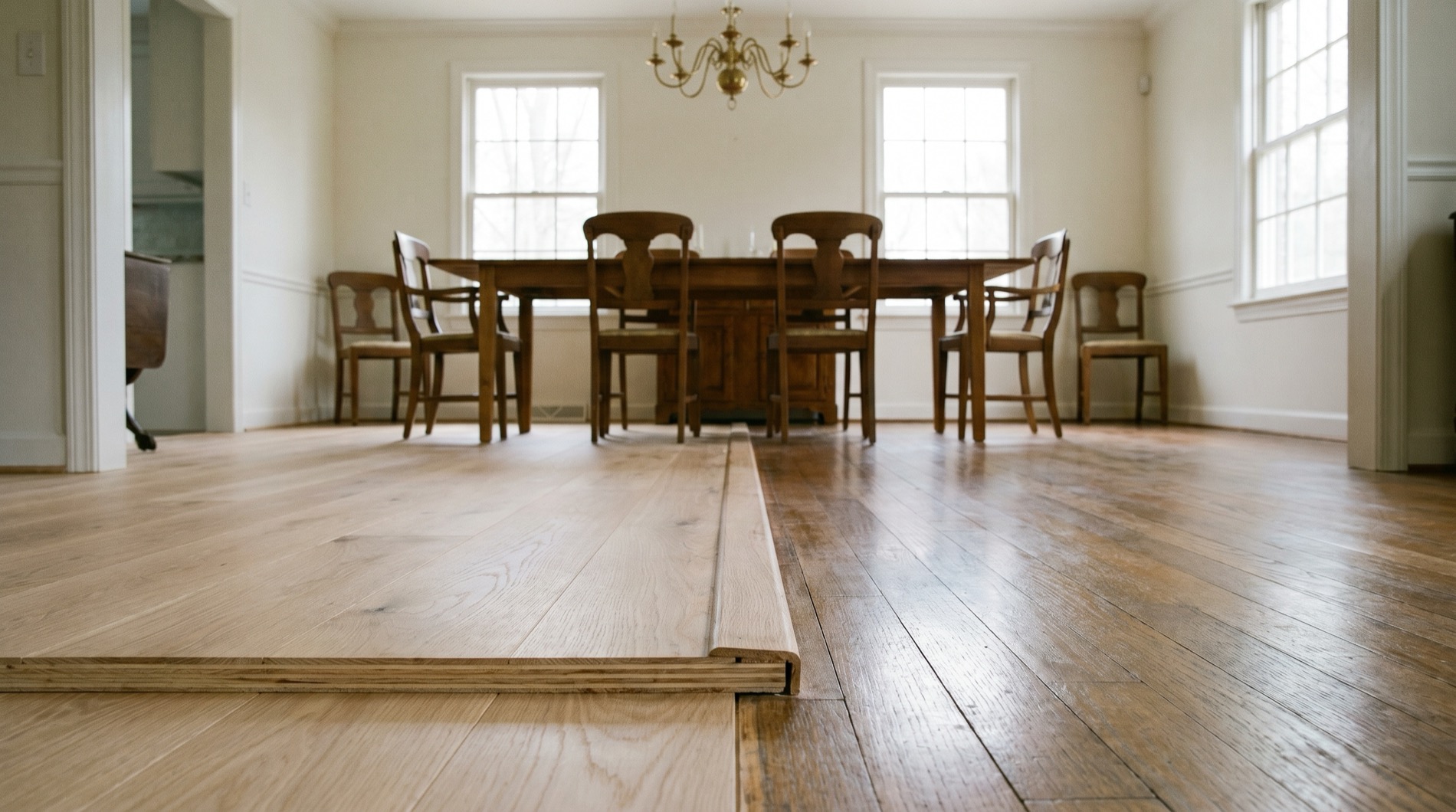
The refinishing question that comes up on almost every walkthrough in the DMV: "How many times can this floor be redone before we have to replace it?" The honest answer depends on three things the floor itself answers, not the homeowner. What kind of hardwood is it (solid, engineered, or prefinished). How thick is the wear surface today, after every prior refinish cycle has already eaten some of it. And how aggressive does the next refinish need to be (deep sand to bare wood, or a light screen-and-recoat).
The generic answer floating around the internet is "3 to 10 times." That number is right for a healthy solid 3/4 inch oak floor on Day 1 and wildly wrong for a 1928 Alexandria colonial floor that has been redone four times by four owners and now has 1/16 inch of wood left above the tongue. Potomac Floors refinishes hardwood across Alexandria, Arlington, Fairfax, Falls Church, Tysons, Reston, Ashburn, Springfield, Bethesda, Rockville, DC, and the broader DMV. Below is the real answer we walk every homeowner through with a measuring gauge in hand at the in-home estimate.
The short answer by floor type
Quick answer
Solid 3/4 inch hardwood: 6-12 full refinish cycles over the floor's lifetime, plus 2-4 screen-and-recoats between full refinishes. A properly maintained solid oak floor in a DMV home will usually hit the homeowner's tolerance for the disruption before it hits the physical wear-layer limit. Engineered hardwood: depends entirely on the wear-layer thickness above the plywood core. 1mm wear layer (cheap big-box product) = 0 full refinishes, 1 screen-and-recoat at most. 2mm = 1 light cycle. 3mm = 1-2 cycles. 4mm = 2 cycles. 5-6mm premium = 2-3 cycles. Prefinished aluminum-oxide: effectively 0 cycles. The factory topcoat physically destroys belt-sander abrasives within minutes; the only path is to strip the entire topcoat (an aggressive, expensive job most installers will not take on) or screen-and-recoat without breaking the original factory finish.
That table is the head answer. The body of this guide is the math behind it, because the head answer hides the part that actually decides the next refinish on a real DMV floor: how much of the original wear surface is still there today, after every prior refinish has already taken its cut.
What a refinish physically removes
Quick answer
A full refinish makes three passes with a drum or belt sander at progressively finer grits (typically 36 or 40 to open the surface, then 60 or 80, then 100 or 120 finish) and removes roughly 1/32 inch (0.8mm) of wood per cycle on a healthy solid floor. Deeper cuts on heavily damaged floors (water staining, pet damage, severe cupping) can pull 1/16 inch (1.6mm) per cycle. A screen-and-recoat (often called a "buff and coat") uses a 120-180 grit screen on a buffer, scuffs the existing finish without breaking through to bare wood, and removes essentially zero wood. The math: every full refinish costs you a measurable slice of the wear face; every screen-and-recoat costs you nothing structural.
The mechanical reason the number is not "infinity" is that a hardwood floor is wear-surface-limited. A solid 3/4 inch plank has the tongue cut into the side of every board at roughly 5/16 inch from the bottom face, which means the usable wear surface above the tongue is only about 7/16 inch (11mm) thick from new. Every drum-sander pass takes 1/32 inch. Naive math: 14 cycles. Real-world math: the first cycle on an old floor often pulls 1/16 inch because there is staining, deep scratches, or cupping to flatten through, so the average is closer to 1/24 inch per cycle, and the practical floor of usable thickness is about 1/8 inch above the tongue before the sander starts kissing the tongue itself and the floor has to come out.
The other physical fact is that the original mill finish (the smoothest, most-tightly-grained surface on the plank, called the "face") is gone after the first refinish. Every subsequent refinish is sanding through wood that is one growth ring deeper into the plank, which on plain-sawn oak means more visible grain swirl, less consistent color uptake on stain, and gradually different aesthetics with every cycle. The floor that came back beautifully after cycle 3 will look noticeably different after cycle 5, and not always in the way the homeowner expects.
Solid hardwood: 6-12 cycles, with caveats
Quick answer
A new 3/4 inch solid oak floor with 7/16 inch of wood above the tongue takes 6-12 full refinish cycles before the wear face is too thin to risk another pass. The range depends on (1) how deep the first cycle had to cut to flatten existing damage, (2) sander operator aggressiveness (a heavy hand on a drum sander takes 50% more wood per cycle than a careful one), (3) whether the floor was already partially refinished by a prior owner. The realistic DMV expectation: an original 1990s-era oak floor will see 6-9 refinishes before the wear face hits the tongue. An original 1920s-era 5/16 inch wear face on a thinner historic plank will see 2-4 cycles depending on what has already been done to it.
The high end of the range (12 cycles) is the textbook number for a brand-new, never-refinished solid 3/4 inch white oak floor with a 7/16 inch wear surface above the tongue, refinished by a careful operator who pulls only the minimum needed wood per cycle. That number assumes a 50-60 year homeowner timeline with full refinishes every 8-12 years and screen-and-recoats every 3-5 years between them. It is the right number to quote a homeowner installing new solid hardwood today and asking "how long will this last."
The low end of the range (6 cycles) is the more honest number for a real DMV floor that has already lived a life. The first refinish on a 1990s Alexandria townhouse oak floor that has been walked on for 30 years pulls 1/16 inch or more because there are deep scratches at the kitchen entry, a pet stain bleed in the dining room corner, and cup boards across the front of the wood stove that need to be flattened. That first cycle eats almost twice the typical wood. The next 5 cycles run normal at 1/32 inch each, and by cycle 6 the floor is at 1/8 inch above the tongue and we are recommending screen-and-recoat or replacement, not another full refinish. The first refinish on a tired floor is the most expensive in physical terms.
The variable that changes the most between operators is sander aggressiveness. A careful drum-sander operator using sequential grits (36, 60, 100) and feathering the cuts pulls about 1/32 inch per cycle. An aggressive operator using a single coarse grit (16 or 24) to "save time" pulls 1/16 inch or more per cycle and shaves 50% off the floor's total refinish budget. The cheapest refinish quote in town is often the operator running coarse grits and finishing fast. That floor will see one fewer cycle in its lifetime than the same floor refinished correctly. The cost-comparison breakdown is in our hardwood refinishing cost piece.
Engineered hardwood: the wear-layer math
Quick answer
Engineered hardwood's refinish budget is entirely set by the wear-layer thickness above the plywood core, because the moment a sander breaks through the wear layer into the plywood underneath, the floor is destroyed at that spot. The realistic budget: 1mm wear layer = 0 full refinishes (screen-and-recoat only), 2mm = 1 careful cycle, 3mm = 1-2 cycles, 4mm = 2 cycles, 5-6mm premium = 2-3 cycles. A drum sander cannot guarantee depth control below about 1/32 inch (0.8mm), which is why a 1mm wear layer is functionally zero. One pass and the sander breaks through somewhere on the floor.
| Engineered wear layer | Typical product class | Full refinish cycles | Screen-and-recoat budget |
|---|---|---|---|
| 1mm (sliced veneer) | Big-box budget engineered, $3-$4 sqft material | 0 (too thin) | 1, maybe 2 |
| 2mm (sliced veneer) | Mid-tier engineered, $4-$6 sqft | 1 careful cycle | 2-3 |
| 3mm (sawn-face) | Standard engineered, $6-$9 sqft | 1-2 cycles | 3-4 |
| 4mm (sawn-face) | Premium engineered, $8-$11 sqft | 2 cycles | 4-5 |
| 5-6mm (sawn-face) | Top-tier engineered, $10-$15 sqft | 2-3 cycles | 5-7 |
The reason 1mm wear layers are functionally zero refinishable is the depth control limit on a drum or belt sander. A skilled operator can hold a cut to about 1/32 inch (0.8mm) on a flat clean floor. Anywhere the floor has the slightest hill or valley (every solid wood floor does), the sander cuts deeper at the high spots. A 1mm wear layer cannot accommodate that variance. One pass and there are dime-sized punch-throughs at every high spot. We will not refinish a 1mm wear-layer engineered floor; we will quote a screen-and-recoat or replacement. The honest quote is the one that does not destroy the floor while sanding it.
The good news for engineered hardwood is that screen-and-recoat scales much better than full refinish. A 2mm wear-layer floor that gets 1 full refinish in its lifetime can also support 2-3 screen-and-recoats spaced 3-5 years apart, which keeps the floor looking new for 15-20 years on a single layer of finish before any sander touches the wood. The distinction between "how many refinishes" (1-3 for engineered) and "how many service cycles" (3-7 for engineered, counting recoats) is the real lifespan math. Full structural comparison of solid vs engineered is in engineered vs solid hardwood.
Prefinished hardwood: why it is almost never refinishable
Quick answer
Prefinished hardwood (factory-applied UV-cured aluminum-oxide topcoat) is functionally not refinishable in the traditional sense. The aluminum-oxide ceramic particles in the factory topcoat are harder than the silicon-carbide abrasives in standard sandpaper. A drum sander loaded with 36-grit will destroy the abrasive belt in 2-3 minutes of contact with prefinished factory finish before the belt has cut through the topcoat. The only paths: (1) screen-and-recoat without breaking through the original factory finish (works only if the existing finish is intact), or (2) a specialty chemical strip + aggressive multi-pass sand at premium pricing, only worth it on premium prefinished installs.
The aluminum-oxide story is the one most homeowners never hear when they buy prefinished hardwood. The factory finish is so durable it carries a 25-50 year warranty against wear-through. That is the selling point. The hidden cost of that durability is that the same hardness that defeats foot traffic also defeats refinishing abrasives. A standard refinish job on prefinished hardwood goes through 6-8 belts of premium sanding paper on the first cut alone and still does not break through cleanly; the floor ends up with patchy finish removal, deeper sand marks in the bare-wood spots, and an overall result that looks worse than before the work started. Most professional installers in the DMV (Potomac included) will not quote a full refinish on prefinished hardwood without explicitly warning the homeowner of the cost and risk.
The practical refinish path for prefinished hardwood is screen-and-recoat. A 120-grit screen on a buffer scuffs the existing factory finish (it does not break through to bare wood), and a fresh coat of compatible polyurethane bonds to the scuffed surface. The result: a clean, fresh finish without the wood removal. The catch: it only works if the original finish is still mostly intact. If the homeowner has worn through the factory finish into the bare wood at the kitchen entry or in front of the front door, those bare patches will absorb the new finish differently and show as visible color and sheen differences. At that point the floor is past screen-and-recoat and into "replace the floor or live with the patches." The full prefinished vs site-finished tradeoff is in prefinished vs site-finished hardwood.
The DMV old-home factor
Quick answer
Pre-1950 DMV homes (Old Town Alexandria, Georgetown, parts of Arlington, Capitol Hill) often have original 25/32 inch or even 11/16 inch tongue-and-groove solid oak floors with a thinner wear face than modern 3/4 inch product. Many of those floors have already been refinished 2-4 times by previous owners, leaving the current wear face at 3/16 inch or less above the tongue. The first move on any historic home walkthrough: pull a transition piece or a register cover and measure the actual remaining wear thickness. The textbook "6-12 cycles" assumes a new floor; an 1928 Alexandria colonial floor may have only 1-2 cycles of usable wood left in it before it has to be replaced.
The historic plank thickness story matters because the DMV has a lot of housing stock from before the 3/4 inch nominal solid hardwood standard was settled in the 1950s. A typical 1925 Capitol Hill oak floor was milled to 25/32 inch nominal with a wear face above the tongue of about 3/8 inch. A 1900 Old Town Alexandria heart-pine floor was often milled to 11/16 inch with an even thinner wear face. Those original floors are beautiful and worth saving, but the refinish budget is a fraction of a modern 3/4 inch product's budget, and four owners over a century have usually already spent most of it.
The walkthrough check we run on every historic DMV home: lift one floor register or one threshold transition piece (a 30-second job with a flat pry bar), expose the cut end of a representative plank, and measure with a depth gauge or dial caliper. The number we are looking for: total plank thickness, position of the tongue's top edge, and remaining wood above the tongue. If the remaining wood above the tongue is 1/4 inch or more, there is at least one careful refinish cycle left. If it is 1/8 inch or less, the floor is at the end of its refinish life and the next move is either screen-and-recoat (to extend it 3-5 more years before any wood is removed) or replacement with the same era-appropriate plank to maintain the historic character.
The other historic-floor variable is that the original mill cuts on pre-1950 plank are not always parallel to the bottom face. Older mill technology produced planks with slight taper across the width, which means the wear face is thicker in the middle of the plank and thinner at the edges. A historic floor refinished aggressively at the edges will see edge-board wear-through (sander breaks through to the tongue at the perimeter of every board) several cycles before the field shows any problem. The careful refinish on a historic floor uses a soft-pad orbital edger at the perimeter and a drum sander in the field, which preserves the edge wood. That technique is the difference between getting 2 more cycles out of an old floor and destroying it on the first cycle.
Screen-and-recoat: the 10:1 multiplier
Quick answer
A screen-and-recoat (buff and coat) uses a 120-180 grit screen on a buffer to scuff the existing finish, then applies a fresh coat of compatible polyurethane. It removes no wood. A solid hardwood floor that supports 8 full refinishes over its lifetime can also support 16-20 screen-and-recoats, spaced 3-5 years apart, between those full refinishes. Cost in the DMV: $1.50-$2.50 per sqft for a screen-and-recoat vs $4.50 per sqft for a full refinish. Done on schedule, screen-and-recoats stretch the refinish budget by roughly 10x in service-cycle terms.
Screen-and-recoat is the most underused maintenance move in residential hardwood. The standard owner pattern in the DMV: get the floor refinished, walk on it for 15 years, watch it accumulate scratches and dull spots, refinish again. That is two full refinishes and 30 years of service, using 1/16 inch of wood total. The optimized pattern: get the floor refinished, screen-and-recoat at year 4, again at year 8, again at year 12, then full refinish at year 16. Same 16-year span, only one full refinish used, 1/32 inch of wood, four scuff-and-recoat cycles in between that kept the surface looking fresh the whole time. Run this pattern for 50 years and the floor uses 4 full refinishes of wood instead of 7-8.
The catch is timing. Screen-and-recoat works only if the floor still has its original finish layer intact. If the homeowner has let the finish wear through to bare wood at the entry or in front of the kitchen sink, the screen-and-recoat will produce visible patches where the new finish bonds to bare wood instead of to the existing finish. At that point the floor needs a full refinish, not a recoat. The right time to schedule the recoat is when the surface looks scratched and dull but no bare wood is visible anywhere on the floor, usually 3-5 years after the last refinish or recoat in a typical DMV household. Our care and timing guide is in hardwood floor maintenance: DIY vs pro.
How to check what cycle your floor is on
Quick answer
Four ways to check before paying for a refinish quote: (1) pull a floor register or transition piece and measure the wood above the tongue with a depth gauge or caliper; (2) look at the gap line at the wall where the shoe molding sits. A heavily refinished floor often sits 1/8 to 1/4 inch lower than the threshold of the next room; (3) count visible nail heads. Old face-nailed floors often show nail heads on a refinished surface where the original wood has been sanded down to the nail's height; (4) check the doorway transitions. A floor that is significantly lower than the adjacent room flooring has lost wood. Any of those signs together suggests the floor is on its third or later refinish cycle and the remaining budget is limited.
The register-lift measurement is the most accurate of the four checks and takes about a minute. Lift one HVAC register cover in a heat-supply duct that runs through a wood-floor room. The register frame sits on top of the finished floor, with the duct boot recessed below. The exposed cut end of the floor plank (the boards that were cut to fit around the register boot) shows the full plank thickness from top to bottom in cross-section. A depth gauge or a sharp pencil measurement against a caliper gets you the total thickness in 30 seconds, and the position of the tongue is visible.
The shoe molding gap check is the rough field test. Most newly-installed hardwood floors are level with or slightly above the threshold of the adjacent room. A floor that has been refinished 3-4 times sits visibly lower at every doorway because each refinish has removed wood that the adjacent room's tile or LVP has not lost. If you can see 1/4 inch of vertical step from the hardwood down at the kitchen tile, the floor has lost about 3-4 cycles' worth of wood. If the step is 3/8 inch or more, the floor is well past the textbook refinish budget.
The nail-head check is the historic-home indicator. Pre-1950 oak floors were often face-nailed (cut nails driven through the top face of the plank, not blind-nailed through the tongue). The nail heads were originally countersunk and the holes filled with wood plugs or putty before the original finish. Every refinish exposes those nail heads slightly more as the wood around them is removed. A historic floor with visible nail heads above the surface has been refinished at least 2-3 times and the remaining wear face is shallow. Going further on that floor risks the next nail head sticking up enough to catch a sock or, worse, the next refinish cycle hitting the nail head with the sander and tearing both the floor and the sandpaper.
The four tells that mean replace, not refinish
Quick answer
Four physical conditions mean the floor cannot be refinished again and replacement is the only real option: (1) the tongue is exposed anywhere on the floor (the side groove of any board is visible above the next board), (2) face-nail heads are visible above the surface, (3) the boards have cupped through to the tongue (no flat wood left to sand without exposing the joinery), (4) measured wood above the tongue is under 1/8 inch. Any one of these and we quote replacement, not refinish. Two or more and the floor was past its refinish life one or two cycles ago.
The exposed-tongue tell is the most definitive. Every hardwood plank has a tongue cut into one long edge and a groove cut into the other; they interlock to hold the floor together. The top of the tongue sits about 1/4 inch below the top face of a new plank. As refinishing removes wood from the top face, the tongue gets relatively closer to the surface. When the top face has been sanded down level with the top of the tongue, the next refinish exposes the tongue itself as a hard ridge running along the seam between every two boards. We have seen DMV floors with the tongue exposed at the perimeter of every plank. The original wear face was completely consumed and the next cycle would have cut into the joinery. That floor is structurally done; no more refinishes are possible without destroying the floor's mechanical integrity.
The cupped-through-to-tongue tell is the post-water-damage condition. A floor that has cupped severely (the edges of each board rise above the center, forming a concave shape) can sometimes be sanded flat. That is the standard repair for moderate cupping. The limit is when the cup is deep enough that flattening it would require removing more wood than the floor has left above the tongue. We measure with a straight edge across multiple boards. If flattening the cup would consume more than half the remaining wear face, the floor is past sanding and into replacement. The cupping diagnosis and prevention detail is in our hardwood floor buckling and cupping piece.
The measured-under-1/8-inch tell is the conservative quantitative line. Even if the tongue is not exposed and no nail heads show, a floor with under 1/8 inch of wood above the tongue cannot reliably absorb another sander cut without local punch-throughs. The drum sander cannot hold depth precision below about 1/32 inch on a typical residential floor, and 1/8 inch divided by 1/32 inch is 4, meaning at best 1 more careful cycle is possible, and at worst the next cycle ends with bare patches where the sander broke through. We quote screen-and-recoat or replacement, never another full refinish, on a floor that measures under 1/8 inch.
Refinish vs replace: the DMV cost math
Quick answer
Potomac Floors all-in DMV pricing: hardwood refinishing $4.50/sqft (sanding, staining, sealing. Three coats of polyurethane), solid hardwood replacement $8.50/sqft (material + installation + demo and removal of the old floor). A 1,000 sqft refinish is $4,500. The same 1,000 sqft as a full replacement is $8,500. The break-even calculus: if the floor has 2+ refinish cycles left in it, refinishing is dramatically cheaper. If the floor has 0-1 cycles left, replacement is the right call because you will be back here in 8-10 years paying for replacement anyway plus the wasted refinish cost on top.
The pricing comparison is the part of the conversation we have at every walkthrough on a tired old floor. The homeowner is hoping to refinish because it sounds cheaper. The honest math says: if the floor will hold up for another 15-20 years after one careful refinish, the $4,500 is great spend. If the floor will need full replacement in 8 years anyway because the next refinish is the last one, the $4,500 is rented time. It postpones the replacement but does not avoid it. In that second scenario, the better move is often to replace now while the prep is straightforward (no failing finish layers to scrape off, no edge wear to repair) and skip the refinish.
The other variable is what kind of hardwood the homeowner wants going forward. A historic Alexandria home with the original 1928 oak floor at the end of its refinish life faces a choice: replace with new 3/4 inch solid oak (rebuilds the budget for the next century, breaks the historic character slightly), replace with thick-wear-layer engineered hardwood (lower maintenance, fewer future refinishes, modern aesthetic), or commit to one careful last refinish and accept that the next failure is the end. Each option has tradeoffs the full decision tree covers in our refinish vs replace piece.
What actually extends the refinish budget
Quick answer
The maintenance moves that actually stretch a hardwood floor's refinish budget: (1) screen-and-recoat every 3-5 years to avoid wear-through to bare wood, (2) felt pads on every chair and furniture leg, replaced every 6-12 months, (3) entry mats at every exterior door to trap grit before it lands on the floor, (4) keep indoor RH between 35-55% year-round to prevent the seasonal cupping that eats refinish cycles, (5) clean with a flooring-specific cleaner (not vinegar, not steam, not over-wetting). The single biggest avoidable wear factor in DMV homes is grit tracked in from outdoor surfaces. Every grit particle under a shoe is a microscopic sander pass on the finish.
The recoat-on-schedule habit is the one with the biggest leverage. A floor that gets screen-and-recoated every 4 years for the entire owner timeline uses 1 full refinish cycle every 16 years instead of 1 every 8 years. Across a 40-year ownership that is 2-3 fewer full refinish cycles consumed and an equivalent fewer 1/32 inch slices of wood removed. The same floor that would have hit the textbook refinish limit at year 60 with the "wait until it looks bad" pattern stays inside the budget through year 80 with the schedule-driven recoat pattern. The cost difference: 4 screen-and-recoats at $2/sqft ($8 over the period) vs 1 extra full refinish at $4.50/sqft ($4.50 over the period), so the recoat schedule costs slightly more in cash but buys the equivalent of one full refinish in floor lifetime. Worth it on any floor the homeowner expects to keep for 15+ years.
The humidity-control habit is the structural one. A DMV floor that swings between 25% RH in February and 65% RH in August will cup and gap repeatedly over the years, and every cup that needs to be sanded flat eats more wood than a normal refinish pass. A floor that stays inside 35-55% RH year-round (whole-house humidifier in winter, AC running consistently in summer) cups and gaps minimally and refinishes cleanly with minimum wood removal each cycle. The humidity math is the same math behind the acclimation protocol covered in hardwood floor acclimation in the DMV.
FAQs about hardwood floor refinish limits
How do I know how many times my floor has already been refinished?
If you bought the home recently, ask the previous owner or check the disclosure docs; many DMV refinishes get documented in the sale paperwork. If no record exists, the visual signs are the indicators: shoe-molding gap, register-frame height vs floor surface, threshold step into adjacent rooms, visible nail heads on old floors. Lifting a register cover and measuring the actual remaining wood above the tongue with a depth gauge is the definitive answer; we do this on every refinish quote in a home that has been lived in for more than 20 years.
Can you tell during a walkthrough quote whether my floor can be refinished?
Yes, in about 15 minutes. We measure the wear thickness at one or two access points (register, transition, threshold), inspect the field for cupping, check the perimeter for exposed tongue, count any visible face-nail heads, and test a small inconspicuous area with fine sandpaper to confirm the existing finish is sanding through to clean wood. The quote we give factors in any cycles already consumed.
Will my refinish look the same as the original floor?
The wood color and grain change subtly with every refinish cycle as the sander reveals deeper grain. The new finish color depends on the stain chosen. Modern wood stains and finishes give us much more control than the original floor had. A homeowner who wants the floor to look "the same as when it was new" often does not realize the original 1990s floor was a specific stain choice; they can match it exactly if we have a sample to color-match against, or shift to a different stain entirely. The stain options for the DMV climate are in hardwood floor stain colors.
Can I refinish a floor that has water damage?
Depends on the damage. Surface water (spill, dishwasher leak that was cleaned up fast) usually sands out with a single refinish cycle, and we lose 1/16 inch of wood instead of 1/32 inch on the affected boards. Deep saturation (long-term leak, flooded basement that wicked up through the boards) often crystallizes minerals inside the wood that the sander cannot remove and that telegraph through any new finish as dark stains. Boards with deep saturation usually need to be replaced individually before the refinish. We lift them out, install matching new boards, and refinish the whole field together so the patch is invisible. The water-damaged-floor decision tree is in water-damaged hardwood floors and insurance claims.
How long does a refinish cycle take?
For a typical 1,000 sqft DMV refinish: Day 1 is sanding (three passes, 36/60/100 grit, with edger work at the perimeter). Day 2 is stain (if a color change is happening). Day 3 is the first coat of polyurethane. Days 4-5 are coats 2 and 3 with light buffing between. The floor is walkable in socks at hour 24 after the last coat, walkable in shoes at hour 48, and ready for furniture and rugs at day 14. The cure time is the longest part of the process and the part the homeowner has to plan around. Full timing breakdown is in oil-based vs water-based polyurethane.
What is the cheapest engineered hardwood that can still be refinished?
Anything with a 2mm or thicker sawn-face wear layer. The cutoff is 2mm because below that the drum sander cannot hold depth precision without breaking through to the plywood substrate. In the DMV market, a 2mm wear-layer engineered floor usually starts around $4-$6 per sqft material. Anything below that price point is almost certainly a 1mm or thinner sliced-veneer face, which is functionally not refinishable.
Does the finish type matter for how many refinishes are possible?
Slightly. Oil-based polyurethane is easier to sand off than water-based. The abrasive load on the sandpaper is lower and the cuts come faster. Water-based finishes (especially the newer crosslinked formulas) are harder and slower to remove. Aluminum-oxide factory finishes (prefinished hardwood) are by far the hardest. The finish type does not change the wood available for refinishing; it only changes how easy the refinish job itself is and how much wear the abrasives take. The finish decision and its long-term impact is in oil-based vs water-based polyurethane.
Bottom line: most floors never hit the limit
The textbook answer ("6-12 cycles for solid hardwood") is technically correct and rarely the limiting factor. The realistic limit for almost every DMV solid hardwood floor we work on is one of two things: (1) the homeowner runs out of tolerance for the disruption of a full refinish before the floor runs out of wood, or (2) the floor has been mistreated for decades (no humidity control, no regular maintenance, deep water damage, aggressive prior refinishes) and the remaining wear face is consumed before the homeowner expected. The first case is the happy outcome. The floor outlives multiple owners and gets passed forward. The second case is the one we are usually called in to assess.
The way to keep your floor inside the "outlives you" bucket: install with proper acclimation and moisture control, maintain indoor RH year-round, screen-and-recoat on a 3-5 year schedule, use felt pads and entry mats to control grit, and call a careful operator for each full refinish so the cuts are minimum-depth and the wear budget compounds. Done that way, almost no DMV homeowner sees the back end of the refinish budget in their own ownership.
If you have a floor today that you suspect is at or past its refinish limit, the right next step is not a quote on faith. It is a walkthrough with a measuring gauge. We lift a register, measure the actual remaining wear face, count the prior cycles, inspect the perimeter for exposed tongue, and give you a real answer: full refinish, screen-and-recoat, or replacement. The all-in pricing covers the work either way; the right choice depends on what the floor itself tells us when we measure it.
Want a real answer on whether your floor can be refinished? Potomac Floors handles hardwood refinishing and replacement across Alexandria, Arlington, Fairfax, Falls Church, Tysons, Reston, Ashburn, Springfield, Manassas, Bethesda, Rockville, DC, and the broader DMV. We measure remaining wear thickness on every refinish quote, recommend the path that actually fits your floor's remaining budget, and price both options all-in: $4.50/sqft for refinishing, $8.50/sqft for solid hardwood replacement (material, installation, demo, removal). Call 571-341-7247 or request a free in-home walkthrough. The honest quote is the one that does not destroy the floor while quoting it.