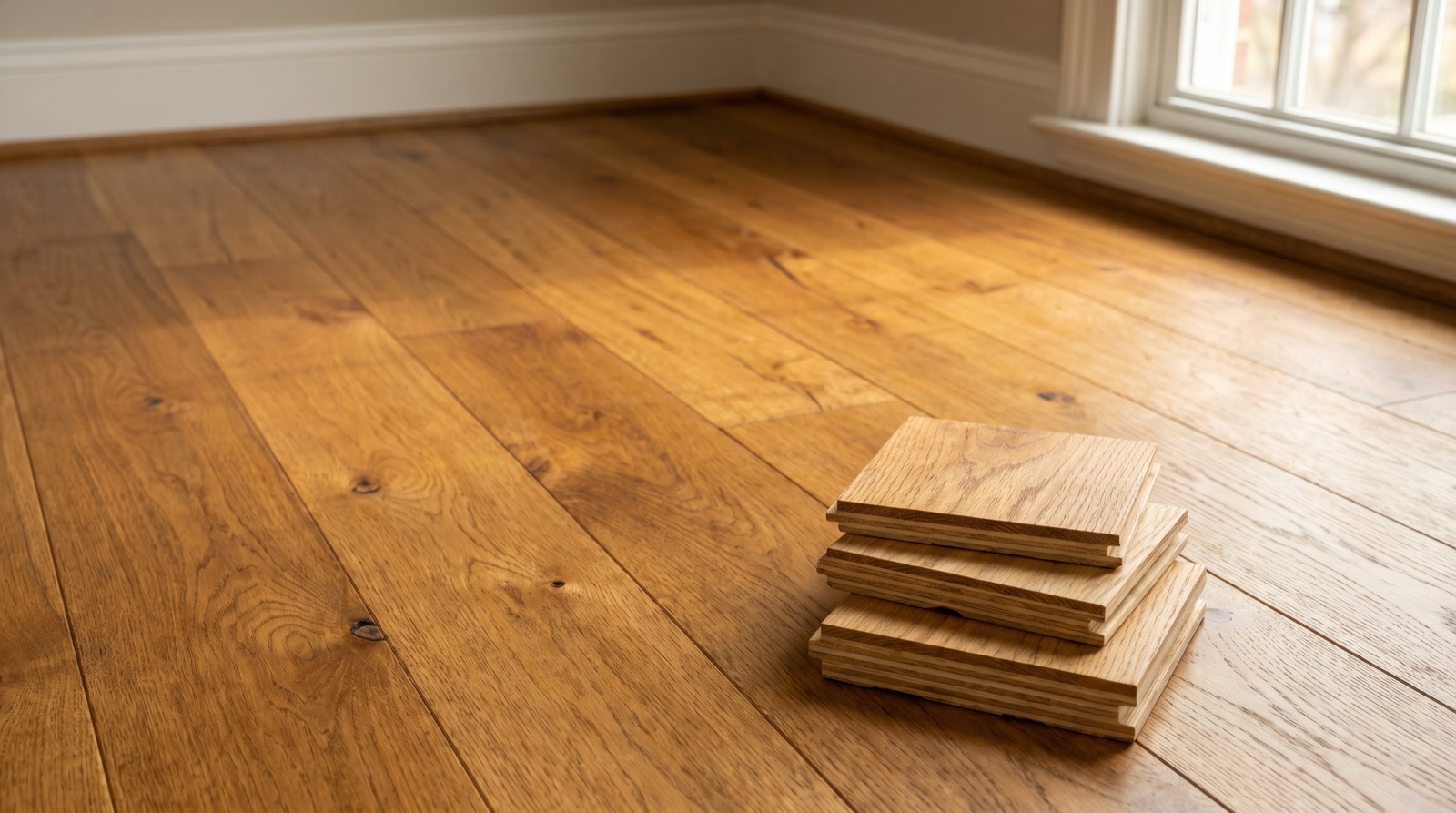
Every week a DMV homeowner walks into a flooring showroom with engineered hardwood already picked. They've ruled out solid (humidity, basement install, condo slab) and they've ruled out LVP (they want the real-wood look and refinish potential). Then the salesperson hands them four samples in different thicknesses and says "they're all engineered, pick what you like." That's the moment the wrong decision usually happens. Thickness on engineered hardwood is not a preference. It's a spec that controls refinish potential, subfloor compatibility, install method, sound underfoot, and 20-year cost. After 20+ years of installing engineered floors across Alexandria, Arlington, Fairfax, Falls Church, Bethesda, Reston, and the rest of the DMV metro, here's the honest guide. What each thickness actually means, which one fits which house, and the answer for the ~70 percent of DMV homes where one thickness is clearly the right pick.
For the installation scope behind those specifications, see our hardwood flooring service.
The short answer for DMV homeowners
Quick answer
For ~70 percent of DMV homes, 1/2" engineered hardwood with a 3mm wear layer is the right pick. It works over concrete slab (post-2000 condos and basements), plywood (70s-80s split-levels), and original plank subfloors with overlay (pre-1950 colonials). It accepts all three install methods (nail, glue, float). It refinishes twice over its lifespan. It costs ~$8.50/sqft all-in at Potomac. It's the engineered thickness that doesn't lock you into a single subfloor or install method. Go thicker (5/8" or 3/4") only if you have a real plywood-over-joist subfloor AND want 3-4 refinish cycles over 40+ years. Go thinner (3/8") only if you're laminating over an existing hard surface where total floor height matters (kitchen cabinet toe-kicks, transitions to tile). Outside those two cases, 1/2" with 3mm wear layer is the honest answer.
That's the head answer. The body walks through what each thickness actually is, the wear-layer math that decides refinish potential, the subfloor compatibility matrix, install methods by thickness, and the price spread.
The two thicknesses on every engineered spec sheet
Quick answer
Every engineered hardwood spec sheet lists two thicknesses. The total plank thickness (3/8" to 3/4") decides install method and subfloor fit. The wear-layer thickness (the real-wood veneer on top, 0.6mm to 6mm) decides how many times the floor can be sanded and refinished. Homeowners almost always look at the total thickness and ignore the wear layer. That's backwards. A 3/4" plank with a 1mm wear layer cannot be refinished at all. A 3/8" plank with a 4mm wear layer can be refinished twice. The wear-layer number is the one that matters for lifespan.
Engineered hardwood is built like a sandwich: a top layer of real hardwood (oak, maple, hickory, walnut, etc.), bonded to a multi-ply plywood or HDF core, with a balancing veneer on the bottom. The top layer (the wear layer) is the only part of the plank that gets sanded during a refinish. Everything below it is structural and never touched. So the wear-layer thickness is the refinish budget, and the total thickness is the install spec.
| Spec | What it controls | Typical range |
|---|---|---|
| Total plank thickness | Install method (nail/glue/float), subfloor compatibility, plank rigidity, sound underfoot, transition height | 3/8" to 3/4" (9mm to 19mm) |
| Wear-layer thickness | Refinish potential (number of sand-and-refinish cycles), dent recovery via sanding, visual repair of scratches | 0.6mm (utility) to 6mm (premium) |
The two specs are independent. A 3/8" plank can have a 2mm wear layer or a 4mm wear layer. A 3/4" plank can have a 1mm wear layer (rare but exists) or a 6mm wear layer. When you're spec-shopping, always confirm both numbers. Most product cut sheets bury wear-layer thickness in the small print. See our engineered vs solid hardwood piece for how engineered construction differs from solid hardwood structurally.
3/8" vs 1/2" vs 5/8" vs 3/4": head-to-head
Quick answer
The four common engineered hardwood thicknesses are 3/8" (9mm), 1/2" (12mm), 5/8" (15mm), and 3/4" (19mm). The thicker the plank, the more it behaves like solid hardwood: heavier, more rigid, accepts nail-down install, feels solid underfoot, costs more. The thinner the plank, the more it behaves like a floating laminate-style product: lighter, more flexible, glue-down or float only, sits lower over transitions. For DMV homes the middle two (1/2" and 5/8") cover ~85 percent of installs. 3/8" is the niche product for low-clearance overlays. 3/4" is the premium product for plywood-over-joist subfloors where the homeowner wants solid-hardwood feel without the moisture risk.
| Spec | 3/8" (9mm) | 1/2" (12mm) | 5/8" (15mm) | 3/4" (19mm) |
|---|---|---|---|---|
| Typical wear layer | 0.6-2mm | 2-3mm | 3-4mm | 4-6mm |
| Refinish cycles | 0-1 | 1-2 | 2-3 | 3-4 |
| Install methods | Float, glue | Float, glue, staple | Float, glue, staple, nail | Nail (preferred), glue, staple |
| Concrete slab | Yes (glue or float) | Yes (glue or float) | Yes (glue, with caveats) | No (use 1/2" or 5/8" instead) |
| Plywood subfloor | Yes (float or glue) | Yes, all methods | Yes, all methods | Yes (nail-down) |
| Plank rigidity | Flexible | Semi-rigid | Rigid | Most rigid |
| Feel underfoot | Hollow without good underlayment | Solid with proper underlayment | Very solid | Indistinguishable from solid hardwood |
| Sound when walked | Hollow click without pad | Soft thud with proper underlayment | Soft thud | Solid thud, no hollow |
| Typical use | Low-clearance overlays, condos with toe-kick constraints | Most condos, townhouses, slab installs | Single-family homes, plywood subfloor, premium feel | Plywood-over-joist single-family, premium long-term |
| Potomac DMV all-in | $8/sqft | $8.50/sqft | $9-9.50/sqft | $10-11/sqft |
| Best for DMV homes | Niche: kitchen overlays, low-transition installs | ~70% of installs, the workhorse | 15% of installs, premium feel, plywood subfloor | 10% of installs, luxury, 40-year horizon |
The big jump in real-world feel happens between 3/8" and 1/2". A 3/8" plank without a good attached pad sounds and feels noticeably hollow underfoot. Homeowners often call it "cheap-feeling" within months of install. A 1/2" plank with proper underlayment feels solid and quiet. The jumps from 1/2" to 5/8" to 3/4" are smaller and mostly about refinish potential and install-method flexibility.
💡 Key takeaway
If you're shopping engineered hardwood in the DMV and one of these four numbers is missing from the spec sheet, walk. Reputable brands (Mirage, Mercier, Lauzon, Kahrs, Mullican, Bruce Engineered, Shaw) publish both total and wear-layer thicknesses on the cut sheet. Budget products sometimes hide the wear-layer number because it's under 1mm. That's a "cannot be refinished" floor sold at solid-hardwood pricing. We've replaced a few of these in DMV homes where the homeowner thought they had refinish potential and didn't. See our hardwood refinishing cost guide for what refinishing actually involves.
Wear layer: the number that decides refinish potential
Quick answer
Wear-layer thickness controls how many times an engineered floor can be sanded and refinished, and a sand-and-refinish removes ~1mm of wood each cycle. So a 2mm wear layer = 1 refinish cycle before the layer is exhausted and the plywood substrate is exposed. A 3mm wear layer = 2 cycles. A 4mm wear layer = 3 cycles. A 6mm wear layer = 4-5 cycles (effectively solid-hardwood lifespan in refinish terms). The wear layer is the single most underweighted spec when homeowners shop engineered hardwood, and the single highest-leverage one for 30-year cost.
| Wear-layer thickness | Refinish cycles | Effective lifespan (DMV residential) | Notes |
|---|---|---|---|
| 0.6mm (utility grade) | 0 (sand only at edges, not full refinish) | 15-20 years (replace, don't refinish) | Budget product, refinish-impossible. Treat as LVP-class lifespan. |
| 1mm | 0-1 (very light screen-and-coat only) | 20-25 years | Screen-and-recoat ($2-3/sqft) extends life but no full sand |
| 2mm | 1 full refinish | 30-35 years | The minimum we recommend for DMV homes you'll own 10+ years |
| 3mm | 2 full refinishes | 40-50 years | The sweet spot. Pairs with 1/2" total thickness |
| 4mm | 2-3 full refinishes | 50-60 years | Premium spec. Pairs with 5/8" total thickness |
| 6mm | 3-4 full refinishes | 70+ years | Effectively solid-hardwood lifespan. Pairs with 3/4" total thickness |
The refinish math is straightforward but rarely explained at the showroom: when we sand a hardwood floor (engineered or solid), we remove ~1mm of wood per full refinish cycle to get below the existing stain, scratches, and oxidation, then re-stain and re-seal. A 2mm wear layer gives you one cycle. After that, the wear layer is exhausted and any further sanding exposes the plywood substrate, which means the only path forward is full replacement, not another refinish.
For a homeowner planning to live in the house 30-40 years, the 1mm-vs-3mm-vs-6mm wear-layer choice is the difference between replacing the floor twice over the hold period versus refinishing twice and never replacing. The wear-layer premium pays for itself many times over on long holds. See our how many times can you refinish hardwood guide for the detailed refinish-cycle breakdown across engineered and solid construction.
Which thickness fits which DMV subfloor
Quick answer
The DMV has three dominant subfloor types, each with a thickness range that fits. Post-2000 condos and basements over concrete slab: 3/8" or 1/2" (glue-down or float). 70s-80s split-levels and post-2000 single-family on plywood subfloor: any thickness, with 1/2" or 5/8" most common. Pre-1950 colonials with original plank subfloors: 3/4" nail-down over plywood overlay, OR 1/2"-5/8" float over engineered underlayment. The wrong thickness for the subfloor leads to either install failure (3/4" floating, click-lock joints fail) or sub-optimal feel (3/8" over plywood feels hollow).
Three DMV-specific subfloor types and their thickness fits:
- Concrete slab (post-2000 condos in Tysons, Reston Town Center, Crystal City, NoMa, Pentagon City + finished basements anywhere in the DMV). Cannot nail into concrete. Must glue or float. Best fit: 1/2" engineered glue-down with a moisture barrier, or 3/8" engineered float. 3/4" engineered over slab is fundamentally a mismatch: too heavy for floating, too rigid for glue-down expansion, no advantage over thinner glue-down products. The condo HOA may require a specific IIC acoustic rating from the underlayment; verify before ordering. See our engineered hardwood over concrete slab deep dive for the moisture-test-first protocol.
- Plywood subfloor over 2x10 joists (70s-80s split-levels in Vienna, Annandale, Springfield, Burke, Reston, Centreville; post-2000 single-family across NoVA). All install methods work. Best fit: 1/2" or 5/8" nail-down or staple-down, or 3/4" nail-down if you want maximum refinish potential. 3/8" works but feels hollow over plywood unless paired with a premium attached cork pad. The thickness decision here is mostly about feel and refinish potential, not install method.
- Original plank subfloor in pre-1950 colonials (Old Town Alexandria, Lyon Village, Arlington, Capitol Hill, Falls Church City, Bethesda older neighborhoods). Original 1x6 or 1x8 pine planks running diagonally to the joists. Cannot nail engineered directly to plank subfloor. The planks shift seasonally and the nails work loose. Required: lay a 3/8" or 1/2" plywood overlay first (sanded smooth), then nail or glue engineered hardwood over. 3/4" engineered with a 1/2" plywood overlay = 1.25" total floor height, which usually requires undercutting doorjambs and may force a stair-tread adjustment. 1/2" engineered with overlay = 7/8" total height, manageable in most period homes.
If you don't know what your subfloor is, the moisture test and visual subfloor inspection are the first thing we do on a free estimate. See our floor leveling cost guide for when subfloor prep is required regardless of thickness.
Install method by thickness: nail, glue, float
Quick answer
Engineered hardwood thickness controls which install methods are physically possible. 3/8" planks can only float or glue. The wood is too thin for a nail or staple to hold without splitting. 1/2" planks add staple-down to the list. 5/8" planks add nail-down. 3/4" planks accept all four methods but nail-down is the strong recommendation when the subfloor is plywood. The wrong install method for the thickness is a callback waiting to happen: staples into 3/8" planks split the wood at the tongue, glue under floating 3/4" planks cracks under thermal expansion, nail-down on concrete slab is impossible regardless of thickness.
| Thickness | Nail | Staple | Glue | Float | Best DMV match |
|---|---|---|---|---|---|
| 3/8" (9mm) | No | No | Yes | Yes | Condo over slab; low-clearance overlays |
| 1/2" (12mm) | Marginal | Yes | Yes | Yes | Most installs: condo, townhouse, split-level |
| 5/8" (15mm) | Yes | Yes | Yes | Yes | Premium feel, plywood subfloor |
| 3/4" (19mm) | Yes (preferred) | Yes | Yes | Marginal | Plywood-over-joist, premium long hold |
The full install-method tradeoff (cost, sound, repairability, when each method fails) is in our hardwood installation methods guide. The short version: nail-down is the strongest long-term install but only works on plywood or wood subfloor; glue-down is the only choice for engineered over slab; float is the fastest install but the easiest to fail if the subfloor isn't flat to 3/16" in 10 feet.
Refinish math: lifespan by wear-layer thickness
Quick answer
Run the math on a 1,200 sqft DMV townhouse main floor. Spec A: 1/2" engineered, 2mm wear layer, $8.50/sqft all-in = $10,200. Refinished once at year 20 ($4.50/sqft = $5,400). Replaced at year 35 ($10,200 in today's dollars). Total over 35 years: $25,800, or ~$737/year. Spec B: 5/8" engineered, 4mm wear layer, $8.50/sqft all-in = $10,200. Refinished twice at year 18 and year 35 ($5,400 each). Still on original install at year 50. Total over 50 years: $21,000, or ~$420/year. The thicker wear-layer floor costs less per year over the hold period because it lasts longer. Worth it only if you plan to own the home 20+ years.
The cost-per-year math is the honest framework for the thickness decision. Premium wear layer pays back when you'll be in the house for the long haul. Budget wear layer pays back when you'll move within 10-15 years and the wear-layer math doesn't compound. For DMV homeowners in starter homes who plan to upgrade within 8-12 years, 1/2" with 2mm wear layer is honest and right-sized. For homeowners settling into a forever home in Arlington, Old Town Alexandria, Bethesda, or Falls Church City, 5/8" or 3/4" with 4-6mm wear layer is the math that wins.
One footnote on refinishing engineered hardwood: the refinish process is the same as for solid hardwood (sand to bare wood, stain, seal with oil-based or water-based polyurethane). The constraint is the wear layer. There's a hard ceiling on how many sand-cycles the floor accepts. See our poly comparison piece for which finish fits which household.
Feel underfoot and sound: walking the differences
Quick answer
The 3/8"-to-1/2" jump is the biggest single change in how an engineered floor feels and sounds. Above 1/2", the differences are subtle. 3/8" engineered without a premium attached pad sounds hollow and feels flexy underfoot. Homeowners report it within months as "cheap-feeling," even on a high-end product. 1/2" with proper underlayment feels solid and quiet. 5/8" and 3/4" feel essentially identical to solid hardwood. For DMV homes the practical thresholds are: never go below 1/2" unless you have a hard clearance constraint; pay for 5/8" if you want a "feels like solid hardwood" install without solid-hardwood moisture risk.
Three things drive sound and feel under engineered hardwood:
- Plank thickness. Thicker = more solid feel, less flex when walked, deeper sound. 1/2" is the threshold where the floor stops feeling hollow.
- Subfloor type and flatness. A perfectly flat plywood subfloor makes any thickness feel solid. A wavy or hollow subfloor (common in older DMV homes) telegraphs through thinner planks. 5/8" or 3/4" hides minor subfloor imperfections better than 3/8" or 1/2".
- Underlayment quality. Premium attached pads (cork, IXPE) on floating installs change the sound and feel more than the plank thickness does. A 1/2" plank with attached cork pad over a flat subfloor feels better than a 5/8" plank with cheap foam underlayment over a wavy subfloor.
For condo and townhouse installs where the downstairs neighbor (or downstairs room) matters, the underlayment IIC rating is the spec to verify. See our condo and townhouse soundproof flooring guide for the HOA acoustic-spec breakdown.
Price by thickness: Potomac DMV 2026 all-in
Quick answer
Potomac DMV 2026 engineered hardwood pricing runs $8 to $11/sqft all-in across the four thicknesses. 3/8" engineered: $8/sqft. 1/2" with 2-3mm wear layer: $8.50/sqft. 5/8" with 3-4mm wear layer: $9-9.50/sqft. 3/4" with 4-6mm wear layer: $10-11/sqft. All prices include material, professional installation, underlayment (for floating installs), demo and removal of old flooring, furniture moving, and final cleanup. No hidden charges. The price spread from 3/8" to 3/4" is ~$3/sqft, or $3,600 on a 1,200 sqft townhouse main floor. Premium species (American walnut, hickory, exotic) adds another $1-2/sqft on top of the thickness baseline.
| Room size | 3/8" all-in | 1/2" all-in | 5/8" all-in | 3/4" all-in |
|---|---|---|---|---|
| 200 sqft (small bedroom) | $1,600 | $1,700 | $1,800-1,900 | $2,000-2,200 |
| 400 sqft (master bedroom + closet) | $3,200 | $3,400 | $3,600-3,800 | $4,000-4,400 |
| 800 sqft (main floor condo) | $6,400 | $6,800 | $7,200-7,600 | $8,000-8,800 |
| 1,200 sqft (townhouse main floor) | $9,600 | $10,200 | $10,800-11,400 | $12,000-13,200 |
| 1,800 sqft (single-family main floor) | $14,400 | $15,300 | $16,200-17,100 | $18,000-19,800 |
| 2,500 sqft (whole-house refloor) | $20,000 | $21,250 | $22,500-23,750 | $25,000-27,500 |
For context, solid hardwood at Potomac runs $8.50/sqft all-in across most species, the same price as 1/2" engineered. The reason most DMV homeowners pick engineered isn't the price; it's the moisture tolerance (basements, slabs, condos) and the install-method flexibility. See our hardwood cost per square foot breakdown for the full pricing landscape across species and types, and our LVP vs hardwood lifetime cost guide for the 20-year comparison against LVP.
💡 Key takeaway
Compare the total installed scope, not a sticker price. A retail quote may list subfloor prep, demo, removal, underlayment, transitions, and installation separately. Put the same items side by side before deciding which written quote costs less. See our hidden flooring charges guide for the comparison checklist.
Room-by-room thickness picks for DMV homes
| Room / situation | Recommended thickness | Why |
|---|---|---|
| Condo over concrete slab (Tysons, Reston Town Center, NoMa, Pentagon City) | 1/2" with 3mm wear layer, glue-down | Slab compatibility, refinish potential, premium feel, fits most condo HOA acoustic specs |
| Finished basement (any DMV home) | 1/2" with 2-3mm wear layer, glue-down or float | DMV basement humidity tolerated; thinner plank fine because feel is less critical in basement use |
| Townhouse main floor (70s-80s + post-2000, plywood subfloor) | 1/2" or 5/8" with 3mm wear layer, staple or nail | Plywood subfloor accepts any method; 5/8" if planning long ownership |
| Single-family main floor (post-2000, plywood subfloor, suburban NoVA) | 5/8" with 4mm wear layer, nail-down | Premium feel, 2-3 refinish cycles, fits long single-family hold |
| Pre-1950 colonial (Old Town Alexandria, Lyon Village, Capitol Hill, Bethesda older) | 1/2" or 5/8" with 3mm wear layer over plywood overlay | Original plank subfloor needs overlay; 5/8" feels best over the layered subfloor |
| Single-family forever home, 30+ year hold | 3/4" with 6mm wear layer, nail-down | Solid-hardwood feel and lifespan; 3-4 refinish cycles |
| Bedroom on upper floor (light use) | 1/2" with 2mm wear layer | Light use doesn't justify premium wear layer; baseline spec is fine |
| Kitchen (where engineered is allowed by your HOA / preference) | 1/2" or 5/8" with 3mm wear layer, glue-down preferred | Glue-down resists appliance leak risk better; consider LVP for kitchens as an alternative |
| Rental property | 1/2" with 2mm wear layer | Refinish potential over tenant cycles; not worth premium wear-layer math for landlord-grade install |
| Bathroom (engineered NOT recommended) | n/a (use tile or LVP) | Any thickness of engineered fails standing water risk; see our tile pricing |
⚠️ Watch out
The single most common DMV thickness mistake we see: 3/4" engineered floating over a concrete slab. The homeowner reads "engineered hardwood" as one thing and assumes the thick option is always better. In reality, 3/4" engineered on slab is a stuck product: too rigid to float reliably (click-lock joints fail under foot traffic), too heavy for proper glue expansion, and worse than 1/2" glue-down on every dimension that matters in a slab install. We've replaced four DMV condo floors in the last two years for exactly this mistake. If you're buying for a slab install, stop at 1/2" or 5/8" maximum.
The honest pick: 1/2" with 3mm wear layer for ~70% of homes
The honest field-level recommendation after 20+ years of engineered installs across the DMV: 1/2" engineered hardwood with a 3mm wear layer is the right pick for ~70 percent of homeowners. The reasons:
- Fits every DMV subfloor (slab, plywood, plank-with-overlay)
- Accepts every install method (nail with caution, staple, glue, float)
- Refinishes twice over a 40-50 year lifespan
- Feels solid underfoot with proper underlayment (the 3/8"-to-1/2" jump is real; the 1/2"-to-5/8" jump is subtle)
- Sits at a reasonable transition height with tile and carpet (~9/16" total including underlayment, matches standard transition strips)
- Costs $8.50/sqft all-in at Potomac, the same as solid hardwood, with better moisture and slab tolerance
The two narrow cases where 1/2" isn't the right pick:
- Go thicker (5/8" or 3/4" with 4-6mm wear layer) when you're settling into a forever home, you have a plywood-over-joist subfloor, and you want solid-hardwood feel plus 3-4 refinish cycles over a 40-60 year hold. The premium is real but pays back on long ownership.
- Go thinner (3/8" with 2mm wear layer) only when you have a hard clearance constraint: kitchen cabinet toe-kicks that can't be raised, transitions to tile that need to stay below a fixed threshold, or an overlay over existing hard surface where the final height matters more than the feel. Outside those cases, 3/8" is too flexy and hollow for most DMV homes.
Whatever thickness you land on, the wear-layer number is the one to fight for. Walk if the spec sheet doesn't list it. A 3/4" plank with a 1mm wear layer is a worse buy than a 1/2" plank with a 3mm wear layer, full stop.
Mistakes that waste money on either end
Four common DMV thickness mistakes we see on quote-walks every month:
- Picking thickness on look or price without checking wear layer. The most common mistake. Homeowner sees "3/4" engineered hardwood" on the box, assumes it's a premium product, doesn't check the wear-layer spec, gets home and finds out the wear layer is 1mm. Now they have a thick plank that can't be refinished, paying solid-hardwood prices for LVP-class lifespan. Fix: always confirm wear-layer thickness in the small print before ordering.
- Going 3/4" on a concrete slab. Covered above. Wrong product for the substrate. The 3/4" thickness was bred for nail-down plywood-over-joist installs. On slab it's stuck between bad floating performance and overkill glue-down. Fix: stop at 1/2" or 5/8" for slab installs.
- Going 3/8" on a plywood subfloor to save money. The $50-$100 savings per 100 sqft over 1/2" is real, but the floor feels hollow and the homeowner regrets it within months. Once installed, the only fix is full replacement. There's no "add thickness later" path. Fix: spend the extra $0.50-$1/sqft and go 1/2" minimum on any subfloor where you'll feel the floor every day.
- Ignoring transition heights. Different thicknesses create different transitions to adjacent rooms (tile bathroom, carpeted bedroom, existing hardwood). A 3/4" engineered floor next to a 5/16" tile floor needs a 7/16" transition strip (sometimes available, sometimes a custom-mill job). Fix: measure the transition heights of every adjacent room before picking thickness, and confirm a stock transition strip is available for the spread.
For a full walk on DMV-specific install gotchas across all hardwood types, see our buckling and cupping piece and the acclimation guide. The principles apply across all engineered thicknesses.
FAQs about engineered hardwood thickness
What thickness of engineered hardwood is best?
For ~70 percent of DMV homes, 1/2" engineered hardwood with a 3mm wear layer is the right pick. It fits every subfloor (slab, plywood, plank-with-overlay), accepts every install method (nail with caution, staple, glue, float), refinishes twice over a 40-50 year lifespan, feels solid underfoot with proper underlayment, and costs $8.50/sqft all-in at Potomac. Go thicker (5/8" or 3/4") only for a forever home with plywood subfloor where you want solid-hardwood feel and 3-4 refinish cycles. Go thinner (3/8") only when you have a hard clearance constraint.
Can you refinish engineered hardwood?
Yes, if the wear-layer thickness is at least 2mm. A full sand-and-refinish removes about 1mm of wood per cycle, so a 2mm wear layer gives you one refinish, a 3mm wear layer gives you two, a 4mm wear layer gives you 2-3, and a 6mm wear layer gives you 3-4. Anything under 2mm can only be screen-and-recoated, not fully refinished. The total plank thickness (3/8" vs 3/4") doesn't matter for refinish potential. Only the wear-layer thickness does.
Is 3/8" engineered hardwood good enough?
Only in narrow cases: overlays over existing hard surfaces where total floor height matters, kitchen cabinet toe-kick clearance constraints, and transitions to fixed-height tile floors. In any other DMV install, 3/8" feels hollow and flexy underfoot. Homeowners report it as "cheap-feeling" within months. The jump to 1/2" is the biggest single feel-and-sound improvement across the four thicknesses. If you don't have a clearance constraint forcing the thin plank, spend the extra $0.50-$1/sqft and go 1/2" minimum.
What's the difference between 1/2" and 5/8" engineered hardwood?
The 1/2"-to-5/8" jump is subtle in feel: both feel solid underfoot with proper underlayment, both refinish twice (assuming similar wear layers), both accept all four install methods. The real differences: 5/8" is more rigid (hides minor subfloor imperfections better), accepts nail-down installs more reliably, and typically pairs with a premium 3-4mm wear layer that adds an extra refinish cycle versus the typical 2-3mm on 1/2" planks. The price spread runs $0.50-$1/sqft. For a forever home with plywood-over-joist subfloor, 5/8" is worth the premium. For a 5-15 year hold, 1/2" is honest and right-sized.
Can 3/4" engineered hardwood be installed over a concrete slab?
Technically yes, practically no, and we recommend against it for every DMV slab install. 3/4" engineered is too heavy and rigid for reliable floating performance (click-lock joints fail under foot traffic over time), and too thick for proper glue-down expansion behavior. There's no real advantage over 1/2" or 5/8" glue-down on a slab. The refinish potential difference is small (both can host a 3-4mm wear layer), and the slab thermal cycling stresses thicker planks more. For DMV slab installs (post-2000 condos, finished basements), stop at 5/8" maximum, prefer 1/2" with proper underlayment.
How thick is the wear layer on engineered hardwood?
Wear-layer thickness ranges from 0.6mm (utility-grade, refinish-impossible) to 6mm (effectively solid-hardwood refinish lifespan). Common ranges: 3/8" plank typically pairs with 0.6-2mm wear layer; 1/2" plank with 2-3mm; 5/8" plank with 3-4mm; 3/4" plank with 4-6mm. The wear-layer number is published on every reputable manufacturer's cut sheet: Mirage, Mercier, Lauzon, Kahrs, Mullican, Bruce Engineered, Shaw. If you can't find the wear-layer thickness in the spec, walk. That's a sign of a budget product that can't be refinished.
Does engineered hardwood thickness affect sound underfoot?
Yes. The 3/8"-to-1/2" jump is the biggest single change. 3/8" engineered without a premium attached pad sounds hollow and clicky when walked, especially over plywood subfloor. 1/2" with proper underlayment sounds and feels solid. Above 1/2", the differences are subtle and mostly about plank rigidity hiding subfloor flaws. For condo and townhouse installs where downstairs neighbors or downstairs rooms matter, the underlayment IIC acoustic rating affects sound transmission more than plank thickness does. Verify the HOA's required IIC spec before ordering.
What thickness of engineered hardwood for a DMV basement?
1/2" engineered with a 2-3mm wear layer, glue-down with a proper moisture barrier, is the right spec for DMV basements. The DMV basement environment (50-65 percent summer humidity, slab moisture, occasional seepage events) is the reason engineered exists. Solid hardwood would cup and crown within two seasons. The 1/2" thickness handles the slab environment without thermal-cycling stress, costs ~$8.50/sqft all-in installed, and refinishes once or twice over a 30-40 year basement lifespan. Always moisture-test the slab (calcium chloride or hygrometer) before install. See our slab install deep dive.
How much more does thicker engineered hardwood cost?
At Potomac DMV 2026 pricing, the spread from 3/8" to 3/4" engineered is about $3/sqft all-in: 3/8" runs $8/sqft, 1/2" runs $8.50, 5/8" runs $9-9.50, 3/4" runs $10-11. On a 1,200 sqft townhouse main floor, that's $9,600 for 3/8" vs $13,200 for top-spec 3/4", a $3,600 spread. The thickness premium often correlates with wear-layer thickness, which over a 30-50 year hold delivers far more value than the upfront premium implies (the per-year cost flips in favor of the thicker, premium-wear-layer floor by year 18-22 of ownership).
Can I install engineered hardwood myself?
Floating installs (any thickness, click-lock products) are DIY-feasible for handy homeowners willing to do careful subfloor prep, acclimation, and expansion-gap layout. Glue-down and nail-down installs are much harder to DIY successfully: wrong adhesive choice, missed nails in tongue, skipped acclimation, or uneven trowel spread all cause callbacks within 1-3 years. For DMV homeowners considering DIY, 1/2" engineered with a click-lock float install is the most forgiving combination. For nail-down or glue-down installs, hire a pro. The labor cost is much less than the cost of replacement after a failed DIY. See our installation methods guide for the full DIY-vs-pro breakdown by method.
Bottom line: the 60-second spec
The 60-second spec
Three questions. What's your subfloor (concrete slab, plywood over joist, or pre-1950 plank with overlay)? How long do you plan to own the home? Do you have a clearance constraint at any transition? Default answer for ~70 percent of DMV homes: 1/2" engineered with a 3mm wear layer. Refinishes twice. Fits every subfloor and install method. Costs $8.50/sqft all-in at Potomac. Go 5/8" or 3/4" with a 4-6mm wear layer only for a forever home on plywood subfloor where you want solid-hardwood feel. Go 3/8" only when you can't fit anything thicker at a transition. And always (always) confirm the wear-layer thickness on the spec sheet before ordering. The wear-layer number is the one that controls 30-year lifespan, and it's the spec budget products hide.
If you're in the DMV (Alexandria, Arlington, Fairfax, Falls Church, Bethesda, Reston, or anywhere in our service area) and you want a real walk-through on which engineered thickness fits your specific house, give us a call at 571-341-7247 or request a free in-home estimate. We bring samples of all four thicknesses (3/8", 1/2", 5/8", 3/4"), pull the wear-layer spec on every sample, walk every room with you, check the subfloor type and flatness, identify the transition heights you need to match, and quote two or three options on your specific square footage. All-in pricing, in-house crew (no subs), and the walkthrough is free whether you book the work or not. See our engineered vs solid hardwood piece for the bigger material decision, the hardwood vs engineered vs LVP comparison for the full three-way picture, and the best hardwood species guide if the species pick is still open.