The short answer on dustless
Quick answer
Dustless refinishing means every sander is hooked by hose to a vacuum that pulls dust at the point the abrasive meets the wood. It removes most of the airborne dust. It's not zero dust, and nobody honest will tell you it is. It's also a completely different service from sandless refinishing, which doesn't sand your floor at all.
Search it and almost every result is a company selling it to you, which is why the question underneath never gets answered. Is there such a thing as dustless floor refinishing, or is it a word on a truck? The honest answer has "most" in it, and most is still a lot.
Here's the version from a crew that sands floors across Alexandria, Arlington, Fairfax and the rest of the DMV. Dustless is worth having. The word just promises a little more than the equipment delivers.
What dustless refinishing actually is
Quick answer
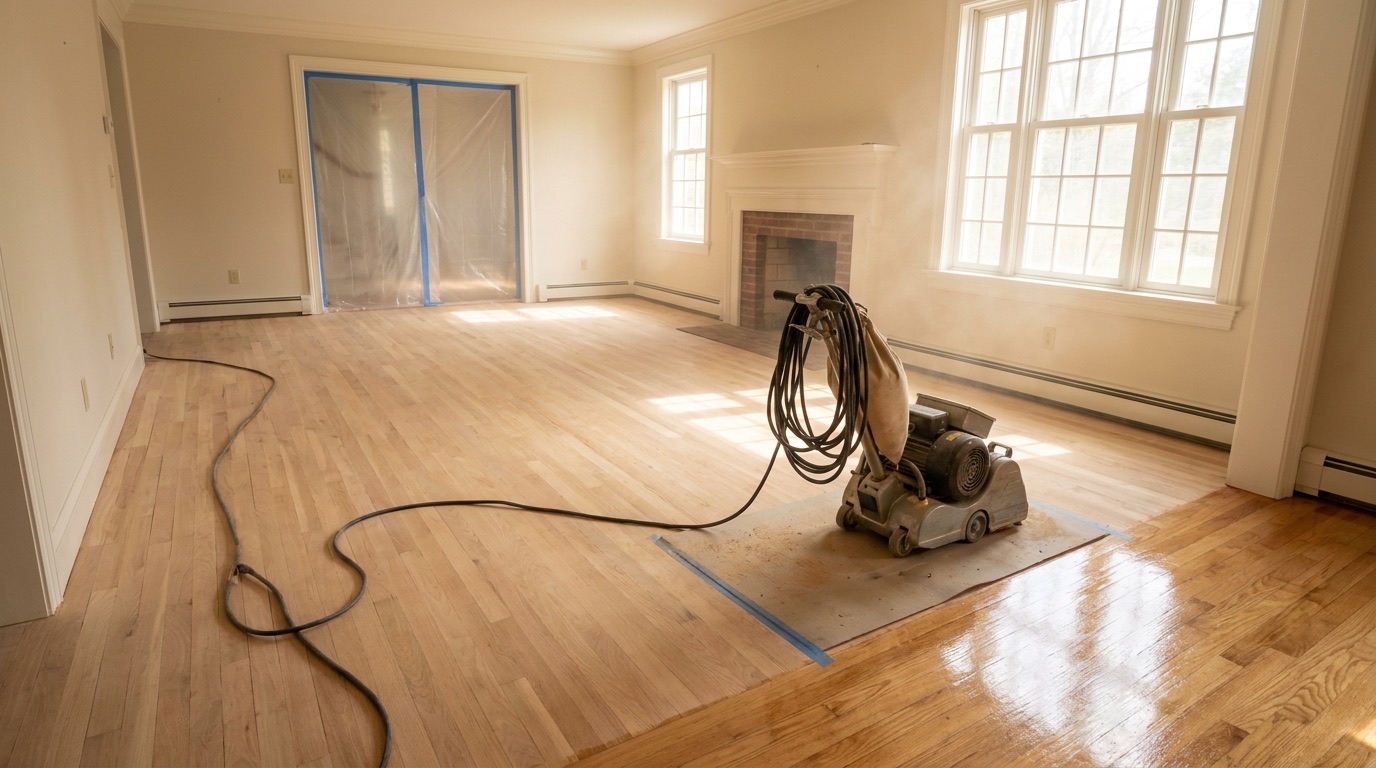
It's a dust containment system. Each sanding machine runs a hose to a HEPA vacuum, often a truck unit parked in your driveway. The sanding itself doesn't change. Same machines, same grit sequence, same passes, same finished floor. What changes is where the dust goes.
A conventional refinish has four stages. A big drum or belt sander takes the old finish and a thin layer of wood off the field of the room. A hand-held edger does the last few inches against the baseboards, inside closets, and under radiators. A buffer smooths the whole floor. Then stain and finish coats go on.
Dustless changes one thing about that. Every machine is tied to a vacuum, so the dust gets pulled at the cut instead of drifting into the room and settling wherever it likes. The wood doesn't come out better because there's a hose attached. Your house comes out cleaner. That's the whole product.
💡 Key takeaway
"Dustless" is an unregulated term. No certification sits behind it, no standard, no inspection, so any shop can print it on a truck. That's not a reason to avoid it. It's a reason to ask what equipment is on the job instead of trusting the word, and that includes asking us.
How much dust is still in the house
Quick answer
Expect a light film on window sills, door tops and horizontal surfaces in the rooms next to the work. What you should not get is the gray coat on every surface in the house that an uncontained sanding job can leave behind for weeks.
Dust mostly escapes in four places. At the edger, because it's small, it moves constantly, and its port is the weakest. In the corners, where the work is done by hand with a scraper and no vacuum exists. When a canister or bag gets emptied. And every time a hose comes off a machine to move it to the next room.
So we still tape the doorways. We still mask the supply and return registers. We still hang plastic at stair openings. If a contractor tells you the plastic is unnecessary because they're dustless, slow down on that sentence. The containment system and the barriers do different jobs, and dropping the second one doesn't make the first one work harder.
The ductwork is the part people miss. If your house is forced air, an open return in a room being sanded pulls fine dust straight into the duct, where it sits until the system kicks on and blows it back into the house. That can go on for weeks after the crew has gone. Seal the supply and return registers in the work area, and keep the system off while sanding runs. It costs nothing, and skipping it's why dust keeps turning up long after the crew has gone.
The two questions that separate a real system from a sticker
Quick answer
Ask: is the edger on the vacuum too, and where does the vacuum exhaust go? The big sander is the easy one to hook up and the one you watch. The edger is where the dust gets out.
Everybody connects the drum sander. It's the loud machine in the middle of the room, it runs for hours, and it's the one a homeowner stands and watches. The edger is a different story. It gets picked up and set down a hundred times, it works in tight spots where a hose is in the way, and leaving it unconnected saves real time. Containment on the big machine and a bare edger still leaves you with a dusty house.
The second question matters just as much. A vacuum that pulls dust out of the air and then pushes the finest particles back through a cheap filter has only moved it. The fraction small enough to pass a poor filter is the fraction you'd breathe. A proper system either runs HEPA filtration or exhausts outside the house. Ask which one they run.
Dustless isn't the same as sandless
Quick answer
Dustless means your floor gets sanded, cleanly. Sandless means your floor doesn't get sanded at all. It's a chemical scuff and a fresh topcoat over the finish you already have. Two different purchases at two different prices.
These two words get used near each other constantly and they mean opposite things. A sandless or no-sand service cleans the floor, abrades the existing finish chemically or with a light buff, and rolls a new coat on top. No wood is removed. Anything that went through the old finish into the wood is still there when it dries, just under a shinier surface. Color barely moves, so a floor you wanted lighter or darker isn't a candidate.
It also has a bonding problem you should know about. If the floor has been waxed, or cleaned with a product that leaves polish behind, or if the existing finish is already flaking, the new coat has nothing to grip and it can peel. A good shop tests a patch first. If your finish is worn but not damaged and you want a few more years out of it cheaply, sandless is a legitimate call and we'll tell you so. It's just not a refinish.
| Conventional sanding | Dustless sanding | Sandless recoat | |
|---|---|---|---|
| Old finish | Removed to bare wood | Removed to bare wood | Stays on, coated over |
| Scratches and gouges | Sanded out | Sanded out | Still there |
| Change the color | Yes, any stain | Yes, any stain | No, tone shift at most |
| Dust in the house | Heavy, everywhere | Light film nearby | Almost none |
| Uses up floor thickness | Yes | Yes | No |
| When it's the right call | Empty house, tight budget | Occupied house, worn or damaged floor | Finish dull but sound |
One thing the table can't show. A floor only has so many sandings in it before the wear layer runs out, which is why how many times a floor can be refinished is worth knowing before you book either service, and why engineered hardwood has its own answer. If your floor is near the end of that count, a recoat is the right call.
Does dustless refinishing cost more?
Quick answer
At most shops it's an upgrade line or a higher per foot rate. The equipment is real money and the hoses genuinely slow a crew down, so the upcharge isn't a trick. Our refinishing is $4.50 per square foot all in, sanding, staining and sealing, with no separate dustless line on the quote.
If a quote lists dustless as an add on, that's a fair way to price it. What isn't fair is a low headline number that turns into the same total once the containment, the stain and the third coat get added back. When you compare two refinishing quotes, line them up on the same three things: how many finish coats are included, whether stain is in the number, and whether dust containment is in the number or beside it. Two quotes that look far apart are often the same job written two ways.
The full breakdown of what moves a refinishing price in this market is in our DMV refinishing cost guide. If the floor is far enough gone that you're weighing a new one, refinishing versus replacement is the comparison to run first.
What you still have to do before we sand
Quick answer
Everything off the floor and out of the room. Art off the walls, curtains down, closets that open into the room emptied. Pets somewhere else. Dustless changes how much cleanup you face afterward. It doesn't change the prep.
Wall art comes down because sanding vibration walks frames off hooks, and that's true in a contained job too. Curtains come down because fabric holds the fine dust that does get out and releases it later. Clear the top of the bookcase in the next room while you're at it. Empty any closet that opens into the work area, because the edger goes in there.
The coating days are a separate constraint and they have nothing to do with dust. Nobody walks on a floor that's curing, including pets and including socks. How long that lasts depends on what goes down, and the split between the two common finishes is covered in oil based versus water based polyurethane. If anyone in the house is sensitive to fumes, that article is the one that decides your plan, not this one. The day by day version of the whole job is in our refinishing timeline.
Pre-1978 DMV homes and the paint next to your floor
Quick answer
A vacuum on a sander is dust control. It's not lead-safe work practice. In a home built before 1978, ask separately how the crew handles the painted baseboards and trim the edger runs against, and whether the firm holds EPA lead-safe certification.
Plenty of what we refinish in Del Ray, Old Town, Arlington and across DC went up long before 1978. The floor itself is bare wood under the finish, so the boards aren't the concern. The trim beside them can be. Baseboards, shoe molding and door casings in an old house often carry several layers of paint, and the edger works right up against all of it.
Federal lead-safe rules cover renovation work that disturbs paint in housing built before 1978, above a minimum disturbed area, and they require the firm doing it to be certified. Confirm how your contractor handles it before the machines arrive, not after. It's a fair question, and a certified firm answers it in one sentence. Just don't accept "we are dustless" as the answer, because those are two different subjects.
Condos and high-rises: what the building will ask for
Quick answer
Expect a certificate of insurance naming the association, approved work hours, a reserved service elevator and corridor protection. And ask where the vacuum filters get changed, because on the ninth floor there's no driveway to park the truck unit in.
Buildings around Tysons, Rosslyn, Ballston and downtown DC all run some version of the same list, and the association will want it before the first machine comes up. Book that paperwork early. It's the item that moves start dates, not the sanding.
The dustless piece has a wrinkle in a tower. Truck mounted vacuum units live in a driveway, which a high rise doesn't have, so the crew runs portable HEPA units inside the unit instead. That's fine, and it works, but filter and canister changes then happen in your home rather than at the curb. Ask how they handle that. A refinish leaves the existing floor in place, so building sound rules usually aren't triggered, but if you're weighing a replacement instead, condo and townhome sound requirements are the thing to read first.
Is dustless worth paying extra for?
Quick answer
Yes if the house is occupied, if anyone has asthma or a respiratory condition, if there's an infant, or if the floor plan is open enough that sealing the work off isn't realistic. Less critical in an empty house you're staying out of anyway.
The clearest case is refinishing part of a house while living in the rest of it. An open plan makes it clearer still, because there's no doorway to tape and the work area is the living area. Anyone with a respiratory condition should treat it as non negotiable rather than an upgrade.
The weakest case is an empty house between owners or tenants, or a whole house refinish where you have already moved out for the week. The dust has nothing to land on that matters and no one is breathing it. Spend the money on the finish instead.
💡 Key takeaway
What dustless doesn't buy you is a better floor. The wood, the finish and how long it lasts come out the same either way. You're buying a cleaner house and cleaner air while the work happens, which is worth money if you're living in it. It just isn't a quality upgrade.
FAQs about dustless floor refinishing
Is dustless hardwood floor refinishing really dustless?
No. It captures most of the dust at the sanding head through a vacuum system, which is a large improvement over an uncontained job. Some still escapes at the edger, in hand scraped corners, and when canisters get changed. Expect a light film nearby, not a gray coat through the house.
What is the difference between dustless and sandless refinishing?
Dustless sands your floor to bare wood with vacuums attached. Sandless doesn't sand at all. It scuffs the existing finish and rolls a new coat over it. Sandless leaves scratches and can't change color, but it costs less and doesn't use up floor thickness.
Does dustless refinishing cost more?
At most shops, yes, either as an add on line or a higher rate, because the equipment costs real money and the hoses slow the crew down. Our refinishing is $4.50 per square foot all in for sanding, staining and sealing, with no separate dustless charge.
Do I have to leave the house during dustless refinishing?
Not for the dust in most cases, which is the point of it. The finish is the deciding factor. Oil based polyurethane has strong fumes and a long cure, water based is milder and dries faster. If anyone is sensitive, plan to be out for the coating days regardless of the sanding method.
Does dustless sanding take longer?
Slightly. Dragging hoses and moving a vacuum unit between rooms adds handling time, and canisters need emptying. It usually doesn't add a day to a normal job. What it saves you is the cleanup afterward, which on an uncontained job can take longer than the sanding did.
Does dustless sanding produce as good a finish?
The finish is identical. Same machines, same grit sequence, same number of passes, same coatings. The vacuum only changes where the dust goes. Some crews find less airborne dust means less grit settling into a wet coat, but the wood underneath comes out the same either way.
Can floor sanding dust get into my HVAC system?
Yes, and this is the part people miss. An open return in the work area pulls fine dust into the ductwork, where it sits until the system runs and blows it back out. Seal supply and return registers in the room and keep the system off during sanding.
Bottom line
Dustless refinishing is a vacuum system. It catches most of the dust where it's made, it leaves a light film instead of a gray coat, and it changes nothing about the floor itself. In an occupied house it earns its money. In an empty one you're paying for something nobody is there to notice. Two questions before you book either way: is the edger on the vacuum, and where does the exhaust go.
Sandless is the other word, and it means something else entirely. If your finish is dull but sound, a recoat is cheaper and smarter. If there are scratches in the wood or you want a different color, only sanding gets you there. If a quote uses the two words as though they're the same service, get the difference in writing before you sign.
We refinish hardwood across the DMV with our own crews and all-in pricing. Ask us the same two questions you'd ask anyone else. We would rather answer them than have you guess. See what the work includes on our hardwood refinishing page, look at stain colors and sheen levels if you're picking the look, or get a free estimate and we'll walk your floor and tell you honestly whether it needs sanding at all.