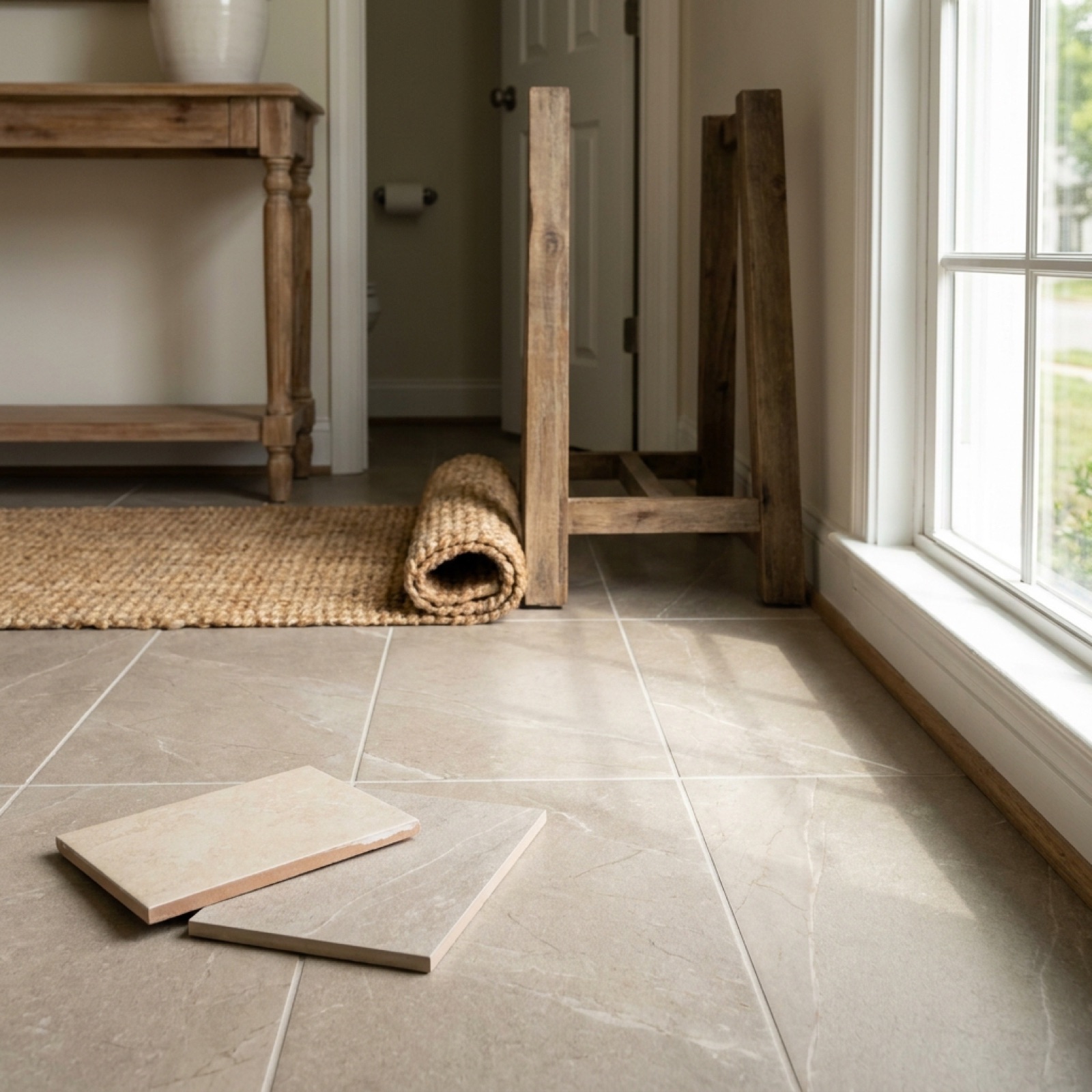
"Do I need porcelain, or is ceramic fine?" is the question almost every DMV homeowner asks the moment we start scoping a tile job, whether it is a powder room in Old Town Alexandria, a basement floor in a Reston townhouse, a mudroom in a Vienna split-level, or a kitchen in a McLean rebuild. The honest answer is that the two are closer cousins than the showroom makes them sound, the real difference comes down to one lab number (water absorption), and for most DMV floors the right pick is porcelain, while ceramic still earns its place on walls and on a tight budget in low-traffic dry rooms. After 20+ years installing tile across this metro, here is the real decision guide: the actual technical difference, the head-to-head tradeoffs, what the PEI rating means and which one to buy, the room-by-room call for a DMV home, the freeze-thaw and basement-slab rules that are specific to this climate, the best tile for a bathroom floor, honest install pricing, and the mistakes we get called back to fix.
The short answer for DMV homeowners
Quick answer
Porcelain is the floor tile. Ceramic is the budget and wall tile. The difference is density: porcelain absorbs 0.5 percent water or less, ceramic absorbs more, so porcelain is harder, more water-resistant, and the only safe choice for any DMV surface that sees moisture, freeze-thaw, or real traffic. For a DMV home that means porcelain for entries, mudrooms, kitchens, bathrooms, basements, screened porches, and anything over a slab. Ceramic is fine on shower and tub walls, on a backsplash, and on a low-traffic dry floor where you want to save money. The price gap is smaller than people think: porcelain material runs roughly $3-8 per square foot, ceramic $1-4 per square foot, and the labor to install either one is nearly identical because the hard part of a tile job is the prep, the layout, and the grout, not the tile body. The premium you pay for porcelain on a floor pays for itself the first winter it does not crack.
The rest of this guide explains the one lab number that actually separates the two, the full head-to-head, what PEI rating to buy, the room-by-room call for DMV housing stock, the climate rules that bite homeowners here, the bathroom-floor question specifically, real install pricing, and the failures we are called to repair.
The real difference: water absorption, not marketing
Quick answer
Porcelain and ceramic are both fired clay. The official line that separates them is water absorption: porcelain is certified to absorb 0.5 percent or less of its weight in water, ceramic absorbs more than that. Porcelain is made from a finer, denser clay (often with feldspar) pressed harder and fired hotter, around 2,200-2,500 degrees, which vitrifies the body into something close to glass. Ceramic is fired cooler with a coarser clay, leaving a more porous body under the glaze. That single property cascades into everything else: a denser body is harder, more scratch and dent resistant, far less likely to soak up water and crack in a freeze, and it carries its color deeper through the tile so a chip is less visible. The glaze on top can look identical on both. The body underneath is where they part ways.
Walk a tile showroom and you will hear "porcelain is just better ceramic." That is half right and half marketing. Both are clay tile. The body density is the real, testable difference, and it is the reason porcelain costs more to make and lasts longer on a floor. The certification that matters is the ASTM water-absorption test: anything rated at 0.5 percent absorption or less can legally be called porcelain. Everything above that is ceramic, no matter how premium the glaze looks. When a salesperson cannot tell you the absorption number, ask to see the spec sheet. We do this on every job before we order.
⚠ Watch out
"Porcelain-look" and "porcelain finish" are not porcelain. Big-box stores sometimes shelve a glazed ceramic next to true porcelain with near-identical photos and a price that looks like a deal. Check the box for the water-absorption rating or the words "porcelain" with a PEI rating. If it only says "ceramic floor tile," it is ceramic, and on a DMV entry or basement it will not hold up the way you expect.
Porcelain vs ceramic head to head
Quick answer
Porcelain wins on hardness, water resistance, freeze resistance, and outdoor use. Ceramic wins on price, ease of cutting, and weight. Both win equally on style, because the glaze and print technology is now identical across the two. The practical read for a homeowner: if the surface gets wet, gets cold, or gets walked on hard, buy porcelain. If it is a wall, a backsplash, or a low-traffic dry floor on a budget, ceramic is honest value.
| Property | Porcelain | Ceramic | Why it matters in the DMV |
|---|---|---|---|
| Water absorption | 0.5% or less | 0.5% to 10%+ | Porcelain survives moisture, slabs, and freeze-thaw; ceramic can crack when wet tile freezes |
| Hardness / durability | Very hard, dense body | Softer, more porous | Porcelain takes mudroom grit and pet claws without chipping |
| Freeze-thaw rated | Yes (most porcelain) | No (interior only) | Only porcelain belongs on a DMV porch, stoop, or unheated garage |
| Color through body | Often full-body | Glaze over lighter body | A chip on porcelain hides; a chip on ceramic shows the pale clay underneath |
| Cutting / install | Harder, needs a good wet saw + diamond blade | Easier to score and snap | Marginal labor difference; both need a pro for a clean job |
| Weight | Heavier | Lighter | Matters on second-floor and wall installs, rarely on slab floors |
| Material cost | ~$3-8/sqft | ~$1-4/sqft | Smaller gap than most expect; the floor lasts decades either way the prep is done right |
| Best use | Floors, wet areas, outdoor, slab, high traffic | Walls, backsplash, low-traffic dry floors | Most DMV floor jobs are porcelain; ceramic covers walls and budget rooms |
The takeaway from the table: there is no scenario where ceramic outperforms porcelain on a floor. Ceramic's entire advantage is cost and slightly easier cutting. So the real question is never "which is better," it is "is this surface demanding enough to need porcelain, or can ceramic do the job for less." On walls and backsplashes the answer is usually ceramic. On floors in a four-season climate like ours, the answer is usually porcelain.
PEI rating: the number that actually matters
Quick answer
PEI is the surface-wear rating, scored 1 to 5, and it tells you whether a tile can handle the traffic of a given room. For DMV floors, buy PEI 3 minimum for any room people walk through, PEI 4 for entries, kitchens, mudrooms, and busy households, and PEI 5 for commercial-grade traffic. PEI 1 and 2 are wall and light-use tiles only. A tile can be true porcelain and still carry a low PEI if its glaze is soft, so check both the porcelain rating and the PEI number, not just one.
| PEI rating | Rated for | DMV use |
|---|---|---|
| PEI 1 | Walls only, no foot traffic | Shower walls, tub surrounds, backsplash |
| PEI 2 | Light traffic, soft footwear | Powder rooms, low-use guest baths |
| PEI 3 | Moderate traffic | Most residential floors: living areas, bedrooms, main baths |
| PEI 4 | Moderate-heavy traffic | Entries, kitchens, mudrooms, busy family homes, pets |
| PEI 5 | Heavy / commercial traffic | Storefronts, very high-traffic mudrooms, rentals |
The common DMV mistake is buying a beautiful PEI 2 tile for a busy kitchen because the showroom display looked great. Two years later the glaze has a dull traffic path worn into it. Match the PEI to the room, then pick the look. We tell every client to write the room down first and shop within the right PEI band second.
Which tile for which room in a DMV home
Quick answer
Floors that get moisture or traffic get porcelain. Walls and backsplashes get ceramic. That single rule covers about 90 percent of the calls we run. The DMV exceptions worth knowing: anything over a basement slab is porcelain, anything outdoors or in an unheated space is porcelain, and a low-traffic dry guest powder room is the one floor where ceramic is genuinely fine if you want to save.
| Room / surface | Our default | Why |
|---|---|---|
| Entry / foyer floor | Porcelain, PEI 4 | Grit, road salt, wet shoes all winter |
| Kitchen floor | Porcelain, PEI 4 | Drops, spills, dragged chairs, heavy traffic |
| Mudroom floor | Porcelain, PEI 4-5 | The hardest-working floor in a DMV home |
| Main bathroom floor | Porcelain, PEI 3-4 | Standing water, steam, daily use |
| Powder room floor | Ceramic or porcelain, PEI 2-3 | Low traffic and dry, ceramic saves money here |
| Basement floor (over slab) | Porcelain | Slab moisture and the occasional damp event |
| Shower / tub walls | Ceramic, PEI 1 | No foot traffic, ceramic is the value pick |
| Backsplash | Ceramic | Decorative, no traffic, easiest to cut for outlets |
| Screened porch / stoop | Porcelain, freeze-thaw rated | Exposed to DMV winters, ceramic will crack |
If you are deciding the broader floor question before you even land on tile, our guides on the best flooring for DMV bathrooms, best flooring for DMV kitchens, and best flooring for DMV basements walk through tile against LVP and the other options room by room.
DMV-specific: freeze-thaw, slabs, and humidity
Quick answer
Three things about this climate change the porcelain-vs-ceramic call: our real freeze-thaw cycles, our slab basements, and our humid summers. The DMV swings below freezing and back above it dozens of times each winter. Any tile that holds water and then freezes will crack, which rules ceramic out of every exterior, garage, and unheated surface. Our basements sit on or near slabs that wick moisture, so basement tile must be porcelain set over the right membrane. And our summer humidity means a poorly sealed grout line in a bathroom grows mildew fast, which is a grout and sealing issue more than a tile-body issue.
The freeze-thaw point is the one that costs DMV homeowners money. A glazed ceramic tile on a front stoop or a screened-porch floor looks fine the first fall, then the first hard freeze after a rain gets into the porous body and pops the tile or spider-cracks the glaze by spring. Porcelain rated for exterior use absorbs almost no water, so there is nothing inside the tile to freeze and expand. If anyone quotes ceramic for an outdoor or unheated DMV surface, that is a red flag.
For basements, the issue is the slab. Most DMV basements are concrete slabs that pass water vapor up from the ground, and many of the homes built between the 1950s and 1990s have minor slab cracking or unevenness. Porcelain over a slab needs two things done right: a crack-isolation or uncoupling membrane so a moving slab crack does not telegraph up and crack the tile, and a flat substrate. The membrane is the difference between a basement tile floor that lasts 30 years and one that cracks along the slab joint in year two. We cover slab moisture and prep further in our DMV floor leveling cost guide, and if you are weighing a heated tile floor, the compatibility details are in our radiant heat flooring guide.
⚠ Watch out
Large-format porcelain (anything 15 inches or larger on a side, and the popular 24-by-48 plank tiles) needs a flatter substrate than smaller tile. The industry spec tightens to roughly 1/8 inch of variation over 10 feet for large-format. Most DMV slabs and a lot of 1960s-90s subfloors fail that on the first measurement, which means a self-leveling step before tile goes down. Skip it and large tiles "lippage," where one edge sits higher than its neighbor and you feel and see every joint.
Best tile for a bathroom floor
Quick answer
For a bathroom floor, buy porcelain, PEI 3 or 4, with a textured or matte finish for slip resistance, in a smaller format if the floor is small. The body should be porcelain for the water resistance, the finish should not be high-gloss because wet gloss tile is slippery, and a 12-by-24 or smaller tile on a small bathroom floor means fewer cuts and a flatter result. The grout matters as much as the tile here: use a quality grout, seal it, and the floor handles steam and standing water for decades.
"Best tile for bathroom floor" is one of the most-searched tile questions, and the honest answer is boring in the best way: porcelain, matched PEI, matte or lightly textured finish, sealed grout. The decorative options (hex mosaics, wood-look planks, stone-look large format) are all available in porcelain, so you never have to trade durability for the look you want. For a main or family bath where the floor gets wet daily, porcelain is not optional. For a powder room that stays dry, a good ceramic in PEI 2-3 is a legitimate way to save. The slip point is worth repeating: in a wet room, skip polished tile and pick a matte or structured surface, or at minimum a smaller tile with more grout lines for grip.
Real DMV tile install cost
Quick answer
Installed tile in the DMV typically lands around $9-18 per square foot all-in, and the tile body (porcelain vs ceramic) is the smallest variable in that number. The big cost drivers are the prep (leveling, membrane, demo of old flooring), the layout complexity (diagonal, herringbone, and small mosaics cost more labor than a straight grid), the tile size (large format needs more prep, mosaics need more setting time), and waterproofing in wet areas. The porcelain-over-ceramic material upcharge is usually only $2-4 per square foot, which on a typical bathroom floor is a small fraction of the job total.
| Cost component | Typical DMV range | Notes |
|---|---|---|
| Ceramic tile material | $1-4/sqft | Walls, backsplash, budget dry floors |
| Porcelain tile material | $3-8/sqft | Floors, wet areas, outdoor, slab |
| Tile labor (setting + grout) | $7-12/sqft | Higher for diagonal, herringbone, mosaic, large format |
| Demo + removal of old floor | $1.50-4/sqft | Depends on what is coming up and the subfloor under it |
| Self-leveling / crack membrane | $1.50-4/sqft | Common on slabs and large-format installs |
| Shower waterproofing | By the job | Pan, membrane, niche work priced per scope |
Tile is the one product where we quote custom rather than a single all-in per-square-foot number, because a 40 sqft powder room with a straightforward grid and a 200 sqft kitchen with large-format porcelain over a slab that needs leveling are completely different jobs. What stays the same is the all-in promise: the quote includes material, installation, demo and removal, and any prep we flag up front, with no surprise line items mid-job. Our DMV hidden-charges guide explains the quote traps we built our pricing to avoid, the general tile pricing picture is in our tile installation cost guide, and you can see the full service on our tile and ceramic page.
Tile mistakes we get called to fix
Quick answer
The repairs we get called for are almost never "wrong tile body" alone. They are ceramic used where porcelain belonged, no crack membrane over a slab, large-format tile over an unleveled floor, unsealed grout in a wet room, and polished tile in a bathroom. Every one of these is a prep or selection decision made before the first tile went down, which is exactly why the tile body and the install plan have to be chosen together.
The five we see most in DMV homes:
- Ceramic on an entry or basement floor. Cracks and chips show the pale body underneath within a couple of winters. The fix is a tear-out and reinstall in porcelain, which costs more than buying porcelain the first time.
- No crack-isolation membrane over a slab. A slab moves, the crack telegraphs straight up, and the tile splits in a line across the floor. Almost always a basement.
- Large-format tile over an unleveled subfloor. Lippage on every joint, you feel the edges with bare feet, and the floor reads as a bad install even though the tile is fine. The substrate was the problem.
- Unsealed or low-grade grout in a shower or main bath. Mildew and staining in our humid summers, and water working behind the tile. A grout and sealing problem, not a tile problem.
- Polished tile on a bathroom floor. Beautiful and dangerously slick when wet. We re-do these in a matte or textured porcelain.
The thread through all five: the tile body is one decision, and the prep, layout, waterproofing, and finish are the decisions that actually determine whether the floor lasts. Picking porcelain is necessary, not sufficient. The install plan is the rest of it.
FAQs about porcelain vs ceramic tile
Is porcelain tile always better than ceramic?
On a floor, in a wet area, outdoors, or over a slab, yes. Porcelain is denser, harder, and water-resistant, so it outperforms ceramic anywhere that matters. On walls, backsplashes, and low-traffic dry floors, ceramic does the same job for less, so "better" depends on the surface. There is no floor where ceramic beats porcelain on performance.
Can I use ceramic tile on a bathroom floor?
On a low-traffic powder room that stays dry, a PEI 2-3 ceramic is acceptable and saves money. On a main or family bathroom floor that sees standing water and steam daily, use porcelain. The water resistance and durability are worth the small upcharge in a room that gets wet every day.
How can I tell porcelain from ceramic in the store?
Check the box for a water-absorption rating of 0.5 percent or less, or the word "porcelain" paired with a PEI number. The unglazed edge of a porcelain tile is usually the same color as the face because the color runs through the body, while ceramic shows a paler clay under the glaze. If the box only says "ceramic floor tile," it is ceramic.
Does porcelain cost a lot more than ceramic?
The material gap is smaller than most people expect, usually $2-4 per square foot. Because labor, prep, and grout are the same for both and make up most of a tile job, choosing porcelain over ceramic on a typical bathroom floor adds only a small fraction to the total cost.
Will ceramic tile crack on my front porch in winter?
Likely yes. The DMV freezes and thaws repeatedly each winter, and ceramic absorbs enough water that a freeze can crack the body or the glaze. For any exterior, stoop, screened-porch, or unheated-garage surface, use porcelain rated for freeze-thaw and exterior use.
Is porcelain or ceramic better for a basement floor?
Porcelain. DMV basements sit on slabs that pass moisture, and porcelain's near-zero water absorption handles that far better than ceramic. The bigger requirement is the install: a crack-isolation membrane over the slab and a flat substrate matter as much as the tile choice.
What PEI rating do I need for a kitchen floor?
PEI 4 for a DMV kitchen. Kitchens see heavy traffic, dropped pans, dragged chairs, and spills, so the surface needs a wear rating built for moderate-to-heavy use. PEI 3 is the minimum for any walked-on floor, and PEI 4 is the safer call in a busy household.
Bottom line: how to choose
For a DMV home, the rule is simple: porcelain on floors and wet or cold surfaces, ceramic on walls and budget-friendly dry rooms. Match the PEI rating to the room before you fall in love with a look, demand the water-absorption spec sheet so you know what you are actually buying, and remember that the tile body is only half the decision. The prep, the membrane over a slab, the leveling for large format, the waterproofing in a shower, and a matte finish on a wet floor are what make a tile floor last 30 years instead of cracking in two.
We install both porcelain and ceramic across the DMV, and every quote is all-in: material, professional installation by our in-house crew with no subcontractors, old flooring demo and removal, and any prep flagged up front with no surprise line items. If you want a straight answer on which tile your specific room needs and what it will actually cost, request a free estimate or call us at 571-341-7247 and we will walk the space with you.