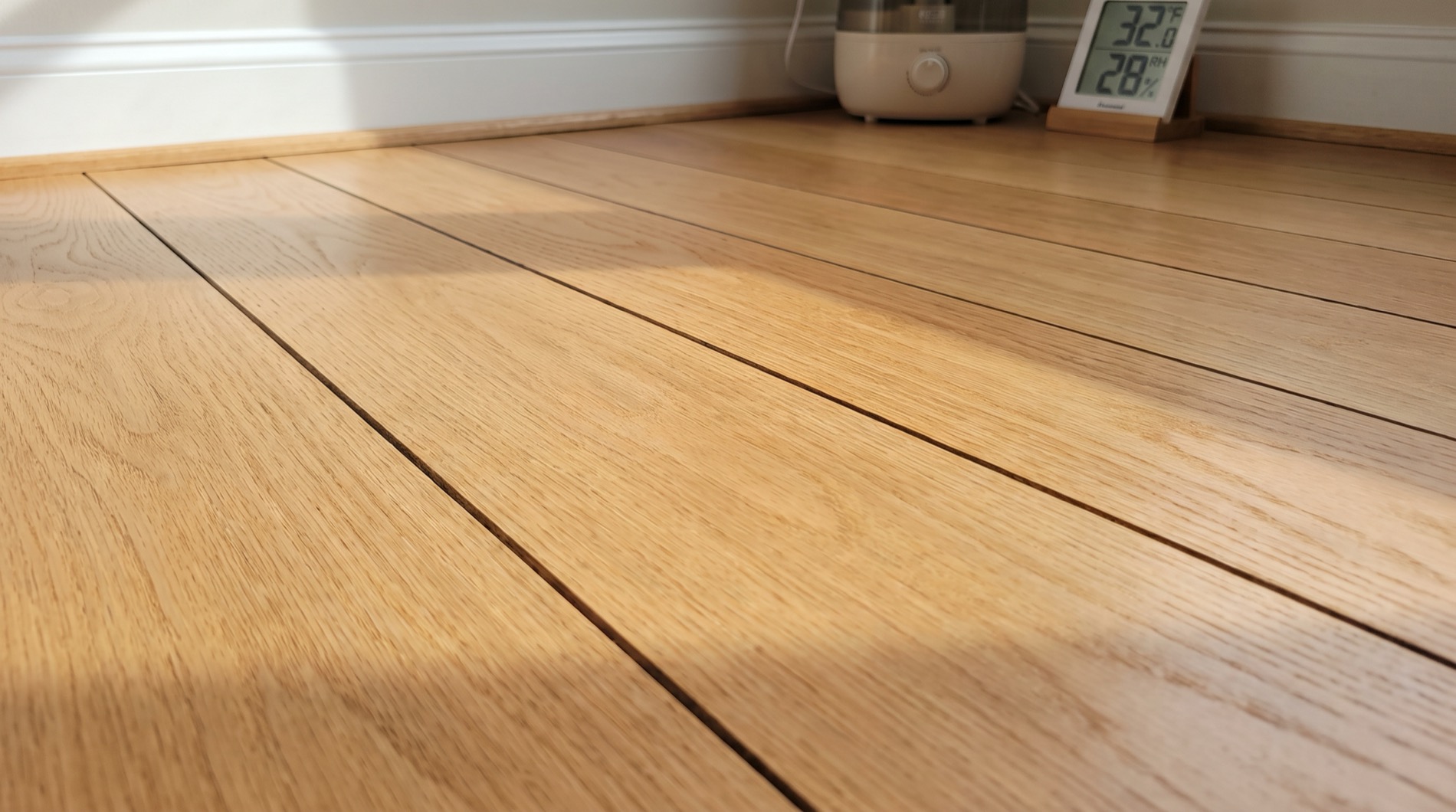
Every January and February we get the same call from DMV homeowners. They walk barefoot across the living room and feel cold air rising through gaps between hardwood planks that weren't there in October. They send a photo. Sometimes it's hairline. Sometimes you can drop a quarter on edge into the gap. They want to know two things: is this normal, and what do I do about it. The honest answer is that most winter gaps in DMV hardwood are a normal seasonal cycle that closes back up in summer, but some are a real failure that needs repair, and the difference is measurable in millimeters and pattern. After 20+ years installing and refinishing hardwood across Alexandria, Arlington, Fairfax, Falls Church, Vienna, Bethesda, Reston, Old Town, Tysons, and the rest of the DMV metro, here's the honest winter-gap playbook. Why gaps open, the normal-vs-problem threshold, what species and plank width do to make it worse, the humidity targets that prevent it, the fill-or-leave decision, the DIY methods that work and don't, and what it costs when professional repair is the only fix.
The short answer for DMV homeowners
Quick answer
Hairline gaps under 1/16 inch between hardwood planks in winter are normal in the DMV and close back up in summer. Gaps over 1/16 inch (about the thickness of a credit card) suggest indoor humidity dropped too low (under 25% RH), the species is moving more than expected, or the install skipped acclimation. Gaps over 1/8 inch that don't close back in summer mean a real failure, usually a subfloor moisture problem or boards that contracted past their elastic range. Fix the indoor humidity first (target 30-50% RH year-round with a whole-house humidifier on the HVAC). Don't fill normal seasonal gaps with putty or rope; they'll force the boards apart in summer and cause edge crushing. Professional repair runs $4 to $12 per linear foot for spot fill, $4.50/sqft for full refinish-and-rebatten if the whole floor needs work.
That's the head answer. The body walks through the moisture-content math, the species and width amplifiers, the humidity targets that actually work in a DMV winter, the fill-or-leave decision rule, the DIY methods that work and don't, the professional repair cost band, and the diagnostic for when gaps don't close in summer.
Why hardwood floors gap in DMV winters
Quick answer
Hardwood is a hygroscopic material. It absorbs and releases moisture with the surrounding air. The DMV indoor humidity drops from ~55-65% RH in summer to ~20-30% RH in winter (forced-air heat strips moisture out of the air). Hardwood reaches an equilibrium moisture content (EMC) of roughly 11-12% at 65% RH and roughly 5-6% at 25% RH. As the wood loses moisture, it physically shrinks across the grain, typically 0.15% to 0.25% per percentage point of moisture lost. That shrinkage shows up as visible gaps between planks every winter.
The numbers, in plain terms: a 3-inch wide red oak strip with 6 percent moisture content drop (from 11% summer EMC to 5% winter EMC) shrinks roughly 0.03 inches across its width. A 7-inch wide white oak plank under the same humidity swing shrinks roughly 0.07 inches. Across a 12-foot run of 3-inch strip flooring (48 boards), the aggregate winter shrinkage is roughly 1.4 inches distributed across 47 joints, mostly invisible. Across the same run of 7-inch wide plank (20 boards), the aggregate shrinkage is roughly 1.4 inches distributed across 19 joints, each gap is roughly 0.07 inches, which the eye reads as a defect.
Three things drive DMV winter hardwood gapping specifically:
- Forced-air heat strips humidity. The DMV's typical heating system (gas or electric forced air) pulls outdoor air with low absolute humidity (cold air holds little moisture) into the house, then heats it. Heated air at the same absolute humidity reads as much lower relative humidity. A house that was 50% RH on a 50-degree October day can drop to 20% RH on a 15-degree January day with the same heating system running.
- Older homes leak more. 1955-1985 split-levels, Arlington Cape Cods, and Old Town pre-war colonials have higher air-exchange rates with outdoor air. The drier outdoor air pulls indoor RH lower than in newer, tighter construction (post-2010 builds). Same hardwood, same heating, more gapping in the older house.
- Single-stage humidifiers can't keep up. A portable room humidifier puts out ~1-2 gallons per day; a typical DMV single-family home loses 6-15 gallons per day to ventilation and exhaust in winter. Without a whole-house humidifier sized to actual home volume and air exchange rate, the indoor RH can't be held above 30% in deep winter.
For the summer counterpart (humidity-driven expansion that causes cupping and buckling) see our DMV humidity failure guide. For the install-week protocol that prevents both seasonal failures see our acclimation guide.
Normal hairline vs problem gap: the 1/16-inch rule
Quick answer
The rule of thumb most installers use: gaps under 1/16 inch (roughly the thickness of a credit card or a dime on edge) are normal seasonal hardwood movement and close back up in summer. Gaps 1/16 to 1/8 inch are at the edge of normal, usually fine, but a sign indoor humidity is running too low or the species/width is moving more than expected. Gaps over 1/8 inch (a quarter on edge) in winter that don't close back to hairline in summer are a real failure and need repair.
| Gap width | What it means | What to do |
|---|---|---|
| Hairline (under 1/32") | Normal seasonal movement; closes in summer | Nothing. Don't fill. |
| 1/32" to 1/16" (credit card) | Normal in DMV winters; indoor RH probably 25-35% | Run humidifier; targets 30-50% RH year-round |
| 1/16" to 1/8" (penny on edge) | Indoor RH probably under 25%, or species/width is high-movement | Whole-house humidifier; spot fill only if you can verify gaps close in summer |
| Over 1/8" (quarter on edge) | Real failure if it doesn't close in summer: install error, subfloor moisture issue, or board contraction past elastic range | Diagnostic call from a pro; possible spot board replacement or full refinish-and-rebatten |
| Random isolated wide gap among normal boards | Subfloor fastener pull-through, board cup that opened a joint, or localized subfloor moisture | Pull and reset that board; check for subfloor cause |
The pattern matters as much as the absolute width. Even seasonal gapping across the whole floor (every joint shows similar width) reads as a humidity issue. A few isolated wide gaps in a floor that's otherwise tight reads as a localized board or install problem. Take photos in February and again in August. If February gaps close to invisible or hairline by August, that's normal seasonal movement. If they stay open in August, that's a failure.
⚠ Watch out
A common mistake we see: the homeowner notices wide winter gaps, panics, hires a non-installer handyman to "fill the gaps." The handyman crams wood putty, rope, or sawdust-and-glue into the gaps in February. Summer comes, the boards expand back, and there's nowhere for them to go because the gap is now filled. The boards either crush at the edges (visible damage along every joint) or cup upward (the floor lifts in spots). Repair cost on a crushed-edge floor after this scenario is usually a full refinish ($4.50/sqft) plus board replacement on the worst spots. Don't fill normal seasonal gaps. Verify with photos across seasons first.
What makes the gap worse: species, width, age, install
Quick answer
Four factors amplify visible winter gapping in a DMV hardwood floor. Species movement (red oak and hickory move more than white oak or quarter-sawn anything). Plank width (a 7-inch plank shows roughly 3x the per-joint gap of a 2.25-inch strip with the same percentage shrinkage). Floor age (boards installed before whole-house humidifiers were standard often have larger seasonal swings). Install method (boards that weren't acclimated to job-site humidity for 5-10 days before install, or were installed to a wet subfloor, will show larger seasonal movement permanently).
| Factor | Less gapping | More gapping |
|---|---|---|
| Species | White oak, walnut, quarter-sawn anything, engineered hardwood | Red oak (plain-sawn), hickory, maple, wide-grain pine |
| Plank width | 2.25" strip, 3-4" standard | 5-7" wide plank, 8"+ extra-wide |
| Cut | Quarter-sawn (vertical grain), rift-sawn | Plain-sawn (flat-grain) |
| Install method | Nail-and-glue or full glue-down | Floating install, straight nail without glue assist on wide plank |
| Acclimation | 5-10 days on-site at job-site humidity before install | Boards installed straight off the delivery truck |
| Humidity control | Whole-house humidifier on HVAC, target 30-50% RH year-round | No humidifier; RH swings 20% winter to 70% summer |
Two practical implications. First, if your floor is red oak in a 1970s DMV split-level without a whole-house humidifier and you're seeing 1/8-inch winter gaps, that's the species, the age, and the missing humidity-control stack all at once, and the fix is the humidity, not the floor. Second, if you're planning a new install and want to minimize seasonal gapping, the move is white oak engineered, 4-5 inch width, glue-down or nail-and-glue install, with a whole-house humidifier specified as part of the job scope. For the full species comparison see our DMV hardwood species guide and our plank width guide.
Prevent winter gaps: humidity targets that actually work
Quick answer
The published spec from the National Wood Flooring Association (NWFA) is 30-50% RH year-round. Hit the bottom of that range in winter and visible gapping mostly disappears. The portable humidifier in the bedroom doesn't get you there in a DMV single-family home. A whole-house humidifier wired into the HVAC supply plenum, sized to home square footage and air-exchange rate, is what holds 30-50% RH through a Northern Virginia January. Budget $400-1,200 installed for a steam or bypass humidifier on the HVAC. The flooring savings (no spot repairs, no premature refinish) pay it back inside 2-3 years.
| RH range | What happens to hardwood |
|---|---|
| Above 60% RH | Boards approach 12%+ EMC, expand toward each other, risk cupping/buckling |
| 50-60% RH | NWFA spec; boards stable at ~9-10% EMC; tight joints, no gapping |
| 30-50% RH | NWFA spec; boards at ~6-9% EMC; minor seasonal hairline gaps acceptable |
| 20-30% RH | Below NWFA spec; boards at ~5-6% EMC; visible 1/16" gapping likely |
| Under 20% RH | Boards at 4-5% EMC; significant gaps (1/8"+), risk of board checking and splits |
The practical setup for a DMV single-family home: a $25 digital hygrometer placed in the main living area (away from heat registers and windows). Watch winter RH. If it routinely drops below 30%, you need humidity control. Options:
- Whole-house bypass humidifier ($400-700 installed). Mounts on the HVAC return; uses heat from the supply air to evaporate water. Works well in milder climates and smaller homes. Marginal in deep DMV winters in larger homes.
- Whole-house steam humidifier ($800-1,500 installed). Generates steam independently of HVAC heat. Holds higher target RH in larger homes and deeper winters. The right call for 3,000+ sqft DMV homes with hardwood.
- Portable room humidifiers (last resort). Useful in a bedroom or a single problem room; not a whole-house solution. Need refilling every 1-2 days, can't hold the RH on cold January nights.
💡 Key takeaway
If you have hardwood in the DMV and no whole-house humidifier, you're going to see winter gaps every year. The fix is upstream of the floor. Spec the humidifier first, then make the floor decision. A $1,000 humidifier eliminates a $3,000-15,000 floor repair five years from now, every time.
Fill the gaps or leave them: the decision rule
Quick answer
The decision rule is simple but most homeowners get it wrong. Leave normal seasonal gaps alone. Don't fill any gap that you have not confirmed stays open year-round. Only fill gaps that (a) stay open at peak summer humidity, (b) are wider than 1/16 inch, and (c) are stable in width across two full seasonal cycles. Anything else gets crushed or pushed apart by seasonal movement and creates worse damage than the gap itself.
| Gap behavior | Decision | Why |
|---|---|---|
| Opens in winter, closes in summer | Leave; fix humidity | Normal seasonal movement; filler will crush boards in summer |
| Opens in winter, partially closes in summer (still hairline or under 1/32") | Leave; fix humidity | Normal accumulated minor movement; cosmetic only |
| Stays open year-round but uniform across whole floor | Whole-floor refinish and rebatten, or live with it | Original install was probably at high humidity; floor has permanently contracted to new equilibrium |
| One or two isolated gaps that stay open year-round | Spot board replacement | Isolated install or substrate issue, not seasonal movement |
| Wide gaps with cupping or board crowning at the edges | Subfloor moisture diagnostic + remediation before any floor work | Often a water source under the floor (slab moisture, plumbing leak) |
To verify gap behavior, photograph the same spot at three points in the year: late February (driest), late May (transitional), and late August (most humid). If gaps close visibly between February and August, they're seasonal and shouldn't be filled. If they stay open in August, they're permanent and might be fillable safely.
DIY gap filler methods: what works, what doesn't
Quick answer
Four common DIY gap-filler methods get tried. Only one is reasonable for verified permanent gaps. Wood putty in a tube. Fails almost always (gets pushed out, cracks, mismatched color). Rope or jute pressed in. Works visually but blocks board movement, crushes edges in summer. Sawdust mixed with wood glue or shellac. Historically used on wide plank colonial restorations; reasonable for permanently open gaps under 1/8 inch in stable conditions. Flexible color-matched latex caulk. Reasonable for narrow permanent gaps but will fail again with any movement. Anything elastic (silicone caulk, weatherstripping), not appropriate for hardwood.
| Method | Verdict | When it might work |
|---|---|---|
| Tube wood putty (Minwax, Famowood, etc.) | Bad. Mismatched, brittle, gets crushed | Cosmetic-only on permanently stable narrow gaps; expect to redo every year |
| Rope, jute, or twine | Bad. Blocks seasonal movement, crushes board edges in summer | Never on a floor that moves seasonally |
| Sawdust + wood glue/shellac (traditional) | Reasonable for permanently open gaps in wide plank colonial restoration; needs experienced application | Wide-plank pre-1950 floors where gaps are permanent and the homeowner accepts cosmetic-only fill |
| Color-matched latex caulk | OK for narrow (under 1/16") permanently-stable gaps; will fail with any seasonal movement | Cosmetic-only when humidity is controlled and gaps don't move |
| Silicone caulk, polyurethane sealant | Don't. Stays elastic but stains the wood and can't be sanded/refinished over | Never on hardwood |
| Professional spot-fill with epoxy or color-matched filler + topcoat sand | Best DIY-grade result; still risky on a seasonally-moving floor | Permanent gaps under 1/8" verified across two seasonal cycles |
The honest answer most DMV homeowners don't want to hear: if the gaps are seasonal, the right fix is upstream (humidity control), not in the gap itself. If the gaps are permanent and wide, the right fix is professional rebatten or board replacement, not over-the-counter filler. The middle path (DIY wood putty on a moving floor) is the one that turns a $0 problem into a $4.50/sqft refinish problem two years later.
Professional gap repair cost at DMV pricing
Quick answer
Professional hardwood gap repair in the DMV runs a few clear price bands. Spot fill on a few isolated permanent gaps: $4-12 per linear foot of gap. Board replacement (one or two failed boards): $35-90 per board plus material. Strip-in or "Dutchman" repair on an isolated wide gap: $80-150 per repair. Full sand and refinish of the whole floor (including filling permanent gaps as part of the refinish): $4.50/sqft all-in (sanding, staining, sealing). Full rebatten (cutting and replacing failed boards across a section): $8-15/sqft. Costs include material, labor, and dust containment.
| Repair type | Price band (DMV) | When it's the right call |
|---|---|---|
| Spot fill (color-matched epoxy or filler, top-coat blend) | $4-12 per linear foot of gap | A few isolated permanent gaps under 1/8" wide |
| Single board replacement | $35-90 per board + material | One or two boards with failed joints or splits |
| Strip-in / Dutchman repair | $80-150 per repair | One isolated wide gap (1/4"+) where surrounding boards are sound |
| Full sand and refinish (Potomac all-in) | $4.50/sqft (sanding + staining + sealing) | Wide-pattern minor gapping plus accumulated wear; gaps filled as part of refinish |
| Partial rebatten + refinish | $8-15/sqft for rebattened section | Multiple failed boards in a localized area; surrounding floor sound |
| Full replacement (when refinish/rebatten won't recover) | $8.50/sqft (hardwood all-in) | Subfloor failure, water damage, or accumulated damage past refinish margin |
For the full hardwood cost framework see our hardwood cost guide and our refinishing cost guide. For the refinish-or-replace decision see refinishing vs replacement.
When gaps don't close in summer: the real failure
Quick answer
If winter gaps don't shrink back to hairline by mid-August, the floor has a failure, not a seasonal cycle. Four common causes: original install at very high moisture content (boards permanently contracted to lower equilibrium), subfloor moisture issue holding the boards in a compressed state, board crushing at the edges (often from prior DIY filler), or wood that contracted past its elastic range (rare but happens with very wide plank in extreme dry conditions). The fix path starts with a moisture-meter check of the subfloor, an indoor RH log over a full year, and a decision about refinish vs rebatten vs full replacement.
The diagnostic walkthrough we use on a DMV "gaps that won't close" call:
- Step 1. Indoor RH log. Check the homeowner's hygrometer history (or place one for 60 days across spring/summer). If indoor RH never gets above 40% even in July, the boards never get the moisture they need to swell back. The fix is humidity control before any floor work.
- Step 2. Subfloor moisture check. Pin-type moisture meter under the floor (or pulled through a register cut). Slab subfloors over 4% MC or wood subfloors over 14% MC indicate active moisture, which holds the boards in a state where they can't swell back even in summer. Source identification (slab vapor barrier failure, plumbing leak, basement humidity) comes before floor repair.
- Step 3. Look for prior filler damage. Crushed edges along board joints indicate a previous DIY filler that the boards have pushed against. The fix is usually a full sand-and-refinish with permanent fill, sometimes board replacement on the worst-crushed boards.
- Step 4. Width and species check. Some failures are species-specific. Hickory and very-wide plank pine over a DMV winter with no humidity control can contract past their elastic range and stay open. The fix is full replacement to a more dimensionally stable species (white oak or engineered hardwood).
The honest cost reality on a failed floor: most "gaps that don't close in summer" diagnoses end in a full sand-and-refinish ($4.50/sqft) with epoxy fill on permanent gaps as part of the refinish, or a rebatten ($8-15/sqft for the affected section). A few become full replacement when the species or board condition can't recover. For a free in-person diagnostic see contact.
FAQs about winter hardwood gaps
Are gaps between hardwood floors normal in winter?
Hairline gaps under 1/16 inch (about a credit card thick) are normal seasonal hardwood movement in the DMV and close back up in summer. Gaps over 1/16 inch suggest indoor relative humidity dropped below 30% (the bottom of the NWFA spec range), the species or plank width is moving more than expected, or the install skipped acclimation. Gaps over 1/8 inch that don't close back in summer are a real failure and need professional diagnosis.
What humidity level prevents hardwood floor gaps?
The published National Wood Flooring Association spec is 30-50% relative humidity year-round. Hold the bottom of that range (30% RH) through a DMV January and visible gapping mostly disappears. Most DMV homes can't hold 30% RH in winter without a whole-house humidifier wired into the HVAC. Budget $400-1,500 installed for a bypass or steam humidifier; the floor savings (no spot repairs, delayed refinish) pay it back in 2-3 winters.
Should I fill the gaps between my hardwood planks?
Not until you've confirmed the gaps are permanent. The mistake most homeowners make is filling normal seasonal gaps in February with wood putty or rope. The boards expand back in summer, have nowhere to go, and crush at the edges or cup upward. The damage from a wrongly-filled floor often costs more to repair ($4.50/sqft refinish plus board replacement) than the original gap problem would have. Verify across two full seasonal cycles before filling anything.
Does wood filler work for gaps in hardwood floors?
Tube wood putty (Minwax, Famowood, DAP) is the wrong tool for seasonally-moving hardwood floors. It cracks, gets pushed out, color-mismatches, and on a moving floor it crushes board edges in summer. Professional gap repair uses color-matched epoxy or filler combined with a topcoat sand and recoat to blend into the finish. For permanent (not seasonal) gaps. Sawdust-and-glue is a historical method that works on wide-plank pre-1950 colonial floors with permanent gaps; not for typical modern strip flooring.
How do I know if my hardwood floor gaps are a real problem?
Photograph the same spot in late February (driest) and late August (most humid). If gaps close back to invisible or hairline by August, they're normal seasonal movement and don't need repair. If they stay over 1/16 inch in August, the floor has a real issue: install at high moisture content, subfloor moisture problem, or contracted past elastic range. A moisture meter check on the subfloor and an indoor RH log are the diagnostic next steps.
Why are my hardwood gaps worse than my neighbor's?
Species, plank width, age, and humidity control are the four amplifiers. Red oak gaps more than white oak. 7-inch plank shows roughly 3x the per-joint gap of 2.25-inch strip. Older homes (pre-1985 DMV builds) have higher air exchange rates with cold outdoor air, dropping winter indoor RH lower. Homes without a whole-house humidifier can't hold 30% RH in deep winter. A red oak 2.25-inch strip floor in a 1985 tight house with a working humidifier shows almost no gapping; a hickory 7-inch wide plank in a 1968 split-level without a humidifier shows 1/8-inch gaps every January.
Can I refinish my floor to fix the gaps?
A full sand-and-refinish ($4.50/sqft in the DMV) can fill permanent gaps under 1/8 inch with color-matched epoxy or filler as part of the refinish process. It does not fix gaps that are caused by ongoing seasonal humidity swings. Those will reopen the next winter regardless of refinish. Refinish-as-gap-fix is appropriate when (a) gaps are permanent across all four seasons, (b) the floor is otherwise due for refinish, and (c) the upstream humidity issue has been addressed. Refinish without humidity control on a seasonal-gap floor is wasted money.
Bottom line: the 60-second winter gap decision
Most DMV hardwood winter gaps are a normal seasonal cycle, not a failure. Take photos in February and again in August before doing anything. If the gaps close back to invisible by August, the fix is upstream: a whole-house humidifier targeting 30-50% RH year-round, plus the right species and plank-width choices if you're planning a future install. If the gaps stay open in August, the floor has a real issue and needs a professional diagnostic, usually ending in a sand-and-refinish with permanent epoxy fill ($4.50/sqft) or partial rebatten ($8-15/sqft for the affected section).
The mistake to avoid: filling normal seasonal gaps in February with putty, rope, or sawdust. The boards expand back in summer, the fill gets crushed or forced out, board edges crush against each other, and the original $0 cosmetic problem turns into a $4.50/sqft refinish plus board replacement two years later. We see this on a handful of DMV repair calls every spring. Don't fill until you've verified across a full year that the gap is permanent.
Want a free in-person hardwood diagnostic? Alvaro and the in-house Potomac crew will check your gap pattern, run a subfloor moisture reading, walk through your humidity setup, and give you the honest call on whether the gaps are seasonal, fixable upstream, or a real repair. No subcontractors, no upsell pressure, no hidden fees. Call 571-341-7247 or book a free estimate and we'll get you a real answer before you fill anything.