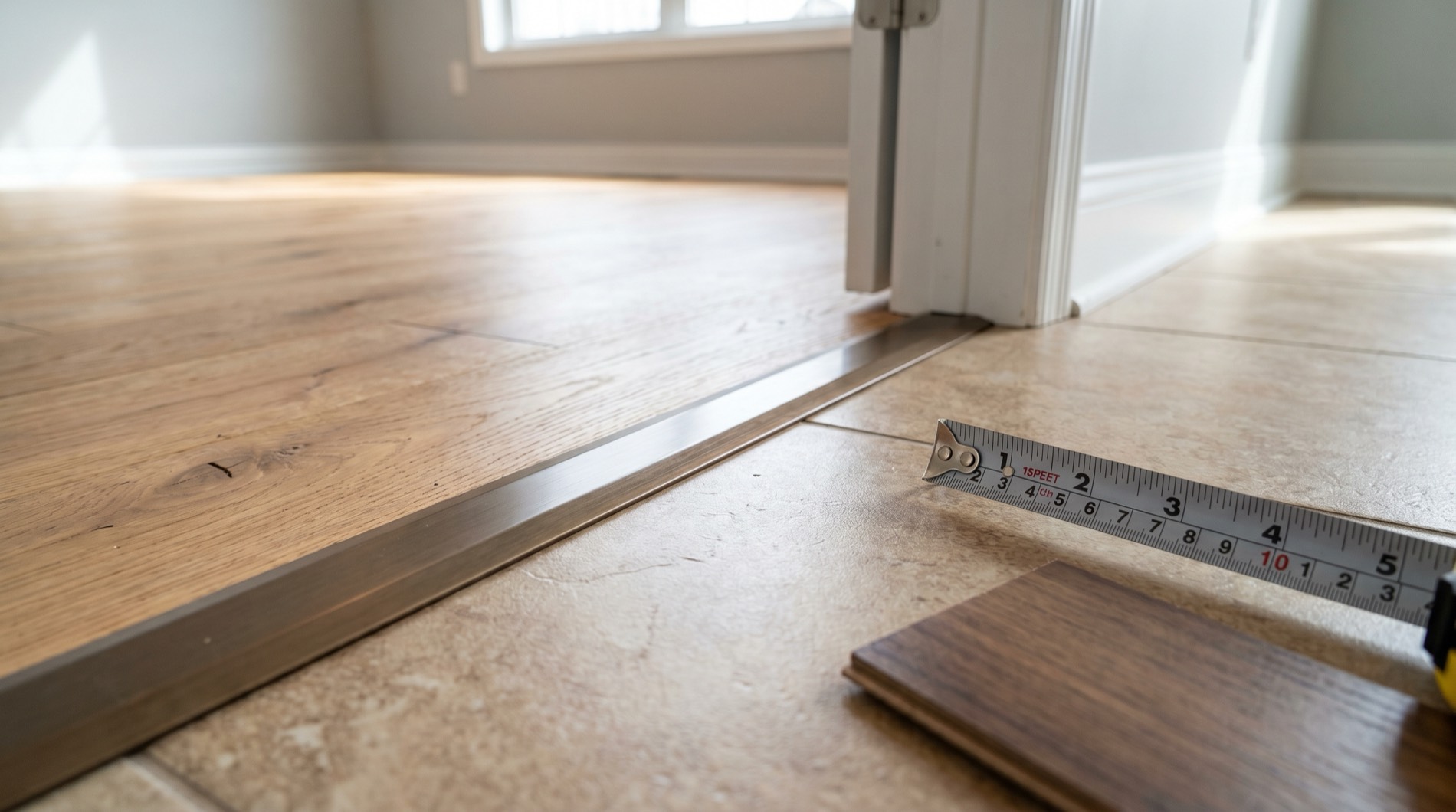
Almost every multi-room flooring quote in the DMV runs into the same conversation at the doorway. New LVP meets old tile. New hardwood meets the existing carpet in the bedrooms. The kitchen tile meets the dining room hardwood at a wide opening with no door. The homeowner asks "what's going to happen right here?" and the answer determines whether the finished floor reads as one continuous home or as a patchwork of leftover scraps.
The transition is the seam where the install either succeeds or visibly fails. Get it right and the floor looks intentional, holds up to seasonal movement, and meets HOA sound rules at the unit boundary. Get it wrong and the homeowner is staring at a mis-cut metal strip, a height delta the toe of every shoe catches on, or a flush seam that opens up in the second winter. Potomac Floors installs and repairs flooring transitions across Alexandria, Arlington, Fairfax, Falls Church, Tysons, Reston, Ashburn, Springfield, Bethesda, Rockville, DC, and the broader DMV. Below is the working decision guide we walk homeowners through at the in-home estimate.
The short answer by material pair
Quick answer
Hardwood meets tile: T-molding if heights match, reducer if hardwood sits higher, Schluter Reno-T or Reno-U if tile sits higher. LVP meets carpet: tack strip with carpet rolled over, capped with a flat threshold or carpet reducer. LVP meets LVP across rooms: flush seam if the floating field is short enough, T-molding if either run is long enough to need expansion-gap relief. Hardwood meets hardwood (two layouts or two species): T-molding to break the runs cleanly. Tile meets carpet: Schluter Schiene or flat metal threshold over the tile edge with carpet tucked behind. Same LVP through a whole house: doable up to about 40 linear feet in any one direction before the floating panel needs a midline transition strip. Glue-down lets you skip the strip entirely.
The transition strip is not decoration. It is the engineered solution to three real problems: the seasonal movement of two floating floors that must expand and contract independently, the height delta between materials with different thickness, and the exposed raw edge of any floor that has been cut to fit a doorway. Skipping it on a job where any of those three problems apply is how installs fail in year two.
Why the transition strip exists
Quick answer
A transition strip does three jobs. One: it absorbs the 1/4 inch expansion gap that every floating floor needs at the perimeter, including at doorways, so the floating panel can move with seasonal humidity without buckling. Two: it bridges a height delta between two floor materials of different thickness so nobody trips and so the joint reads as intentional. Three: it covers the raw cut edge of plank or tile so the wear surface, the core, and the underlayment are sealed and protected from foot traffic and moisture.
The seasonal movement problem is the one homeowners underestimate. A floating click-lock LVP floor in a 20-foot-wide DMV great room expands and contracts roughly 1/8 inch across that width between July humidity (60-70% RH indoors) and February dry-cold (25-30% RH indoors). That movement has to go somewhere. The perimeter expansion gap is where it goes. At every wall and every doorway, the floating panel needs 1/4 inch of empty space behind the trim or transition strip. When two floating floors meet at a doorway with no transition strip, the only place that movement can go is into each other, and the planks either buckle upward at the joint or push the doorway casing out of alignment.
The height delta problem is the second issue. A typical 6mm SPC luxury vinyl plank with attached underlayment sits about 6.5mm above the subfloor. A 3/4 inch solid hardwood install sits about 19mm above the subfloor. A 1/2 inch porcelain tile over 3/8 inch thinset and 1/4 inch cement backer board sits about 28mm above the subfloor. A carpet over 7/16 inch rebond pad sits about 13mm above the subfloor. These are not abstract numbers; they are the real-world deltas we hit at every doorway on multi-material installs. A reducer strip bridges a 6 to 14mm delta. A flush seam works only when the delta is under about 1mm and the subfloor on both sides is dead flat.
The third issue, the exposed cut edge, is the one that determines longevity. An LVP plank cut to length at a doorway has the wear layer on top, the SPC or WPC core in the middle, and the underlayment on the bottom. The cut edge exposes all three. Foot traffic over an exposed cut edge eventually delaminates the wear layer from the core, and any moisture that wicks into the cut edge swells the core if it is WPC. The transition strip covers the cut edge and keeps the assembly sealed.
Five transition types, explained
Quick answer
The five transitions that handle almost every DMV residential job: T-molding (two floors of equal height, both need expansion relief), reducer (taller floor steps down to shorter floor), threshold (carpet tucks under one side, hard floor cut clean on the other), Schluter profile (any tile transition, with Reno-T for equal heights and Reno-U or Schiene for height differences), flush seam (two floors the same height with no need for movement, glued or both fully bonded). Each handles a specific combination of height delta, expansion need, and material pair.
| Type | When it wins | Height delta it handles | Typical DMV cost installed |
|---|---|---|---|
| T-molding | Equal-height pair, both floating | 0 to 2mm | $55-$95 per doorway |
| Reducer | Taller floor to shorter floor | 3 to 14mm | $65-$110 per doorway |
| Threshold (carpet) | Hard floor meets carpet | 5 to 15mm | $55-$95 per doorway |
| Schluter Reno-T | Tile to equal-height hard floor | 0 to 3mm | $95-$165 per doorway |
| Schluter Reno-U / Schiene | Tile to shorter floor, or tile edge to carpet | 4 to 22mm | $105-$185 per doorway |
| Flush seam | Same height, both glued or bonded, no movement | Under 1mm | $45-$85 per doorway (extra subfloor prep + adhesive) |
Cost reflects the strip itself, the cuts, the fastening or adhesive, and the installer time for the doorway. It assumes the surrounding floor install is already happening; standalone "replace one transition strip" service calls run higher because of the trip, the minimum time on site, and the small-job overhead.
T-molding: equal-height pairs
Quick answer
A T-molding is the workhorse transition for two floors of the same height. The profile is a literal T: a flat top cap that covers both floor edges, with a stem that drops between them into a channel routed in the subfloor or held by an aluminum base track. The cap absorbs expansion movement from each side. Best for LVP-to-LVP across rooms, hardwood-to-hardwood between two layouts or two species, and laminate-to-laminate. Width usually 1.5 to 2 inches across the top.
The T-mold is the strip most homeowners picture when they hear "transition." It is right for the case where both floors are the same nominal thickness (LVP to LVP across a doorway, hardwood to hardwood across a stair landing, laminate to laminate between two bedrooms), both floors are floating or both need a perimeter expansion gap, and the wide cap (1.5 to 2 inches) is acceptable visually. The cap sits a millimeter or two above both floors, which is the small height bump you feel when walking over.
The install: cut the T-mold to the door opening width minus 1/8 inch on each side for fit. Anchor an aluminum base track to the subfloor with screws (the track holds the T's stem). The two floating floors run up to within 1/4 inch of the track on each side, leaving the expansion gap. The T-mold snaps into the track, the cap covers the gap and both floor edges. The stem drops into the track without bonding to either floor, so both floors can move independently.
The mistake we see: T-mold installed without a real expansion gap on one side. The floor pushes against the stem, the T-mold rises slightly, the homeowner snags a sock on it within the first month. The fix is to pull the T-mold, cut a relief gap on the offending side (1/4 inch from the strip edge to the planks), and re-snap.
Reducer: height-mismatched pairs
Quick answer
A reducer is a tapered strip that steps down from a taller floor to a shorter floor. The thick edge sits flush with the taller floor's wear surface; the strip ramps down to the lower floor at a gentle angle. Best for hardwood-to-LVP (hardwood is taller), hardwood-to-tile when hardwood sits higher, LVP-to-existing-vinyl-sheet, and any case where the height delta is 3mm or more. The ramp eliminates the trip hazard and seals the cut edge of the taller floor.
The reducer handles the case where the two floors are not the same thickness. A common DMV example: the homeowner adds 3/4 inch solid oak hardwood in the living room but keeps the existing 6mm LVP in the kitchen. The 12 to 13mm delta is too large for a T-mold (the T's stem would not bridge it, and the cap would have an unsightly slope). The reducer is the right answer. Its thick edge matches the hardwood thickness, it tapers down across about 2 inches to match the LVP height, and the wear surface of the reducer is the same wood species as the hardwood for visual continuity.
Two ways the reducer fails. First, picking a stock reducer that does not match the taller floor's thickness. A reducer milled for 1/2 inch engineered hardwood does not work over 3/4 inch solid. The taper angle is wrong, the edge does not seat against the hardwood cut edge, and there is a visible gap. We carry reducers in 1/4, 3/8, 1/2, and 3/4 inch profiles and order custom-milled when nothing stock fits. Second, installing the reducer over a substrate that is not dead-level across the doorway. The reducer needs a flat bridge from the taller floor edge to the shorter floor edge. If the subfloor dips between them, the reducer rocks when stepped on and eventually splits. Subfloor prep across the doorway is non-negotiable.
Cost adds about $10 to $20 per doorway versus a T-mold because the reducer is a wider piece, often needs to be cut to a custom angle for non-standard doorways, and the install requires more careful subfloor leveling.
Threshold: doorway divider
Quick answer
A threshold is a flat-topped strip that sits in the doorway, usually narrower than a T-mold (1 to 1.5 inches), with one or both edges tapered down to meet the floors. Best for carpet-to-hard-floor transitions where carpet rolls up under the strip on one side and tack-strip holds the carpet edge. Also used for "track" thresholds at exterior doors and for tile-to-LVP across a bathroom doorway where Schluter is not the choice. The visual is cleaner than a T-mold and the strip handles small height deltas.
The threshold's most common DMV use is the bedroom doorway where LVP or hardwood meets carpet. The carpet runs up to the doorway, gets tucked over a tack strip nailed to the subfloor, and the threshold caps the joint. The hard floor side of the threshold sits flush with the hard floor wear surface; the carpet side has a slot the carpet edge tucks into. The result is a clean line at the doorway with no fraying carpet edge and no exposed tack strip.
Two install details that matter. First, the carpet-side slot needs to be tall enough to accommodate the carpet pile plus the pad. A standard threshold sized for 1/4 inch pile and a 7/16 inch pad fails when the homeowner has thick frieze with a 1/2 inch upgraded pad. The carpet bunches under the strip and looks lumpy. Spec the threshold against the actual carpet build. Second, the threshold has to anchor to something solid. We screw the threshold into the subfloor with the carpet tack strip already in place. The screws are countersunk and capped with matching plugs. If the subfloor is concrete (basement bedroom over slab), we use concrete anchors and pre-drill.
For exterior doors (front door, garage door, basement walk-out), the threshold is usually a separate door-track threshold that the door manufacturer specified, and our flooring transition stops 1/4 inch short of the door threshold with a small expansion gap. We do not run interior LVP or hardwood up to and under an exterior door threshold; the seasonal humidity swing at the exterior boundary is enough to buckle the planks.
Schluter profiles: when tile is involved
Quick answer
Any tile-to-anything transition uses a Schluter (or Schluter-equivalent) metal profile installed in the thinset bed with the tile. Reno-T for equal-height tile to hard floor. Reno-U for tile to a lower hard floor (the U-channel ramps down). Schiene for tile to carpet or for finishing a tile edge that meets a lower surface. The profile gets installed simultaneously with the tile; retrofitting it after the tile is set is much harder. The metal is anodized aluminum, stainless, or solid brass depending on the finish picked.
Tile is the material where the transition gets locked in at install time. Schluter profiles (or near-equivalent products from M-D Building Products, Profilpas, or Custom Building Products) are L-shaped or T-shaped metal strips with a perforated anchor leg that bonds into the thinset bed when the tile gets set. Once the thinset cures, the profile is permanently embedded in the tile assembly. The exposed leg covers the tile's edge and steps down to the adjacent floor.
The three most common DMV Schluter calls. Reno-T: equal-height tile to hardwood, equal-height tile to LVP, equal-height tile to laminate. The T-profile cap covers both edges. Reno-U: tile to a lower hard floor, with a U-shaped ramp from the tile edge down to the lower floor. Common at bathroom-to-hallway transitions where the bathroom tile sits 10 to 15mm above the hallway LVP because of thinset and backer board build. Schiene: tile to carpet, tile to a sunken landing, or any tile edge that is unfinished and needs a clean exposed edge. The Schiene is the L-shaped end-cap profile that hides the raw tile edge and the thinset bond line.
The reason we install Schluter at tile time (not after): retrofitting requires cutting the tile edge off cleanly, regrouting, and bonding a face-mount profile onto the cut edge with epoxy. The result is usable but visibly worse than the in-thinset install, and the install cost more than doubles. On every tile job that ends at a doorway, the Schluter profile spec is part of the quote, picked in the same conversation as the tile and the grout color. Tile cost details and the full install math are in our tile installation cost piece.
Flush seam: when you can skip the strip
Quick answer
A flush seam skips the visible transition strip entirely. The two floors meet edge-to-edge in the doorway, sealed with color-matched flexible filler or a small bead of urethane. Works only when (1) both floors are fully bonded (glue-down LVP, nailed solid hardwood) so neither moves seasonally, (2) the two floors are the same nominal thickness within 1mm so there is no step, (3) the subfloor across the doorway is dead level, and (4) the homeowner accepts that any future repair will be more expensive than a stripped install. Premium look, premium prep, premium repair cost.
The flush seam is the install homeowners ask for most often and the one we install least often, because the four conditions above are strict. The most common case where it works: glue-down LVP running continuously through a multi-room install over a clean dry slab in a DMV basement or a single-story addition. The adhesive bonds every plank to the subfloor, nothing moves, and the run from room to room can cross the doorway without expansion relief. We feather the cut edge of the plank at the doorway, butt the next room's run tight to it, and seal the joint with a color-matched urethane bead.
The other common case: nailed solid hardwood running continuously through a great room into the adjacent hallway with no doorway change. The nails into the joists hold every board, the seasonal movement is absorbed by the perimeter expansion gap at the exterior walls, and the flush seam at the great-room-to-hallway opening reads as one continuous wood floor.
Where flush seam fails. Two floating floors of the same material butted flush will eventually push each other up at the doorway as they expand into each other; we have done dozens of repairs on flush-seam click-lock installs done by previous installers. Two floors of different thickness butted flush leaves a visible step that every shoe catches on; the homeowner asks us to "smooth it out" within six months. Two different materials (LVP and hardwood) butted flush respond differently to seasonal humidity; the joint opens up in winter and closes in summer, creating a visible gap line. Any subfloor unevenness shows through immediately as a rocked or split joint.
The repair cost on a flush-seam install is the trade-off most homeowners do not appreciate at install time. A damaged plank in a flush-seam glue-down install requires cutting the plank out, scraping the cured adhesive without gouging the subfloor, and color-matching a replacement plank to a now-aged surrounding floor. The labor for that single-plank repair is 4x to 6x what it would be on a stripped install where the strip lets us isolate the work zone.
What we install by material pair
Quick answer
The decision matrix below is what we walk through at the in-home estimate. Every doorway gets one of these answers based on the two materials meeting at it, the height delta, and the install method on each side. None of these answers are aesthetic preferences; they are the structural right answer for the pair.
| Material pair | Default transition | Notes |
|---|---|---|
| LVP to LVP (different rooms) | T-mold (floating); flush seam (glue-down) | Glue-down lets you skip strips up to 60ft runs |
| LVP to carpet | Threshold with tack-strip carpet edge | Bedroom doorways; spec strip against carpet pile + pad |
| LVP to tile | Schluter Reno-U (tile is taller) | Install at tile-set time, not after |
| LVP to hardwood | Reducer (hardwood is taller) | Pick the reducer that matches hardwood thickness |
| Hardwood to hardwood (two species or layouts) | T-mold | Common at stair landings and herringbone-to-straight transitions |
| Hardwood to tile | Schluter Reno-T (equal height) or Reno-U (tile taller) | Bathroom and entry doorways; tile usually wins on height |
| Hardwood to carpet | Threshold with tack-strip | Bedroom and basement doorways |
| Tile to carpet | Schluter Schiene + carpet tack strip | Bathroom-to-bedroom; install Schiene at tile time |
| Tile to tile (different sizes) | Schluter Reno-T or grout joint | Same thinset bed, transition strip optional if heights match |
| Laminate to LVP | T-mold (equal height) or reducer (laminate taller) | Both need expansion relief; never flush seam |
Two notes on this matrix. First, "default" means the install we spec when nothing unusual is going on. HOA sound rules, radiant heat, or commercial use can override the default. We cover those exceptions in the doorway rules section. Second, the matrix assumes the homeowner is keeping different materials in different rooms. If the goal is one continuous floor through the whole house, that is a separate decision covered below.
Doorway rules: expansion gaps, HOA sound, height deltas
Quick answer
Three rules govern every DMV doorway install. Expansion gap: every floating floor (LVP, laminate, engineered floating, click-lock hardwood) needs 1/4 inch of empty space behind the transition strip on its side of the doorway. HOA sound boundary: in DMV condo upper units (Tysons, Arlington, DC, Reston), the doorway between your unit and a common-area hallway must maintain the IIC sound rating across the boundary; an aluminum T-mold base track with a continuous acoustic underlayment beneath is the install. Height delta: a transition strip can bridge a 14mm height delta gracefully; anything larger needs subfloor leveling or a custom-milled threshold or a small wood riser.
The expansion gap rule is the one most DIY installs miss and the most common reason we get called for transition repairs. Every floating floor needs a continuous 1/4 inch perimeter gap, and the doorway counts as perimeter. The aluminum base track for a T-mold creates that gap automatically when installed correctly. The reducer creates it because the strip sits behind the taller floor's edge. The threshold creates it on the hard-floor side. The flush seam install does not create it, which is why flush seam is only an option when both floors are fully bonded.
The HOA sound boundary rule applies to almost every DMV condo upper unit. Most condo HOAs (Tysons Tower, Arlington high-rises, Crystal City, Wesley Heights in DC, Reston Town Center) require an IIC sound rating of 50 or 55 minimum for hard-surface floors. The rating applies across the entire floor assembly, including at the doorway boundary with the common-area hallway. An aluminum T-mold base track screwed directly into the subfloor breaks the acoustic underlayment's continuity at the doorway and reduces the IIC rating by 3 to 5 points in lab tests. The fix: run the acoustic underlayment continuously across the doorway under the T-mold base track, do not screw through the underlayment, and use a perimeter sealant where the track meets the doorway casing. We spec this on every condo doorway and pull the building's specific IIC requirement before the install.
The height delta rule. A transition strip handles a height delta gracefully up to about 14mm (the maximum reducer ramp before the slope gets steep enough to catch toes). Beyond 14mm, the install needs subfloor leveling on the shorter floor's side (build up the subfloor with shim plywood or self-leveling compound to reduce the delta) or a small custom wood riser at the doorway. We see the 14mm-plus case most often where homeowners add 3/4 inch hardwood next to existing 6mm LVP without leveling, or where bathroom tile sits 20 to 25mm above hallway carpet because of thick backer board. Both cases need pre-install subfloor work, not a custom-shaped strip.
The whole-house-one-floor question
Quick answer
Running one flooring through the whole house simplifies the install and eliminates most transitions, but has limits. A floating click-lock LVP install handles continuous runs up to about 40 linear feet in any one direction before the floating panel needs a midline transition strip. A glue-down LVP install handles continuous runs of any practical residential length. A nailed solid hardwood install handles whole-house runs as long as the perimeter expansion gap is honored at every wall. Tile and carpet are almost never run whole-house in the DMV; they show up as kitchen, bath, and bedroom inserts. The right answer depends on the install method, the size of the longest open run, and whether the homeowner wants the kitchen and bath finished in something more water-tolerant than the rest of the house.
The whole-house-one-floor question comes up at every multi-room quote where the homeowner has seen continuous-flooring designs on Instagram or Pinterest and wants the same effect. The answer is usually yes, with two caveats: the install method needs to match the longest open run in the home, and the kitchen and bathroom usually still call for something different.
The longest open run is the constraint that decides install method. A typical 1980s DMV split-level in Vienna or Annandale has a great room that opens to the kitchen, runs across to the dining area, and continues into the foyer. Easily 50 to 60 linear feet of continuous open space in one direction. A floating click-lock LVP install across that run will buckle within two seasons unless we put a midline transition strip somewhere in the middle. Most homeowners hate the midline strip in an otherwise open floor. The fix is to switch to glue-down LVP for the open run (no expansion gap needed, no midline strip) and accept the higher install cost and the harder future repair. Glue-down LVP runs $6.50 to $7.50 per square foot at Potomac Floors versus $6.50 for floating; the full breakdown is in our glue-down vs floating LVP piece.
The kitchen and bathroom question is the second caveat. Even on whole-house continuous-flooring installs, most DMV homeowners want tile in the master bath and the powder room for water tolerance, and many want a different finish in the kitchen. The transition then becomes the Schluter profile between the LVP or hardwood and the tile, installed at tile-set time. The continuous-flooring effect still reads in the public spaces; the wet rooms get the right material for water exposure.
One whole-house material we recommend against: laminate. Modern laminate is good but the swelling on water exposure means a kitchen plumbing leak or a bathroom overflow takes out a much larger area than the same leak under LVP. For continuous whole-house installs, LVP is the right material; the reasons are in our laminate buckling piece.
What transitions actually cost in the DMV
Quick answer
As part of a larger install, transition strips run $45 to $185 per doorway depending on type. T-molding and standard reducers fall on the low end ($55 to $110). Schluter profiles fall on the high end ($95 to $185) because the metal is more expensive and the install happens at tile time with the tile crew. A typical DMV whole-house multi-room install has 4 to 8 doorways with transitions, so the all-in transition line on the quote runs $300 to $1,200. We disclose every transition as a separate line item; it is part of the all-in price, not a hidden add-on. Our full quote transparency breakdown is in our flooring quote hidden charges piece.
Three line items make up the transition cost on every doorway: the strip material, the fasteners or adhesive, and the installer time on site. The strip material runs $8 to $45 each depending on type (a stock oak T-mold at $12, a Schluter Reno-T anodized aluminum profile at $35). The fasteners or adhesive run $3 to $8 per doorway. The installer time runs about 15 minutes for a T-mold or threshold, 25 minutes for a reducer with subfloor leveling, and 30 to 45 minutes for a Schluter profile installed in the thinset bed.
The standalone "replace one transition strip" service call is different math. The minimum call to the home runs $185 to $295 in the DMV regardless of what gets done, because the trip, the assessment, and the small-job overhead are the same whether one strip or four get replaced. Most homeowners who call us for a single replacement also have one or two other items they want addressed; the per-strip cost on a multi-item visit comes down to roughly the in-install range above.
Five field mistakes that ruin a transition
Quick answer
The five mistakes we see most often on DIY transitions and on rushed pro installs: no expansion gap (the strip rises within months as the floating floor pushes against it), wrong strip type for the height delta (T-mold over a 10mm step, reducer over a flush pair), subfloor not leveled across the doorway (the strip rocks and eventually splits), aluminum T-mold base track screwed through acoustic underlayment in a condo (kills the HOA IIC rating at the unit boundary), Schluter profile face-mounted after tile is set (looks worse and lasts shorter than installing at tile time).
The expansion gap mistake is the dominant repair call we get. A homeowner or a previous installer ran the floating floor tight to the existing T-mold base track or up to the threshold with no relief. The floating floor expanded into the strip across the first humid summer and pushed the strip up. We get the call when somebody trips on the rising T-mold cap. The fix requires pulling the strip, cutting a relief gap on the offending side (1/4 inch from the strip edge to the planks), and re-snapping the strip. Easy when caught early; if left for years, the planks at the doorway have to come up and the click joints near the doorway often have to be replaced.
The wrong-strip-type mistake is the second-most common. A homeowner picks a T-mold off the big-box shelf for a doorway where the two floors are 10mm different in height. The T-mold cap sits at an angle to bridge the delta, looks unfinished, and the lower edge does not seal to the shorter floor's surface. The right answer was a reducer. We end up replacing the strip on the next call.
The subfloor-not-leveled mistake shows up two seasons after install. The doorway subfloor had a 3/16 inch dip (very common in 70s and 80s DMV homes; the joist below the doorway often runs perpendicular to the doorway and has settled). The strip was installed over the dip without shimming. The strip rocks under foot traffic, the screws back out, and the strip eventually splits or separates from the floors. Subfloor prep across every doorway is part of our install spec.
The aluminum T-mold base track in a condo upper unit is the install mistake that costs the homeowner an HOA violation letter. The previous installer screwed the base track directly through the acoustic underlayment, breaking the continuity at the unit boundary. The downstairs neighbor files a noise complaint, the HOA's sound engineer tests the floor, the assembly fails the IIC requirement at the doorway, the homeowner gets a remediation order. The fix is to run the acoustic underlayment continuously across the doorway under the base track and to use a perimeter sealant where the track meets the doorway casing. The compliance details for upper-unit installs are in our soundproof condos and townhomes piece.
The face-mounted Schluter mistake happens when a homeowner adds a tile bathroom next to an existing hardwood floor and the tile installer set the tile right up to the hardwood edge with no Schluter profile. The hardwood edge is now exposed against the tile, the homeowner asks for a transition strip after the fact, and the only option is a face-mounted profile bonded to the tile edge with epoxy. The face-mount looks visibly added-on (a 3/8 inch tall ridge against the tile face) and lifts away from the tile over time. Spec the Schluter at tile-set time.
FAQs about flooring transitions
Do I need a transition strip if I am running the same flooring through every room?
If the floor is floating, yes, when any single continuous run exceeds about 40 linear feet in one direction. The floating panel needs a midline transition strip to break up the run so the expansion gap can absorb seasonal movement. If the floor is glue-down or nailed, no midline strip needed for continuous runs of any practical residential length.
Can I match my transition strip to my flooring color?
Yes for wood-finish strips (oak, walnut, maple T-molds and reducers come in 20-plus stain options). For Schluter profiles, you pick the metal (anodized aluminum in brass, bronze, black, or chrome; stainless steel; solid brass). For thresholds, custom stain matching is available but adds 2 to 3 days lead time. We match the strip finish to the dominant adjacent floor at every doorway as the default; the homeowner can override.
What is the difference between a T-molding and a threshold?
T-molding bridges two floors of equal height and absorbs expansion movement from each side. Threshold is a flat-topped strip used at doorways where one side meets carpet (which tucks under the strip) or where the doorway needs a clean divider between rooms. Both look similar to a casual eye; the structural job is different.
Why does my T-molding stick up so much?
Probably the install missed the expansion gap on one or both sides, and the floating floor has pushed against the strip. The cap that should sit 1 to 2mm above the floors is now sitting 4 to 6mm above and a sock catches on it. Fix is to pull the strip, cut a 1/4 inch relief gap from the strip edge to the planks on the offending side, and re-snap the strip. The fix takes about 20 minutes per doorway.
Can I install transitions over radiant heated floors?
Yes, but the strip and the anchor have to be heat-rated. We use Schluter profiles in the thinset bed over tile-and-radiant installs, and we use glue-down reducers and thresholds bonded with heat-rated adhesive (Mapei Ultrabond ECO 575) over LVP-and-radiant. T-mold aluminum base tracks anchored mechanically to the subfloor work fine over electric mat installs but never over the heating wires themselves. The mat layout has to leave a wire-free zone for the doorway anchor. Full radiant compatibility details are in our radiant heat flooring piece.
How long does a transition strip last?
A properly installed T-mold, reducer, threshold, or Schluter profile lasts as long as the floors on either side. We have pulled 30-year-old T-molds out of 1990s DMV homes that still seated correctly. Failures come from install mistakes (no expansion gap, no subfloor leveling, wrong strip type) or from impact damage (heavy furniture dragged across the strip). Strip replacement is straightforward; the strip is a wear part, the floors are not.
Can I do a flush seam between hardwood and tile?
Almost never. Hardwood moves seasonally; tile does not. The joint opens up in winter (when the hardwood contracts) and closes in summer (when the hardwood expands). The visible gap line moves season to season and looks unfinished. The right install is a Schluter Reno-T or Reno-U profile in the thinset bed, set at tile-install time.
Bottom line: how we spec transitions on every job
Every DMV multi-room install at Potomac Floors gets the same transition decision tree. We walk every doorway at the in-home estimate, measure the height delta on each side (the existing floor side and what we are installing), confirm the install method on each side (floating vs glued vs nailed), check the HOA sound spec if the unit is an upper-floor condo, and pick the strip type for each doorway. The strips show up on the quote as line items with the strip type, the finish, the doorway location, and the unit cost. Nothing is hidden, nothing gets added later. The all-in price stays all-in.
The honest install is the one that uses the right transition for the structural problem at the doorway. Most rooms get a T-mold, a reducer, or a threshold and the transition is solved for the life of the install. A few rooms get a Schluter profile because tile is involved. A handful of high-end installs over slab get a flush seam, with the trade-off on repair cost disclosed at quote time. The whole-house continuous-flooring effect is doable when the install method and the longest open run line up; when they do not, we recommend the midline strip and explain why.
Most installers do not walk the doorways at the quote because the strips look like an afterthought from the showroom. They are not. The doorway is where the floor either succeeds or fails visibly within two years. Get the transition right at install time and the homeowner never thinks about it again. Get it wrong and the call comes back within the first season.
Need a real installer's eye on your multi-room quote? Potomac Floors does in-home estimates across the DMV. Alexandria, Arlington, Fairfax, Falls Church, Tysons, Reston, Ashburn, Springfield, Manassas, Bethesda, Rockville, DC, and the broader service area. We walk every doorway, measure every height delta, and spec the transition that works for the room, the building, and the homeowner's budget. Call 571-341-7247 or request a free quote online. All-in pricing. Material, professional install, demo, removal. Disclosed before any work starts.