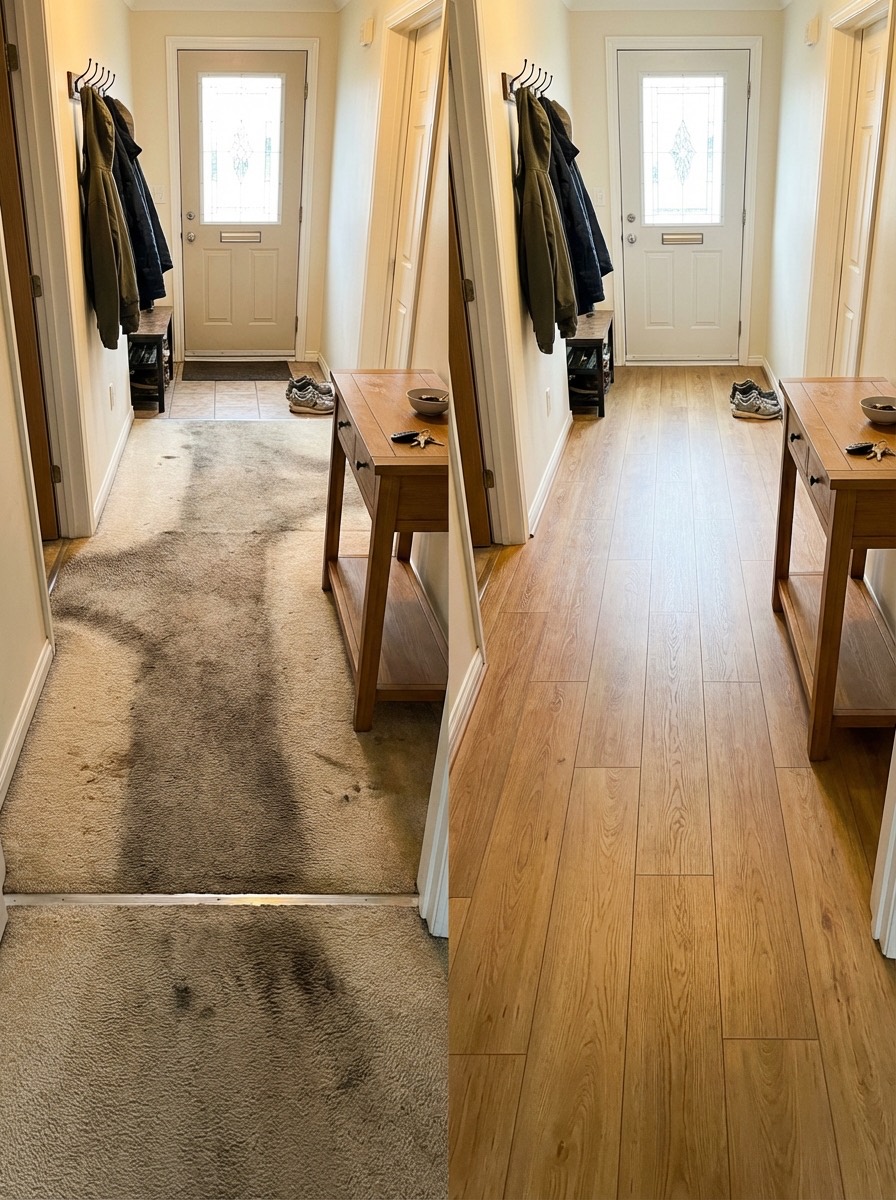
The short answer
Quick answer
For a DMV mudroom the two real winners are porcelain tile and rigid luxury vinyl plank. Both are fully waterproof and shrug off snow, road salt, and grit. Tile is the toughest, best for a sealed entry off the garage or a side door where a cold hard floor does not matter. Luxury vinyl plank is warmer and cheaper, and it lets you run the same floor straight into the kitchen or hall, which is why it wins for an open mudroom that flows into the house. Skip hardwood, laminate, and carpet at the door. The part most guides miss is that your layout, not the material list, makes the call.
Use the layout decision below, then compare the flooring services that match it.
Search "best flooring for a mudroom" and every result is the same list: porcelain tile or luxury vinyl plank, both waterproof, both handle salt and snow. That is not wrong, but it stops right where the real decision starts. After 20-plus years installing floors across Alexandria, Arlington, Fairfax, and the rest of the DMV, including plenty of side-entry mudrooms in older colonials and garage vestibules in newer builds, here is the part those lists leave out. Tile and LVP are both good answers, and which one is right for you comes down to how your mudroom is laid out and how hard it gets hit in a NoVA winter. Get that straight and the choice is simple.
What a mudroom floor has to survive
Quick answer
A DMV mudroom floor fights four things at once: standing water off wet boots, road salt that pits and dulls cheap surfaces, sand and grit that grind like sandpaper, and heavy in-and-out traffic. The floor has to be waterproof, hard-wearing, and quick to mop. That knocks most materials out of the running fast.
The mudroom is the hardest-working floor in a DMV home, and winter is what proves it. Snow and slush come in on boots and puddle by the door. The county salts and brines the roads all winter, and that salt rides in on your shoes as abrasive, slightly caustic crystals. Sand and grit come with it and act like sandpaper underfoot. On top of that the room takes constant traffic, everyone in the house passing through with bags, kids, and dogs. In a lot of DMV homes the mudroom is also a side entry off the garage or a back door on a colonial, so it is the first thing that meets the weather. A floor that survives all of that has to be genuinely waterproof, hard enough to resist grit, and easy to wipe clean. That short list is why the answer keeps landing on tile or vinyl.
Tile or vinyl plank: the real decision
Quick answer
The mudroom choice almost always comes down to porcelain tile vs luxury vinyl plank, and your layout decides it. A sealed mudroom off the garage or a side door is tile territory: maximum durability, and a cold hard floor does not matter in a room you only pass through. A mudroom that opens into the kitchen or hall is LVP territory: warmer underfoot, and you can run one floor through both rooms.
Both floors are waterproof and both handle a mudroom, so the tiebreaker is not which is tougher on paper, it is how your room is built. Porcelain tile is the most durable surface you can put down. It is nearly impossible to scratch, salt does not touch it, and it wipes clean in seconds. The trade-off is that it is cold and hard, and it needs a room of its own. That makes it the right call for a sealed vestibule off the garage or a closed side entry, a space you walk through rather than stand in. Luxury vinyl plank is nearly as tough, fully waterproof, and it is warmer and softer underfoot, which matters in a room where you sit to pull off boots. It also costs less. Its one weak spot is the wear layer, and salt is exactly what tests it, which we cover below. We break the two down head to head in our LVP vs tile guide. The short version: sealed and separate, lean tile; open and connected, lean LVP.
💡 Key takeaway
Do not pick the material first. Look at the room. Is your mudroom a closed vestibule off the garage or side door, or does it open straight into the kitchen or hall? A closed room points to tile. An open one points to vinyl plank. The layout answers the question the material lists cannot.
Every mudroom floor, ranked
Quick answer
Porcelain tile and rigid luxury vinyl plank are the two floors worth installing in a DMV mudroom. Sealed concrete works for a rough garage-side utility entry. Laminate, solid hardwood, and carpet all fail fast at a door that sees snow and salt, and they are the floors we get called to rip out.
| Material | Waterproof | Handles salt & grit | Best role in a mudroom |
|---|---|---|---|
| Porcelain tile | Yes | Excellent | Best for a sealed, high-abuse entry |
| Luxury vinyl plank (LVP) | Yes | Very good with a thick wear layer | Best for a mudroom open to the house |
| Sealed concrete | Yes | Excellent | Fine for a garage-side utility entry |
| Laminate | No, swells at seams | Poor | Not recommended |
| Solid hardwood | No, stains and cups | Poor | Not recommended |
| Carpet | No | Poor, traps salt and mud | Not recommended |
The top two are close, and the layout rule above splits them. Below them, sealed concrete is a fine, cheap surface for a raw garage-side entry where looks do not matter, though it is cold and stains without a good sealer. Everything under that line fights a mudroom. Laminate looks like wood but drinks water at the seams, solid hardwood stains and cups the first hard winter, and carpet is a sponge for exactly the salt, grit, and slush a mudroom throws at it. We explain why each fails further down.
Why road salt is the real enemy
Quick answer
Water gets the attention, but road salt does the quiet damage in a DMV mudroom. Salt crystals are abrasive and slightly caustic. Tracked in on boots, they pit and dull a thin vinyl wear layer and etch unsealed stone over a winter or two. The fix is a hard dense surface, and on LVP a thick wear layer plus a matte or textured finish that hides grit.
Here is the thing the generic lists skip. In the DMV, the mudroom floor is not mostly fighting water, it is fighting salt. Every winter the roads get salted and brined, and that salt comes home on everyone's shoes. Salt crystals are hard and a little caustic, so they do two things: they grind at the surface like fine sandpaper, and they slowly etch and dull anything soft or porous. On cheap vinyl with a thin wear layer, a couple of DMV winters leave the traffic path by the door looking scuffed and cloudy. This is why, if you go LVP in a mudroom, the wear layer is the spec that matters most. Buy a thick one, and pick a matte or textured, mid-tone finish rather than a dark glossy plank, because texture and a busy tone hide sand and salt haze between mops. We break down what wear-layer number to buy in our LVP wear layer guide. Porcelain tile skips this whole problem, since salt does nothing to a fired ceramic surface.
If you go tile, the grout is where it fails
Quick answer
Tile itself is nearly bulletproof in a mudroom, but the grout lines are not. Standard cement grout is porous, so salt water and mud soak in, stain, and break it down over freeze-thaw winters. If you tile a DMV mudroom, use epoxy grout or seal the cement grout well, pick a mid-tone color that hides dirt, and use large-format tile so there is less grout to defend.
People pick tile for a mudroom because tile is indestructible, and then they are surprised when it looks bad in two years. The tile is fine. The grout is what let them down. Plain cement grout is porous, so salty slush and mud soak straight into it, stain it a dingy gray, and, through the DMV's freeze-thaw swings, work it loose. The fix is not exotic. Use epoxy grout, which is waterproof and stainproof, or seal a good cement grout and reseal it every year or two. Choose a mid-tone grout color, never bright white, so the dirt that does land does not show. And spec a large-format tile, which means fewer grout lines across the floor and less of the weak point to protect in the first place. We cover grout choices and sealing in our tile grout guide, and how tile choice itself matters in porcelain vs ceramic.
Flowing one floor into the house
Quick answer
The reason a lot of DMV homeowners pick LVP for a mudroom is the transition. A mudroom rarely stands alone; it opens into the kitchen, hall, or laundry. Running the same luxury vinyl plank through all of them makes the space feel bigger and skips the awkward threshold strip and height mismatch between two different floors. Tile in a sealed vestibule sidesteps this by being a closed room.
This is the point that decides a lot of jobs, and no online list mentions it. In most DMV homes the mudroom is not a separate room, it is the first few feet of an open floor plan that runs into the kitchen, the hall, or the laundry room. When two rooms flow together like that, putting a different floor in each one creates a hard line across the opening: a metal threshold strip, a small step in height, and a visual break that makes both rooms feel smaller. Running one continuous luxury vinyl plank floor through the mudroom and into the connected space removes that line entirely, so the whole area reads as one larger room. That is a real reason to lean LVP over tile when the mudroom is open, and it is exactly the kind of detail we plan in our room-to-room transitions guide. A tiled vestibule that closes off with a door does not have this problem, because it is a room of its own by design. LVP also happens to be the easiest of these floors to keep clean day to day, as we show in how to clean vinyl plank.
Floors to skip in a mudroom
Quick answer
Skip solid hardwood, which stains and cups the first time snowmelt sits on it. Skip laminate, whose fiberboard core swells like a sponge at the seams once salt water reaches them. Skip wall-to-wall carpet at the door, since it traps salt, grit, and moisture and never really comes clean. These are the mudroom floors we get called to tear out.
A few floors just do not belong at a door that meets DMV winters, and these are the ones we most often get called to rip out and replace. Solid hardwood is the classic regret: it looks beautiful for one fall, then the first slush that puddles by the door soaks into the grain and leaves dark stains and cupped boards that only sanding fixes. Laminate is the next trap, because its photo layer looks tough but the fiberboard core underneath swells like a sponge the moment salt water finds a seam, the same weakness we cover in is laminate waterproof. Wall-to-wall carpet at the entry is the third: it grabs every bit of salt, sand, and moisture that comes through the door and holds onto it, so it stays gritty and dingy no matter how often you vacuum. If you want the durability of a real work floor, none of these three gets you there. If traction and mess are your worry because of pets, our best flooring for dogs guide lands on the same waterproof surfaces for the same reasons.
What it costs installed in the DMV
Quick answer
At Potomac, luxury vinyl plank is $6.50 per square foot all-in, covering material, install, and hauling the old floor away. Tile we quote per project because the price depends on the tile, the layout, and the prep. A mudroom is usually a small room, so the total is modest, and our all-in price means no surprise line items at the end.
A mudroom is one of the cheaper rooms to floor, simply because it is small, so the material choice does not swing the total the way it would in a whole house. Rigid luxury vinyl plank is $6.50 per square foot all-in, and that one number covers the material, the professional install, and hauling away the old floor, with no add-ons at the end. Tile we quote per project, because the cost really does depend on the tile you pick, the layout, and how much prep the subfloor needs. Carpet is $3.25 all-in and hardwood is $8.50, but we steer you away from both at a mudroom door for the reasons above. Because our installs are done by an in-house crew, the quote you get is the price you pay, and we spell out how we avoid hidden charges in a separate guide. If the mudroom is part of a bigger project, our whole-house cost breakdown puts it in context.
FAQs about mudroom flooring
What is the best flooring for a mudroom?
Porcelain tile or rigid luxury vinyl plank. Both are fully waterproof and handle salt, snow, and grit. Choose tile for a sealed entry off the garage or a side door where maximum durability wins. Choose luxury vinyl plank for a mudroom that opens into the house, since it is warmer, cheaper, and flows into the next room.
Is tile or vinyl plank better for a mudroom?
Tile is more durable and fully scratch-proof against grit, so it wins in a sealed, high-abuse entry. Vinyl plank is warmer, softer underfoot, cheaper, and lets you run one floor into the connected kitchen or hall. For an open mudroom, most DMV homeowners are happier with luxury vinyl plank. For a closed vestibule, tile.
Is vinyl plank flooring good for a mudroom?
Yes, rigid luxury vinyl plank is one of the two best mudroom floors. It is fully waterproof, warm underfoot, and easy to mop. The one spec that matters is the wear layer: buy a thick one and a matte or textured finish so tracked-in road salt and grit do not pit and dull the traffic path by the door.
Does road salt damage flooring?
Yes. Road salt crystals are abrasive and slightly caustic, so they grind and dull soft or porous surfaces over a winter or two. They pit thin vinyl wear layers, etch unsealed stone, and stain cement grout. Hard, dense floors like porcelain tile and thick-wear-layer LVP resist it best, and a good entry mat catches most of it.
Can you put hardwood in a mudroom?
We do not recommend it. Solid hardwood soaks up the snowmelt and slush that puddle by a mudroom door, then stains dark and cups within a winter. Water-damaged boards only come back with a full sanding. If you want a wood look at the door, use luxury vinyl plank in a wood finish, which is waterproof.
What flooring is easiest to clean in a mudroom?
Porcelain tile and luxury vinyl plank are both quick to clean, since salt, mud, and slush wipe or mop off a waterproof surface in seconds. LVP has fewer grout lines to scrub, while large-format tile keeps grout to a minimum. Pair either with a mid-tone, matte or textured finish so grit does not show between cleanings.
Bottom line
Best flooring for a mudroom is not a single material, it is a match to your room. Both porcelain tile and rigid luxury vinyl plank are waterproof and beat back the salt, snow, and grit of a DMV winter. Choose tile when the mudroom is a sealed vestibule off the garage or a side door, where its unbeatable durability shines and the cold hard surface does not matter. Choose luxury vinyl plank when the mudroom opens into the kitchen or hall, so you get a warmer floor you can run right through both rooms. If you go tile, protect the grout with epoxy or a good sealer; if you go LVP, buy a thick wear layer and a textured finish. Skip hardwood, laminate, and carpet at the door. If you are in Alexandria, Arlington, Fairfax, or anywhere in the DMV and want a straight answer for your mudroom, we install luxury vinyl plank, tile, and carpet across the whole metro. Get a free in-home quote and we will tell you honestly what fits your entry and your winters.