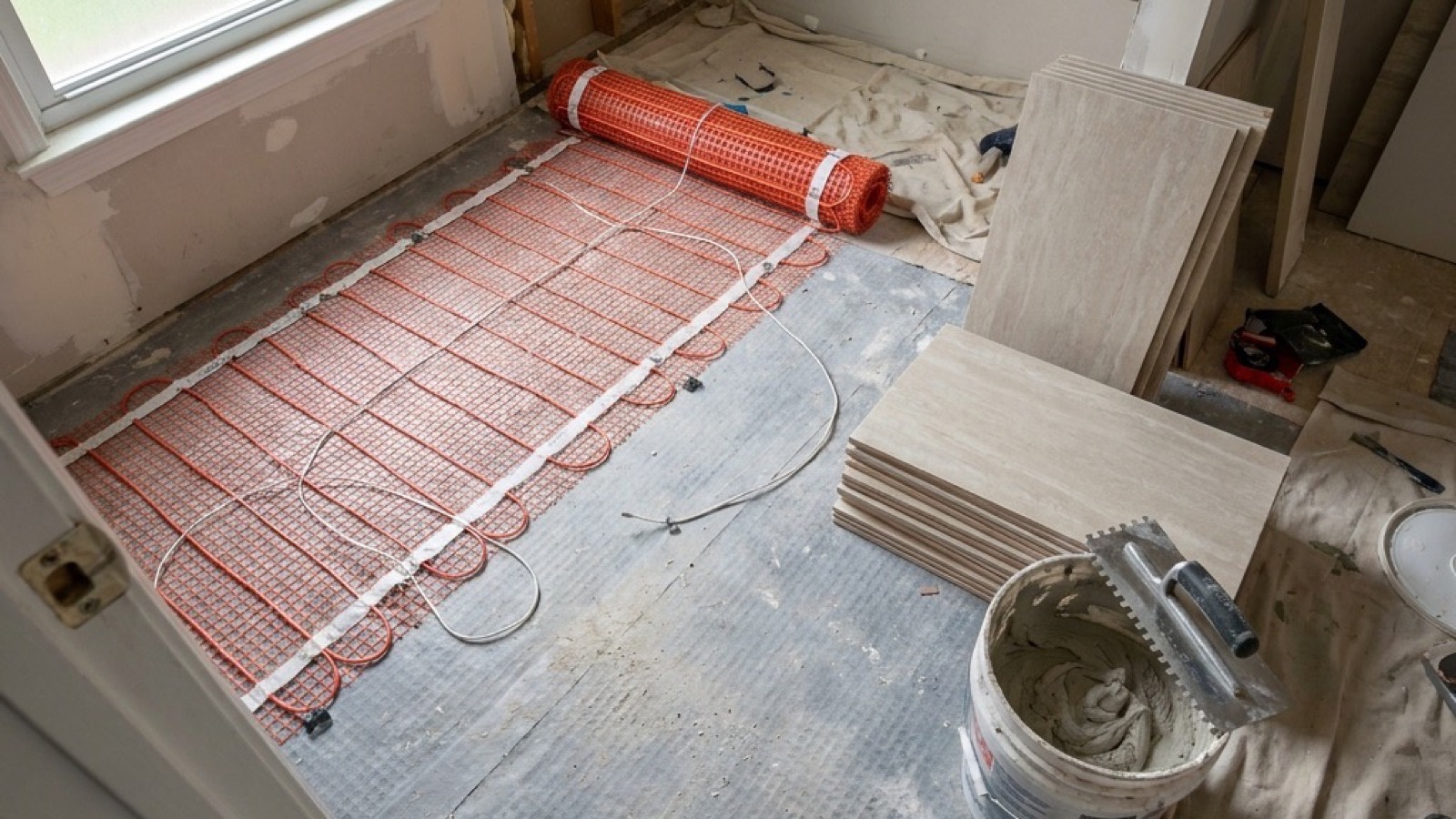
The short answer on heated floor cost
Quick answer
In the DMV in 2026, an electric heated floor added to a bathroom during a tile remodel typically runs about $600 to $1,200 for a powder room, $1,000 to $2,200 for a standard hall bath, and $2,000 to $4,500 for a master bath, installed. That works out to roughly $8 to $14 per square foot of heated floor, and it is much cheaper to add while the tile is already coming up than to retrofit later. These are DMV market estimates; the real number depends on the heatable floor area, your electrical panel, and the system you pick.
A heated bathroom floor is the upgrade people ask about the moment they feel one on a cold morning, and the cost question is where most of the confusion lives, because the numbers online are all over the map. What follows is how the price actually works in Northern Virginia, DC, and Maryland: what it costs by bathroom size, the difference between electric and hydronic systems, the one billing detail that surprises everyone, why adding it during a tile job costs a fraction of a retrofit, and what it costs to run once it is in. We install these under tile as part of bathroom remodels, so this is the installer's view, not a manufacturer's. For the room's full material picture, our DMV bathroom flooring guide is the companion piece.
What a heated bathroom floor costs in 2026
Quick answer
Installed, an electric radiant floor generally costs $8 to $14 per square foot of heated area in the DMV, versus roughly $2 to $6 per square foot for the heating system materials alone. National cost tools quote $8.86 to $12.80 per square foot for radiant floor heat, and a real Northern Virginia bathroom remodel commonly adds around $2,500 for a full Ditra-Heat system. The catch is that "per square foot" means heated square feet, not the whole room.
The reason quoted numbers vary so much is that people mix up two different things: the cost of the heating parts and the cost of the finished, installed floor. A heating mat or cable kit from a big-box store runs about $2 to $6 per square foot, and that is the number in most product listings. But that mat does nothing until someone lays it into thinset over a proper membrane, wires a thermostat with a floor sensor, ties it to a dedicated GFCI circuit, and then sets tile on top and grouts it. Add that skilled labor and the finished cost lands around $8 to $14 per heated square foot. National cost databases put installed radiant floor heat at $8.86 to $12.80 per square foot, which matches what we see locally once you account for DMV labor rates. A homeowner in Northern Virginia recently reported paying about $2,500 to add a full Schluter Ditra-Heat system to a bathroom remodel, which is a realistic local figure for a standard bath.
Powder room, hall bath, master: what each runs
Quick answer
Cost tracks the heated floor area, not the room size. A powder room heats a small strip and runs about $600 to $1,200 added during a remodel; a standard hall bath runs about $1,000 to $2,200; a master bath runs about $2,000 to $4,500. You only heat the open, walkable floor, so a 60-square-foot bathroom might only have 25 heatable square feet once you subtract the vanity, tub, and toilet footprint.
| Bathroom | Heatable floor area | System materials | Installed add-on during a remodel |
|---|---|---|---|
| Powder room / half bath | ~8-15 sqft | $150-$400 | $600-$1,200 |
| Full hall bath (~40-60 sqft room) | ~15-30 sqft | $300-$700 | $1,000-$2,200 |
| Primary / master bath (~80-120+ sqft room) | ~40-80 sqft | $700-$1,600 | $2,000-$4,500 |
Here is the detail almost no online calculator explains: you do not heat the whole room. You heat the floor people actually stand on, which means the mat stops at the vanity, the tub, the shower, and the toilet. In a typical DMV hall bathroom, a 50-to-60-square-foot room often has only 20 to 30 square feet of open floor worth heating. That is good news for the budget, because the per-foot cost applies to a smaller number than you would guess from the room's dimensions. It is also why an installer who has actually measured your open floor will give you a very different number than a calculator that assumes the full room. A tile setter can tell you the heatable area from the layout in about a minute, and that number, not the room size, is what drives the price.
Electric vs hydronic (which one bathrooms use)
Quick answer
For a single bathroom, electric radiant is almost always the right system: lower install cost, thin profile that barely raises the floor, and simple to zone for one room. Hydronic (hot-water tubing) makes sense for whole-house or large-area heating, not one bath, because it needs a boiler or water heater tie-in and a manifold. Nearly every bathroom heated floor we install is electric.
There are two ways to warm a floor. Electric radiant uses a thin heating cable or a pre-spaced mat that sits in the thinset right under the tile. Hydronic radiant runs warm water through tubing, usually in a thicker mortar bed, fed by a boiler or a water heater. For one bathroom, electric wins on every practical measure: it is cheaper to install, the mat adds only about an eighth of an inch to the floor height, and it heats one room on its own thermostat without touching your heating system. Hydronic is more efficient to run over large areas and lasts longer, so it earns its keep in a whole-floor or new-construction radiant project, but the tie-in cost makes it overkill for a single bath. Electric systems are rated to last around 25 years, which comfortably outlasts most tile floors, so for a bathroom remodel it is the standard choice and the one these price ranges assume.
What you're actually paying for
Quick answer
A heated floor is five things: the heating mat or cable, an uncoupling or membrane layer, a thermostat with a floor sensor, a dedicated GFCI electrical circuit, and the labor to lay it all in and set tile on top. The mat is the cheap part. The thermostat, the electrical work, and the skilled tile labor are where most of the cost sits.
| Component | Typical cost | What it does |
|---|---|---|
| Heating mat or cable | $2-$6 / sqft | The element that produces the heat, laid in thinset under the tile. |
| Uncoupling / membrane layer | $1.50-$3 / sqft | Systems like Ditra-Heat that hold the cable and protect the tile from movement cracks. |
| Programmable thermostat + floor sensor | $150-$280 | Controls the floor temperature and runs it on a schedule so it is warm before you wake up. |
| Dedicated GFCI circuit | $200-$600 | Electrician runs a protected circuit from the panel. Higher in older DMV homes with a full panel. |
| Labor (lay-in + tile set) | Bundled with tile | The skilled part. During a remodel it rides along with the tile job you are already paying for. |
People fixate on the mat because it is the part with a price tag on the shelf, but the mat is the least of it. The thermostat is a real cost and worth doing right, because a programmable one that warms the floor before your alarm goes off is most of why the upgrade feels worth it. The electrical is the piece homeowners forget: a heated floor needs its own protected circuit run back to the panel, and in an older Arlington, Old Town Alexandria, or DC home with a full electrical panel that can mean adding capacity, which the section below on DMV realities covers. And the labor to embed the system and set tile flat over it is skilled work. That last piece is exactly why the timing of the install matters so much.
Why it's far cheaper to add during a tile remodel
Quick answer
Adding a heated floor while you are already retiling costs a fraction of retrofitting one later, because the expensive labor (removing the old floor and setting new tile) is happening anyway. Doing it as a standalone project later means tearing out a perfectly good tile floor first, which commonly triples or more the real cost. If you are remodeling the bathroom, decide on heat now.
This is the single most important cost fact in this whole guide. A heated floor lives under the tile, so the labor to install it is inseparable from the labor to set the tile. When you add it during a remodel, the floor is already open, the thinset and trowel are already out, and the mat drops into the same work session. The only new cost is the system material, the thermostat, and the electrical circuit. When you decide you want it a year later, none of that is true anymore. Someone has to demo the finished tile floor you just paid for, haul it out, and reset everything, which means you pay for tile removal and a second full tile install just to get the mat underneath. That is why "can I heat my bathroom floor without removing the tile?" almost always has a disappointing answer: not for a real embedded system. The cheap, clean moment is when the floor is already coming up. If a bathroom remodel is on your list, this is a five-minute decision to make now that saves a large multiple later. The same logic drives the surprises in our guide to what a low flooring quote leaves out.
What it costs to run
Quick answer
An electric bathroom floor is cheap to run because the heated area is small and a thermostat only runs it when you want it. Expect roughly $0.15 to $0.35 per hour of actual heating, which real owners report as about $10 to $15 a month in peak winter for a bathroom on a morning-and-evening schedule. It heats the floor, not the whole house, so it is a comfort upgrade, not a heating-bill line item.
A common worry is that a heated floor will spike the electric bill. In a bathroom it does not, for two reasons. First, the heated area is tiny, often 20 to 30 square feet, so the wattage is low. Second, nobody runs it all day. A programmable thermostat warms the floor for an hour before you wake and an hour in the evening, then shuts off, so it draws power only during the windows you actually use the room. Manufacturers put the running cost around 15 to 35 cents per hour of heating, and owners who track it report roughly $10 to $15 a month during the coldest DMV months, dropping to almost nothing the rest of the year. Compared to the comfort, that is a small operating cost, and it is one of the few luxury upgrades where the running expense is genuinely minor.
Are heated bathroom floors worth it?
Quick answer
It is worth it if you are already retiling the bathroom, want a warm floor under tile or stone, and plan to stay a while. The comfort is real and the running cost is low. It is a weaker value as a standalone retrofit (the tear-out cost) or if you rarely use the bathroom in winter. For a master bath you use daily, most owners say it is one of the upgrades they would keep.
Whether a heated floor is worth it comes down to timing and use. Tile and stone feel cold underfoot, which is exactly why the upgrade exists, and a warm floor on a January morning in the DMV is a comfort people genuinely love and rarely regret. The math is strongest when you are already remodeling, because the add-on cost is small against the full project and the labor is shared. It is a comfort and lifestyle upgrade rather than a resale investment, so do it for yourself, not for the appraisal, though a warm master bath floor does show well to buyers. Where it makes less sense is as a standalone retrofit that forces a floor tear-out, or in a guest bath nobody uses on cold mornings. If you use the bathroom every day and the tile is coming up anyway, it is one of the easiest upgrades to say yes to. Since it lives under tile, it also pairs naturally with the material decisions in our DMV bathroom tile guide and works with the flooring types in our radiant heat compatibility guide.
DMV realities: old panels, condos, permits
Quick answer
Two local factors move the cost: older homes may have a full electrical panel that needs capacity added for the new circuit, and condos or HOAs often require an electrical permit and may restrict floor work. A heated floor is an electrical job as much as a tile job, so the age of your home and the rules of your building matter to the final number.
The DMV housing stock adds a wrinkle you will not find in a national cost guide. A heated floor needs its own dedicated, GFCI-protected circuit, and in an older Alexandria, Arlington, or DC home the electrical panel may already be full, so an electrician has to add a subpanel or free up capacity before the simple circuit run is even possible. That is a real, home-specific cost that only shows up once someone looks at your panel. Condos and high-rises add their own layer: many require an electrical permit and inspection for the new circuit, some restrict how floors can be built up, and a few older buildings simply do not have the panel capacity in the unit. None of this makes a heated floor a bad idea, but it does mean the honest price depends on your specific home and building, which is why we quote it after seeing the space, not over the phone. The same behind-the-wall unknowns that drive our subfloor findings in DMV homes apply here.
How we price a heated floor
Quick answer
We price a heated floor as an add-on to the tile bathroom remodel: we measure the actual heatable floor area, spec the system and thermostat, factor the electrical work your panel needs, and give you one all-in number for the add-on with no hidden line items. Because it is custom to your room and panel, it is a "see it, then quote it" number, not a flat rate.
When a heated floor comes up on a bathroom remodel, we handle it as part of the tile scope, not as a separate mystery upcharge. We measure the open floor to get the real heatable area, pick the system that fits the layout, size the thermostat and sensor, and check what your electrical panel needs to carry the new circuit. Then you get one all-in add-on price, quoted alongside the rest of the bathroom, so you can decide with the full number in front of you. Everything is installed by our in-house crew, tile and heat together, with no subcontractors handing off the electrical to someone who never saw the tile plan. That is the difference between a floor that heats evenly and lasts and one that fails a few years in because the mat and the tile were installed by two crews who never talked. The full service is on our bathroom remodeling page.
FAQs about heated bathroom floor cost
How much does it cost to put a heated floor in a bathroom?
In the DMV in 2026, added during a tile remodel, expect about $600 to $1,200 for a powder room, $1,000 to $2,200 for a standard hall bath, and $2,000 to $4,500 for a master bath, installed. That is roughly $8 to $14 per heated square foot. A standalone retrofit that forces a tile tear-out costs much more, because you pay to remove and reset the floor.
Can I add a heated floor without removing the tile?
Not for a proper embedded system. Electric radiant mats and cables live in the thinset directly under the tile, so installing one means the tile floor has to come up. There are surface mats and rugs that sit on top, but they are not the same as a built-in heated floor. The clean, cheap moment to add one is while you are already retiling.
Are heated bathroom floors worth it?
If you are already remodeling and use the bathroom daily, most owners say yes. The comfort of a warm tile floor is real, the running cost is low (about $10 to $15 a month in peak winter), and the add-on cost is small when the labor is shared with the tile job. It is a comfort upgrade, not a resale investment, so do it for how you live in the room.
How much does a heated floor cost to run?
About 15 to 35 cents per hour of actual heating. Because a bathroom heats a small area and a thermostat only runs it on a schedule, real owners report roughly $10 to $15 a month during the coldest DMV months and almost nothing the rest of the year. It heats the floor, not the house, so it barely moves the electric bill.
Electric or hydronic for a bathroom?
Electric, in nearly every case. For a single bathroom, electric radiant is cheaper to install, adds almost no floor height, and runs on its own thermostat. Hydronic (hot-water) systems make sense for whole-house or large-area radiant heat, but the boiler or water-heater tie-in makes them overkill and overpriced for one bath.
How long do heated bathroom floors last?
An electric radiant system is generally rated to last around 25 years, which outlasts most tile floors, and hydronic systems can last longer. The heating element itself rarely fails when installed correctly; the thermostat is the part most likely to need replacing over that span, and it is a simple swap.
Do I need a permit for a heated floor in the DMV?
Usually yes for the electrical work, since a heated floor needs a new dedicated GFCI circuit. Condos and high-rises often require an electrical permit and inspection, and some buildings have their own rules about floor work. We handle the permitting as part of the remodel so it is done correctly and passes inspection.
Bottom line: how to budget yours
Budget by heated floor area, not room size, and decide during the remodel, not after. In the DMV, plan on roughly $600 to $1,200 for a powder room, $1,000 to $2,200 for a hall bath, and $2,000 to $4,500 for a master bath when the heat goes in with the tile, at about $8 to $14 per heated square foot. Add a little for the electrical if your home has an older, full panel. The running cost is minor, around $10 to $15 a month in deep winter, so the real decision is the one-time install, and the cheapest time to make it is while the floor is already open.
We install heated floors under tile as part of bathroom remodels across the DMV, and every quote is all-in: the system, the thermostat, the electrical, and the tile labor by our in-house crew with no subcontractors, with the panel and permit realities named before you sign. Because the honest number depends on your actual floor and your actual panel, the right next step is a real look at the room. Request a free estimate or call us at 571-341-7247 and we will measure the heatable area, talk through the system, and give you a straight add-on price. For the rest of the bathroom budget, our DMV bathroom remodel cost guide covers the full project.