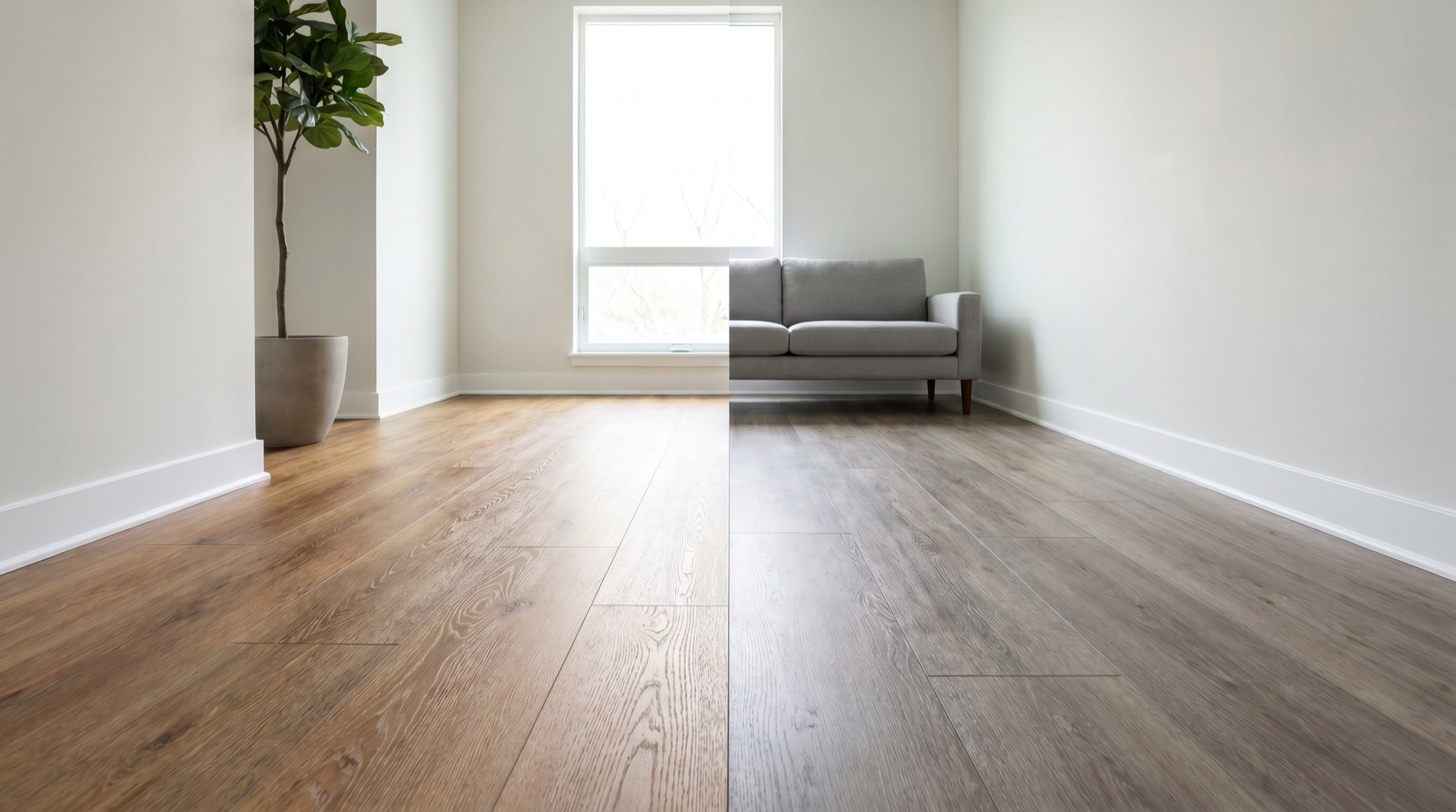
Every week we walk into a DMV homeowner's living room with two flooring samples on the carpet: a piece of luxury vinyl plank and a piece of laminate. They look identical at standing height. Both start at $6.50 per sqft all-in DMV installed. The salesperson at the big-box store told them they're "basically the same thing." They're not. They behave differently around water, kids, dogs, dropped knives, and DMV winter humidity. They make different sounds when you walk on them at night. After 20+ years installing both materials across Alexandria, Arlington, Fairfax, Falls Church, Bethesda, Reston, and the rest of the DMV metro, here's the honest head-to-head: 8 real tradeoffs, room-by-room recommendations, and the answer for the ~85 percent of DMV homes where one is clearly the right call.
If LVP wins your room-by-room comparison, review the scope of our LVP installation service.
The short answer for DMV homeowners
Quick answer
For ~85 percent of DMV homes, LVP is the right pick. The decisive factor is water. DMV summer humidity hits 70-80 percent, basements take on moisture, kitchens get spills, pets have accidents, and laminate's MDF core swells permanently when it gets wet. LVP is 100 percent waterproof and handles all of it. Both start at $6.50/sqft all-in. Laminate still fits dry upper-floor bedrooms, offices, and some rentals. Outside those cases, choose LVP for waterproofing.
That's the head answer. The body walks through the 8 real tradeoffs, the AC4/AC5 hardness wrinkle (where modern laminate actually beats LVP), the DMV-specific moisture math, and the room-by-room matrix.
What LVP and laminate actually are (the layer stack)
Quick answer
LVP is a 4-5 layer all-vinyl plank with a rigid PVC core and a printed wood-look surface. Laminate is a 4-layer plank with a high-density fiberboard (HDF or MDF) wood core, a printed paper wood-look layer, and a melamine wear surface. The core is the entire story. LVP's vinyl core is hydrophobic. It ignores water completely. Laminate's wood-fiber core is hygroscopic. It absorbs water, swells 8-15 percent in thickness, and never returns to its original size. Everything else (the visual layer, the wear coating, the click-lock edge) is nearly identical between the two products. The core is what decides every tradeoff below.
| Layer (top to bottom) | LVP (rigid core SPC/WPC) | Laminate |
|---|---|---|
| Wear layer | Clear PVC, 12-30 mil thick (residential) or up to 40 mil (commercial) | Aluminum-oxide-infused melamine, AC3 to AC5 hardness rating |
| Decorative layer | Printed PVC film with HD wood photo | Printed paper with HD wood photo |
| Core | Rigid SPC (stone-polymer, dense) or WPC (wood-polymer, softer underfoot) | HDF or MDF. Wood fiber pressed at high density |
| Backing | Often pre-attached IXPE or cork pad for sound/insulation | Plain or balancing paper; underlayment usually required separately |
| Total thickness | 4-8 mm typical (residential SPC) | 7-12 mm typical |
The visual quality between modern LVP and modern laminate is nearly indistinguishable from 3 feet away. Both use high-resolution photo layers, both come in 6-9 inch wide planks, both can have realistic embossed wood texture (called EIR, embossed in register). The salesperson saying "they look the same" is right about the look. What they're missing is the structural reality of the cores underneath. See our WPC vs SPC LVP guide if you're still picking between LVP types, and the LVP wear layer guide for how to read mil ratings on the box.
Price head-to-head: both $6.50 per sqft all-in
Quick answer
Potomac DMV 2026 pricing: LVP and laminate both start at $6.50/sqft all-in. Both include material, professional installation, underlayment, old flooring demo and removal, furniture moving, and final cleanup. A 500 sqft living room is $3,250 in either material. A 1,200 sqft main floor is $7,800 in either material. Choose by moisture exposure, not a price gap. Both prices beat Home Depot and Lowe's after their add-ons (subfloor prep, removal, install, underlayment, transitions all billed separately) by 30-40 percent. See our beat-any-quote page for the full pricing comparison.
| Room size | LVP all-in (Potomac DMV) | Laminate all-in (Potomac DMV) | Rate relation |
|---|---|---|---|
| 200 sqft (small bedroom) | $1,300 | $1,300 | $0 |
| 400 sqft (master bedroom + closet) | $2,600 | $2,600 | $0 |
| 800 sqft (main floor condo) | $5,200 | $5,200 | $0 |
| 1,200 sqft (townhouse main floor) | $7,800 | $7,800 | $0 |
| 1,800 sqft (single-family main floor) | $11,700 | $11,700 | $0 |
| 2,500 sqft (whole-house refloor) | $16,250 | $16,250 | $0 |
💡 Key takeaway
There is no installed-price spread at Potomac. Run the lifetime cost math (full breakdown in our LVP lifetime cost guide) on the rooms you are actually flooring: laminate can work in dry rooms, while LVP avoids the replacement risk created by standing water. Choose by moisture exposure, not a fictional upfront saving.
Water and moisture: the one tradeoff that decides most rooms
Quick answer
LVP is 100 percent waterproof. Laminate is water-resistant at best, and almost always permanently damaged by standing water. A spilled glass on LVP is a paper-towel problem. A spilled glass on laminate that sits for 30 minutes in the seam is now a $200 plank replacement at best, and a swollen 8x6 foot section at worst once the water wicks down the click-lock joints. In the DMV (where summer indoor RH hits 60-70 percent without a dehumidifier, basements take on moisture seasonally, and any dishwasher, fridge ice line, or washer hose can fail silently overnight), this single tradeoff is what makes LVP the right pick for ~85 percent of homes.
Here's the structural reality:
- LVP rigid core is solid PVC. Submerge a plank in a sink full of water for 48 hours and pull it out. No swelling, no warping, no change in thickness. The wear layer doesn't lift, the click-lock joints don't separate. We've personally tested this on Shaw Floorté, Coretec, LifeProof, Pergo Extreme, and Mohawk RevWood LVP. All behave the same way. Water-related callbacks on LVP installs in the DMV are vanishingly rare.
- Laminate HDF/MDF core is compressed wood fiber. Even "water-resistant" laminate (most major brands have a tier marketed this way) holds up against light surface moisture for 30-90 minutes, but standing water reaches the core through the click-lock joints, the core swells 8-15 percent in thickness, and the plank is permanently distorted. Repair = pull and replace the affected planks. If the swell is at the perimeter under a baseboard you might not notice for months until paint cracks above the baseboard.
- The DMV-specific risk profile. DMV homes face moisture from: basement slab moisture (every Alexandria, Arlington, Falls Church basement we've measured shows 40-60 percent RH in summer even with HVAC running), kitchen and bathroom appliance leaks (we've seen 6-month silent fridge ice-line leaks destroy 60 sqft of laminate kitchen floor), pet accidents (a wet spot left for hours on laminate = guaranteed swell), child-related spills, mopping (laminate hates wet mopping), and seasonal humidity swings that stress wood-fiber cores year after year.
If the room is going to see water (basement, kitchen, bathroom, laundry, mudroom, entryway with snow boots in winter, anywhere a pet drinks water), LVP is the only honest call. If the room won't see water at all (upper-floor bedroom, office, formal living room), laminate works fine. The water question alone settles the decision for most of the house. See our basement flooring guide, kitchen flooring guide, and why your laminate is buckling piece for the specifics.
Scratch vs dent: the AC4/AC5 hardness flip
Quick answer
Modern laminate is harder than LVP, meaning more scratch-resistant. LVP is softer, meaning more dent-resistant. AC4 and AC5 laminate (the residential-heavy and commercial grades sold by Pergo, Mohawk, Shaw, Quick-Step) carries an aluminum-oxide melamine wear layer that's harder than any LVP wear surface we've tested. Drag a kitchen chair across it: laminate barely marks, LVP shows a faint line in the wear layer that may need replacement after years of repeated abuse. Drop a cast-iron pan on it: laminate cracks or chips the wear layer permanently at the impact point, LVP dents and rebounds, sometimes fully. So laminate wins scratches, LVP wins impacts. For DMV homes the impact resistance matters more (kids, dropped phones, dog claws) but it's not a clean sweep.
This is the one tradeoff where conventional wisdom (and most competitor articles) gets it backwards. Modern AC4 and AC5 laminate is genuinely harder than LVP. The aluminum-oxide melamine layer is the hardest residential floor surface you can buy short of porcelain tile. We've seen 15-year-old Pergo laminate kitchens with no visible scratching across heavy traffic paths where the LVP next door (same age, same household) shows clear chair-drag lines in the wear layer.
The flip side: when something hits laminate hard, the wear layer cracks or chips because the laminate is rigid. LVP's softer vinyl gives, dents at the impact point, and often rebounds without visible damage. A dropped wine glass on laminate can chip a 1/4-inch divot in the wear layer that no putty hides. The same drop on LVP usually leaves nothing.
| Damage type | LVP outcome | Laminate outcome | Repair option |
|---|---|---|---|
| Surface scratch (chair drag, dog claw) | Faint line in wear layer; cumulative over years | Almost no mark on AC4/AC5 | LVP: replace plank ($25-$50). Laminate: rarely needed. |
| Dropped phone or remote | Often no mark | Usually no mark unless edge-on impact | Neither requires repair |
| Dropped knife or heavy pan | Small dent, often rebounds | Chip or crack in wear layer, permanent | LVP: usually no repair. Laminate: replace plank. |
| Pet claw repeated traffic | Wear pattern visible after 5-10 years | Almost no visible wear on AC4/AC5 | LVP: localized plank replacement. Laminate: rarely needed. |
| Furniture-leg static load (heavy bookcase) | Permanent indent under leg if no glide | No indent. Rigid core resists | Both: use felt or hard-plastic glides under furniture legs. |
| Hot pan dropped face-down | Burn mark, plank usually salvageable | Burn mark, often chips the wear layer too | Both: replace plank ($50-$150 incl. labor) |
The honest summary: in a household with kids and pets, the LVP wins more days than the laminate, because dropped-thing damage is more common than chair-drag damage, and LVP heals what laminate cracks. In a quiet adult household with no pets, the laminate wins more days because nothing gets dropped but chairs and barstools get pushed around constantly. Neither material is bulletproof.
Feel underfoot and sound: walking the difference
Quick answer
LVP feels warmer and softer underfoot; laminate feels harder and colder. The reason: LVP's vinyl core has a different thermal mass than laminate's compressed wood fiber, and most premium LVP ships with an attached IXPE or cork backing pad for sound dampening. Sound-wise, laminate is famously "clackier." The rigid core transmits footfall impact through the floor and into the room as a sharp high-frequency click. LVP with attached pad damps that impact down to a soft thud. Walk a DMV showroom in socks: the difference is obvious within 5 steps.
For most DMV homeowners this is a "nice-to-have" tradeoff that LVP wins but isn't decisive. For three groups it matters more than they expect: parents with kids who get up at 5am (laminate sound carries through ceilings and downstairs); condo dwellers under HOA acoustic requirements (some buildings require a pre-attached IIC-rated pad, which LVP ships with by default and laminate requires a separate underlayment for); and anyone with downstairs neighbors. See our condo soundproof flooring guide for the HOA acoustic spec breakdown.
One footnote on warmth: neither material is genuinely warm underfoot like carpet or radiant-heat-equipped tile. Both feel cool in winter on bare feet. The "warmer" rating is relative. LVP is less cold than laminate, both are colder than wood, all are warmer than tile.
Lifespan and warranty: 15-25 vs 10-20 years in real DMV use
Quick answer
In real DMV residential use, LVP lasts 15-25 years before replacement. Laminate lasts 10-20 years. The high end of each range assumes light use, an adult-only household, well-controlled indoor humidity (35-50 percent RH year-round), and no water events. The low end factors in pets, kids, basement installs, and at least one moderate moisture incident. Manufacturer warranties on both products run 15-30 years for residential, but the fine print excludes "water damage" (laminate) and "wear-through" (LVP). The real-world replacement trigger is usually water-induced swell for laminate and wear-layer scuffing in high-traffic paths for LVP.
The lifespan math still matters even though the installed price is the same. Take a 1,200 sqft townhouse main floor:
- LVP path: $7,800 install (Potomac DMV). Lasts 18-22 years average. Cost per year over lifespan: ~$390/yr. No replacement at the 10-year mark.
- Laminate path: $7,800 install (Potomac DMV). Lasts 12-15 years average (DMV humidity + kitchen exposure shorten residential laminate). At year 13, a replacement is about $7,800 plus you live through a second install. Two installs over 18 years: ~$15,600. Cost per year over lifespan: ~$870/yr.
There is no upfront laminate saving at Potomac. The practical difference is replacement risk: a water event can force a second laminate install, while LVP is built for wet rooms. That replacement also means another 3-5 days of crew in the house, furniture moved, and disrupted rooms.
Caveat: the lifespan math is different for rental properties where the cycle is intentionally short (4-7 year refresh between tenants). For rentals, laminate's lower initial cost and the planned-replacement model can win. See our rental properties flooring guide for the landlord-specific decision.
Installation: both float, both click-lock, one big subfloor difference
Quick answer
Installation is nearly identical: both products float over an underlayment, both use click-lock or angle-tap edges, both go in at 3/16-inch expansion gap from walls. The one real difference: LVP is more forgiving of an imperfect subfloor than laminate. LVP's rigid SPC core spans small dips and humps in the subfloor without flexing or popping the click-lock. Laminate's HDF core is more sensitive to subfloor flatness. Anything over 3/16-inch in 10 feet starts to telegraph through the planks and can stress the joints. In DMV homes with 60-80-year-old plywood or original plank subfloors, this matters: LVP usually goes down over the existing subfloor without leveling, while laminate often requires self-leveling compound first.
Three install factors that change the real-world cost gap:
- Subfloor prep. If your DMV home has a wavy subfloor (common in pre-1990 builds), laminate may require floor leveling at $1.50-$3/sqft on top of the install. LVP usually skips this. On a 1,000 sqft laminate install, that adds $1,500-$3,000 before other scope. See our floor leveling cost guide.
- Acclimation. Both products need to sit in the room for 48 hours before install to acclimate to the home's temperature and humidity. Laminate is more sensitive to skipped acclimation. Installed too dry, it gaps in summer; installed too humid, it buckles in winter. LVP is forgiving but not exempt. See our acclimation guide. The principles apply to both LVP and laminate.
- Transitions. Both float, so both need expansion gap and transition strips at room boundaries, doorways, and against fixed surfaces (kitchen islands, fireplaces). Our transitions guide covers the full transition matrix for both products.
Install time is the same for both, about 1.5-2 days for a typical 800-1,200 sqft DMV main floor with our in-house crew, including demo of old flooring, subfloor sweep and check, install, and cleanup.
Resale value: what DMV buyers and appraisers see
Quick answer
In the 2026 DMV resale market, LVP reads as "good." Modern, expected, value-add. Laminate reads as "fine" in the right places (upper-floor bedrooms) and "cheap" in the wrong ones (kitchen, basement, main living). DMV listing agents and buyers in the $500k-$1.5M range expect LVP or hardwood in main-floor and wet areas; laminate in those rooms gets flagged in showings as a "we'll have to replace this" item. Appraisers don't differentiate explicitly, but comps in Alexandria, Arlington, Fairfax, and Bethesda show LVP installs holding value better than laminate over 5-7 year hold periods. For homes likely to sell within 10 years of the install, select the material that fits the room's moisture exposure and buyer expectations.
The DMV resale market specifics: condos in Tysons, Reston Town Center, Crystal City, NoMa, and Pentagon City almost universally expect LVP or engineered hardwood in living and kitchen areas; laminate gets a "outdated" tag from picky buyers. Townhouses in Springfield, Burke, Centreville, and Vienna are more forgiving of laminate but still favor LVP in kitchens and basements. Single-family homes in the $700k+ range (particularly the renovations market in Falls Church City, Old Town Alexandria, Lyon Village, Bethesda, and Chevy Chase) expect LVP minimum, with hardwood preferred in the main living spaces.
For a home you plan to live in for 20+ years and never sell, the resale factor doesn't matter. For anything sub-10-year, factor it in. Our hardwood vs engineered vs LVP comparison covers the broader resale picture across all three premium options.
Room by room: which one wins where in your DMV home
| Room | Winner | Why |
|---|---|---|
| Basement (any DMV home) | LVP only | DMV basement humidity + slab moisture + flood risk = laminate is guaranteed to fail within 5-10 years |
| Kitchen | LVP | Dishwasher leaks, fridge ice lines, dropped pots. Laminate fails the first water event |
| Bathroom (powder room) | LVP | Splash zones around toilet and sink kill laminate in 3-7 years |
| Bathroom (full bath) | Tile (preferred), LVP (acceptable) | Neither material is ideal. See our tile pricing |
| Mudroom / entryway | LVP | Snow boots, rain, salt. Laminate suffers; LVP shrugs it off |
| Laundry room | LVP | Washer hose failure is the #1 water disaster. Laminate is unrecoverable |
| Main floor living/dining | LVP (preferred) | Dropped wine, pet accidents, kitchen overflow events all reach this floor; LVP forgives, laminate doesn't |
| Upper-floor bedroom | Either, laminate fine | Dry environment, light use, no water risk. Choose by finish and scratch resistance |
| Office / den (upper floor) | Either, laminate fine | Same rate; choose by finish and scratch resistance |
| Stairs | Hardwood (preferred), LVP (acceptable) | Laminate stair treads chip on the nose; not recommended. See stairs flooring guide |
| Rental property (whole unit) | Laminate (dry rooms) or LVP (wet / high-risk rooms) | See our rental flooring guide for the per-cycle math |
| Whole-house single material | LVP | Covers wet rooms safely and looks fine in dry rooms. No mixed-material decision |
⚠️ Watch out
The single biggest mistake we see in the DMV: laminate in a basement. The big-box stores still sell "water-resistant" laminate for basements and homeowners pick it for the price. In DMV summer humidity, that floor swells within 2-4 years, and it's almost always uninsurable damage (slow humidity, not a "covered water event"). We replace 15-20 swollen-laminate basements every year in the DMV. Don't be one of them.
The honest answer: LVP for ~85% of DMV homes, laminate when...
The honest field-level answer after 20+ years of installing both products across the DMV: LVP is the right call for the great majority of homeowners. At the same all-in price, water risk, lifespan, and resale are the decision factors. Put down LVP where water exposure is plausible.
The narrow cases where laminate is genuinely the right pick:
- Upper-floor dry rooms only. If you're flooring 2-3 upstairs bedrooms and an office, laminate at $6.50/sqft is honestly fine. The rooms won't see water, the use is light, and its scratch resistance may suit the household.
- Rental property optimized for replacement cycle. Landlords on a 5-7 year refresh cycle between tenants may choose laminate for dry upper-floor rooms and LVP for wet or high-risk rooms. The installed rate is the same, so the decision is about water exposure and the replacement plan rather than an assumed upfront saving.
- Existing AC4/AC5 laminate floor you love that needs partial replacement. If you're patching a section to match an existing laminate floor that's still in good shape, stick with laminate. Mixing LVP and laminate in adjacent rooms reads as a renovation mistake to buyers and looks visually off.
- Bedroom-only refloor where you'll sell within 3 years. You're updating the look quickly before listing and the room isn't a wet zone. Laminate gets you the modern wood look fast and cheap, and the resale impact in a sleep-zone room is minimal.
Outside those four cases, LVP is the right pick. The math is the math. Water risk + lifespan + resale + DMV humidity all point the same direction for most homes.
Mistakes that wreck either floor (DIY and contractor traps)
Both products are surprisingly easy to ruin if the install is sloppy. The four most common DMV failure patterns:
- Skipping the expansion gap. Both LVP and laminate need a 3/16-inch gap between the floor and any vertical surface (walls, doorframes, fireplaces, kitchen islands). Skip the gap, and seasonal humidity swings have nowhere to push the floor as it expands. Result is buckling, ridging at seams, or click-lock joint failure. We see this on DIY installs constantly. The fix is destructive: rip out the perimeter, cut the planks back, reinstall. See our why laminate is buckling piece. Same physics applies to LVP.
- Installing over a damp subfloor. Both products require a moisture-tested subfloor. LVP is more forgiving (won't damage the material) but moisture trapped between the slab and the LVP can grow mold. Laminate is immediately damaged. Wood-fiber core swells from below within months. Always moisture-test slabs (calcium chloride or hygrometer) before installing either.
- Mixing manufacturers' click-lock systems. Each brand has a slightly different click-lock geometry. Mid-install substitutions ("we ran out of the planned product, we'll use this similar one") almost always cause joint failures. Order 10 percent overage from one product run and stick with it.
- Wet-mopping laminate. The #1 maintenance mistake. Standing water on a mop wicks into the seams, the core swells from below, and the swell shows up as raised edges between planks over 6-12 months. Always damp-mop (not wet-mop), and never let standing water sit. LVP is fine with wet-mop but the habit transfers. Homeowners who go from wet-mopping laminate to wet-mopping LVP develop a longer-term mold risk under the floor.
For DIYers, the honest read is that LVP is more forgiving of a slightly off install than laminate. The rigid SPC core spans subfloor imperfections and tolerates the random skipped step. Laminate punishes mistakes faster. If you're going DIY, pick LVP. If you're hiring a pro, either is fine, assuming the pro respects the prep steps above.
FAQs about LVP vs laminate in Northern Virginia
Is LVP better than laminate?
For the great majority of DMV homes, yes. LVP is 100 percent waterproof while laminate's wood-fiber core swells permanently when wet. LVP lasts 15-25 years in real DMV use; laminate lasts 10-20 in the same conditions. LVP also feels warmer underfoot and is quieter under traffic. The honest exceptions are dry upper-floor rooms and rental rooms with a deliberate replacement plan. Outside those cases, LVP is the right pick.
How much more does LVP cost than laminate?
At Potomac Floors in 2026, LVP and laminate are both $6.50/sqft all-in. On a 1,200 sqft townhouse main floor, either is $7,800. Both prices include material, professional install, underlayment, demo and removal of old flooring, furniture moving, and final cleanup. Compare that scope line by line with any other written quote because retailer add-ons and inclusions vary.
Can you put laminate in a DMV basement?
Technically yes, in reality no. DMV basements average 50-65 percent relative humidity in summer even with HVAC running, and the slab below ground level retains moisture year-round. "Water-resistant" laminate marketed for basements still has a wood-fiber core that swells from sustained high humidity over 2-4 years. We replace 15-20 swollen-laminate basements every year in the DMV. Put LVP in any DMV basement. It's the only material that handles the humidity without failing.
Which is more scratch resistant, LVP or laminate?
Surprise answer: modern AC4 and AC5 laminate is harder and more scratch-resistant than any LVP. The aluminum-oxide melamine wear layer is exceptionally tough against surface abrasion from chair drags, dog claws, and dragged furniture. LVP's vinyl wear layer scratches more readily. The flip is impact damage. When something hits laminate hard, it chips or cracks the wear layer permanently, while LVP dents and often rebounds. For homes with kids and pets where impact damage is common, LVP wins more days. For quiet adult households with no pets, laminate's scratch advantage shows.
Is LVP or laminate better for pets?
LVP. Pet urine is the deciding factor. A wet spot left on laminate for an hour wicks into the seam and swells the core permanently. Pet water bowls are another constant low-grade water source that LVP shrugs off and laminate slowly absorbs. Dog claws scratch LVP slightly faster than AC4/AC5 laminate, but the scratches are cosmetic and replaceable plank by plank, whereas a swollen laminate plank requires pulling a much bigger section to repair. For multi-pet DMV households, LVP is the only material we recommend.
How long does LVP last vs laminate?
Real DMV residential use: LVP lasts 15-25 years; laminate lasts 10-20 years. The high end of each range assumes light use, controlled indoor humidity (35-50 percent RH year-round), no water incidents, and no heavy abuse. The low end factors in pets, kids, basement installs, and at least one moderate moisture event. Manufacturer warranties on both products run 15-30 years for residential, but exclusions for water damage (laminate) and wear-through (LVP) mean warranty rarely covers the actual reasons floors get replaced.
Can you tell the difference between LVP and laminate visually?
Not from standing height. Modern LVP and modern laminate both use high-resolution photo layers, both come in 6-9 inch wide planks, and both can have realistic embossed wood texture. From 3 feet up, they're nearly indistinguishable. The differences show on close inspection: LVP edges are slightly softer, laminate edges are crisper; LVP has more give underfoot, laminate is more rigid; tapped with a knuckle, LVP sounds duller, laminate sounds tinnier. Buyers walking through a home in showings rarely notice the difference; pickier buyers and inspectors will identify it on closer look.
Do LVP and laminate need underlayment?
Both need underlayment for sound, thermal, and minor subfloor smoothing. Most premium LVP ships with a pre-attached IXPE or cork pad. No separate underlayment needed unless you want extra sound dampening or a vapor barrier on a concrete slab. Laminate almost always requires a separate underlayment (foam or cork, $0.30-$0.60/sqft material). In DMV concrete-slab condos and basements, a 6-mil polyethylene vapor barrier is required under both products. The underlayment cost is rolled into Potomac's all-in pricing for both. No separate line item.
Is LVP good for resale value in the DMV?
Yes. In the 2026 DMV resale market (Alexandria, Arlington, Fairfax, Falls Church, Bethesda, Reston, Tysons), LVP reads as expected and modern. Buyers don't flag it as a replacement item, and listings with LVP in wet zones (kitchen, basement, mudroom) close faster than equivalent listings with laminate. Laminate in main-floor or wet areas reads as "we'll need to replace this," which can knock $5,000-$15,000 off perceived value depending on the home. For homes likely to sell within 10 years, LVP is usually the safer material choice in wet zones.
Can you mix LVP and laminate in the same house?
Technically possible, practically unwise. Adjacent rooms in different materials create visible transitions that read as either intentional design (acceptable if framed and detailed) or as renovation mistake (more common). The bigger issue is resale. Buyers walking through wonder "why is this room different" and assume something was patched. If you're flooring a whole-house project, pick one material and run it through (LVP is the safest single-material choice for DMV homes because it works everywhere). If you must mix, mix LVP downstairs and laminate upstairs only, and use a clean threshold strip at the transition.
Bottom line: the 60-second decision
The 60-second decision
Two questions. Will the room ever see water (basement, kitchen, bath, mudroom, laundry, anywhere pets drink)? Will the home sell within 10 years? If either answer is yes, pick LVP. $6.50/sqft all-in Potomac DMV. If both answers are no and the room is upper-floor dry use, laminate at the same $6.50/sqft all-in rate is honestly fine. For a whole-house refloor, LVP every time. It works in every room, lasts 15-25 years, and protects resale. For a single dry bedroom, laminate is a workable fit. Everything in between, LVP wins.
If you're in the DMV (Alexandria, Arlington, Fairfax, Falls Church, Bethesda, Reston, or anywhere in our service area) and you want a real walk-through on which material fits which rooms of your specific house, give us a call at 571-341-7247 or request a free in-home estimate. We bring samples of both LVP and laminate, walk every room with you, point out the wet-zone risk areas a quote-on-the-phone contractor can't see, and explain the dry-room versus waterproof tradeoff for your specific square footage. All-in pricing, in-house crew (no subs), and the walkthrough is free whether you book the work or not. See our hidden flooring charges guide for what to watch for in any competing quote, the LVP lifetime cost piece for the longer-term math, and the hardwood vs engineered vs LVP comparison if hardwood is also in the mix.