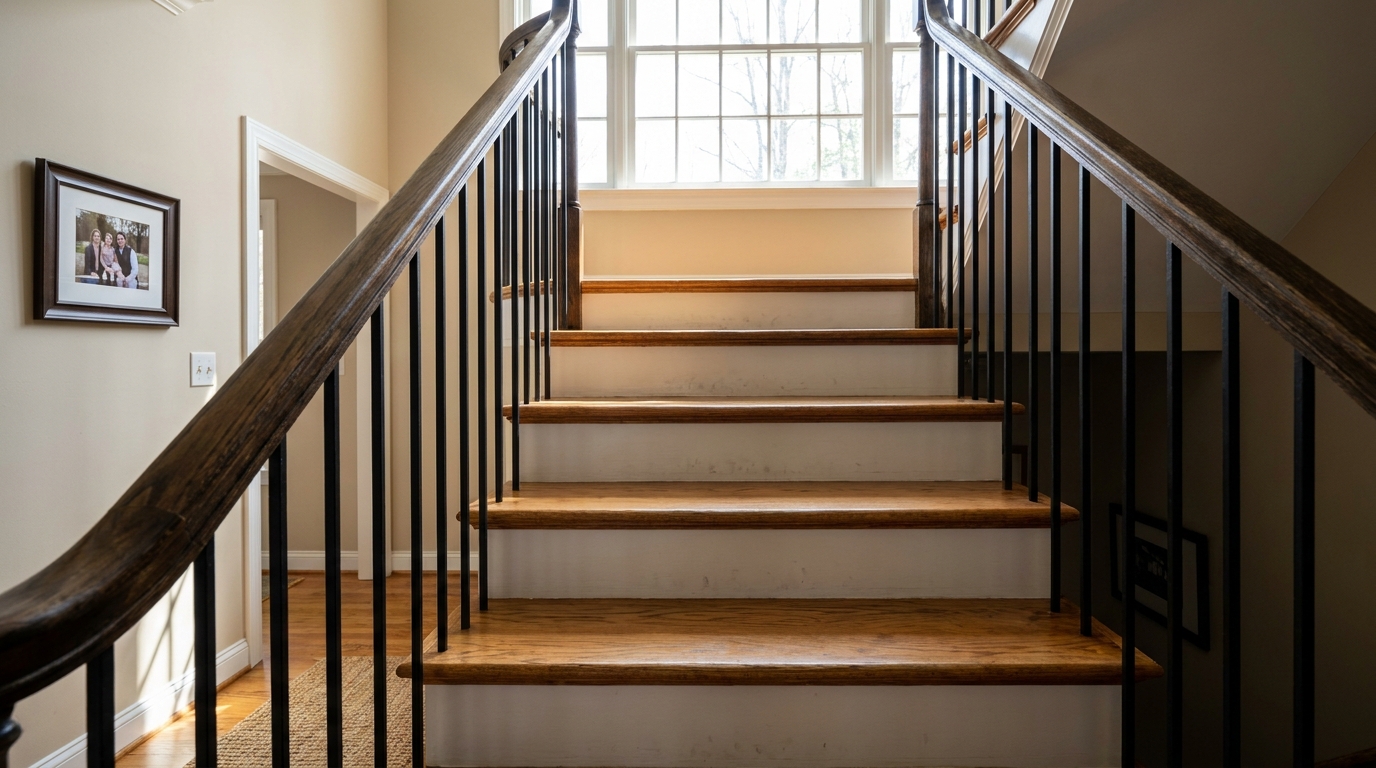
Stairs are the most-touched surface in a house. They take more wear per square inch than any floor in the home, and they show every install mistake immediately. So picking the right material for stairs is a different decision than picking material for a floor, even though most homeowners treat it as the same call.
We install, refinish, and rebuild stairs across the DMV. Here is the honest ranking of the four real options for a DMV staircase, with real per-step pricing, why open-sided stairs change the math, and what we wish more homeowners knew before they signed the quote.
Best flooring for stairs: the short answer
Quick answer
For most DMV homes, the right call is hardwood on the main staircase for durability, resale, and the look that buyers expect in a colonial or townhouse, and low-pile carpet on basement or secondary stairs where safety and quiet matter more than appearance. LVP works on stairs but only with proper stair-nose pieces, not by bending plank over the edge. Laminate is the worst stair material because the click joints fail at the nose. Per-step DMV pricing in 2026 lands roughly $100 to $200 for hardwood, $30 to $80 for carpet, $60 to $120 for LVP, and $50 to $90 for laminate.
Those are planning ranges. A real quote depends on how many steps, whether the sides are open or closed, the species, and what is already there. The sections below explain how to read your own quote, which option fits which house, and where the install actually goes wrong on stairs.
Why stair flooring is its own decision, not just floor leftovers
Quick answer
A floor is a flat plane. Stairs are a series of small wood pieces, each cut, set, and finished by hand around an existing railing. They are carpentry, not flooring. That means the material that works best on your floors is not automatically the material that works best on your stairs.
Two structural realities make stairs a different decision than floors:
- Stairs are carpentry, not flooring. A floor planks down fast over open area. Each stair is a tread, a riser, and a nosing, individually cut and fitted. There is no economy of scale, which is why stairs are priced per step. The same square footage costs three to four times more to do on stairs than on a flat floor. See the deep math in our hardwood stairs cost guide.
- The nose is the failure point. The front edge of each step (the nosing) takes every footfall and is what your eye sees from below. Any material that does not have a proper, manufacturer-made nosing piece will fail at that edge over time. This is the single most important spec to ask about on a stair quote.
That second point is why laminate is a bad stair material even though it is fine on a floor, and why LVP needs care on stairs even though it is excellent on a floor. The plank itself is fine. The edge is the problem.
The four real options ranked for DMV stairs
Quick answer
Ranked best to worst for a DMV main staircase: 1) Hardwood, 2) Carpet (for basement or secondary stairs), 3) LVP with proper stair noses, 4) Laminate. The ranking changes by use case: carpet wins on safety and noise, hardwood wins on durability and resale.
| Option | Best for | Lifespan on stairs | Slip resistance | Resale impact |
|---|---|---|---|---|
| Solid or engineered hardwood | Main staircase in a colonial, townhome, or single-family | 25+ years, refinishable | Moderate (add runner if needed) | Positive. What buyers expect |
| Low-pile carpet or runner | Basement stairs, secondary stairs, homes with kids or older parents | 8-12 years, replaceable | High | Neutral, depends on color and condition |
| LVP with stair-nose pieces | Rentals, basement walk-outs, condos that want continuous look from floor onto stairs | 10-15 years | Moderate to low (smooth surface) | Slightly negative on a high-end home, neutral on a mid-tier rental |
| Laminate | Tight-budget situations only, and we still discourage it | 5-8 years before nose failure | Low | Negative on most homes |
The ranking is not absolute. A basement walk-out in a DMV townhouse with an LVP basement floor often calls for matching LVP on the stairs so the eye reads one continuous surface. A 1920s Alexandria colonial with original oak treads on the main stair calls for refinishing the wood, not covering it. Use this ranking as a starting frame, then match the material to the actual staircase.
Real per-step DMV cost for each option in 2026
Quick answer
For a typical 13 to 16 step DMV flight in 2026, expect roughly $1,500 to $4,000 for hardwood, $400 to $1,200 for carpet, $800 to $1,900 for LVP with proper stair noses, and $650 to $1,400 for laminate. Open-sided stairs add roughly 20 to 30 percent because of the returned edges.
| Material | Per-step installed (DMV 2026) | Standard flight (13-16 steps) | What is included |
|---|---|---|---|
| Solid or engineered hardwood | $100-$200 per step | $1,500-$4,000 | Tread, riser, nosing, install labor, basic finish |
| Low-pile carpet on stairs | $30-$80 per step | $400-$1,200 | Carpet, padding, install, old-carpet demo |
| LVP with stair-nose pieces | $60-$120 per step | $800-$1,900 | LVP plank, separate stair-nose moulding, install on each step |
| Laminate | $50-$90 per step | $650-$1,400 | Laminate plank, stair-nose moulding, install |
Two pricing notes most quotes will not spell out:
- Stair noses are not free on LVP and laminate. The plank cannot bend over the edge. The installer has to use a manufacturer-made stair-nose moulding piece, often $20 to $40 per step on top of the plank. If a quote uses LVP or laminate on stairs and shows no stair-nose line item, ask where it lives in the price.
- Demo is real labor on stairs. Tearing off old carpet, prying tack strip, and pulling staples is hours of work per flight. A carpet-to-hardwood conversion typically adds $200 to $400 of demo on top of the per-step number. We break this down in our guide to hidden flooring quote charges.
Open vs closed sides: how stair geometry changes the math
Quick answer
A closed staircase has walls on both sides and is the cheapest to do. An open staircase (one or both sides exposed with balusters) needs a finished, returned edge on every tread, which is real extra labor. Open stairs typically add 20 to 30 percent to the per-step price across all four materials.
This is where DMV housing stock matters. A 1970s split-level in Springfield often has a closed-on-both-sides stair, which is the simplest carpentry. A 1990s Reston colonial usually has one open side with a railing. That needs a returned edge on every tread. A modern Tysons condo with a floating staircase has open sides and exposed risers and is the most labor-intensive of all.
If the open side stays in place during the install, every tread has to be cut around the existing balusters too. Quotes that bundle in railing demo and rebuild are not always worth it on a closed-tread refinish, but they often are on a full hardwood replacement where the balusters were going to come out anyway.
Safety, slip, and code reality on stairs
Quick answer
Smooth hardwood and LVP stairs can be slick in socks, especially in homes with kids or older adults. The two real fixes are a runner (carpet down the center of a wood stair) or specifying a satin or matte finish instead of a high-gloss finish, which is more slippery than the texture difference suggests.
Slip is the safety reason carpet is still the right call on a lot of basement and secondary stairs in the DMV, even though hardwood looks better. A few practical guardrails when picking a stair material:
- Nosing depth. The front of each tread should overhang the riser by about three-quarters to one-and-a-quarter inches. This is what gives your foot a stable landing edge. Quotes that use a square edge with no overhang feel cheap underfoot and read wrong visually.
- Tread thickness. Solid or engineered hardwood treads should be at least one inch thick. Thinner stock flexes underfoot and the nose chips.
- Finish sheen. Satin or low-sheen finishes are noticeably less slippery than gloss. We default to satin on stairs unless a homeowner specifically asks for a more polished look.
- Runners. A runner is a long carpet strip down the middle of a wood stair, leaving the sides exposed. Best of both worlds for a colonial with original oak: keep the wood, add the safety. Runners typically install for $400 to $900 on a standard flight on top of the wood underneath.
Watch out
High-gloss polyurethane on stairs looks great in real-estate photos and is genuinely more slippery than satin. If you have kids, dogs, or anyone older than 70 using the stair regularly, ask for satin or low-sheen. The visual difference is small. The slip difference is not.
Refinishing existing wood stairs vs replacing them
Quick answer
If you pull up old carpet and find solid wood treads underneath, refinishing is almost always the right call. It typically runs $40 to $80 per step, roughly half the cost of new hardwood, and often matches your existing floor better than any new tread could. The decision tips toward replacement only if treads are split, deeply gouged, or were never finish-grade wood in the first place.
This is one of the most common pleasant surprises on DMV jobs. A buyer moves into a 1960s Arlington Cape Cod with carpeted stairs, pulls the carpet for a clean look, and finds original solid oak treads underneath that just need sanding and a fresh finish. The same logic on the floors is covered in our hardwood refinishing vs replacement decision guide.
Refinishing makes sense when the existing treads are solid, finish-grade wood (oak, maple, or in older homes, occasionally heart pine) and have at least one good refinishing cycle of thickness left. It does not make sense when the treads are pine that was always painted, when they are visibly split or rotted, or when you want to change the species to match a new floor on a higher level. In those cases, full new treads make more sense and the math in our hardwood stairs cost guide applies.
FAQs about the best flooring for stairs
What is the best flooring for stairs with kids and dogs?
Low-pile carpet or a wood stair with a runner. The carpet gives traction and absorbs the impact of feet and paws. Pure hardwood with a glossy finish is the worst combination for a busy household because it shows every scratch and is slippery in socks. If you want the wood look, do satin-finish hardwood with a runner down the middle.
Can you put LVP on stairs?
Yes, but only with proper stair-nose moulding pieces, not by bending plank over the edge. The plank itself is fine on the tread surface. The nose is where every cheap LVP stair install fails. Expect $20 to $40 per step in extra stair-nose moulding on top of the plank cost.
Why is laminate a bad choice for stairs?
Laminate clicks together with a tongue-and-groove joint that was never designed to be at the front edge of a heavily-walked surface. The joint at the stair nose works loose and chips within a few years of normal use. Even with the manufacturer's stair-nose moulding, laminate fails earlier on stairs than any of the other three options.
Hardwood stairs vs carpet stairs: which is better for resale in the DMV?
Hardwood, in almost every DMV submarket. Buyers expect hardwood on a main staircase in a colonial, townhome, or detached home above the $500K range. Carpet on the main stair reads as a future expense to most buyers, even when it is in good shape. Carpet on basement or secondary stairs is fine and does not hurt resale.
Do hardwood stairs need to match the hardwood floor?
Closely, yes. They do not have to be a perfect match, but they should be the same species and a stain within one shade of the floor. A maple stair next to oak floors reads as a mistake. An oak stair stained to match an oak floor reads as right, even if the stain is not exact.
How long does it take to install hardwood stairs in the DMV?
A standard flight of 13 to 16 steps typically takes one to two full days for a clean install, plus another one to two days for stain and finish drying if site-finished. Refinishing existing wood stairs is faster, usually one day plus dry time. We cover full-house timelines in our hardwood install timeline guide.
Can I install LVP or carpet on the stairs myself?
Carpet on a standard closed staircase is the most DIY-friendly of the four. LVP on stairs is the hardest because every tread is a custom cut around the nosing. Hardwood and laminate fall in between. The single biggest reason to use a pro on stairs is the nose detail. That is what your eye reads from below and what fails first when it is wrong.
Bottom line: which stair flooring fits which house
Pick by the house, not by what the floor is:
- Main staircase in a DMV colonial, townhome, or detached single-family above $500K. Solid or engineered hardwood, satin finish, with a runner if there are kids or older adults using it regularly. Match the species and stain to the second-floor hardwood within one shade.
- Basement stairs or secondary stairs in any DMV home. Low-pile carpet on padding. Safer, quieter, easier on the budget, and the resale hit is essentially zero on a basement stair.
- Rental, basement walk-out, or modern condo where the eye reads from LVP floor onto stair. LVP with proper manufacturer stair-nose pieces. Confirm the stair-nose line item is on the quote.
- Existing carpeted stair where solid wood treads are underneath. Pull the carpet, refinish the wood. Half the cost of new treads and often the best-looking result.
Stairs are the highest-stakes per-square-foot decision in a flooring project because they take the most wear and show every install mistake. The right call is rarely the same material as the floor it connects to. Match the material to the actual staircase and the actual household, and the staircase becomes the part of the install you brag about, not the part you fix later.