The short answer
Quick answer
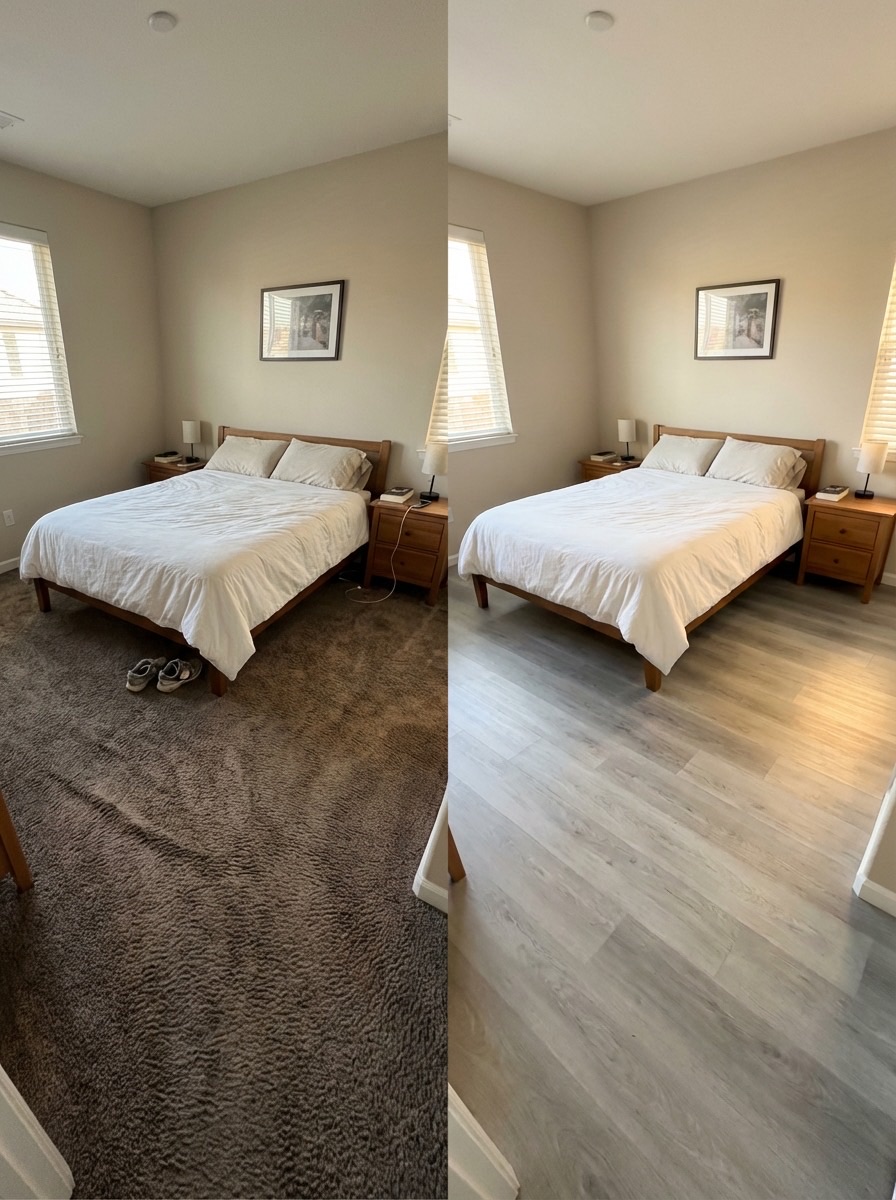
Carpet is still the most comfortable bedroom floor, warm and quiet underfoot, and it is the cheapest to install. Luxury vinyl plank is the best all-around pick if you want a hard floor that is durable, waterproof, and low-maintenance. Hardwood is the premium choice and adds the most resale value. Laminate is a dry-room wood-look option. A bedroom is a low-traffic, barefoot, quiet room, so comfort and sound matter more than the scratch resistance that decides a kitchen or hallway. Get that straight and the choice gets simple.
Start with the room, then compare the flooring services that fit it.
Most "best flooring for a bedroom" articles online give you the same four materials and skip the part that actually decides which one is right. After 20-plus years installing floors across Alexandria, Arlington, Fairfax, and the rest of the DMV, here is the honest version. A bedroom is not a kitchen. Nobody drags a chair across it a hundred times a day, nobody tracks in road salt, and you walk it barefoot at 6am. That changes the whole ranking. The floor that wins in your entryway can be the wrong call in your bedroom, and the soft, "less durable" floor everyone warns you about is often exactly right here.
What a bedroom actually needs
Quick answer
A bedroom floor is judged on comfort underfoot, warmth, and quiet, not on how well it survives heavy traffic. Bedrooms see the least wear of any room in the house, so durability drops down the list and feel moves to the top. Moisture only matters for a basement or over-garage bedroom. That is why carpet ranks higher here than it does anywhere else in the home.
Rank a bedroom floor on four things, in this order. First, comfort: you are barefoot, and often the first and last thing your feet touch each day. Second, quiet: a bedroom is where you want less sound, both underfoot and carried up from the room below. Third, warmth: a cold floor on a January morning in Virginia is a real thing, and some materials hold cold more than others. Only fourth comes durability, and here is the key point, a bedroom is the lowest-traffic room in the house. There is no cart, no pet stampede at the door, no daily grit. So the scratch-and-dent worry that pushes people toward tough floors elsewhere barely applies. The exception is moisture, which only matters if the bedroom sits on a basement slab or over a garage. Sort your priorities like that and the material choice almost makes itself.
Every material, ranked for a bedroom
Quick answer
For pure comfort, carpet wins. For an easy-care hard floor, luxury vinyl plank wins. For resale and looks, hardwood wins. Laminate is the value wood look, and tile is the one material to skip in a bedroom because it is cold and hard underfoot. Below is the quick verdict on each.
| Material | Comfort | Quiet | Best for | Watch out for |
|---|---|---|---|---|
| Carpet | Best | Best | Kids, upstairs rooms, cold feet, budget | Traps allergens; shows wear over years |
| Luxury vinyl plank (LVP) | Good | Good with underlayment | Easy care, spills, basement bedrooms | Firmer than carpet; add a rug |
| Hardwood | Good | Fair, needs a rug | Resale, master suites, a premium look | Cost; scratches; not for damp slabs |
| Engineered hardwood | Good | Fair, needs a rug | Wood look over concrete or radiant heat | Thin veneer refinishes fewer times |
| Laminate | Fair | Fair with underlayment | Dry rooms, a wood look, kids' rooms | Not waterproof; hollow sound if underlayment is skipped |
| Tile | Poor | Poor | Not recommended for a bedroom | Cold and hard; wrong room for it |
The pattern is the opposite of what you would pick for a busy room. Soft, quiet, warm floors rise to the top, and the hard, tough, cold materials that dominate a kitchen or entry drop down. That is not a mistake, it is the room doing its job. We compare the two most common bedroom hard floors head to head in our LVP vs hardwood cost guide.
Carpet: still the bedroom classic
Quick answer
Carpet is the most comfortable and quietest bedroom floor, and the cheapest to install. It is warm on bare feet, absorbs sound so a bedroom feels calmer, and cushions a fall, which is why it stays the top pick for kids' rooms and upstairs bedrooms. The padding underneath matters as much as the carpet itself. The trade-off is that carpet holds allergens and shows wear over the years.
Carpet gets treated like the old-fashioned choice, but in a bedroom it still makes the most sense for a lot of people. It is the warmest floor on a cold morning, the quietest to walk on, and the softest place to stand or for a kid to play. It is also the least expensive floor we install. Two things decide whether carpet feels cheap or plush, and neither is the carpet you see in the showroom. The first is the pad underneath. A good pad is what makes carpet feel luxurious and it is what makes it last, so we never cut corners there. Our carpet padding guide walks through the thickness and density to ask for. The second is fiber and pile height matched to the room. For a bedroom you can go softer and taller than you could in a hallway, because there is no heavy traffic to crush it. If a bedroom is specifically for kids, we cover the durability and stain angle in our best carpet for bedrooms guide. The honest downside is allergies: carpet traps dust and dander, so if someone in the house has real sensitivities, a hard floor with a washable area rug is the cleaner call.
Luxury vinyl plank: the low-worry pick
Quick answer
Luxury vinyl plank is the best hard floor for a bedroom if you want a wood look with almost no upkeep. It is waterproof, scratch-resistant, warmer underfoot than tile, and it is the only wood-look floor safe over a basement slab. With a quality underlayment it walks quietly. Add a soft area rug beside the bed and you get the clean look plus the comfort.
If you want a hard floor in your bedroom, luxury vinyl plank is usually the smartest one. It gives you a real wood look, it is fully waterproof, it shrugs off scratches, and it needs almost nothing beyond a sweep and an occasional mop. In a bedroom it has two more quiet wins. It is warmer than tile and it runs cheaper than hardwood while looking close. The one thing LVP is not is soft, so most people pair it with a plush area rug beside the bed for the barefoot comfort a bedroom wants. Quiet is where the install matters: on every job we put down an underlayment, which cushions the plank, evens the subfloor, and cuts the hollow, tappy sound cheap installs are known for. That underlayment is also what makes LVP a real option in an upstairs bedroom, which we get into below. And because it is waterproof, LVP is the go-to for a basement or over-garage bedroom where solid wood would fail. If you are weighing it against laminate, our LVP vs laminate guide lays out the difference.
Hardwood and engineered wood
Quick answer
Hardwood is the premium bedroom floor and adds the most resale value, especially in a master suite. It looks and feels warmer than tile and lasts for decades. Solid hardwood needs a wood subfloor, not a damp slab, so a basement bedroom calls for engineered wood or LVP instead. Wood shows scratches and needs an area rug to keep a bedroom quiet.
Hardwood is the floor buyers notice, and in a master bedroom it reads as the premium choice and helps at resale. It is warm, it is timeless, and a solid wood floor can be sanded and refinished several times over its life, so it outlasts everything else if you look after it. In a low-traffic bedroom, scratches come slowly, which is a point in wood's favor here. Two cautions. First, real wood carries sound, so a bedroom with hardwood wants a large area rug to soften footsteps and keep the room from echoing. Second, solid hardwood needs a wood subfloor and stable humidity, and it has to be acclimated in the home before we lay it or Virginia's seasonal swings will make it gap and cup. Our acclimation guide explains why that wait is not optional. If your bedroom is on a concrete slab, in a basement, or over radiant heat, engineered hardwood is the better wood, because its layered core stays put where solid wood moves. We break down the difference in our engineered vs solid hardwood guide.
Laminate: dry-room wood look
Quick answer
Laminate gives you a wood look at the same all-in price as LVP, and a bedroom's light traffic is a good fit for it. Modern laminate is tough and scratch-resistant. The catch is that it is not waterproof, so it is fine for an upstairs or main-level bedroom but wrong for a basement. Skip the underlayment and it sounds hollow, so a good pad underneath is the difference.
Laminate is a practical wood-look option when you do not need hardwood's resale value. In a bedroom it works better than people expect, because the low traffic never tests its main weakness, and today's laminate resists scratches well. Two things to know. It is not waterproof, so a spill left sitting or a damp basement slab can swell the seams, which keeps laminate out of below-grade bedrooms and pushes you to LVP there instead. And laminate lives or dies on its underlayment, the foam or cork layer that cushions it and kills the hollow, clicky sound a bare install makes. We include the right underlayment as standard, and our underlayment guide covers the options. For a kids' room or a dry guest room, laminate is a sensible pick.
The upstairs-bedroom noise fix
Quick answer
A hard floor in an upstairs bedroom sends footstep noise straight down into the room below. Carpet with a good pad is the simplest fix. If you want LVP, laminate, or wood upstairs, an acoustic underlayment under the floor is what keeps the room below quiet. This is the single most common reason we still put carpet in second-floor bedrooms.
This is the part that decides a lot of bedroom floors and almost no online guide mentions it. Sound travels down. Put a hard floor in a second-floor bedroom and every footstep, dropped shoe, and rolling chair transmits into the living room or kitchen underneath. Carpet with a quality pad solves it for free, which is a big reason wall-to-wall carpet is still standard in upstairs bedrooms across the DMV. If you have your heart set on LVP, laminate, or wood upstairs, you can absolutely do it, but the acoustic underlayment under the floor becomes the important part, not an afterthought. Because we install an underlayment on every job, this is built into how we quote an upstairs hard floor rather than an upgrade you have to know to ask for.
💡 Key takeaway
Match the floor to how the room is used, not to the rest of the house. A downstairs master can take hardwood or LVP for the look. An upstairs kids' room usually wants carpet for the quiet and the soft landing. A basement bedroom needs a waterproof floor, which rules out solid wood and laminate. One house can, and often should, have different bedroom floors on different levels.
Best pick for your situation
Quick answer
Kids' room: carpet for the soft landing, or LVP if spills are the bigger worry. Master suite: hardwood or LVP for the look, with a rug. Basement or over-garage bedroom: LVP, because it is waterproof. Allergy household: a hard floor with a washable area rug. Guest room on a budget: laminate or carpet.
Here is how the choice shakes out by situation. For a young kid's room, carpet is hard to beat for the soft, warm floor to play on, though if you expect spills and accidents, waterproof LVP with a play rug on top is the practical swap. For a master suite where the look and resale matter most, hardwood is the premium answer and LVP is the low-maintenance one, both with a soft rug by the bed. For any bedroom on a basement slab or over a garage, go waterproof with LVP and treat it like the below-grade room it is, the same way we would a basement. If someone in the house has allergies or asthma, skip wall-to-wall carpet and run a hard floor with an area rug you can wash. And if the room is a pet's favorite spot, our best flooring for dogs guide covers the scratch-and-accident angle.
What it costs installed in the DMV
Quick answer
At Potomac, carpet is $3.25 per square foot all-in, laminate and luxury vinyl plank are $6.50, and hardwood is $8.50, each including material, underlayment, professional install, and hauling away the old floor. An average DMV bedroom of 150 to 200 square feet lands roughly between $500 and $1,700 depending on the material. A small bedroom can hit a labor minimum, so the price per foot reads higher than a whole-house job.
Bedroom pricing follows the same all-in model we use everywhere: one number that covers the material, the underlayment, the professional install, and removing the old floor, with no surprise line items at the end. Carpet is $3.25 per square foot; laminate and luxury vinyl plank are $6.50; and hardwood is $8.50. For a typical DMV bedroom of 150 to 200 square feet, that puts carpet around $500 to $650, laminate or LVP around $975 to $1,300, and hardwood around $1,275 to $1,700, material and labor and removal included. One honest note: a single bedroom is a small job, so it can hit our labor minimum, which makes the cost per foot look higher than a big install. We would rather you know that going in, and we quote whole-house or multi-room jobs at a better rate. We spell out how we keep quotes clean in our guide to hidden charges in a flooring quote.
DMV bedrooms: basements, condos, and old homes
Quick answer
Two DMV specifics change the bedroom call. Finished basement and split-level bedrooms sit on concrete, so they need a waterproof floor like LVP, not solid wood. Condos and townhomes often have HOA rules requiring sound-rated underlayment under any hard floor over another unit. Older Alexandria and Arlington homes may have original hardwood upstairs worth refinishing instead of replacing.
A few things about DMV homes are worth naming before you decide. First, basements and split-levels. A lot of Northern Virginia homes have a finished basement or lower-level bedroom sitting right on a concrete slab, and slabs can wick moisture up from below. That rules out solid hardwood and laminate for those rooms and makes waterproof LVP the safe answer. Second, condos and townhomes. Many buildings and HOAs require a sound-rated underlayment under any hard floor installed over a neighbor's unit, and some restrict hard floors in bedrooms entirely. We install to those specs, and our soundproofing guide for condos and townhomes covers the rules. Third, older homes. Many original Alexandria, Arlington, and Del Ray houses have real hardwood under old bedroom carpet. If yours does, refinishing that wood is often cheaper and better than a new floor, and it keeps the character. When we pull up carpet and find sound original oak, we tell you, because that is a win worth keeping.
FAQs about bedroom flooring
What is the best flooring for a bedroom?
Carpet is the most comfortable and quietest bedroom floor and the cheapest to install, which keeps it the top pick for kids' rooms and upstairs bedrooms. Luxury vinyl plank is the best hard-floor choice for easy care, and hardwood is the premium option for looks and resale. Match the floor to the room, not the rest of the house.
Is carpet or vinyl plank better for a bedroom?
Carpet is warmer, quieter, and softer underfoot, so it wins on pure bedroom comfort and costs less. Luxury vinyl plank wins on easy care, spills, and allergies, and it is the only one of the two safe on a basement slab. Many people run carpet upstairs and LVP in the master, with a rug beside the bed for comfort.
Should a bedroom have hardwood floors?
Hardwood is a great bedroom floor for looks and resale, especially in a master suite, and its low traffic means slow, minor wear. Add a large area rug to soften footsteps and warm the room. Skip solid hardwood on a basement slab or over a garage, where engineered wood or LVP handles the moisture better.
What flooring is best for an upstairs bedroom?
Carpet with a good pad is the simplest choice upstairs because it keeps footstep noise from carrying into the room below. If you prefer a hard floor, LVP, laminate, or wood all work upstairs as long as an acoustic underlayment goes under them. Condos and townhomes may require a sound-rated underlayment by HOA rule.
What is the best flooring for a basement bedroom?
Waterproof luxury vinyl plank is the best floor for a basement bedroom because it handles the moisture a concrete slab can wick up. Carpet over a proper moisture barrier is a comfortable second option. Avoid solid hardwood and laminate below grade, since both can swell or cup when the slab gets damp.
How much does it cost to floor a bedroom in the DMV?
At Potomac, a typical 150 to 200 square foot bedroom runs about $500 to $650 in carpet, $975 to $1,300 in LVP, and $1,275 to $1,700 in hardwood, all-in with material, underlayment, install, and old-floor removal. A single small bedroom can hit a labor minimum, so multi-room and whole-house jobs cost less per square foot.
Bottom line
Best flooring for a bedroom comes down to remembering what a bedroom is: a low-traffic, barefoot, quiet room where comfort beats toughness. Carpet is still the most comfortable and the best value, especially upstairs and for kids. Luxury vinyl plank is the smart hard floor if you want low upkeep and a waterproof floor for a basement bedroom. Hardwood is the premium look and the best for resale in a master suite. Laminate is a dry-room wood look for a main-level room. And if the bedroom is over a living space, the underlayment under a hard floor matters as much as the floor itself. If you are in Alexandria, Arlington, Fairfax, or anywhere in the DMV and want a straight answer on what belongs in your bedroom, we install carpet, luxury vinyl plank, and hardwood across the whole metro. Get a free in-home quote and we will tell you honestly what fits your room and your budget.